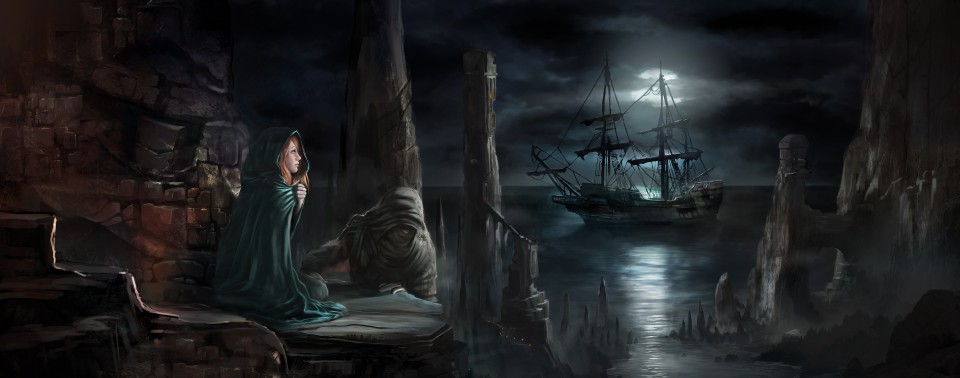
“Saints and Monsters” by Ellen McGinty

Tags

, , ,

On finishing this book, two thoughts linger on my mind: first, that this Japan is completely unfamiliar to me, and second, that the love triangle was really unnecessary.

The first is positive, the second is definitely not.

THE SAKURA (Cherry Blossom):

If all you know about Japanese history is samurai, shoguns, and geishas, then you will most likely not recognise Ezo—the world of this book—unless you are told what period it is. And the author tells you: it’s Japan’s Meiji era, when samurai and everything we learnt about Japan (from manga and anime, let’s be honest) are old history, and the country has modernised and opened up to the world after centuries of isolation. In this fictional Japan, there’s gunpowder, coffee, modern ships, trains, and foreigners. And Ezo is a matriarchy, only queens rule, which was unthinkable in real Japan.

. . . in Ezo, the firstborn daughter doesn’t simply inherit the crown, she earns it by facing a dragon.

It’s a somewhat “Westernised” world, though, which surprised me a little. If you’ve come to this book because of its Japanese inspiration, you should know this in advance so as not to be disappointed: Ezo is NOT exactly like historical Japan, it’s a Japanese-like world. Although we don’t see much of the world, the fact that it is anchored in real history helps to make it internally coherent and to understand what kind of mentality and technological advancement it possesses. Even their religion, a mixture of Buddhism and Christianity (there is a cathedral and healing monastic orders called Saints), is understandable if we mentally place this in an area like Nagasaki, where both coexisted natively.

I liked the world despite how little we are shown, because it’s unusual and well-constructed: it just needs to be shown more and not described so much, so that it feels “lived in.” The fact is, a lot is left to the reader’s imagination, and if they aren’t interested in Asian history or don’t know a little about it, the world feels very limited and small in size.

The dragons stand out in the worldbuilding. In Asian folklore, these dragons are sea creatures and don’t fly with wings like their Western counterparts. And unlike in the West, they are benevolent symbols rather than malevolent ones, like in the West the supreme evil, Satan, is described as a dragon and in the East the dragon gods are life, prosperity, and wisdom-giving. Our dragons destroy by breathing fire, their dragons give sustenance by managing life-giving water in all its forms. If you aren’t familiar with this major cultural difference between European dragons and Asian dragons, then the dragons of Saints & Monsters and their magic might confuse you. I can already see that most who read this book won’t know much about Asian dragon folklore because the Western version dominates.

Not that the dragon lore here is very detailed; there are some vague aspects of their magic that the author should’ve clarified (or will do so in future books), but I cannot emphasise enough that knowing at least a little bit about Asian dragon mythology helps a lot to fill in the gaps you may have in your understanding of why dragons are the way they are here. Especially the part about why they’re essential to Ezo’s prosperity, why queens have to tame them before being crowned, and why they become vengeful in certain circumstances.

And, of course, I loved that the Beauty & Beast element in this story comes from the dragons. Yes, that arc was predictable and all, but the best-known Asian versions of B&B have always had a dragon or serpentine Beast. It’s no surprise to me that some readers have seen something of Beauty and the Beast in this book, as the author told me once. She said she didn’t see it and didn’t intend to write it on purpose, but I think it came about naturally if accidentally because the Asian version of this type of fairy tale features this fantastic animal by default. For example, the Chinese version and three Japanese versions of B&B are “The Dragon Prince,” “The Dragon Husband,” “The Serpent Husband,” and “The Eight-Headed Serpent,” all of which are B&B/Animal Bridegroom tale type fairy tales that feature a dragon or serpent.

So you know now, Ellen: your book is a Beauty & Beast-inspired story. Unintentional as it may be, you can confidently embrace it.

A third positive aspect to highlight is that the main character, Meera, has a physical disability: she has spina bifida, a crooked spine.

I would’ve preferred that the blue hair and so on hadn’t been included as part of her condition, that it had simply been a medical condition with nothing extra. I’m not at all concerned that Meera doesn’t seem to be greatly affected by her crooked spine, because spina bifida varies greatly from person to person and doesn’t affect everyone the same way. For example, England’s King Richard III had a crooked spine but was a good warrior and fought in several battles, whereas I recently met a girl with spina bifida who can barely stand for few minutes at a time because she gets very tired and can’t run or walk fast. Therefore, I didn’t find it unrealistic at all that Meera can move around fairly well even though her body hurts afterwards, because it seems to me that her condition is mild to moderate, not severe. No health condition is exactly the same for two people, that’s why disability classifications and degrees of severity exist in medical fields.

But the blue hair and “cerulean princess” stuff was unnecessary. Having weird-coloured hair is so anime-like, and it detracts from the seriousness of her disability. If the people see her as “defective” and “worthless,” it had to be because she’s not physically “whole,” not because she looks like a character out of a manga.

THE AJISAI (hydrangea):

Here, we have three main characters: Princess Meera, Duke Casmir, and the sea dragon Soran. For me, Casmir started out as the best, but at a certain point the plot dropped him and his character growth arc wasn’t done justice, and the weakest was Soran, with Meera in the middle.

My mixed feelings stem from the fact that I’m not convinced that any of the three had the story they each deserved, and all because of the romance that danced into the plot like an intruder. Starting with Casmir, I was liking him so much in the beginning because he seemed like an excellent love interest apart from being a catchy character in his own right: he had a complex past, a dysfunctional and abusive home life, he was lord of a fiefdom that had an interesting geopolitical positioning in relation to Ezo, he had inner demons to overcome, and above all, he loved Meera despite her anime looks and crooked back. He was dutiful, serious, and honourable . . . and ended up being little more than a Gaston figure. He was the worst treated of the three in this book, and he didn’t deserve that.

Then there’s the fact that Meera is forced to choose the opposite of what she initially wanted for no apparent reason. At first, she wants to be a Saint (nun) but is developing feelings for Casmir because he treats her well and loves her unconditionally, then Runa falls and this blighted dragon bloke appears and she ends up falling in love with him. Why? What makes that dragon make her feel safe and protected when it is precisely because of her own stupidity that she is in trouble with the dragons in general and this dragon in particular? And why does the dragon reciprocate her feelings even though she has taken everything from him? It doesn’t feel natural. The circumstances cause their romance to feel like making the victim fall in love with the executioner, and the executioner falls in love with the victim in turn. Rather uncomfortable for me. The dragon arc could’ve been done without forcing a love triangle.

And finally, Soran . . . What can I say about him? He’s a funny character (the scene of his crossdressing as a courtesan and his beloved pink trousers made me laugh), but he was the one I liked the least because he got the worst characterisation. Not because he lacks more exploration of his backstory like Cass, but because he’s like a plot puppet. I’m largely neutral on enemies-to-lovers plots, I don’t have strong feelings for or against this, as long as it’s done well I am contented. But this isn’t, it’s not clear why Soran changes, why he goes from hate to love, why he suddenly decides he no longer wants to be a dragon and prefers to live with humans and stay mortal. He and Cass have the same type of POV here (third person present tense), but Soran reads more shallow, and although he spends more time with Meera than Cass does, his chemistry with her is low-key because they spend their time running around like crazy trying to win their three trials to retrieve the dragon heart back to its rightful place.

It doesn’t feel like he has more than one layer, to be honest, not much of a personality besides “I’m a misanthropic dragon who quips and snarks and is dragonish.” None of the three characters is all that multi-layered, but Cass was on his way to be the most complex until he was discarded once his usefulness to the plot waned.

THE IBARA (thorny shrub):

Pace. Pace. Pace.

Narration shift. Narration shift. Narration shift.

Love triangle. Love triangle. Love triangle.

Those are the issues I had with this book, and you can probably guess which one was the biggest. Normally, pacing doesn’t bother me unless there’s a noticeable imbalance, like really noticeable, and there is one here: the tendency to rush the plot when there’s only a quarter or so left before the ending. In this case, when Meera is about to complete the second trial shortly before the end, the plot suddenly picks up speed and races towards the finish line, and as a result, everything is told to us instead of shown to us.

In part, that the female main character is a first person narrator helps to make it less annoying that we are told everything (“I” narrators always are narrower windows into a story than “they” narrators), but we have two more POVs to narrate the story, and those POVs are even more limited. That shift between first person for the girl and present tense third person for the boys shouldn’t have existed; it doesn’t let the narration flow smoothly and it adds to the pacing and tell-over-show issues.

And finally, the love triangle. I’ve already mentioned how it undermined the character growth of the three main characters, but you also feel that the “winner” in the competition for the girl’s heart isn’t the best choice. The noble-hearted girl that wants to reign to save her people and the piece of selfish scaled sea bug that doesn’t give a hoot about the well-being of the realm felt so unearned to me. Did any of you ever watch the film Dragonheart? I watched it as a child and I still remember the scene about the dragon’s heart that saved the prince’s life has to end it to save the kingdom, it made quite the lasting impression at my young age; and the ending of Saints & Monsters struck me like a romantic fanfic on the core theme of the film. Almost as if Draco ended up falling in love with King Einon if Einon were a girl that Sir Bowen was in love with instead of Kara, and Queen Aislinn had to untangle the lovey mess slapping everyone back to sense.

(That hurt to type.)

This book has been an Ikebana arrangement of cherry blossoms, hydrangeas, and thistles. It will depend a lot on personal taste whether you find such a flower arrangement lovely or not. For me, and judging this solely on the B&B aspect, Saints & Monsters was one of the Notable Releases of 2025, my personal list of books that didn’t quite have it in them to make it to the Best Of upper rung but that had something original or worthwhile that made them stand out.


“The Peddler” by Elyssa S. Schwendy

Tags

, , ,

This book has an interesting idea for a plot, similar to that of News of the World in a fantastical version and The Story Peddler without the part about stories that can kill. It’s about a wandering saleswoman that arrives on a stormy night at a tavern in a coastal town, where a few patrons are killing time sheltering from the heavy rain. Before this captive audience, Verre the peddler takes a bunch of strange objects out of her bag of wares to show to the curious crowd looking on. Is she going to sell these things?

Oh, no, she’s not going to sell them—and in any case, some of those objects are too valuable for her humble listeners to afford—as she’s a storyteller and is going to use them to tell stories. Each object has a story about how it came into her possession, and Verre takes advantage of the curiosity their uniqueness arouses in the townsfolk at the inn to tell them one by one: there’s an apple-shaped ruby locket, a brooch, a hand-painted teacup, a pearl comb that belonged to a mermaid, a mirror that was always dark, a golden straw, a beast’s fang, a sailcloth bag . . . Eight objects with eight stories worth telling (there’s a bonus story, but it isn’t linked to a specific object).

These eight stories are supposed to be retellings of fairy tales, but they don’t seem to be. This is partly because they are told as episodic anecdotes passing as life stories and partly because of how Elyssa Schwendy writes her retellings: they aren’t straightforward remakes, she has tried to make them as original as possible and doesn’t tell you anywhere which tales she is supposed to be retelling, not even in an Author’s Note.

For me, this is what I liked most about the book. I love a good challenge, because I can usually guess easily which fairy tales they are, and The Peddler has made me work harder than I usually do to identify them.

In some of the short stories, you can guess right away which fairy tale they are working on, for example those that retell Snow White and Sleeping Beauty are obvious from the start. But with most of them, it’s hard to know which fairy tale they’re based on.  It doesn’t happen to me often, but at least with three of the stories, I couldn’t guess which fairy tales were used and struggled to guess, and I feel perfectly fine about that.

Is there one inspired by Beauty and the Beast here? No, not exactly. Though one of them could be seen as having the B&B theme . . . if you squint. That was a bit disappointing, but not unexpected from the hints I got in the Contents page.

That said, I can’t claim to have had a favourite story in this collection, mainly because I found them rough, told in a hurried and summarised way, with little character depth, and in a narrative format that I think works better spoken than written. The stories are not hers, but Verre tells them all in first person as if she had experienced them herself or was relaying what she had heard. I think that telling these stories in first person POV wasn’t the most appropriate approach, and that they should have been told in third person, leaving first person narration for Verre’s chapters.

They do feel like they’re being told to you personally, though, which is why I insist that this book would be much better as an audiobook, preferably with a narrator that can do different voices to differentiate each protagonist in each story and give Verre’s chapters their own distinctive voice.

There really are stories that are much better told than written.

Another thing I liked was the “bonus” story that Verre drops at the end, when her listeners are already leaving after the storm has subsided and only a curious little girl remains with one more question to ask. Although that chapter is very short and the one that follows is even shorter and ends more abruptly, I liked that it was there because of what it hints at. What and who is Verre, really? And how is it that a humble peddler without a penny to pay for a room in an inn has these objects obtained from people in lofty places? Why does she travel telling stories instead of selling wares? She’s so mysterious, we aren’t told much about her, if anything, and she doesn’t seem to charge for telling stories. So what does she live on?

There are many loose ends here, and the book doesn’t pick them up or wrap them. But it does give us clues to guess the answers we don’t get, the key being in that last story. I, at least, have been able to form a halfway decent idea of what and who Verre is.

I also feel that her story can continue, as there is still a good chunk to be explored. If the author were so inclined, a novella-length sequel that tells us a little more about Verre would be nice. Some of the tales she tells could also be turned into longer stories, but personally I don’t see that potential in any of them. They aren’t so interesting individually, but work well together as a bouquet of entertaining slice-of-life episodes told by an ambulatory peddler. It’s the peddler herself who is interesting, in my opinion, and I wouldn’t mind reading more of her adventures in the future.

I received an ARC from SnowRidge Press in exchange for an honest review.

“Kill the Beast” by Serra Swift

Tags

, , ,

An angry and malodorous chud who doubles as the town’s blacksmith and unofficial Faerie headhunter, and a fastidious dandy who doubles as the town’s resident Vogue on two high-heeled legs and is secretly attempting this faux-Victorian world’s equivalent to suicide by cop?

Who even thought that such a plot was a good idea for a Beauty and the Beast retelling?

And I’m rating the chud and the dandy this highly?

This might sound strange, but I think that this book’s greatest weakness is also its greatest strength.

By this, I mean Lyssa Cadogan.

Lyssa is a complicated character if not a complex one: she doesn’t have as much depth as she could have had, but she is sufficiently three-dimensional because we know what she looks like (she’s tall and muscular, somewhat stereotypical of buff lesbians), her personality range and emotional scope (she’s motivated by trauma from her brother’s murder and has a terrible relationship with her father), and her depth (her character improves, matures, and redeems itself throughout the book). Whether you end up liking her as a character or not, you get to know her very, very well.

And perhaps it’s knowing her too well that loses her to readers, but also endears her to readers.

Because Lyssa is a moody woman with anger issues, violent, rude, foul-mouthed, inconsiderate, unempathetic, vengeful, and irritating. In short, she has too many flaws and is extremely unlikable.

If you don’t normally enjoy unlikable main characters (myself included), you won’t like this and it may make you abandon ship; and for those who read Beauty & Beast retellings, it may be an extra unpleasant shock because she, as a woman, is going to be framed as the Beauty figure in this story, but she’s the exact opposite of Beauty. What’s more, Alderic has more in common with Belle than Lyssa does, who is instead more like a lab created her from bits from the Beast and Gaston (I feel dirty writing this). Neither of them is anything like the characters in the fairy tale whose roles they emulate, as if their fairy godmothers got their wires crossed and implanted on Lyssa the chip for Gaston and the Beast and on Alderic the two chips for Belle and Adam.

So rather than Beauty and the Beast, this was more like The Brute and the Toff.

So why did I like the story?

Well, as I was saying: because Lyssa is the best and worst (and ugliest) thing in the book all by herself. She’s a textbook Unlikeable Female Character, and she’s so on purpose, not because of bad writing.

There has been quite a bit of debate in some fandoms about how unlikeable and toxic female characters are treated compared to male characters, and how female characters tend to receive more hatred from the public when they make mistakes or have notorious character flaws, even when they aren’t supposed to be villains or anti-heroines. Male characters are allowed to get away with many things that female characters are not, and I think Lyssa is a case in point.

The thing is, Lyssa has the flaws that the Beast character usually has in retellings of the fairy tale: a violent man, full of flaws, morally ambiguous, traumatised, and cursed, who needs redemption or to learn a hard lesson. And readers accept this and sympathise with the character despite his flaws, even more so if the Beast has a sad backstory: The Beast in the original fairy tale is a child groomed and sexually assaulted by a fairy; in the Disney version, the enchantress oversteps her bounds with a child for a supposed slight and practically condemns him to death for not wanting to open his house to a stranger in a storm; Sandor Clegane in ASOIAF was an abused child who was burned by his brother, and so on and so forth. Why shouldn’t something like that happen to a woman?

That happens to Lyssa. She’s extremely traumatised because her brother, whom she loved more than anything in the world, has been killed by the Hound of Buxton Fields, the monster created by the fairies, and despite all her martial prowess and ferocity, she wasn’t able to protect her brother. On top of that, she’s always had daddy issues, hates her father for abandoning them and failing to protect either her brother or her. That’s why she’s embittered, has PTSD that she won’t admit to, and is brutally aggressive because she no longer cares about anything.

Nothing matters to her except going with her dog Brandy to kill each and every fairy to avenge her brother. A life for a life, blood for blood. That’s her motto.

I wouldn’t have been surprised if the author had made her an alcoholic or drug addict because of her PTSD, but in this story that’s not the case. The “alcohol and drugs” Lyssa uses to treat her mental issues are anger and violence, which are her outlet and her fuel in her hunt for fairies and monsters. And the truth is, I understand her psychology, I can see the motives for her nihilistic and suicidal mindset.

And when you understand her psychology, you want her to heal. You want her to stop being a brute rushing towards self-destruction for revenge. You want her to learn. You want her to let go and find peace. You want her to redeem herself. Because that’s the point of Beauty and the Beast, not the romance itself.

And thus why it is so frustrating that Lyssa doesn’t have a redemptive arc worthy of her character.

The thing that could heal Lyssa’s heart and mind is the same thing used against the Hounds created by fairies: compassion. But that is precisely the lesson Lyssa refuses to learn. She’s so stubborn and closed-minded that by the time she hears the truth about the monsters from her witch friends Ragnhild and Nina, it’s too late.

It’s always so bloody and frustratingly too late for this girl. Everything that happens by the second half onwards can be guessed fairly early on in the plot—I already knew the ending just 40% of the way through the book, but keep in mind that I read a lot of B&B retellings and know all the tricks inside out—but the important stuff happens so late in the story, and is developed so little, if at all.

For example, Honoria, the ex-girlfriend that became a Hound-warden (a brotherhood that protects the monsters from fairy hunters like Lyssa) as soon as she learnt the truth, had wanted to explain it to Lyssa, but was stabbed by Lyssa for her troubles (I warned you, this girl is very brutish). It’s a plotline that could’ve been very good, as well as crucial to redeeming Lyssa by making her see her mistake and that her revenge is misguided. Honoria could’ve helped Lyssa learn the truth about her brother and the monsters, and then Lyssa wouldn’t have had the trauma she has or been seeking suicide-by-fae alongside Alderic. Honoria loved her very much, she wanted to help her, she wanted to help all the Hounds. But Honoria only appears briefly towards the end, and that whole thing is so rushed. Lyssa learns hardly anything.

If it were up to me, I would’ve made this a retelling of The Ballad of Tam Lin rather than Beauty and the Beast. Partly because the plot is more similar to Tam Lin’s, with the fairies, the monsters they create, and the fae queen who has the protagonist’s love in her court. This isn’t an impression I’m pulling out of thin air; Tam Lin is mentioned in the book, so at the very least Serra Swift thought of it too.

But more than anything, it’s because an “I love you” between Lyssa and Alderic isn’t believable to me. Yes, I know Lyssa is bisexual and is believable as such (the author is also bisexual, so she knows what she’s writing about), and that she and Alderic have good chemistry . . . but it’s the chemistry of partners, not the chemistry of lovers. How on Earth do you break a Beauty and the Beast-style spell without a loving bond? When has a platonic “I love you” ever broken a curse for true love?

Well, it can’t. And considering the specifications that the fairy set to create a Hound, it’s ridiculous that a “platonic” bond could break a curse by a spiteful fairy who was discarded after a night of rolling around in bed with a womaniser. Think about it, it’s like a fairy curses you for an one-night stand and then leaving, and tells you that you will never be human again until you learn to love someone else more than yourself (and who put a gun to her head and forced the silly fairy to spread her legs for the first handsome reckless human she stumbled upon, anyway? These overbearing fae!), and you spend ages looking for a woman to love you . . . only for the first Mike Tyson-sized angry bi-girl with whom you have nothing romantic to cure you of your furry disease via a good old beating.

It struck me as almost mocking in its irony. If any kind of love was enough, Ragnhild would be breaking curses left and right all by herself, and she would un-curse all the Hounds all by herself with just her loving little witch’s heart, and would have booted Lyssa and Alderic out of her cottage to go to Hell with their monster problems, dead bro problems, daddy issue problems, and muscle and wardrobe problems.

That ending didn’t make me feel like Lyssa’s redemption was complete, nor did it make it clear to me like Lyssa had learnt her lesson. At least I’m not so sure that this girl has stopped being such a brute; her anger and her tendency to hit first and ask questions later have definitely diminished. But what else has changed? I don’t know, everything happens fast. Lyssa abandons her self-destructive career and her plans for revenge because Revenge Is Wrong, and that’s the note we end the moral lesson of the day on, ladies and gentlemen.

It’s so frustrating. Such a good female character, such good groundwork laid for redemption, and it’s not taken advantage of to its full potential. I think I now understand readers of The Count of Monte Cristo that hate the moralising about forgiveness and revenge that Dumas foisted on Edmond Dantès instead of letting him kill them once and for all for being idiots, dammit. To top it all off, I’m starting to feel that Alderic is Lyssa’s bi-platonic version of Haydée.

Either this story has a second part/a sequel, or I’m going to go crazy with frustration.

And yes, the frustration is also fed by that I didn’t like Alderic. What am I supposed to do with a lord with a short-stature complex who wears heels and spends more on shoes than I do on vet bills for my cat and dog? He bored me, and I didn’t see the humour in him as much as I the storyline asked me to. He’s dumb, good-natured but dumb. The one I wanted more of was Honoria, for Lyssa to go brute-in-shining-armour to rescue her and snatch her from under the fairy’s nose, so she could learn from her mistakes and admit her guilt to make amends. In other words, Lyssa’s redemption and healing should have come thanks to Honoria, not Alderic.

Even Ragnhild and Nina would have sufficed, for that matter.

That’s why I think her story is incomplete, even though Kill the Beast is a standalone book. Lyssa has a way to go yet until full redemption, and Alderic didn’t really need redemption as much as to just grow up (and kick the guilty fairy in the shins with a pointy high-heeled shoe). They killed the literal Beast, but they didn’t quite redeem the metaphorical Beast. If there were to be a second part, it would have to be with Lyssa and Honoria; there is plenty of pending stuff there.

“The Trident and the Pearl” by Sarah K. L. Wilson

Tags

, , ,

It took me quite a while to get into this story, and I almost didn’t make it. I was about to give up halfway through, and that was avoided only because I ended up liking the two main characters and got hooked on the revenge plot.

I’m very demanding when it comes to how Greek mythology is handled in retellings. I pay a lot of attention to worldbuilding in such cases, and although this book is more of a folkloric fantasy yarn than a mythological retelling, the alternate world that has been invented here is clearly a fictionalised version of the Greek islands of the Aegean. Therefore, the gods, myths, and legends that abound here are those of Ancient Greece with altered names.

I did not particularly appreciate the blending of myths here. I am not opposed to combining them with fairy tales when they are compatible and done well, although it is not my preference, and I certainly don’t like it when several Greek myths that have nothing to do with each other are mixed together: each myth has its own context and symbolism, and they are neither interchangeable nor combinable like clothes or shoes, something that not all authors understand. In the case of The Trident and the Pearl, the author has mixed Greek myths that are fundamentally at odds with each other.

On the one hand, there’s the beginning of the book, which seems to be taken from “King Thrushbeard”—my least favourite B&B-adjacent fairy tale for how misogynistic it is—but not entirely, because it also seems to be inspired by the beginning of “Eros and Psyche” when Psyche is sacrificed to the monster. And as the plot develops, an absurd jumble of intermingled Greek myths begins to emerge: Oceanus and Thetys, Poseidon and Amphitrite, Eros and Psyche, Orpheus and Eurydice, etc., etc. So many myths thrown into the pot like vegetables into soup! There are even hints of Dido and Aeneas, elements of “The Odyssey,” something from the myths of Dionysus, something from Hades & Persephone, the Japanese tale of “The Crane Wife” (mixed with Eros & Psyche), and even the Arthurian legend of the Fisher King.

And strangest of all: the gods in this world have souls. Apart from their physical bodies, they have souls. The Greek gods didn’t have souls (or they would’ve been mortal) because they were incorporeal and spiritual beings.

The author is a Christian, which may explain some of these oddities. No offence intended, but Evangelical Christians are not usually the best at understanding ancient mythology, for they judge it through the lens of their beliefs. And so, a polytheistic mythology as ancient as the Greek one isn’t going to fare well if judged through monotheism: either it is sanitised to suit their own “clean” requirements or it comes out worse in some way.

And as if to confirm my suspicions, when I reached the Acknowledgement, I read the author thanking God “for not being like the gods I have created.”

This has been a major obstacle for me, but it won’t necessarily be for others. If you can overlook all this, and I imagine most readers will since my demands regarding lore aren’t the norm, the chances of your liking this book increase. What helps is that you probably won’t even notice the inconsistencies with the myths unless you are very, very knowledgeable about Greco-Roman mythology (and many are not or only know the basics), that this isn’t supposed to be a retelling of any of the myths (it only borrows the clothing, so to speak), and that the author avoided being preachy (an important point for readers who tend to avoid books written by Christian authors for this reason).

The hook in this book is the characters, as it is a very character-driven story told in first person POV by the female protagonist. Coralys is brave, strong, and determined. She cares deeply about her islanders and desperately wants to protect them and solve their misfortunes, even at her own expense. But she’s also emotionally inconsistent, angry, vengeful, quarrelsome for no reason, sometimes rude, and makes terrible decisions. In other words: a good person full of flaws. Oke, on the other hand, is the opposite: kind as can be, loving, calm, and longing for a good life and true love, which his status as an imposter god makes impossible.

(Speaking of them, because I can read some Greek, I find it very grating that Coralys and Okeanos go by the nicknames “Cora” and “Oke.” The Greeks didn’t abbreviate their names in the style of 21st-century English speakers. And yes, I know this isn’t Greece, but it is pseudo-Greece.)

The relationship between Coralys and Okeanos is a very slow burn and depends almost entirely on her taking the initiative (which she does late in the plot, half a dozen chapters from the end). In a way, it’s good that it goes so slowly, because she was married before and is still in love with her late husband, and this new marriage was forced upon her against her will. For his part, Okeanos is a bit childish, loving like a teenager who has just discovered that hormones are good for something: all longing and more yearning. It’s all a bit corny, but at least the rival is dead, so there’s no love triangle.

Win a god’s oath,

Marry the drowned queen,

Collect the dead to serve.

Fill a thimble with riches.

Heal the crown of the sea.

Turn the betrayer’s heart.

Mend time with golden stitches.

Drink the ocean dry.

Spin moonlight into silver.

Split the seven seas in twain.

The arc of the five impossible tasks to rescue a soul from the Underworld, which are ten but in this volume only goes through the first five, is very Psyche-like. But I liked these better than Psyche’s impossible tasks because: one, they are more complicated, and two, Coralys is aware that there are “cheat codes” to completing them. This woman isn’t helpless at all, she knows her stuff, and the mix of myths in this particular case has worked very well. I think it’s the best part of the book, honestly.

But boy, is the ending depressing! So much investment in seeing whether she’ll succeed at those five tasks, only to end up wanting to strangle that idiot god. I’m not going to tell you what happens, only that the ending is slightly cliffhangery, but it’s a cliffhanger you can live with until the next book.

Will I read the next book? I don’t know yet. This first instalment was almost fifty-fifty for me, and if it ended up being fifty one-forty-nine, it was by a hair’s breadth. It will depend a lot on my mood when the next book comes out, but given how things have turned out with Coralys and how she almost, almost managed to take revenge on the idiot god responsible for her husband’s tragedy, I’m not entirely lacking in enthusiasm, so I’ll leave it at a maybe.

I received an ARC through NetGalley in exchange for an honest review.

“How to Find a Nameless Fae” by A. J. Lancaster

Tags

, , , ,

This retelling has the funniest Rumpelstiltskin I’ve come across so far.

And the most irritating.

Ah, but the princess more than makes up for this clumsy and out-of-touch Fae lord who annoyed me more times than he made me laugh. Because Gisele is unique amongst princesses: she isn’t young but in her forties, she isn’t particularly beautiful, she has no striking attributes of any kind, she has no magic, she will inherit nothing, no one seeks her hand in marriage, and to top it all off, she is cursed.

And it’s all the fault of Rumpelstiltskin, who in this world has no name because he lost it through distraction and failure to plan well and foresee the consequences of his deal with Queen Bianka, Gisele’s mother, who promised him her firstborn in exchange for spinning straw into gold but failed the test of guessing the Fae’s name, and that is why Gisele is now a debt to be collected.

Ah, but the clumsy and clueless Fae lord hasn’t even bothered to remember that he has to collect this debt and take the princess away. So after decades of waiting in vain and noticing that her curse is getting worse, Gisele must make a decision:

On her fortieth birthday, Princess Gisele of Isshia realised she was going to have to save herself.

The only way to save herself is to go to Fairyland and beat Rumpelstiltskin’s arse propose a new deal to the Fae sorcerer that will settle her mother’s unpaid debt and thus break the curse weighing on her. It’s more than an inconvenient curse but worse than its seemingly harmless description suggests, because she carries a curse of aversion: people round her avoid her as much as possible, the sight of her unsettles people, and it hurts physically to touch her, so she has been raised separately from her two brothers, has no friends or ladies-in-waiting, and is very lonely. Only animals don’t avoid her or feel like they’ve been electrocuted if she touches them.

And so the princess sneaks off to Fairyland, finds Malediction, Mal for short—that’s what she calls him because he has no name and she has to address him somehow—and . . . Well, she falls in love with him, what else is there to do?

But not so fast, because this book may be long but both the plot and the romance are slow-burn, very slow at times. Not that I wouldn’t complain about the absence of insta-love.

Truthfully, there isn’t much to analyse (or criticise) in this book. It’s one of those stories that are concocted with generous quantities of sugar and humour to make you laugh and have a good time, and there’s a lot of silly and goofy stuff that the main characters and their friends do, as well as comical but capricious creatures like Skymallow (the sentient house with an opinion of her own about everything) and Zingiber (the talking cat that thinks everyone not an animal is ugly, be it human or fae), and other Fae beings that come and go. We don’t see much of Fairyland, but it does feel “active” through the main characters’ eyes. The whole plot centres on the main characters’ adventures as they attempt to recover Mal’s missing name, which he lost in a rather reckless manner, as explained quite early. And they are funny adventures, even the chapter titles are meant to be funny, such as the one that sounds like a tribute to Monty Python called “Strange Women Lying in Streams.”

How much you enjoy this book will depend on your sense of humour. For me, written humour doesn’t usually work so well as visual humour: I tend to laugh more at slapstick comedy films than at comical stories; written humour is more miss than hit with me. What’s more, this author bears a resemblance to T. Kingfisher that wouldn’t have elevated her in my eyes if I had known of this beforehand, but luckily Lancaster doesn’t tend to force the joke like Kingfisher does, and so even though she has resorted to the same formula of an unconventional, stereotype-breaking older woman protagonist wrapped up in a Grumpy/Sunshine romance with a scatterbrained partner, Lancaster does it much better. Perhaps because she has a sense of humour that takes itself less seriously and she lets her characters be as scatterbrained as they like. And, above all, her unusual woman protagonist doesn’t suffer from the Not Like Other Girls syndrome that afflicts Kingfisher’s female protagonists.

I liked How to Find a Nameless Fae quite a bit for two reasons: the one I just described, and the blend of “Rumpelstiltskin” and “Beauty and the Beast.”

He looked more like a gentleman poet than a dread sorcerer. Rumpled red curls, embroidered waistcoat, complicated neckcloth, and enough jewelry to stir envy in a court dandy.

Except no court dandy she knew had furry cat ears or a tufted tail twitching behind him.

Yes, Malediction’s appearance makes him the Beast in this story, but in his case there is no curse at play that transformed him into one; his is another kind of “curse.” One that is largely self-inflicted. He’s truly a feline-looking Fae, neither human nor humanoid Fae, which may make the intimate scenes with the very human Gisele uncomfortable for some readers. And there are several, explicit ones at that that describe the nature of Mal’s unmentionables. That’s why it’s also important to take this story as pure comedy and not overanalyse it. The B&B component is just one touch here and another touch there, because the main story this book retells is “Rumpelstiltskin,” and to tell the truth, I probably wouldn’t have detected the B&B vibe if it weren’t for the fact that this story borrows elements from other retellings of the fairy tale.

All in all, it’s a cute and sweet yarn, but definitely not “clean,” So if you are the sort of reader that prefers their stories free of spice, do take that into consideration if you want to read this book.

“A Forest Darkly” by A. G. Slatter

Tags

, , ,

How many books with witches living on the edge of a dangerous wood have you read? Probably many, and even if you haven’t, maybe from just looking at blurbs you already know what to expect. The witch is maybe young or young-looking, and very pretty, and there’s usually a “witch hunter” or a demon or a shapeshifter that’s prohibitively hot and sassy and is after her for the same reason cats go after mice.

Gone are the days of the witch in Hänsel and Gretel. And I, for one, find that replacing one fairy tale trope for another modern fairy tale trope that’s not even part of the traditional lore isn’t my idea of improvement.

So when I do pick up a book with a witch protagonist, it must have something worthwhile to offer. In the case of this book, the blurb wasn’t selling me anything out of the ordinary, I took it up on A. G. Slatter’s name alone.

I’ve said this before: the author reminds me of another Angela for how she writes and weaves fairy tales and folklore into her stories in a way that makes them read both familiar and different at the same time, very immersive and atmospheric. That was my impression when I first found her work in an anthology years ago, by now she’s had enough experience and has polished her own style to be different to Angela Carter’s. Some similarities remain, and I’m glad for it, but Slatter is her own distinct flavour of fairy teller.

What does A Forest Darkly offer that’s different to the legion of witch-in-a-dark-wood stories out there? Oh, the answer is easy: Mehrab.

Mehrab isn’t your stereotype of a witch, she’s neither a hot girl nor a terrifying crone. She is a plain healer in her mid-fifties (my estimate) living by a town near a forest known for the usual dangers to folk and fauna, from which children start to disappear and she decides to unmask the culprit one day she accidentally spots the probable cause whilst out hunting. So far, a simple plot, even deceptively Cottagecore-like.

And then she accepts as apprentice a girl that is a Cinderella insert, except that this Cinderella set the prince on fire when he tried to rape her and is now in trouble for it. Oh, and turns out the town is called Berhta’s Forge and someone living there may or mayn’t be the Erlking, who may or mayn’t be behind the disappearance of the children and their cruel fates, and may or mayn’t have had a too-close connection to our witch, who in turn may or mayn’t have a secret past connected to a mysterious Marlinchina—a The Juniper Tree insert.

And because nobody expects the Spanish Inquisition even in fantastical worlds, there’s an overzealous churchman doing overzealous churchman things, i. e., build a church and have his first witch hunted, tried, and executed.

What did I tell you about Slatter’s stories being a coexistence of the old and the new?

It’s in this combination of the stereotypical and the innovative that I stumbled upon my one and main issue with this book: the mixing of fairy tales and folklore isn’t quite smooth. There’s witchy lore, there’s religious stereotypes, and there’s Horror genre conventions aplenty, and there’s at least four tales mashed in into this sauce: Cinderella, The Juniper Tree, The Erlking, Little Red Riding Hood, and a dash of the forest god Cernunnos. And the one that stands out as the sore thumb full of bone splinters sticking out of it is the second fairy tale, which is shoved in midway through the book and is rather confusingly told (it took me an age to figure out who Marlinchina was).

I should clarify that it isn’t the number of tales, or even the chosen tales themselves, what makes the combination unsmooth and full of jagged edges. I do think the tales are the right ones given the plotline and characters, and creatively chosen at that, but . . . It’s the mixing of the ingredients what makes for a good cake. You can take eggs, milk, butter, sugar, and flour and make a delicious cake with it, or you can make a complete mess of a batter even your cat will find insulting. In this book, the “batter” is rough, not a smoothly kneaded dough. To use Slatter’s own imagery, it’s a Sourdough full of ragged bits and un-melted pebbles that don’t make for quite the perfect bagel.

It’s Mehrab who keeps this dough cohesive and tasting good despite the rough pebbles your teeth crack on. She’s such an endearing grump, good-hearted and harsh, like a maiden aunt who will scold your mother for not giving you enough veggies and tell your dad he sucks at setting up an example for you whilst secretly slipping you a few candy bars when they’re not looking. Being a woman past middle age, she’s cynical about the world at large, but willing to help those that distrust her, and still romantic enough to enjoy a love affair in which she has the last word.

Faolan, the town’s blacksmith, is another interesting character I wish had had a larger role in this story. At first, he seems like just a love interest for Mehrab, a dependable widower with a rash son to pair up with Mehrab’s witchling protégée, until he gets dragged by his rekindled infatuation into her search for the missing children’s killer and you start to suspect there’s more to the man than meets the eye. I didn’t guess what the truth was, and I won’t say more than I already have in case you want to guess by yourself, so I’ll only say that the developments in this portion of the story are the most original take on the Alder King I’ve read. The solution Slatter comes up with for the mystery surrounding the Erlking is something I had thought of for a story I’ve had running in my head for a year (yes, I do create fairy tales to tell to myself when bored, my brain is weird like that), but even so I didn’t envision such a possibility, and now that I’ve read it, I quite like it. I think my friend Mariella, another Erlking fangirl, will like this arc if nothing else in the book.

The crowning glory arc here is, for me, the thin but strong thread of redemption that’s woven throughout the entire book. One question you ask yourself is the motives for Mehrab’s presence in Berhta’s Forge, as you are told early in the story that she was brought to this town by her witch mentor, the same one who brings Rhea to be fostered and tutored by Mehrab. But why? What does Mehrab need protection from? Oh, a lot, it turns out. A lot to be protected from and a lot to atone for. I wasn’t expecting a redemption arc for a witch, not in this kind of story, and it was a bit of a punch to see her past catch up to bite her very hard on the rump. It’s such a bittersweet conclusion to her redemption arc, enough to make me curse the fact that no author seems to want to twist the original folktale so that the Erlking and Berhta get a somewhat happyish ending. I’m feeling like I’m the lone mariner aboard this ship.

But I’m nevertheless satisfied with it and how it all was wrapped up. Slatter’s stories aren’t happy stories, but they are memorable stories. And to me this is the most memorable of hers to date.

I received an ARC via NetGalley in exchange for an honest review.

AUTHOR INTERVIEW: AnnMarie Pavese

Tags

,

Welcome to Conversations with Fairy Whisperers, AnnMarie! We are excited to have you over here in our space to connect the Folkloric Fantasy and fairy tale retellings readership with the creators of the stories they love. Tell us about yourself, what is the backstory of you becoming an author and how did you begin writing stories in the Folkloric Fantasy genre specifically?

Hi, I’m so excited to get to be interviewed on your amazing blog! My name is AnnMarie Pavese (pah-vay-see) and I currently live up in the mountains of Arizona.

As to how So Sang the Dawn came to be, it started as a project I never set out to publish. I had been writing various story scenes for a while, using it as a creative outlet and a form of therapy to help sort out some heavy loss I had been dealing with in my early 20s. I had worked on scenes and chapters in secret for two years without sharing them with anyone, until one day I hesitantly showed some of what I had written to a cousin of mine who had also been dabbling in writing at the time. She was really touched by the scenes I had shared, and told me that there was something special about my story. She was confident that if I would share it with other people, it would impact them in a really unique way.

So I decided to make So Sang the Dawn into an actual story. It took five years to write the book, and I published it in 2017 when I was 26. Now, eight years later, I’ve rewritten the entire book, while keeping the plot, the characters, and the themes intact, and have been able to add so many great elements to the story that early-twenties me didn’t have the skillset for.

Republishing So Sang the Dawn now in 2026 really does feel like publishing it for the first time, and I’m so happy and excited to see how people are impacted by this beautiful story I originally never set out to tell.

Of all the styles and formats Folkloric Fantasy and retellings come in—pictorial, screen, graphic, illustrated, or written—which do you most favour?

I would definitely have to say my favorite version of Folkloric Fantasy is a combination of illustrated and written. I’ve always been inspired by that style, and while there’s not much room for illustrations in the current version of So Sang the Dawn, it’s still my dream to one day hire an artist to create ilI’ve always been really interested in folklore and mythologies. There’s something so fascinating about them. I think it would be hard to pick a specific favorite, because the older I get, the more I appreciate studying lore and legends from all different cultures. I think looking at all cultures as a whole is what makes folklore so interesting to me, because I love to see the differences between them, and especially the similarities where cultures and people groups cross.

If I had to pick a few favorites, I’ve always been interested in Norse mythology, and, living in the United States, Native American culture and mythology has always been really fascinating to me.

Whilst not a traditional retelling, you have taken elements and themes from traditional Western folklore to integrate them into your novel, what would you consider are the joys and challenges of adapting such a large folkloric compilation into a new creation?

If So Sang the Dawn is known for one thing, it’s being massive. I find that I absolutely love working with a story and a series this size, because when there are no limits, the possibilities of what I can explore as a storyteller are endless. That said, writing a story on such a massive scale definitely has its challenges, and one of the hardest things for me is keeping all of the tiny details straight. When you write stories that are easily three or even four times the size of traditional stories, it can be really, really tough to remember everything and keep it straight.

One of the ways I help myself do this is by collecting up all the scenes in the book that are of a similar nature and isolating them while I write and edit them. For example, I used to pull all of Aurora’s conversations with Warlord Seigan (the villain) from the entire book, and work on just those chapters for months at a time. This ensured that every time Aurora spoke with him, his motivation, mood, wording choices, and mannerisms were the same across the book. Then, when I was satisfied with those scenes, I would put them all back into their respective places throughout the book and read them in context. And then usually edit them again, and rinse and repeat. But that’s a system that works really well for me, because I can isolate anything in that way: descriptions, dialogue, side characters, battle scenes, etc., and ensure that those elements are cohesive every time they show up.

So Sang the Dawn includes a story thematically similar to “Beauty and the Beast,” my favourite tale. How did you come across the idea for this story, and what can you tell us about its creative process?

I really love this question. There are so many beautiful themes threaded throughout my book, and one of the main elements I knew that I wanted to weave into the story from the very beginning was the concept of unconditional love. It’s something that I’ve experienced in my own life, both the lack of and the presence of, and it’s something that’s really interesting to me: how a person can love someone so deeply that nothing can shatter or break that bond.

The theme of unconditional love is something you see woven all throughout So Sang the Dawn. The biggest example of this is the relationship between Aurora and Raine. But you can also see it between Aurora and Saoirse, Aurora and Eysa, and Aurora and Fordrin and Merryn, the tavern keepers. In all of these situations, Aurora is definitely the “beast” character. She causes a lot of hurt to the people around her for the sake of survival, and unwillingly betrays the people she loves.

There is also a very physical “beast” aspect of Aurora that, without giving away too much, is present from the very first page of the book, with the black lion that haunts her dreams. And I really loved exploring what unconditional love would look like in the context of not only betrayal, but in a setting where the beast in Aurora was very real and very dangerous to the people around her.

Speaking of unconditional love, what struck me the most upon reading your book was the strong bond between the main character and her best friend, a true Womance as I would call it. Most stories in this genre and for this age range tend to focus on romance as the default important relationship, what motivated you to explore functional and healthy feminine dynamics instead?

I love the word “Womance”! I’ve always been drawn to a good bromance in storytelling, but you’re right: we don’t have near enough womances depicted!

I think that, in and of itself, is one of the reasons I wanted to write a relationship dynamic like Aurora and Raine’s. Fiction and Fantasy stories are usually so focused on romance, and recently, it seems that the majority of the romances depicted in books aren’t just unhealthy or unrealistic, they’re toxic, warped, and unsettling. And unfortunately, those seem to be the norm now.

I wanted to deviate from the modern standards and show love from a different angle. I wanted to write a relationship between two girls whose friendship was as pure as it is unbreakable. And because Aurora isn’t hyper-fixated on a romance throughout the book, the focus of the story could be much larger, and we could spend more time on her relationship with Raine, and also on the many other relationships and friendships around her. And, as readers, we have an anchor throughout the hardest moments in the book, knowing that at the end of every trial, Aurora will still have that deep, unbreakable bond with Raine that never changes.

Another aspect of the book I found fascinating was that you invented a new language for the inhabitants of this world that sounds reminiscent of Old Norse. What’s the story behind the creation of the Valthan speech?

I’m so glad that you loved the fantasy language! Despite the fact that I wanted to implement a fictional language into the culture of Frostholm very early on, I put off writing the language for about a year because I thought it would be a hard, horrible process. But one day, I just decided to start writing out words. I wrote hundreds of them in a notebook, and then went back and matched them to the English words that fit the sounds of the fantasy words in my head. And I found that I really enjoyed constructing the language. It’s definitely a very different creative process than story writing, but that’s what I love about it.

Currently, Valthan has over 1,200 words, and it’s growing all the time as I continue to add to it. Nearly all the dialogue in So Sang the Dawn can be translated into Valthan, and all almost all of the character names are rooted in the language, too.

Most people point out the fact that Valthan sounds very Old Norse-adjacent, and you would be correct! While I didn’t base the language on Old Norse specifically, I’ve hidden nods to it throughout Valthan, like the word fjord or the name Asbjörn. I love the way Valthan has developed, and while it sounds like a language that could easily exist in our real world, it also very much has its own sounds and really stands on its own.

It’s my dream to someday release a special edition dictionary of the language so people can play with the words themselves and maybe even learn to make a language of their own.

Sounds grand! The language could evolve into one of those fictional languages so well-crafted that they have their own dictionaries and grammar guides in future books. And, on that, I heard that there’s a sequel coming with more of Aurora and Raine’s story. How many books do you plan to write in this world and what can you tell about what we can expect from them?

So Sang the Dawn is book one in a series that will be named after the first book. Right now, I have plans to write twelve books in this series (I know!!!), which I’m incredibly excited about. I plan to go with a unique structure for the series in how the books are laid out. There will be six main books that follow the main plot and conflict of So Sang the Dawn, all told through Aurora’s eyes. And in between each of those main books will come a sort of “bridge” book, where we don’t fully leave the main plot, but we get to experience that part of the story through the eyes of one of the side characters.

So following this book will come the first of those side character stories, and it will be from the perspective of Raine. Her story will pick up right after her tragic separation from Aurora, and we’ll follow her through her time in Rathmar and get to see what she was doing and experiencing while on her own. Because of her missing leg, she won’t follow a warrior path like Aurora did, and will instead end up standing as cupbearer for Warlord Seigan. She’ll also spend a lot of time with Saoirse the healer, and even get to apprentice under her for a time and learn how to be a healer. We’ll also get to see her learn to walk again, we’ll see where her new prosthetic leg comes from, and get to see her take archery lessons from Helja.

After Raine’s story, we’ll go back to the main series, and pick up on the main plot through Aurora’s eyes once again. That book, called So Sang the Dawn: Deep Sky, will open on Aurora and Raine while still in Canaan’s mountain camp. The main focus of Deep Sky will be Aurora and Raine recovering from their time in Rathmar, and we’ll see Aurora returning to the city of Ru’em to find out the fate of all of her friends, and find out her own fate, as she turns herself in and stands trial for all of the things she did while living her betrayal in Ru’em.

After Deep Sky, we’ll move back to the point of view of one of the side characters for a time, although I haven’t revealed who it is yet. Keep an eye out for future announcements from my Instagram page if you want to know who it will be!

Twelve books is a lot! Do you ever see yourself writing something different, like a fairy tale retelling?

As I’m sure you’ve guessed by now, I have years of work ahead of me to write such a massive series. I also have so many other stories I want to tell from within the story world of So Sang the Dawn that don’t fit in the main series. I joke that I’ll probably be writing stories in Frostholm until I’m 90.

Having said that, fairy tales and folklore stories still hold a huge place in my heart, as they really were one of the earliest types of stories I connected with as a little girl. I always thought it would be really fun to tackle a fairy tale retelling, and if I ever had the time, I would love to write a retelling of The Wild Swans by Hans Christian Andersen.

If there was a Hall of Fame for retold fairy tales or myths, which would you consider the best retold stories books and why are they worthy of inclusion in said Hall of Fame?

I’m not sure if these books belong in an official Hall of Fame, but I have a great memory of a set of books I owned as a kid. They were called Tall Tales and the books themselves were only about four inches wide, but probably over a foot tall in length, visually showing just how “tall” the tales were. They were filled with fairy tales and folklore from all different sources, and had all kinds of neat artwork illustrated throughout the pages. I can remember my mom reading to me out of those books as a little girl, and I think one reason the stories stuck with me was because of how unique the physical books were. I also remember laying on the floor and listening to fairy tales and short stories on my mother’s record player: she had a huge collection of vinyls, most of them stories, and I have the best memories of that.

As to a modern author who does really amazing retellings, I’d have to give that honor to my dear friend Savannah Jezowski. She writes so many good books, and one of my favorites is her short story called When Ravens Fall, that’s a Beauty and the Beast retelling with a Norse-inspired culture! I can’t imagine anything that could beat that!

Is there an author who you view as a role model for your own writing?

The answer to this question is almost obvious, in a way. Just about anyone who interacts with my writing says that it feels very Chronicles of Narnia. And they would be correct! A lot of authors and stories have influenced my style and storytelling, but one of my favorites is definitely C. S. Lewis.

The Chronicles of Narnia was one of my favorite stories as a kid, and long before I ever considered becoming a writer, I loved the idea of doing what Lewis did. Crafting a world that everyone from all walks of life could love and enjoy, while also being impacted by very real truths and themes. One of the strongest similarities between So Sang the Dawn and The Chronicles of Narnia that people point out, is how much my character Asbjörn the Great White Bear feels like Aslan. I absolutely love that people think of Asbjörn that way, and definitely take it as a compliment.

However, for me Asbjörn wasn’t about rewriting Aslan, or using Aslan as a trope to attract readers. In one sense, I do love that I get to use Asbjörn as a nod of respect to C. S. Lewis, one of the most legendary authors in my opinion. But, at his core, Asbjörn isn’t just Aslan in bear form. He’s the very spirit of the One who found me in my hardest moments and sat with me in the dark, staying close to me and keeping me warm and safe. In that way, Lewis and I are the same, for bringing the God we know and love into our storytelling, where anyone and everyone can find him, and can know that they, too, are deeply loved. And I’m truly honored that I get to be compared to C. S. Lewis for that.

Thank you, AnnMarie! We look forward to the publication of the sequel, and all the other books that will follow.

And now we close our interesting talk with an update on the book giveaway for “So Sang the Dawn” we are hosting here: “A Tale Transformed” is happy to announce that the Fairy Picker Wheel has chosen a winner! The fortunate reader below shall collect a nice paperback copy of the book, a lovely accompanying decorative object courtesy of the author, and plenty of fairy dust.

“My Secretly Hot Husband,” Volumes 1-4 by Gabi Nam & Harara

Tags

, , ,

I sometimes think to myself that mangaka/manhwaga must be determined to embarrass their readership with these silly-sounding titles that are like their genre’s equivalent to the shirtless Fabio covers in romance novels.

When this manhwa was recommended to me, I wasn’t enthusiastic because of the title. Call it judging a book by its cover, but although titles like this never fail to elicit a smile from me, I tend to not give them a second glance to explore their contents further. Packaging matters a lot in fiction, some readers pick books solely on the cover, others on the blurb, and some more by the title, a fact publishers know well or they wouldn’t spend millions on all three.

I’m glad I decided to trust the recommendation over the corny title, because My Secretly Hot Husband was one of the most charming manhwas I’ve read in recent years. A mix of the complicated and the simple, the cute and the silly, the melodramatic and a dash of seriousness, and more adventure and engaging characters than I had expected.

This manhwa was adapted from a South Korean novel, which I hadn’t known about until after I finished reading all the volumes currently translated into English (four so far, and more coming this year). The plot is more an Isekai tale than Beauty & Beast, but shares enough elements with the fairy tale to appeal to me.

It’s the story of Letitia Grey, a young orphan girl living a hard Cinderella existence at the hands of her abusive uncle, who sacrifices her to an arranged marriage to the Monster Lord of the North to fulfill an oath. When she arrives in her husband’s castle, she learns she’s now in a different world full of demons that must be contained by the Northern Kingdom lords that serve as a human wall like the Night’s Watch in Game of Thrones to prevent the demons from overtaking the kingdom. One of these lords, Erden Halstead, has a reputation for being ”monstrous” and a strange habit of wearing a mask/helmet combo resembling a monster’s head when in reality he is strikingly good-looking. Why does he believe he’s dreadful to look at? We don’t know, it’s a mystery in the beginning, and learning the answer is the draw of the first volumes and, if you are familiar with Beauty & Beast, you’ll likely guess the reason before it’s explicitly stated.

For me, this sold me on the manhwa after the first volume, when I was still unconvinced that this would be worth the investment. In B&B retellings, it’s not uncommon for the Beast figure to be really handsome and the “beastliness” to be only decorative, a trope I detest, and in the first scene that Erden takes his mask off and asks Letitia how can she endure the sight of him every day, I confess I rolled my eyes and took it for clumsy fishing for compliments on his part. Then I wondered if this was an Eros & Psyche situation, in which Eros is a gorgeous god with a horrible reputation as a monster and he hides his appearance from Psyche in an attempt to be loved by himself before being seen. And, after the 3rd volume, I finally understood it: Erden does genuinely believe he’s disgusting to look at, it’s not a ruse and he’s not feigning it or asking for reassurance.

Why? It’s an Eros situation with a slightly Faustian version of Beast’s situation, is all I’m going to say so as to not spoil too much. I want to see this explained further, because I could be entirely right or entirely wrong in my guesses from the crumbs we’ve got so far.

The second thing that sold me on the story was Letitia herself, her character growth. She goes from a crushed little girl to the self-assured Lady of Halstead Castle. If Erden is the heroic fighter and demonslayer, Letitia is the diabolical (pun intended) schemer capable of swindling a Greater Devil out of the clothes on his back. They are matched perfectly: their demon-hunting styles are complementary, one slays them in the battlefield, and the other slays them in their own homes.

It’s Letitia that carries the plot on her shoulders. Needing to win the day for the Halsteads over the devils makes her come up with plans ranging from the hilarious to the serious, from scamming flamboyant metrosexual Belaire out of his wealth and status to out-manipulating dangerous cult-leader Mephistel to save innocent believers. It’s like this girl is in the devils’ world to scam the scammers and manipulate the manipulators. And, in the process, she shows herself as more morally grey than you were led to think at first; she does good and protects her people but her methods aren’t necessarily always ethical because she’s wrestling with devils, not precisely known for ethics or morality. I liked this ambiguity quite a bit.

Before I forget, has anyone noticed the predominance of redhead/brunet pairings in stories with Beauty & Beast undertones? Heh. I’ll have to look deeper into this trope one day. This manhwa doesn’t escape this trend: Letitia is red and Erden is dark.

The story begins by the end, with the couple already married and everything that led to this marriage behind them, so a lot is confusing and a lot isn’t understood. That can bore the reader and cause them to abandon this series, and it also can make this feel choppy and full of plotting holes and loosely woven threads. Explanations are given in layers, like peeling an onion, which requires patience. The tone of the story can be cheesy and YA cute, too, and that mightn’t appeal to those that want a more circumspect tone.

It takes a while to warm up to the relationship between the main characters. Letitia can come across as too enamoured of Erden’s looks, she even says “who would want to divorce a handsome husband?” when he grovels that he should set her free to be happy with someone else; and Erden does grovel often enough that he can come across as a simp. I’m not a fan of this insecure/reassurer dynamic in a context of Beauty & Beast stories, though I understand the psychology of it, and in the case of Erden, I rolled with it considering what he is, even if I wish he was more self-assured and imposing, and didn’t beat himself up so much. And yes, I’m aware that there’s an explanation for his appearance issues and look forward to how this will unfold.

Romance-wise, one development that I’m also not a fan of is that the slow-burn is made artificially slower through the characters’ refusal to acknowledge their mutual feelings, and through the frequent talk of divorce, which became a plot device to drag the story round, because they keep postponing the signing of the divorce with some excuse or other, and once the “obstacle” is solved, they drag their feet back to talking about divorce.

Besides this corny dynamic, it also felt that Letitia has it too easy over the devils, because as smart as she is, she’s still an inexperienced human and those she faces off with are immortal devils, for goodness’ sake, they should know better than let themselves be bested by a slip of a human girl. Even Lucifer says as much! (That scene was amusing, I must admit.)

Will the stakes rise later? Will Letitia (and Erden by association) face really serious danger sometime? Will one of her plans fail one day? Will she find her devilish nemesis? Not sure; the stakes are high for her, but so far it doesn’t look like she can fail. Making her struggle more than she has would probably add more emotional impact to her arc, but we are so early in the story and for all I know this was always meant to be just a cute story with no real danger of struggle and failure.

BOOK GIVEAWAY: “So Sang the Dawn”

Tags

,

Ladies! Gentlemen! Literate animals!

We’re so excited to announce that A Tale Transformed are now hosting our first-ever book giveaway.

Your chance to win an autographed paperback copy of So Sang the Dawn by AnnMarie Pavese is here.

To participate, you have to:

  • Subscribe to my website and send a notification to the email: p2psubmissions @ gmail.com
  • If you’re already a subscriber/follower, you can also participate by sending us a notification.

The giveaway is open until February 7th, when we’ll announce the winner with the publication of our interview with author AnnMarie Pavese.

May the odds be in your favour!

“So Sang the Dawn” by AnnMarie Pavese

Tags

, , ,

This book is like a creature that escaped Narnia and went in search of East of the Sun & West of the Moon but ended up in a party with Vikings, Romans, the Island of Doctor Moreau, the Polar Express, a sprinkling of His Dark Materials, the Hindenburg crash, and Nordic herders with woolly mammoths instead of reindeer.

It’s not as silly as it sounds, I promise!

I’ve owned this book in its original first edition from 2017 since I took advantage of a discount promo to buy an e-copy, but like it happens to all the discounts & freebies I hoard, it was swallowed by The Kindle Black Hole to never be seen again (don’t ask me how many retellings I have there, I should hire a professional archivist to sort those out). Then last year, I mentioned it in passing to Mariella Taylor—the editor for the new version—and she told me a remastered edition would be published soon. Thus the brand spankin’ new copy is in our hands.

Yes, I’ll probably read the 2017 version one day, too, to see the changes and differences by myself. But this time, I am in no position to do a comparative review with the 2026 version as I’d have wished. I’ll try and ask the author later if possible.

The plot of So Sang the Dawn is seemingly straightforward: it starts with a teenage orphan, Aurora Ballern, making ends meet as best she can on tuition-free education and charity jobs at a boarding school she’s been dropped off at after several failed attempts at adoption. She experiences horrific nightmares about a giant black winged lion attacking her, which only her best friend Raine knows about. There’s some oddities going on in the school’s grounds, which clue you in on something else about Aurora we don’t know yet. And right on cue, three chaps that look like they missed the Hallowe’en-was-in-October memo materialise in front of her and kidnap her to an alternate magical world.

You’d be excused for letting out a groan. “Not another faerie kidnapping,” you think.

But sometimes you do need a little kidnapping to salt-and-pepper things up at a dull boarding school. It’s when Aurora and Raine are in Rathmar of Frostholm that the plot takes off, and you have over 700 pages of hard action and hard emotions.

For me, the best thing in this story was the sisterly bond between Rory and Raine, how strong and selfless it is. There are friendships that are as close or closer than sibling ties, that’s the sort of bond these two girls have. Whilst still in school, you sense they’re close but you also know the looming distance as they go their separate ways in life could weaken or break their bond, so it’s really Frostholm that makes it evident that isn’t going to be their fate. Frostholm is a trial by fire that tests not only their bond but their mettle.

And do they come out of it victorious! Not unscathed, not unscarred, not non-traumatised, no longer innocent, but stronger at a cost. The Warlord that has an interest in Aurora won’t stop at anything cruel to get her to obey his orders, and Raine is a pawn he moves against the prized captive to control her. How often do you find a book with female friendship this wholesome? Bromances are a staple in Fantasy, but womances aren’t. The rarer, the more precious.

As Seigan’s captive, poor Rory is given either no choice or the worst of choices, but somehow manages to find loyal friends. That was my second favourite part: Canaan the centaur, Saoirse the healer, Helja the gladiatrix, Geirin the fighter, Fordrin and Merryn the herders, Eysa . . . She makes a few friends, and in a world of warrior-slaves similar to Rome’s gladiators, this means survival. She’s forced to become a masculinised warrior from a gentle schoolgirl, to survive and protect Raine, but she also uses her wits and heart. I think this compensates for the action after twist after adventure type of plot for those that aren’t much into action-packed storytelling.

I was also favourably impressed by the vast world Pavese crafted, she even created a language (Valthan) for it that to me sounds based on the Norse tongue from the time of the sagas. This world is superimposed on a parallel dimension over Antarctica, and its main culture seems Viking-derivative with a dash of Greco-Roman elements and creatures from generic folklore that seem to have undergone some sort of mad-scientist crossbreeding lab experiment (but aren’t). The second main culture seems to be sort of like the Suomi & Siberian reindeer herders living round the Arctic circle but placed on the opposite Pole. Technology-wise, there’s railroad and airships but no gunpowder-based weapons (that I can remember). It’s quite the pout-pourri, and despite such an amount of mixes the author kept it cohesive as a whole.

I liked that the world feels so expansive and lived-in considering there’s only one narrator, that is a First Person POV, but I would’ve streamlined it a bit by whittling down some of the technology to make it more “old-worldish.” In these alternate worlds, the other dimension is either behind our world in tech or, more rarely, is evenly matched in terms of tech advances. But in this case, it’s selective and unequal, and that makes it feel somewhat off. The world Aurora and Raine are kidnapped from is understood to be our present time, but the world they arrive to is a blend of antiquated (they fight with swords, not pistols/gunpowder) and advanced (there’s trains and zeppelins), and perhaps it shouldn’t have been this off-kilter.

I’m very detail-oriented with the stories I invest in, and this is not enough to bother the readership, just noticeable enough to make my personal immersion wobble.

Another thing that made my immersion wobble was the pace. The beginning up to about Chapter 7, the big-chunk middle, and the ending have different narration speeds. Realistically, the slow pace in the beginning couldn’t have been helped: what is there to do at a boarding school that’s exciting? Unless it’s a magical school, not much. Some of the scenes could be rid of, but there was a risk of making the transition to the alternate world in a hurry, with little set up. The pace of the middle of the book was largely ideal: a combination of speedy action and quiet parts. So that leaves the last part of the book towards the end as the one with the pace that will likely be more bothersome, because it’s a rapid action sequence that ends on a scene that, whilst not a cliffhanger, doesn’t wrap up the story either.

At 700-plus pages, it’s hard to maintain a steady pace for the entire book, and the world and the storyline had become so expansive the book couldn’t be a standalone. I’m pretty sure there’s a second book in the making, probably as fat as this one because there’s still a lot to see before this story can be wrapped up.

That said, there wasn’t anything in So Sang the Dawn that was a genuine issue for me. It’s as a whole a feel good story in spite of the tough themes and the suffering the characters go through. Maybe it’s the hopeful tone of Aurora’s narrator “voice”? Because she’s a disadvantaged girl and has had (and is still living) a hard life, but somehow she’s not lost herself. Not yet, at least. She may end with tremendous PTSD after this, but for now she fights.

You’ll ask me, how does this book fit the Beauty & Beast archetype? Good question, very good question. My answer would be: through the Narnia and East of the Sun & West of the Moon thematic parallels. But you have to know what you’re looking at or it’ll all fly over your hairdo.

I am confident in my supposition that AnnMarie Pavese has drunk from the deep The Chronicles of Narnia well for inspiration, and if you know C. S. Lewis’ series you will see it too. Some things are very obvious, such as Asbjørn as an Aslan equivalent. Tough my daydreaming fairy teller mind thought at first he was the White Bear from East of the Sun & West of the Moon and was waiting for him to barge in anytime now to whisk Aurora off Crazy Viking Jarl Wannabe Seigan’s hands, which of course never happens. That should teach me to not see fairy tales when there’s none, a lesson I naturally won’t learn.

But it’s a thematic connection, as I was saying. The “beastliness” in Aurora is a transformation dependent on virtue, like in Beauty and the Beast or East of the Sun & West of the Moon. The ljren are pure beasts that Asbjørn gave to the world, who got corrupted by a twisted warlord for selfish goals, making Seigan the Evil Fairy/Troll Queen figure. Like Beast/the White Bear, Aurora is blameless for the curse but her transformation into a beast depends on how well she can control her inner demons, her character flaws determine if she’ll be a corrupt ljren or can win the battle of wills to be like the pure ljren and retain her humanity, a struggle she can’t win without someone else. Whilst there’s no romance in this book, you can argue for the pure ljren prince to be her Beauty counterpart as he embodies the uncorrupted gift from the Great Bear.

Girl, do I adore spotting these little hidden folkloric eggs . . .

And perhaps the romance will come in the next book to content all those for which this is their bowl of cream. I don’t lean any particular way in this regard, my interest in this story is held by the psychology of Aurora’s hard heroine’s journey, and I can declare myself satisfied with the various non-romantic relationships Aurora develops in the book, especially with Raine and Saoirse. I’m sure there’s going to be more from these girls soon, no way their story ends here.

I received a complimentary ARC copy from the author in exchange for an honest review.