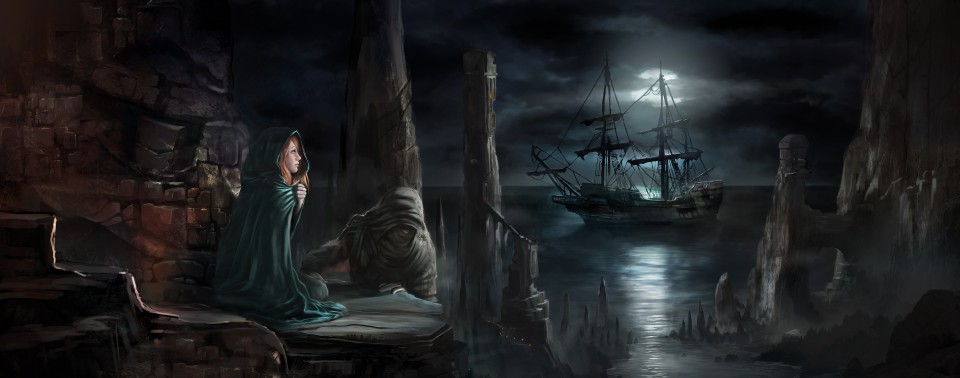

Selene regretted the crushing heartbreak that vibrated through her soul when an agonized howl echoed through the night.
The prince had found someone he truly loved. Selene watched the woman flee past the castle gates, her dark hair whipping in the wind, to return home.
Her heart clenched with shame, but most of all, guilt.
How could jealousy and rage have blinded her to lash out at an innocent being? The anger she had directed toward him was misplaced. All her insecurities, shame, and loneliness were due to a lifetime of proving herself to a man who would never be satisfied. The prince did not deserve this fate—he did not deserve to perish as a beast.

Thank you, Ashley Evercott, for writing these lines. Finally, someone admits that the enchantress that cursed the prince into a beast did very, very wrong and deserves no excuse whatsoever.
This isn’t the first time I’ve read a retelling that tries to tell the story of Beauty and the Beast from the enchantress/fairy godmother’s point of view to “redeem” her, but it is the first one I’ve found (or at least the first in so long I can’t even remember a previous instance) that unconditionally admits that the enchantress went too far with the curse and that it was undeserved, because the prince was innocent.
In all the three main versions of Beauty and the Beast, the prince is innocent. Although Disney’s version tries to shift the blame onto the victim, something that has always bothered me about the film.
And what bothers me even more is that in all the retellings with the enchantress/fairy godmother as the “good” side, the same thing happens: either the prince is entirely to blame for being a bad person and doing something wrong, or the enchantress acts with complete moral justification. In other words, the Beast is villainised so that the enchantress/fairy comes out looking good, as the right side.
This trick of simply switching the roles of hero and villain is abhorrent to me because it’s so simplistic, and it ignores the moral context of the stories that gives meaning to each character’s role in a tale. Even Evercott fell into this trap in a previous retelling of hers that I read and didn’t like it precisely for this reason, amongst others.
So I was surprised that she got it right this time, especially since the beginning suggested that the prince was going to be blamed for his own misfortune. In this world, magic users are called stewards/stewardesses, and magic is strictly regulated by rules overseen by a council of High Stewards, before whom the stewardess Selene is standing trial for cursing the prince. But it’s said that it isn’t exactly for the curse itself but for unauthorised use of magic. Following the Disney story beats, the prince is said to be out of control whilst grieving the loss of his parents and goes on a rampage mistreating his people, so his assigned Stewardess disguised herself as an old woman and offered him a rose as payment to stay inside during a storm, but he threw her out.
With this, I was prepared to not like the book, because this reason for the curse is even worse than Disney’s. How can you curse someone grieving the loss of their parents? Someone like that isn’t in their right mind, so from then on I expected the worst.
It took me a while to realise that it wouldn’t be as I thought. When Selene is sentenced to capture the Pied Piper of Hamelin within three months to return the kidnapped children or be stripped of her magic, and she is branded and her magic is diminished, you gradually begin to suspect there’s more to the affair between her and the prince than what was revealed at the trial. A web of lies, half-truths, and mysteries unravels as she locates the Pied Piper and chases him until captured to hand him over to the High Stewards.
This Pied Piper, Reid, is a hilariously funny clown, a stark contrast to Selene’s stern and grumpy personality, creating a Sourpuss/Sunshine pairing that’s quite entertaining. Since he has his own secrets to hide, he easily guesses what she’s hiding—and lying about—and with his persuasive skills (and his good looks, let’s be honest), he forces her to confront the truth she so desperately denies.
He forces her to redeem herself kicking and screaming.
This is the second thing I liked most about the book: Reid essentially plays the same role in Selene’s life that Beauty plays in the Beast’s. Neat, isn’t it? I couldn’t say if the author did it on purpose, but in this book there are two stories with the redemptive theme of Disney’s Beauty and the Beast: the Pied Piper who redeems the enchantress, and Beauty who redeems the Beast (who in this case doesn’t need it).
Therefore, I would say that Beauty and the Beast is the story that predominates here over The Pied Piper of Hamelin, firstly because of thematic reasons, and secondly because Pied Piper has already “finished” in-story and we are in the post-fairy tale period (Reid has already stolen the children of Hamelin because the mayor didn’t pay him what he was owed for the rats), whereas in the case of Beauty & Beast we aren’t in the aftermath: we are in whilst the story is unfolding (from beginning to end), only that the plot is in the background because we don’t see those involved but rather hear a little about them.
And speaking of that, it wouldn’t be a bad idea to complement Falling for the Pied Piper by writing the story of Rosabelle and Prince Leander. At least, I would like to read it, especially because Leander has intrigued me with the little bit I saw of him, all the trauma he must have gone through losing his parents and having his suffering worsened by Selene, and how he deals with the issue of forgiving her or not.
Now, the theme of forgiveness is another point I really liked. In my previous review, I mentioned that it bothered me that the victim of paternal abuse is portrayed as being so kind to her abusive father and forgiving him so easily, without remorse or even an apology for the mistreatment. Here? That doesn’t happen here. Selene is deeply remorseful, but she knows very well that it’s not right to feel entitled to forgiveness. She doesn’t justify herself to the prince, she doesn’t ask for his forgiveness, she simply apologises and lets her victim decide for himself. And Leander’s reaction seemed very realistic to me, perfectly understandable. For me, this is how forgiveness should be handled, and the truth is, it’s not usually done that way.
So, despite all the book’s flaws, it’s the fact that it managed to redeem the villain without denigrating or villainising the victim/hero that earns this book all the stars I’m giving it. Keep in mind that I’m judging Falling for the Pied Piper as a retelling of Beauty and the Beast, which is a different criteria than those used to judge it as a story.

Whilst there are aspects of the writing and editing in this book that could’ve been done better, I prefer not to dwell on them—others will do that anyway—and instead focus on a couple of things I think should’ve been done better for the sake of the story. Namely, the characters’ appearances and the matter of Steward Rosendale, Selene’s father.
I didn’t like that both Reid and Selene, as well as the High Stewards, have an appearance more befitting a clown than serious and dignified professional magicians. For example, Selene has purple hair (which is why Reid calls her “Violet”), and she and others in her trade have garish, ugly hair, like something out of a clown show. How ridiculous! It’s not just that I don’t like clowns, but that this garish clothing and hair detracts from the dignity of the position. In this world, there are two kinds of magic: structured and wild, and to learn to use the former, you have to study and get a degree as a steward. Why don’t the stewards have a uniform that identifies them instead of walking round dressed in jester rags and with hair as if they killed a Little Pony to use its mane or tail as a wig?
If I had been an editor, I would’ve suggested removing this ridiculous detail. Which, by the way, I’m not sure if it’s only for those who are magical or if it’s a cultural dress code thing, because when they’re “disguised” to fool the bounty hunters, Reid and Selene wear garish, ugly wigs that would identify them anywhere.
But the most significant weakness of the book is Selene’s father. From what we saw, he’s a domineering and selfish man who only cares about the prestige of the Rosendale family, and he’ll sacrifice his daughter for it. He’s the one pushing Selene to extremes in her attempts to earn his affection and approval, forcing her to be an overachiever perfectionist because, for her cold and distant father, nothing she does is ever good enough. After Reid makes her confront the harm she’s caused motivated by her desire to please her father, she should’ve had a moment of reflection, of closure, where she should at least have mentally moved on from her unhealthy relationship with her dad and put all of that behind her.
But she doesn’t. There’s a scene of closure with the prince she cursed, but not with her father, the one behind her actions. Why? There should’ve been a scene of closure with her father, who only appears at her trial and is never heard from again. There’s no closure, not even a moment of reflection from Selene. Nothing. And this is a serious plothole, a glaring one because of its size.
That’s why I didn’t think it was the best idea to end the book with that saccharine little scene at the school with the children. I would’ve preferred that the author hadn’t left anything unresolved about the father-daughter issue. After how well the redemption aspect was handled, it’s a bit jarring that it ends like that, in a void.
Anyway, as I was saying before, if this story must be judged through the lens of the fairy tale, then its thematic development makes it one of the best B&B retellings of the year so far, with all its imperfections.

A mashup! Intriguing, I certainly wouldn’t have thought to combine those two tales.
Me neither, not with the tales’ protagonists at least, but with the villains . . . it sure works!
🤣🤣🤣 First of all, the My Little Pony comment slayed me. I was snickering and trying not to giggle maniacally after reading it.
Second, I actually really like the Hamelin story and many versions of it I’ve read, so there’s something inherently interesting to me about the mash-up here. And the description you’re giving certainly gives me Beka G vibes.
Finally, I also agree that we too often see books where the Beast is the villain instead of the victim, and it saddens me. First, for the reasons you put forth. And second because I had a discussion on original tales with someone the other day (a friend from university) and we were discussing that there are many implications, if not outright suggestions, that the Beast was a victim of abuse and/or sexual assault at her hands. And while that does deeply sadden me that we went from the original contexts to more of a Disney-fied frame of mine on the story, it also makes me wish that more people would add depth to their retellings beyond those basic known story elements of beast makes one mistake and woman curses him. So often there’s no good “why” beyond the suggestion of his selfishness.
Hehehe . . . Sarah already told me she’s in disagreement with me over dissing people’s garish hair in this book. 🤣 RIP purple Little Pony! 🤣
On the matter of the Beast as the victim and the sexual abuse he suffered at the hands of the fairy… I’m both happy and dismayed at how things are now, you know?
I can’t claim to be the first person ever who called out the fairy as a molester, but back when I posited this interpretation in the ‘Pawn to Player’ forum threads over at w.org, NOBODY was talking about it, I searched and searched online and never saw anyone talk about this. The closest was Jack Zipes, and he’s a folklore scholar.
But now, there’s people who do know this and talk as if they made this grand discovery. Just yesterday, I finished reading an indie B&B retelling in which the author talks about Villeneuve vs Disney and what the fairy did to the prince, but . . . her handling of the matter is so troubling to me. This author calls herself a B&B fan of 3 decades and claims to have researched the tale, but what she tells in her intro and how she handles the curse in her retelling makes me wonder if her research was some Wikipedia stuff or whatever.
(I?ll tell you who in private.)
Honestly, you’re right, it’s both gratifying to see it coming to light and being discussed and terrible because even in being seen and discussed it’s still often badly handled or misrepresented. And I get that there’s a lot to balance, but I think a lot boils down to laziness in research and taking short cuts in worldbuilding.