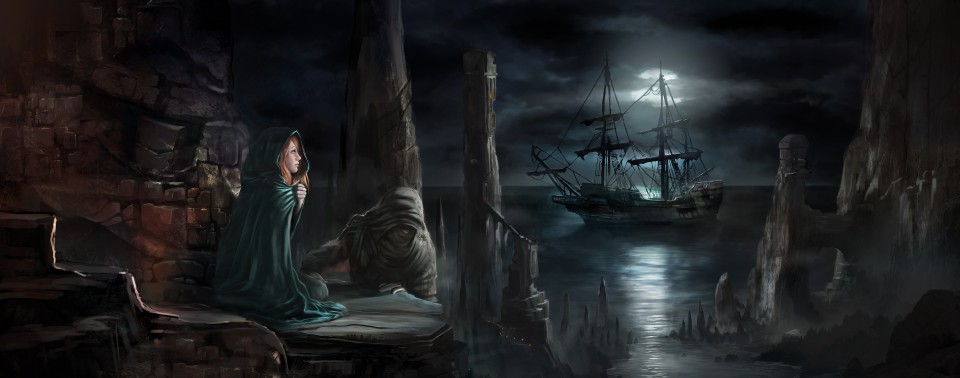

This book has an interesting idea for a plot, similar to that of News of the World in a fantastical version and The Story Peddler without the part about stories that can kill. It’s about a wandering saleswoman that arrives on a stormy night at a tavern in a coastal town, where a few patrons are killing time sheltering from the heavy rain. Before this captive audience, Verre the peddler takes a bunch of strange objects out of her bag of wares to show to the curious crowd looking on. Is she going to sell these things?
Oh, no, she’s not going to sell them—and in any case, some of those objects are too valuable for her humble listeners to afford—as she’s a storyteller and is going to use them to tell stories. Each object has a story about how it came into her possession, and Verre takes advantage of the curiosity their uniqueness arouses in the townsfolk at the inn to tell them one by one: there’s an apple-shaped ruby locket, a brooch, a hand-painted teacup, a pearl comb that belonged to a mermaid, a mirror that was always dark, a golden straw, a beast’s fang, a sailcloth bag . . . Eight objects with eight stories worth telling (there’s a bonus story, but it isn’t linked to a specific object).
These eight stories are supposed to be retellings of fairy tales, but they don’t seem to be. This is partly because they are told as episodic anecdotes passing as life stories and partly because of how Elyssa Schwendy writes her retellings: they aren’t straightforward remakes, she has tried to make them as original as possible and doesn’t tell you anywhere which tales she is supposed to be retelling, not even in an Author’s Note.
For me, this is what I liked most about the book. I love a good challenge, because I can usually guess easily which fairy tales they are, and The Peddler has made me work harder than I usually do to identify them.
In some of the short stories, you can guess right away which fairy tale they are working on, for example those that retell Snow White and Sleeping Beauty are obvious from the start. But with most of them, it’s hard to know which fairy tale they’re based on. It doesn’t happen to me often, but at least with three of the stories, I couldn’t guess which fairy tales were used and struggled to guess, and I feel perfectly fine about that.
Is there one inspired by Beauty and the Beast here? No, not exactly. Though one of them could be seen as having the B&B theme . . . if you squint. That was a bit disappointing, but not unexpected from the hints I got in the Contents page.
That said, I can’t claim to have had a favourite story in this collection, mainly because I found them rough, told in a hurried and summarised way, with little character depth, and in a narrative format that I think works better spoken than written. The stories are not hers, but Verre tells them all in first person as if she had experienced them herself or was relaying what she had heard. I think that telling these stories in first person POV wasn’t the most appropriate approach, and that they should have been told in third person, leaving first person narration for Verre’s chapters.
They do feel like they’re being told to you personally, though, which is why I insist that this book would be much better as an audiobook, preferably with a narrator that can do different voices to differentiate each protagonist in each story and give Verre’s chapters their own distinctive voice.
There really are stories that are much better told than written.
Another thing I liked was the “bonus” story that Verre drops at the end, when her listeners are already leaving after the storm has subsided and only a curious little girl remains with one more question to ask. Although that chapter is very short and the one that follows is even shorter and ends more abruptly, I liked that it was there because of what it hints at. What and who is Verre, really? And how is it that a humble peddler without a penny to pay for a room in an inn has these objects obtained from people in lofty places? Why does she travel telling stories instead of selling wares? She’s so mysterious, we aren’t told much about her, if anything, and she doesn’t seem to charge for telling stories. So what does she live on?
There are many loose ends here, and the book doesn’t pick them up or wrap them. But it does give us clues to guess the answers we don’t get, the key being in that last story. I, at least, have been able to form a halfway decent idea of what and who Verre is.
I also feel that her story can continue, as there is still a good chunk to be explored. If the author were so inclined, a novella-length sequel that tells us a little more about Verre would be nice. Some of the tales she tells could also be turned into longer stories, but personally I don’t see that potential in any of them. They aren’t so interesting individually, but work well together as a bouquet of entertaining slice-of-life episodes told by an ambulatory peddler. It’s the peddler herself who is interesting, in my opinion, and I wouldn’t mind reading more of her adventures in the future.

I received an ARC from SnowRidge Press in exchange for an honest review.
Hmm. This is certainly an interesting conglomeration of things. I feel like there are aspects of it I could really like and some that might drive me nuts. Ironically, I’m not a big fan of first person, despite most of the books I edit being in the first person. But I’m also a character driven reader and author, so if they lacked depth I don’t know how I’d feel about it…
Yeah, definitely a character-driven book.
If nothing else, the stories the peddler tells here are original (I wonder how many fairy tale lovers would be able to guess which tale they are), but it was Verre that kept my interest. I do wish there had been more of her, her chapters were so short and mostly excuses for the next story.
More like intermissions. Gotcha. That’s kind of sad, but I can see why it was probably set up that way. I think I’ll eventually get around to reading this one due to my own curiosity to try to guess, but it’s not high on my list of priorities.