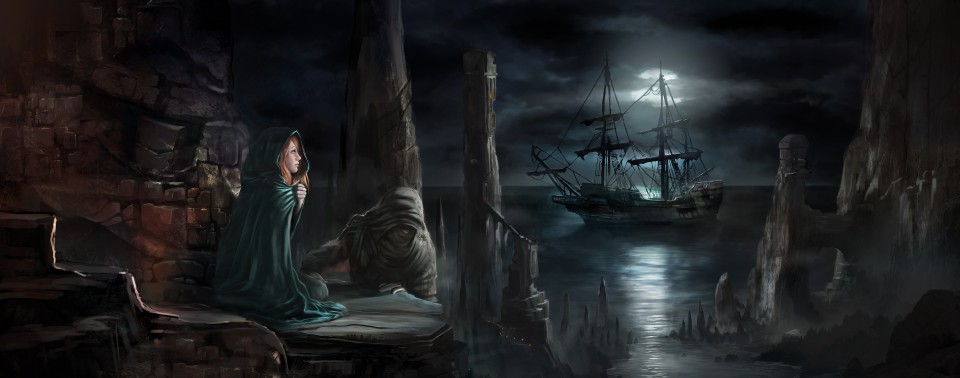

This book is like a creature that escaped Narnia and went in search of East of the Sun & West of the Moon but ended up in a party with Vikings, Romans, the Island of Doctor Moreau, the Polar Express, a sprinkling of His Dark Materials, the Hindenburg crash, and Nordic herders with woolly mammoths instead of reindeer.
It’s not as silly as it sounds, I promise!
I’ve owned this book in its original first edition from 2017 since I took advantage of a discount promo to buy an e-copy, but like it happens to all the discounts & freebies I hoard, it was swallowed by The Kindle Black Hole to never be seen again (don’t ask me how many retellings I have there, I should hire a professional archivist to sort those out). Then last year, I mentioned it in passing to Mariella Taylor—the editor for the new version—and she told me a remastered edition would be published soon. Thus the brand spankin’ new copy is in our hands.
Yes, I’ll probably read the 2017 version one day, too, to see the changes and differences by myself. But this time, I am in no position to do a comparative review with the 2026 version as I’d have wished. I’ll try and ask the author later if possible.
The plot of So Sang the Dawn is seemingly straightforward: it starts with a teenage orphan, Aurora Ballern, making ends meet as best she can on tuition-free education and charity jobs at a boarding school she’s been dropped off at after several failed attempts at adoption. She experiences horrific nightmares about a giant black winged lion attacking her, which only her best friend Raine knows about. There’s some oddities going on in the school’s grounds, which clue you in on something else about Aurora we don’t know yet. And right on cue, three chaps that look like they missed the Hallowe’en-was-in-October memo materialise in front of her and kidnap her to an alternate magical world.
You’d be excused for letting out a groan. “Not another faerie kidnapping,” you think.
But sometimes you do need a little kidnapping to salt-and-pepper things up at a dull boarding school. It’s when Aurora and Raine are in Rathmar of Frostholm that the plot takes off, and you have over 700 pages of hard action and hard emotions.
For me, the best thing in this story was the sisterly bond between Rory and Raine, how strong and selfless it is. There are friendships that are as close or closer than sibling ties, that’s the sort of bond these two girls have. Whilst still in school, you sense they’re close but you also know the looming distance as they go their separate ways in life could weaken or break their bond, so it’s really Frostholm that makes it evident that isn’t going to be their fate. Frostholm is a trial by fire that tests not only their bond but their mettle.
And do they come out of it victorious! Not unscathed, not unscarred, not non-traumatised, no longer innocent, but stronger at a cost. The Warlord that has an interest in Aurora won’t stop at anything cruel to get her to obey his orders, and Raine is a pawn he moves against the prized captive to control her. How often do you find a book with female friendship this wholesome? Bromances are a staple in Fantasy, but womances aren’t. The rarer, the more precious.
As Seigan’s captive, poor Rory is given either no choice or the worst of choices, but somehow manages to find loyal friends. That was my second favourite part: Canaan the centaur, Saoirse the healer, Helja the gladiatrix, Geirin the fighter, Fordrin and Merryn the herders, Eysa . . . She makes a few friends, and in a world of warrior-slaves similar to Rome’s gladiators, this means survival. She’s forced to become a masculinised warrior from a gentle schoolgirl, to survive and protect Raine, but she also uses her wits and heart. I think this compensates for the action after twist after adventure type of plot for those that aren’t much into action-packed storytelling.
I was also favourably impressed by the vast world Pavese crafted, she even created a language (Valthan) for it that to me sounds based on the Norse tongue from the time of the sagas. This world is superimposed on a parallel dimension over Antarctica, and its main culture seems Viking-derivative with a dash of Greco-Roman elements and creatures from generic folklore that seem to have undergone some sort of mad-scientist crossbreeding lab experiment (but aren’t). The second main culture seems to be sort of like the Suomi & Siberian reindeer herders living round the Arctic circle but placed on the opposite Pole. Technology-wise, there’s railroad and airships but no gunpowder-based weapons (that I can remember). It’s quite the pout-pourri, and despite such an amount of mixes the author kept it cohesive as a whole.
I liked that the world feels so expansive and lived-in considering there’s only one narrator, that is a First Person POV, but I would’ve streamlined it a bit by whittling down some of the technology to make it more “old-worldish.” In these alternate worlds, the other dimension is either behind our world in tech or, more rarely, is evenly matched in terms of tech advances. But in this case, it’s selective and unequal, and that makes it feel somewhat off. The world Aurora and Raine are kidnapped from is understood to be our present time, but the world they arrive to is a blend of antiquated (they fight with swords, not pistols/gunpowder) and advanced (there’s trains and zeppelins), and perhaps it shouldn’t have been this off-kilter.
I’m very detail-oriented with the stories I invest in, and this is not enough to bother the readership, just noticeable enough to make my personal immersion wobble.
Another thing that made my immersion wobble was the pace. The beginning up to about Chapter 7, the big-chunk middle, and the ending have different narration speeds. Realistically, the slow pace in the beginning couldn’t have been helped: what is there to do at a boarding school that’s exciting? Unless it’s a magical school, not much. Some of the scenes could be rid of, but there was a risk of making the transition to the alternate world in a hurry, with little set up. The pace of the middle of the book was largely ideal: a combination of speedy action and quiet parts. So that leaves the last part of the book towards the end as the one with the pace that will likely be more bothersome, because it’s a rapid action sequence that ends on a scene that, whilst not a cliffhanger, doesn’t wrap up the story either.
At 700-plus pages, it’s hard to maintain a steady pace for the entire book, and the world and the storyline had become so expansive the book couldn’t be a standalone. I’m pretty sure there’s a second book in the making, probably as fat as this one because there’s still a lot to see before this story can be wrapped up.
That said, there wasn’t anything in So Sang the Dawn that was a genuine issue for me. It’s as a whole a feel good story in spite of the tough themes and the suffering the characters go through. Maybe it’s the hopeful tone of Aurora’s narrator “voice”? Because she’s a disadvantaged girl and has had (and is still living) a hard life, but somehow she’s not lost herself. Not yet, at least. She may end with tremendous PTSD after this, but for now she fights.
You’ll ask me, how does this book fit the Beauty & Beast archetype? Good question, very good question. My answer would be: through the Narnia and East of the Sun & West of the Moon thematic parallels. But you have to know what you’re looking at or it’ll all fly over your hairdo.
I am confident in my supposition that AnnMarie Pavese has drunk from the deep The Chronicles of Narnia well for inspiration, and if you know C. S. Lewis’ series you will see it too. Some things are very obvious, such as Asbjørn as an Aslan equivalent. Tough my daydreaming fairy teller mind thought at first he was the White Bear from East of the Sun & West of the Moon and was waiting for him to barge in anytime now to whisk Aurora off Crazy Viking Jarl Wannabe Seigan’s hands, which of course never happens. That should teach me to not see fairy tales when there’s none, a lesson I naturally won’t learn.
But it’s a thematic connection, as I was saying. The “beastliness” in Aurora is a transformation dependent on virtue, like in Beauty and the Beast or East of the Sun & West of the Moon. The ljren are pure beasts that Asbjørn gave to the world, who got corrupted by a twisted warlord for selfish goals, making Seigan the Evil Fairy/Troll Queen figure. Like Beast/the White Bear, Aurora is blameless for the curse but her transformation into a beast depends on how well she can control her inner demons, her character flaws determine if she’ll be a corrupt ljren or can win the battle of wills to be like the pure ljren and retain her humanity, a struggle she can’t win without someone else. Whilst there’s no romance in this book, you can argue for the pure ljren prince to be her Beauty counterpart as he embodies the uncorrupted gift from the Great Bear.
Girl, do I adore spotting these little hidden folkloric eggs . . .
And perhaps the romance will come in the next book to content all those for which this is their bowl of cream. I don’t lean any particular way in this regard, my interest in this story is held by the psychology of Aurora’s hard heroine’s journey, and I can declare myself satisfied with the various non-romantic relationships Aurora develops in the book, especially with Raine and Saoirse. I’m sure there’s going to be more from these girls soon, no way their story ends here.

I received a complimentary ARC copy from the author in exchange for an honest review.
I’ve heard so much about this book over the years from my Goodreads/writers circle–fascinating to hear your thoughts! 😀
Thank you, Katie! It was a lovely surprise. Do you think you’ll read this?
Most likely not–it sounds like it would be too intense for my tastes–but I can tell it’s really good <3
Having read and edited this, I think it might be a little intense for what you usually prefer because the characters go through a lot, but I also think there’s some cool characters so. Do with that what you will.
Okay, yes, good to know! That’s kind of what I figured, cool characters but very intense.
I, on the other hand, am like Mari. I want blood & guts & suffering in my books. Or I’d not be here because I wouldn’t have got past ASOIAF. 😀
Excellent review! And, I love that the book contains a great female friendship. We need more of those.
Yes! Womances are so rare that it’s always a delight to find them when you least expect it. I had been half-expecting romance would be the focus.
Okay. So, comments are finally happening whoooooooooo ~
First, I am so glad that you liked the book. It’s funny that sometimes it just takes something a little different from our usual to spark our interests again, isn’t it?
Second, I am really happy with how Aurora and Raine’s relationship turned out in this and I also wish for more female friendships. What are some of your other favorite female friendships in fiction that you’ve read over the years?
Oh, boy, that’s a tough question, because Womances are rare to begin with. I can’t even remember when was the last book I found a great Womance in… I should look for some books that have them.
Maybe we should start a Characters Award for retellings like the Smashing & Dashing Awards Katie hosts? 😀 The Best Womance category would be such a hit!