
Heigh-ho, heigh-ho, it’s off on hiatus we go!
16 Tuesday Jun 2026
Posted in PTP TWOW
16 Tuesday Jun 2026
Posted in PTP TWOW
16 Tuesday Jun 2026
Posted in PTP TWOW, The Fairy Whisperers
Tags
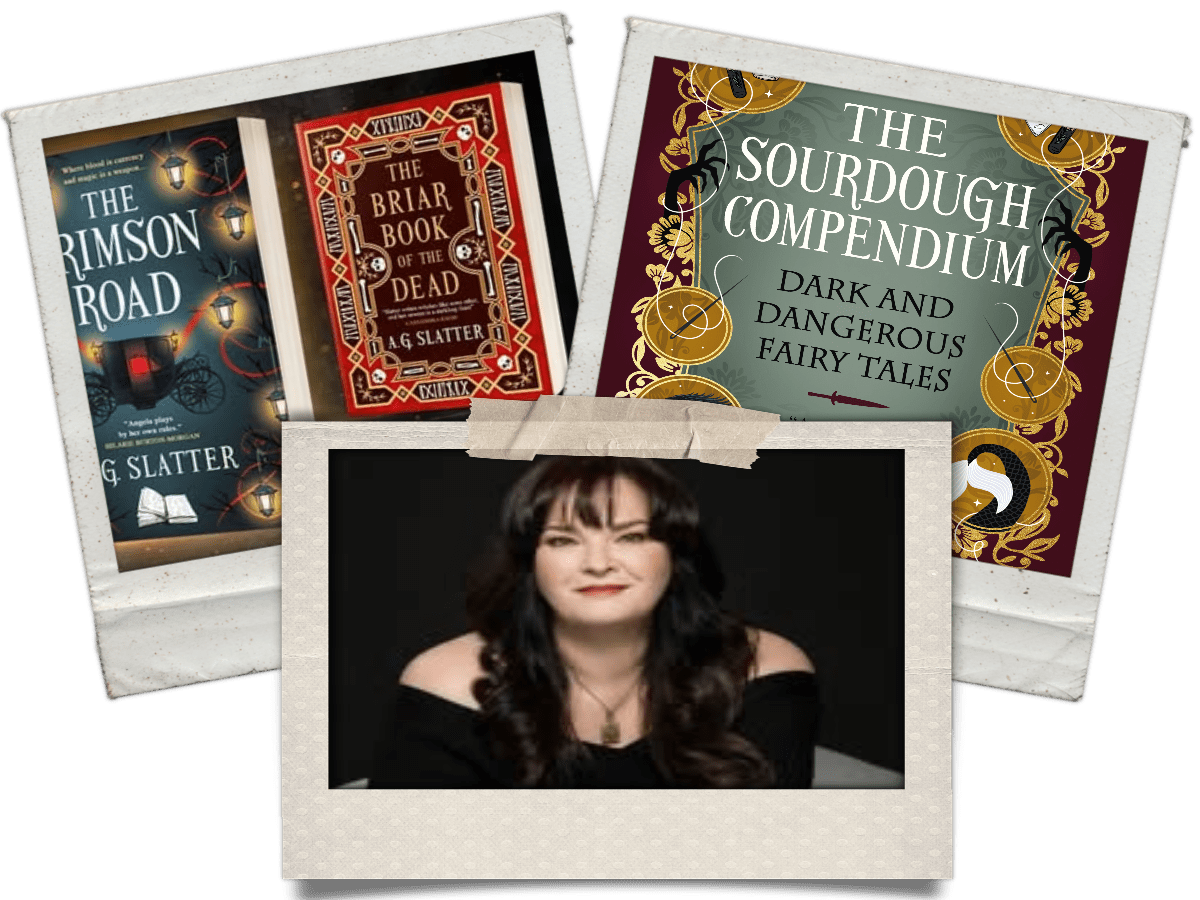
Welcome to Conversations with Fairy Whisperers, Angela! As a big fan of your work, it’s a dream come true to have you here with us. Tell us about yourself, how did you become a writer?
Thank you so much for inviting me along, Marquise. I’ve always been a very big reader, and one day I guess I just decided I would try being a writer—it must have been the right choice as I’ve been doing it for twenty years now.
I started by doing some study in creative writing, and while I was doing that, I was also able to get some pieces published, which encouraged me to keep going. I kind of began with short stories, then stepped up to novellas, then novels. I love what I do and can’t imagine doing anything else.
You have published several books in the Fantasy, Horror, and Paranormal genres, which I understand are your preferred genres. You have a characteristic storytelling style that incorporates fairy tales and diverse fae and supernatural folklore into your books, giving them a distinct Folkloric Fantasy vibe that sets them apart from mainstream Fantasy, and often gives them a fairy tale atmosphere. What fascinates you about fairy tales and how did you begin introducing them into your stories?
I think it started for me in childhood, having my mother read fairy tales to me at bedtime, so they were my earliest stories and have remained my favourites even as I grew up and became a writer myself. I think as you mature you realise that these stories are much more layered and complex than they at first appear, and I think that there’s still so much to be gained from them as both an adult reader and writer.
Fairy tales underpin so much of a person’s life, from thought patterns and beliefs to hope and dreams—and nightmares. I’m really interested in the dark side of such tales, the stuff that isn’t talked about so much in the Disneyfied versions. The first fairy tale I re-wrote was “The Little Match Girl,” which I remembered causing me many tears as a child because of its unfairness; so I think I started with that one first because it was a place to start unpicking a lot of my own fears.
What I try to do with my writing now, the stories in the Sourdough universe, is explore a world that has one foot in fantasy and the other in what looks like a familiar version of the ‘real’ world—so that even stories that don’t look like a rewriting of an older tale, still have a degree of recognizability because of some of their elements, so they feel familiar, like something you might have heard before, but which is still strange and unknown.
Of all the styles and formats fairy and folktales and retellings come in—pictorial, screen, graphic, illustrated, or written—which do you most favour?
Oh, I think it has to be written for me. I’m a writer, after all, and the joy is in the words and the style and the way an author is building a world for you! But I also love the graphic novel form—some of Mike Mignola’s Hellboy stories involve fairy and folktale reworkings and they are just incredible.
And illustrated versions can give incredible visual interpretations of the story—when an artist like Abigail Larson or Audrey Benjaminsen gets hold of a fairy tale the result can be truly amazing. And a film like The Company of Wolves or Pan’s Labyrinth have some absolutely stunning imagery, especially when there’s not such a concern about making everything pretty and sanitized—I think the rough and raw edges make it look more believable.
Your literary output is laden with elements and plots borrowed from fairy stories, some famous and some obscure. Do you have a favourite fairy tale or folktale? What aspects of it appeal to you personally, and why?
Ah, it’s always hard to pick a favourite! I love a lot of the “Donkeyskin” versions, like “All-kinds-of-fur,” “Mossycoat,” “Catskin,” et cetera. I think what appeals to me as a writer is that they’re all tales about girls saving themselves, not staying in terrible situations. It’s probably also why I love Bluebeard kinds of tales like “The Robber Bridegroom,” “Mr Fox,” “The Oxford Student,” et cetera. I’m a fan of self-saving-princess stories.
“Self-saving princesses” is a perfect description for my absolute favourite of all your work so far, the Sourdough Universe series, which comprises five full novels and several short stories, and some of them are easily recognised as retellings of a certain tale whilst others are only vaguely reminiscent of the inspiration or source tale. In your opinion, what makes a retelling stand out? What do you consider the joys and challenges of writing in this specific subgenre?
I think what makes a retelling stand out is how far you can push it from its origins, add in new details, but still have a hint of the original story still at its core.
There’s a wonderful version of the Robber bridegroom tale by Cassandra Khaw called “A Leash of Foxes, Their Stories Like Barter.” I won’t give the story away, but she’s shifted whose story it is to tell, which makes the whole ending come out differently. Then there’s Francesca Lia Block’s “Blue,” which is a modern version of Bluebeard set in LA—it has some familiar elements, but the story’s been stretched away from the original version, so it feels both familiar and strange. I think you can do this by shifting point of view, who your narrator is, changing the setting in terms of time period or cultural landscape; you might retain themes but attach them to different imagery or plot points.
The Sourdough Compendium is coming out in June this year, and it’s a reprint of all my mosaic collections set in this world—I think you can see from the original tales in the first collection, then to those in the second and third how I change the amount the stories are stretched and changed from their origins. I think I definitely got better at that the more writing practice I go, so the bones of the stories in the Sourdough section are probably more recognizable as old tales than those in the Bitterwood or Tallow-Wife sections. I think my joy in writing in this subgenre comes from examining “What can I do here that looks new, but feels familiar? How far can I push this? People will also see different things in your work, too—with A Forest, Darkly the main fairy tale in my head was “Hansel and Gretel,” but another reviewer saw “Little Red Riding Hood” in it far more strongly.
The five Sourdough novels tend to blend several tales into one story rather than use only one tale per story. Is this a deliberate choice on your part or just the way a story develops during the writing process? What fairy tale would you say is the most complicated to reinvent, and why?
I think what I do more of with the novels is have a particular idea or feeling or pain that I want to explore. So, while All the Murmuring Bones is a Gothic mystery set in opposition to “The Little Mermaid” (one of my most hated fairy tales), what I was wanting to do was see how I could upend the traditional Gothic girl stereotype. Part of that took the form of stripping mermaids back from the harmless little Ariels they’ve been turned into and making them into dangerous creatures again—and I suppose that fits in with making girls in gothic stories tough and dangerous again, and not such easy prey.
With The Path of Thorns, I wanted to upend the “governess goes to remote estate and falls in love with a terrible man and redeems him” cliché, so Asher Todd is a character who’s coming with her own agenda and she’s going to do damage. She’s the anti-Jane Eyre, really!
The Briar Book of the Dead has a lot of ghost story elements and the story question for me was “What if you’re not the chosen one but you’ve got to clean up everyone’s mess?”
For The Crimson Road, I was again picking at destinies and also the position of oldest children who are given responsibilities when they shouldn’t.
With A Forest, Darkly, I wanted to interrogate ideas about how and if we can make amends for things we did in the past, for whatever reasons.
The next novel, Our Lady of Battles, is looking at the idea of what happens if you’ve been trained to do something your whole life, and that is getting something for someone else – what happens when all your hard work is given away?
In your opinion, what fairy tale is the most complicated to reinvent, and why?
I’m honestly not sure which fairy tale is hardest to reinvent! I mean, you want to make the story different enough that a reader feels they’re getting something new! It’s something I kind of play with in the novels because I always have inserts of made-up lore or tales that are meant to be books from my characters’ lives or stories that they’re told, so there’s the element of changing details there that feel like they make the old stories feel strange and new.
We know you’re going to release The Sourdough Compendium in June, that collects all the short stories in the same universe as the novels, and of course we would love to read new stories, especially if you were to do a direct “Beauty and the Beast” retelling set in this universe [laugh]. Do you have any plans to write more Sourdough novels or stories?
Haha! I will see what I can do about a “Beauty and the Beast” reworking!
Our Lady of Battles is about a young woman who’s spent her life fighting to regain the throne of a city-state, Five Ports. She’s modelled herself on the city’s St Callwen, who was its founder. The book starts just after the last battle and I’m specifically looking at what happens now? All these Epic Fantasies generally finish with the big battle, but I want to see what happens after that—when the big goal has been achieved, who starts fighting again?
After that, the next novel is The Scarred Queen, which I think will be a pirate adventure? And I have three more Sourdough books pitched to Titan that I’m hoping will be contracted soon! So, yes, plans for more novels.
My first encounter with your work was the anthology A Feast of Sorrows,which contains three short stories entitled “The Jacaranda Wife,” “The Badger Bride,” and “Bearskin,” which made an impression on me and sent me looking for more. My library had two other anthologies, The Girl With No Hands and Other Tales and Sourdough and Other Stories, in which I found “The Chrysanthemum Bride” and “Porcelain Soul” respectively. These five stories have thematic similarities to“Beauty and the Beast,” a favourite tale on this site, in terms of transformation, monstrosity/otherness and humanity, and redemption. How did you come across the idea for these five stories, and what can you tell us about its creative process?
Oh gosh! “The Jacaranda Wife” was my attempt to write a fairy tale that could be said to be Australian—but I also wanted to acknowledge issues like colonization, rather than write something ‘pretty.’ I’d had the idea of a woman being born from a tree for a while and that became the core of it.
“The Badger Bride” was my attempt at something that would fit under the banner of “animal brides/husbands,” and I also love badgers and books, and wanted to see if I could combine them—and this story also links with two others in the Bitterwood collection (“The Burnt Moon” and “The Undone and the Divine”).
“Bearskin” came about because I’d been reading about bears in folklore and there’s an idea that bears are connected to healing and medicine in older cultures, plus this story is part of the Tallow-Wife collection and deals with ideas about lost children and also redemption.
“The Chrysanthemum Bride” came about after I read about a series of murders in China years ago where women were being murdered to be sold as “afterlife brides” to parents with dead, unmarried sons.
“Porcelain Soul” was in the Sourdough collection and it started after I read a quote from Rilke about how dolls are (and I’m going to quote this badly because it was a long time ago!) little abysses into which children pour affection with never getting anything back; the idea that came out of that was what if there were dollmakers who put a little sliver of their own soul into the toys they made?
Many authors who started their careers writing retellings later abandon fairy tale retellings for other genres and story ideas. Do you plan to continue writing retellings in your chosen genres or will you move on to other different projects?
I think I’ll definitely keep my hand in with fairy tales, I love them, after all, and I do think they’re infinitely adaptable.
I also write other things that are more contemporary Horror, short stories and novellas. The Cold House is a novella that came out last year and it’s very much a modern Horror story; Fitcher’s Bird, which is out this year is contemporary Horror AND a reworking of an old fairy tale. I’ve got a few more novellas in the pipeline that are more Horror and less fairy tale.
And speaking of your literary production, I counted fifteen books you have published as A. G. Slatter and thirty as Angela Slatter. That’s an impressive number for any author! Is there a book or books you are the proudest of, and why?
Thank you. I have been writing for a while now!
And again, it’s really hard to have a favourite amongst my book babies. There’s something I love about every one of them; I love Asher in The Path of Thorns, but I also really adore Mehrab in A Forest, Darkly—maybe their personalities are a bit alike, and Mehrab is who Asher would turn into at the same age. I really like Emlyn from Our Lady of Battles as I’m still getting to know her and dig into her personality, and I love Ellie Briar from The Briar Book of the Dead because she’s very pragmatic and has overcome so much and made hard decisions. I really love The Bitterwood Bible collection because it won a World Fantasy Award and I felt like writing that helped me kick my writing skills up a notch.
Some readers have compared you to Angela Carter, a heavyweight of fairy tale retellings, and you’ve paid homage to one of her most famous retellings, “In the Company of Wolves,” in one of your anthologies. Is there any other author who you view as a role model for your writing?
I think that tale is probably “Red Skein,” which is my version of “Little Red Riding Hood”—there were ideas I wanted to play with that felt like an extension of what Carter did in all her wolf stories.
Another role model for me is Tanith Lee, specifically her Flat Earth series, which also use that mosaic structure in each book. I think I probably learned that lovely interlinked structure from her, how best to place stories next to each other for maximum effect like choosing gems for a necklace.
If there was a Hall of Fame for retold fairy and folktales, which would you consider the best retold stories books and why are they worthy of inclusion in said Hall of Fame?
Oh wow, too hard to choose! Definitely you’d include Carter’s The Bloody Chamber, Tanith Lee’s Night’s Master, Emma Donoghue’s Kissing the Witch, a bunch of Christina Henry’s novels, Kell Woods’ After the Forest, Jodie Matthews’ Meet Me at the Surface is amazing and works with folklore, Emma Rose’s Lamb is amazingly mythical and original, C. J. Cooke’s The Ghost Woods, and I think Neil Sharpson’s The Burial Tide would have to go in, too.
That list is not complete!
But it’s an amazing list anyway! Thank you for sharing your thoughts with us, Angela. We will be keeping an eye on your future books, which we hope shall be many more in the years to come.
You’re more than welcome!
16 Tuesday Jun 2026
Posted in A Tale Transformed

If I had to pick a quote that encapsulates the essence of all the stories contained in this Compendium, it would be this one:
“Once upon a time on the far side of yesterday, in a land that never was, in a time that could never be, there lived girls who chose their own fate…”
It’s poetic, fairy tale-like in its phrasing, and sharp in its messaging. But above all, it describes the book’s theme so accurately, because the stories in The Sourdough Compendium are all about women that chose their fates.
Some are victims, some are perpetrators, and some are simply hit by the consequences of their own dumb decisions, but none of the main character girls sits down to wait for things to change through an external actor. They all take the bull by the horns, even when it means illegally or immorally taking the law into their own hands. Angela Slatter likes her women to spread all over the moral spectrum: saints, sinners, and most often ambiguous, which takes me to my second favourite quote to describe female characters in this collection, from the author’s Notes:
. . . her moral compass hasn’t worked in a while.
The Sourdough Compendium is a reprinted anthology of anthologies. It contains three collections of short stories—“The Bitterwood Bible & Other Recountings,” “Sourdough & Other Stories,” and “The Tallow-Wife & Other Tales”—some of which are fairy tale retellings whose source tale is easily recognisable, but most of which are original stories by Slatter that drink so deeply from folkloric wells that they could pass for new traditional fairy tales. They share a common world, the Sourdough Universe, which comprises five full novels (not included here) and the 41 short stories of the anthologies. It’s an impressive amount of world-building, rich and detailed enough that it deserves its own planet, like Tolkien’s or Martin’s works. I’d even say this is Slatter’s own Middle-earth.
Continue reading11 Thursday Jun 2026
Posted in A Tale Transformed

Everywhere you look, you see this book described as Bridgerton meets Once Upon a Broken Heart and Beauty and the Beast. If I were to calculate the degree of influence each of the three inspirational sources had on it, I would say that it is:
45% Bridgerton
40% OUABH
15% B&B.
I am, naturally, speaking thematically. Not the actual proportions of on-page time allocated to each source of inspiration, but the global influence each has on the plot of Death’s Rose.
Each of these has a well-defined narrative demarcation, that makes it feel like braiding two thick cords and one thin thread to create a beautifully solid rope. Bridgerton and OUABH are the cords, and B&B is the bright silk thread that enlivens and adds colour to the braided rope but doesn’t really add to its constitution. Meaning, Death’s Rose isn’t a book that can be judged as a Beauty and the Beast retelling (which it isn’t), but it can definitely be assessed by how it incorporates the key element of the fairy tale that it has borrowed—the curse and its origins—into a story that’s pretty much its own whilst still drawing heavily from two major non-fairy tale sources.
Many books that borrow only elements or scenes from the fairy tale end up using them as purely aesthetic props, decorative in nature. Not so this book; it makes the B&B element part of its moving machinery, and therein lies its strength.
Continue reading06 Saturday Jun 2026
Posted in The Fairy Whisperers
Tags

Welcome to Conversations with Fairy Whisperers, Kate! I have been following your work throughout the years since I first picked up one of your books, and it’s exciting to have you as our guest today. Tell us about yourself, how did you become a writer?
Thank you for having me! I’m honored to be here.
I didn’t really intend to become a writer. I started when I was 13, but as a form of escape. I’d been an avid reader, and the desire to create my own stories formed naturally from that. However, I also carried a lot of social trauma. So, the solitude of story-crafting formed a safe refuge when I became too overwhelmed or anxious throughout my teenaged years. I did it in private without any expectations of ever sharing my work.
It took me over a decade to even complete a first draft. By then I’d also collected a couple of English degrees. At that point, I figured, why not give writing a year or two in earnest? And I just never quit. Basically, I eased into this profession inch by inch until I was too far immersed to retreat.
Your author bibliography lists a varied assortment of books in which retellings stand out. Of all the styles and formats retellings come in—pictorial, screen, graphic, illustrated, or written—which do you most favour as an author and as a reader?
I’m a sucker for variation, and the written word seems to offer the most options in that regard. Even though I loved animated and live-action retellings earlier in my life, if I’m in the mood for a retelling nowadays, I’m searching novels rather than any other medium. However, I do love to put different retellings of the same tale side by side, all different styles and formats welcome. The more variety, the better.
If my maths are correct, you have published five fairy tale retellings to date: of Cinderella, The Little Mermaid, King Thrushbeard twice, and two obscure folktales. What fascinates you about fairy tales and how did you start writing retellings of them?
Fairy tales have a built-in cultural appeal. They contain distilled motifs and messages, which transfer readily to more developed stories. That in turn creates an excellent laboratory for learning story-craft. So, with the exception of Goldmayne, my fairy tale retellings have all been kind of academic in nature. They were exercises for me to write within specific boundaries and to explore well-known story beats from different angles.
I’ve experimented with Point of View (Brine and Bone, “The Little Mermaid” told from the perspective of “the other woman”), in medias res storytelling, (Soot and Slipper, “Cinderella” starting with news of the royal ball instead of backstory on her family situation), and character motivations (Maid and Minstrel, “King Thrushbeard” but justifying why the haughty princess might insult all her suitors).
In each of these, the source tale provides structure while allowing space for creativity.
As for my “King Thrushbeard” period, in addition to Maid and Minstrel and The Beggar Prince, I also have a third, Thrushbeard, that’s a perma-free urban fantasy novelette (link: https://BookHip.com/SLFDGFG). When I wrote Maid and Minstrel, I wasn’t entirely happy with the outcome. I’d focused so much on justifying my princess that I felt like I lost some of the original tale’s appeal. So, I ported it into a UF setting and let my protagonist be genuinely critical instead of defensively lashing out. Then I had an opportunity to write it again, but from the male’s perspective instead in The Beggar Prince.
Each iteration retains pieces of the original tale but has its unique angles as well—kind of like when an artist paints the same scene at different times of day to study how light and shadows fall. (e.g., Claude Monet; I particularly adore his Cathedral at Rouen series. My “Thrushbeard” retellings represent a similar exercise, but in words instead of paint.)
I love your description of fairy tales as laboratories for storycraft! Do you have a favourite fairy tale? What aspects of it appeal to you personally, and why?
My favorite fairy tale is the pair “Scurvyhead” and “Sir Goldenhair” from an obscure collection called The Golden Phoenix and Other Tales. I love the practical-minded main character, Petit Jean, his sassy talking horse, and the adventures they tumble into together. It’s such a fun underdog-hero story, with classic fairy tale vibes but enough uniqueness to feed my aforementioned desire for variation.
Which is why, when I used it as my inspiration for Goldmayne, it got the full-length novel treatment instead of being a short-novel/novella length. I wanted to shine a bright light on a little known but precious corner of folklore.
You also have written at least two retellings of Classics, Beowulf and The Blue Castle. What motivated you to write “The Legendary Inge” and “Deathmark”? And is there a difference in writing or researching for a retelling of a fairy tale and one of a Classic?
My motivation for those two titles stemmed from love of the original sources. The Blue Castle is one of my favorites from L.M. Montgomery, but it’s lesser known in her canon. As for Beowulf, I didn’t originally like it but had to translate it for one of my grad school courses and fell in love during that process. In both cases, I wanted to pay homage to stories that helped shaped my love of literature.
For me, Classics occupy a different cultural space than fairy tales, so their retellings feel different during my creative process. There’s only one source instead of a dozen variations, and it’s more developed, particularly with regards to Character and Dialogue. I tend to focus more on which themes to extract and how to polish them rather than on how to hit story elements beat by beat.
As such, my Classic “retellings” have fewer similarities to their inspirations than my fairy tales. While The Legendary Inge was inspired by Beowulf and Deathmark was inspired by The Blue Castle, I don’t consider them true retellings. Instead, their sources lent me a framework and/or themes that acted as a springboard into new narrative territory.
And theoretically, fairy tales can do the same thing; I just haven’t used them that way. When I’m rewriting a fairy tale, my approach is from a structural/story beat angle, whereas when I use a Classic as inspiration, it’s more like “this, but fantasy” (Beowulf, but fantasy; The Blue Castle, but fantasy), and the “but fantasy” part generally takes over, with echoes of the Classic scattered across the text.
In your opinion, what makes a retelling stand out? What do you consider the joys and challenges of writing in this specific subgenre?
This is such an interesting question. For me, successful retellings either honor or elevate the themes of the original source. I guess that’s a pretty subjective metric. When you’re retelling a story, though, it’s not wholly yours. It wouldn’t exist without its source material, and it comes with a built-in audience that demands respect. Retellings that stand out are able to build on the bones of the original story, adding new perspectives or depths without trampling over beloved elements.
The joys and challenges are two sides of the same coin. It’s challenging to reframe a tale everyone knows, but so satisfying when you find the right angle of approach. Stories worth retelling generally hold insight into the human experience, so the act of reinvention naturally broadens my understanding of other people and of the world I live in. When all the pieces come together, it’s extremely fulfilling.
Excellent point about the success of retellings being tied to respect and elevation of a tale’s themes, it’s something I always harp on her. And on that note, what fairy tale would you say is the most complicated to reinvent, and why?
This might be controversial, but I’m going to say “Cinderella.” It’s been written and rewritten so many times that sincere retellings can feel stale by default, but the more “inventive” ones can feel contrived. To further complicate things, it’s an archetype story (rags to riches), which means it can also act as a structural trope for non-retellings. Because it’s been examined and reproduced from so many angles already—and through so many different media—reinvention is a monumental task. The field has been picked over, which leaves temptation to bring in grain from elsewhere.
Granted, if someone portrays Cinderella as a housemaid by day and a master-thief-assassin by night, I’ll still read it. It’s difficult to keep the story’s integrity under such drastic settings, though, and that integrity is what makes the original tale—or any original fairy tale—so special.
You’re the second author I’ve interviewed that chooses Cinderella, a surprising choice for sure. As for Classics that are difficult to reinvent or modernise, is there one that that you’ve been intrigued by but that you find intimidating to retell?
Alexandre Dumas’ The Count of Monte Cristo. I love a good revenge story and would love to pull this one into a fantasy setting, but it has so many threads going on, plus the expectations of the book audience vs. the various film audiences. I do find it too intimidating to attempt, but maybe someday I’ll work up the courage.
You recently published Yes, Your Serpentine Excellency, a comedic Georgette Heyer-reminiscent Fantasy of Manners that is thematically like “Beauty and the Beast,” although it’s not meant as a retelling of the tale. How did you come across the idea for this story, and what can you tell us about its creative process?
It started from a pitch to use the Forced Proximity trope and developed from there. I imagined a hero who was cursed but didn’t mind, and a heroine who was fearless and thus bored with her life. This led me to develop the magic system, then the setting and supporting characters, then the necessary plot.
I’m an intuitive writer, so my creative process doesn’t come in a set pattern other than to pay attention when inspiration strikes. For this book, that happened over a period of roughly two years, with the bulk of my drafting in the last couple of months before completion. I was struggling with burnout when I started, though, and some of my narrative choices are a reflection of that. Instead of worrying about whether an audience existed for this odd book I was crafting, I wrote something I wanted to read.
I’m so glad others have enjoyed it too!
My co-host and myself are dragon fangirls here on Pawn to Player, as are many of our readers. We love all the dragon tropes! Serpentine Excellency made me curious about your thoughts on mythical beasts, do you have a favourite fantastical creature?
I love the different chimera types: griffons, unicorns, etc. If it’s a mishmash of multiple animal parts, I’m fascinated. My one exception is if human faces are involved. Not a fan of manticores, not a huge mermaid or centaur aficionado, and I can take or leave the sphynx but love the animal-headed members of the Egyptian pantheon. Not sure what that says about me, other than that I don’t want my monsters to express human emotions.
(This is why the mermaids from Brine and Bone are more angler-fish looking without their glamours, by the way.)
On the matter of tropes, you have a lovely descriptive tagline: “Handcrafted Fantasy Made from the Finest Tropes.” How do you decide which tropes or archetypes to twist and which to use as they are?
It’s not exactly a conscious decision. Mostly, I’m just looking for an interesting angle to use any given trope. Some tropes are fun just as they are, while others become more interesting when they flout expectations. Sometimes, they’re just asking for a twist.
For example, “forced proximity” usually involves tension between the two parties: they don’t want to be together, either because of dislike or embarrassment, so the trope causes narrative friction. And it’s a fun trope as-is! But I’d already used it that way in Guardian of Ruses. So in Yes, Your Serpentine Excellency, the two parties don’t mind being together (a twist), which means the tension has to come from somewhere else.
This really ties back to my love of variation. I struggle with a fear of accidentally writing the same story over and over. As a result, I naturally look for narrative opportunities to veer into the weeds. If I use a trope or archetype straight in one book, I’m more likely to twist it in another.
I would say you’re unlikely to fall into that trap, seeing as you wrote two books that are hard to fit into a genre. Both “Namesake” and “The Heir and the Spare” feel as though they exist in a genre somewhere in-between Fairy Tale and Fantasy, with elements from both yet still a different type of story. Our first interviewee here, Beka Gremikova (a big fan of yours, she tells me) also writes like this and calls it Folkloric Fantasy. Is there a particular approach that created the atmosphere of Folkloric Fantasy when you were writing these books that separates them from your traditional retellings?
I like the term “Folkloric Fantasy.” It’s not something I’ve really considered before, but I hope it catches in popularity. Props to Beka for coining it!
I’ve always just tossed these two books in my “original stories” bin. Namesake is a portal fantasy and The Heir and the Spare is technically a thriller in a fantasy setting. They’re both outliers in my catalogue, for different reasons. (That being said, most of my books are outliers from one another. I write what intrigues me in the moment, and it seems I have the creative attention span of a caffeinated hummingbird.)
I don’t recall a particular approach in crafting these two books. In fact, their writing processes were vastly different. Namesake was a struggle, with so much second-guessing and revision, whereas The Heir and the Spare went from idea to publication in 6 months (one of its outlier qualities). However, when I write original stories, I do feel a heavier burden with regards to the story-craft, because the reader won’t have a built-in touchpoint like they do with retellings. In general, I ascribe to minimalist world-building, but I feel like this is most apparent in my original work. I let my readers fill in a lot more gaps than they probably realize they’re filling in, and that might contribute to the Folkloric Fantasy atmosphere.
It’s not that I put it there, but that the Reader is adding it based on a degree of shared humanity/culture.
Do you ever yourself writing an original fairy tale as opposed to a retelling of one?
No. The task itself is daunting, but I’m also not drawn to the Panoramic Method-style storytelling that most fairy tales use. I’m happy writing novels instead.
If there was a Hall of Fame for retold fairy tales, which would you consider the best retold stories and why are they worthy of inclusion in said Hall of Fame?
Beauty by Robin McKinley; this is the first retelling I can remember reading, and it sets a high standard not only for “Beauty and the Beast” interpretations, but for fairy tale retellings in general.
Ever After (1998); this film is my favorite “Cinderella” retelling, a fun and sincere interpretation.
Is there an author or authors who make you think “I wish I could write like that”?
I love Diana Wynne Jones and Jonathan Stroud. They both have such evocative prose, and they’re willing to entangle their characters in dangerous and/or complicated situations. I sometimes worry that I coddle mine too much, haha.
One writing characteristic of yours is your sense of humour that shines in your blogging, your talks, and your writing. In transferring this sense of comedy and absurdity into your stories, how do you balance humour with high stakes plots?
In my view, humor seasons high stakes really well. So, I like to insert levity as a sort of pressure release when the story gets too intense. I will admit, though: this happens in part because I have trouble taking myself seriously. When my writing turns grim, my first instinct is to crack a joke.
And it’s not that I’m trying to be funny, but that humor is part of humanity. Even a one-line quip can add dimension to an otherwise flat scene or prevent a serious moment from becoming overwrought. It’s a potent way for characters to connect at high-stress moments, and ultimately, a good story revolves around those connections.
Authors often say that having to pick a favourite book amongst their literary output is like making them choose a favourite child, so I apologise for Sophie’s Choice-ing you with this question to wrap up our interesting talk. Do you have a favourite story that you have written? Or one that holds more sentimental value to you than the rest?
The Legendary Inge has perhaps the most sentimental value. It’s a small homage to my Swedish grandmother, so it’s populated with nods to that heritage, including some little details that only people in my family would catch.
As for a favorite, I’m always seeking the shiny, new idea. By the time my books are published, I’ve spent so many hours with them that they’ve dulled to my senses. I do love most of my work, but I could identify my problem children easier than picking which one I most prefer. (I won’t, but I could.)
Thank you for this enjoyable conversation, Kate! We will be keeping an eye on all and every one of your future books, as always.
This was fun! Thank you so much!
06 Saturday Jun 2026
Posted in A Tale Transformed
All fairy tale lovers have a fairy tale as a nemesis, and so do authors of fairy tale retellings.
Kate Stradling’s nemesis must be the Grimms’ fairy tale “King Thrushbeard.” I say that half-jokingly because she’s already done three retellings of it to date. And when an author returns to the same fairy tale again and again, it’s for one of two reasons: either they like it very much, or it bothers them very much.
Which of the two applies to Kate’s case? You’ll have to read the interview I did with her and draw your own conclusions.
I myself have a few fairy tales as my nemeses, amongst them “King Thrushbeard.” I have a theory about why it’s such a difficult tale for retellers to crack: the trap it sets is the temptation to whitewash two of its three morally grey main characters. The original fairy tale works precisely because all three—the king, the princess, and Thrushbeard—are at fault, all three are unlikable, and the redemption at the end is imperfect but earned. Strip that moral complexity away to make a romance more palatable to the modern readership, and the whole structure collapses.
Stradling fell into this trap twice before, in my opinion, finally sidestepping it in her second attempt, Thrushbeard, the retelling I’m going to focus on in this review.
Continue reading02 Tuesday Jun 2026
Posted in A Tale Transformed

I once saw a book described as “Fantasy for people who don’t like Fantasy,” and I think something similar could be said about The Unicorn Hunters. This is Historical Fantasy for people who don’t like History.
Or rather, this will appeal more to those who don’t know the real history.
Continue reading01 Monday Jun 2026
Posted in A Tale Transformed

At just 88 pages, there doesn’t seem to be much to say about this book. But for being so brief, it packs a lot into so few paragraphs.
The story is about a recently divorced young woman with a questionable romantic record who, to recover from her latest heartbreak, moves to a remote town in the Scottish Highlands. There, she rents a cottage on the edge of a forest with a reputation for strangeness amongst the locals, where she plans to continue making a living as a botanical illustrator (she draws plants and animals). One day, whilst venturing into Blackwood Forest in search of interesting plant specimens to illustrate, she stumbles upon a never-seen-before creature in the act of dismembering the deer it had hunted.
It’s a shock as brutal as encountering a bear whilst it’s feasting on its prey, and naturally, the creature reacts by going into attack mode. Startled, she reacts in an unusual way: she starts drawing the monster.
Continue reading30 Saturday May 2026
Posted in A Tale Transformed

The Fumbled Fairy Tales series stands on a fun overarching concept, as long as you only want something lighthearted, humorous, and short to read, because these two books are under 200 pages and have a very brisk pace and featherweight worldbuilding
In this world, fairies are guardians of fairy tales so that the stories are preserved as they are, without being mixed up or having their plot threads broken. In the library where they archive all the tales ever written, there is a magically-protected “master book” keeping the stories in order, looked over by fairy Elder Librarian Beatrice. Unfortunately, one day her boss asks her to babysit his half-human daughter, a terribly obnoxious and ill-mannered teen called Winfrey. The first thing Winfrey does is notice the master storybook, and in her arrogance, she decides that fairy tales are passé and outdated relics (sound familiar?) in need of a good shake. Without permission, she grabs the master book and shakes it violently, causing the pages to jumble together, everything to become chaotic, and the tales to blend together like in a blender.
Tales end up intertwined and tangled, with characters ejected from their tales and thrown into completely different ones. The first victim of Winfrey’s mischief is Bella, from Beauty and the Beast, who is ripped from her fairy tale as she tries to save her father and is thrown headfirst into the story of The Frog Prince, here a bullfrog called Riven. She has no choice but to share the tale with him, and, as expected, she falls in love with him and breaks his curse.
My initial reaction was that I didn’t find this way of creating a multiverse, so common in comics, funny. It’s not that I don’t understand that this is supposed to be humour and shouldn’t be taken too seriously, but I didn’t like it because of Winfrey.
Continue reading28 Thursday May 2026
Posted in A Tale Transformed

First thought upon finishing this book: This is the best use of the Seven Deadly Sins I’ve read since “Fullmetal Alchemist.”
Second thought upon finishing this book: That ending is too tragic to be presented as an HEA.
The book left me with mixed feelings that have taken me a while to process, and even now I’m not entirely sure what to think about certain plot points. It’s been a rollercoaster of emotions and thoughts; at times I wanted to give it all the stars, and at other times I took away one or two stars for twists that left my mind blank. I was on the verge of simply leaving the review unrated because of this, and as I write these lines, I’m still not 100% convinced that my rating is final. Perhaps in the long run I won’t think the same way, as my thoughts finally settle.
Continue reading