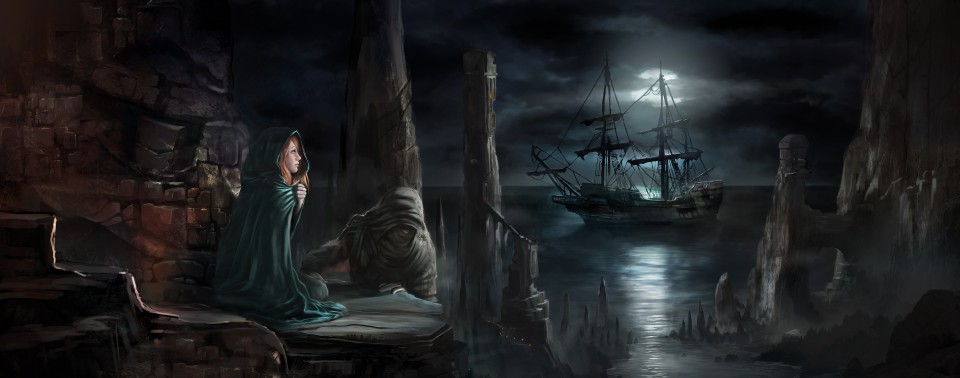

This read like a story that couldn’t decide whether to be Beauty and the Beast*, Narnia, or a Disney collage, and ended up being the most average and derivative Romantasy you could think of.
At first, the story is appealing because of its plot premise: In a world of perpetually dark mountains where the sun doesn’t shine, a class of beings with magical powers called Starmakers are responsible for bringing sunlight to make life possible for the human settlements in those regions and provide them with food. In one of these villages, Reverie, lives the daughter of a hard-working widow, who has a sister sick with Frost, an illness caused by the cold and darkness. How will she survive in this harsh world? By marrying well and hunting well. She is engaged to a man she doesn’t love but needs for the sake of her family.
One day, Aurora goes to the mountains and conveniently “forgets” that it’s illegal to hunt snow stags. Someone who appears to be magical and is otherworldly beautiful appears, and he reminds her that hunting is illegal, that she has magical powers in her blood because “the sun is in her veins,” and that she must go with him to his enchanted castle to learn how to use her innate magic, or she will die a horrible death.
And that’s only the third chapter.
And everything goes to hell from there until the epilogue.
The girl suddenly develops anger and verbal aggression issues, and starts antagonising the Starmaker just because she can. Even though she’s been warned that she’ll die if she insists on ignoring her innate magic and not going with him to train, she gets all cocky and demands that he first heal her half-dead sister and marry her. The first thing: fine, but the second . . . Why does she want to marry a stranger she just met two minutes ago if she’s already engaged to someone else she supposedly “loves”? Don’t ask me, I didn’t write this book, and if I had, I would have written that the Starmaker just left this idiot to die alone.
But of course, he can’t let her die in a rage. The Sun has chosen her as his successor, and you don’t argue with magic unless you want it to kill you or turn you into an immortal rabbit. So if the Sun has chosen the village idiot as your soulmate and successor, you just tie your trousers with string, sigh, and resign yourself to your fate.
So Aurora goes to the castle with the Starmaker, supposedly to “train.” But you can smell a mile away that there will be no training, that this is a plot device to get these two to end up with their knickers down and panting. It’s the law of Romantasyland, don’t look at me like that.
And so it happens, the whole book is Aurora meandering about the castle, writing letters and receiving as many, chatting with the servants (she has better conversations with the servants than with the host), antagonising the Starmaker, arguing with him (she can’t even talk to him without fighting), sulking around the castle, and whining about how angry she is at everything and everyone. Training? What training? Apparently, she doesn’t even need to learn how to use her Sun magic, because the Sun itself will take care of making her magic mature and blossom, and when the time comes, she will know how to use it as if she had spent years learning.
I almost forgot: this girl also runs away from her own wedding. Indeed, the silly goose decides to run away from the wedding that she herself unnecessarily demanded and leaves the groom standing at the altar in front of the whole town (what a way to “honour” the immortal who is the only reason they can eat). Her excuse? Well, she “can’t bear” that the Starmaker will die when she takes over, because she’s had a bout of Attraction Because Handsome and has grown fond of the grumpy old chap.
The funniest part? The silly goose runs away from her own wedding . . . to the Starmaker’s own castle.
My God, what have I done to offend Thee that Thou punisheth me with these terrible stories I end up reading? Just two cents’ worth of logic in my retellings, I beg!
“For all the sun in his blood, he is a cold place to land. He is frustrating and lacks compassion, and I spend most of my days angry with him. In fact, I don’t know that I’ve ever met anyone who exasperates me more.”
Then why did she fall in love with the Starmaker after:
- Demanding marriage to him for no reason,
- Picking fights with him and causing trouble in his own home,
- Having no chemistry with him,
- Telling another man that she loved him and that she can’t marry the Starmaker,
- Having strange and unnatural conversations with him,
- Complaining that he is cold, hard, and annoying,
- Leaving him standing at the altar,
- Not even knowing his name (she never asked him),
- Knowing that he’s going to die, precisely what she claims is the reason she doesn’t want to fall in love.
I don’t know, surely the “painfully handsome” thing and plot armour had something to do with all that. I can’t find any other explanation. These two fall in love with so little basis: he starts kissing her one day, not long after she stood him up at the altar, and immediately tells her that he shouldn’t, that he’ll die and she’ll suffer, etc. But anyway, she asks him to marry her a second time, and this handsome chap is so desperate for a shag that he accepts, fully aware that she doesn’t even know his name.
And the second funniest thing? Get ready . . .
They get married in front of the town (a way to redeem herself for standing him up the first time, I guess) without her even remembering to ask him his name. I mean, if you marry someone without knowing his name, how is your marriage even legal? Don’t worry, because on their wedding night, he reveals his name to her as they’re getting their knickers down for panting business.
The creature’s name is Caspian. I felt like apologising to the ghost of C. S. Lewis on this book’s behalf.
If the chap had at least died and stayed dead, that would’ve improved the story by adding tension, consequences, and costs. In this world, no one pays the price, not even the Starmaker, who spent the entire book claiming that his death is the cost of the Sun’s magic given to Starmakers. The saccharine ending was so frustrating. What was the point of that whole plot if it was going to end so happily? Aurora doesn’t pay the price or let Caspian pay it, and her worst fear doesn’t come true. It’s all been a tease.
The book also fails to deliver on its promise of Beauty & Beast content. There’s nothing “beastly” about the Starmaker; the figure of the Beast is forced upon him with a hammer, we have to swallow that he is “Beast” because the plot says so, not because he is shown to be, like here:
“Miss Finch, the villagers will soon notice your absence. If you wish to keep your identity as the Starmaker Rising quiet, then you will need another explanation for your relocation. I may be cold at times, but I would rather like to avoid developing a reputation as a beastly ruler who plucks unsuspecting women from their homes. Marrying in a large ceremony will alleviate both of those concerns.”
What little B&B there is here is all from ACOTAR, and it should’ve been labelled appropriately. This is the second YA book I’ve read this year that hooks into Beauty & Beast for hype and sales, and ends up actually being inspired by ACOTAR. Please, authors and publicists, be honest and say that you were inspired by Maas’ series, and don’t waste fairy tale enthusiasts’ time making us look for something we aren’t going to find.
This book could’ve been salvaged by the fairy tale atmosphere it is supposed to have. What the people of the cold mountain towns do with mirrors to have light and grow things in greenhouses is something interesting that is done in real life. According to what I’ve seen in the news, this has been done in Norway: large mirrors trap sunlight and reflect it onto a village during the months of absolute darkness. The science and mechanics of this are intriguing to me, and the idea of beings called Starmakers acting as “mirrors” for the same purpose is a great idea for a Fantasy book. But the worldbuilding is so limited, poor and lacklustre that the concept is wasted. Worldbuilding and fairy tale vibes are sacrificed in favour of typical Romantasy fare.
____________________________________
*ACOTAR version, not any of the fairy tale versions. Sarah J. Maas’s series is so popular with retellers and Romantasists it should be its own separate B&B version altogether; we would be spared a lot of headaches and falling for deceitful marketing, especially readers like me who love the fairy tale but can’t stand some of its popular retellings.
I received an ARC through NetGalley in exchange for an honest review.

I, too, believe we owe C.S. Lewis an apology. This book sounds like an absolute wreck. Yikes. I’m glad I didn’t invest in this one. Sadly. The concept sounds really interesting just…badly written.
Haha, indeed. Poor Lewis…
Now you see why I wasn’t in a rush to review this. Great concept, and based in reality as I found out (my sister was the one that first told me about the Norwegians doing Starmaker-style stuff with mirrors to help themselves during Winter, and that sent me into a rabbit hole), but the concept and the execution got divorced by axe. 🙁
Ooooof. That’s kinda the worst though. When there are really cool concepts that are just ruined by bad writing. And then no one can really use them again in a better way because it’s already been done without feeling/seeming like a copycat. Annoying.
That said, I didn’t realize that either. That’s really cool. Did you find out anything interesting during your research rabbit hole trip?
I think it was used more to treat depression than to grow foodstuff like in this book. The winter is very dark up North, and depression soars, so they thought sunlight would combat that. Neat idea, right?
You can look up Rjukan in Norway (the town’s name), or Google “Solspeilet” (the mirror thing), and see pics and videos. I like the idea very much, I was thinking of it all the time as I read this book (and that made me dislike the poor handling of the ‘starmaker’ concept more.)
That is really cool! I wouldn’t have thought of that but that would have made a really neat concept in a fantasy book done that way, too!
But yeah, I think knowing the cool history and possibility behind it would annoy me, too, if I came to a novel expecting one thing and getting this kind of trash instead. Yikes.
Maybe you could draw some inspiration from Rjukan for a certain lil’ retelling you’re cooking… *nudge nudge*
(But seriously, considering that the original tale is Norwegian, it would fit perfectly!)
It would, actually. I made note of that in my research/worldbuilding file so I wouldn’t forget. And I also made a suggestion to Annie to research it because something similar might be worthwhile for her.
Excellent! I trust you (and Annie too) to do a great job.
Sound like a book that I would cross the street to avoid; at least we got an entertaining review out of it.
Haha, thank you, Fred-sensei! That’s the one good thing about duds for me, the entertainment. 🙂