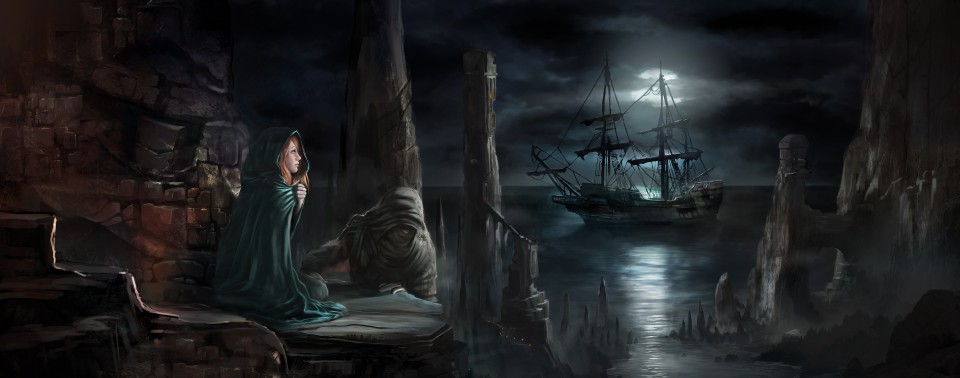
Beauty and the Beast by sandara↗
Seven manga series.
Two graphic novels.
One picture book.
Forty-eight books (four of them anthologies, two not translated into English yet).
That’s the balance this year leaves me with: There has been a total of fifty eight Beauty and the Beast retellings.
“That many?!” I hear you gasp. Yes, my dear fellow fairy tellers, that many. And I’m only counting the books I personally own that were published in 2025. I’m not counting all the books published, naturally, which are probably many more.
Granted, not every single one of the fifty eight books was a retelling. As I said before, I am going to include books that aren’t proper retellings but that have the themes, so some of them were Folkloric Fantasy with Beauty and the Beast influences, intentionally or not.
“What do you mean, intentionally or not?” Oh, it’s simple! The other day, my friend Ellen McGinty was telling me that some readers had commented to her that one of her books reads like Beauty and the Beast even though she herself doesn’t see it nor did she intend it to have such a vibe. I read it afterwards, and I can say I am confidently siding with the readers. Her book does, indeed, have B&B vibes to those in the readership that are familiar with the tale as her sharp-eyed readers evidently are.
Meaning, some of the books weren’t intended to have any dash of B&B seasoning whilst their authors were cooking them, but the nature of folklore is such that they ended up having that seasoning by accident. And I, for one, am not complaining about this happy folkloric accident as it means more variety to my B&B diet, which would otherwise be too vegan and fat-free and decaf I’d end up folklorically malnourished if I adhered strictly to academically-sanctioned parameters for what a proper B&B retelling is.
But I’m not too flexible that I include everything that as much as smells of B&B/Animal Bridegroom. Of course not. Because of that, I do not include fanfiction and I do not include most erotica and romance, which means the thriving kitchen industry of “mafia beast” romances, taboo erotica, and the equally thriving kitchen industry of monster/furry books won’t have a space here. Those are, almost always, not B&B in the least or only use the tale as decoration; they go by genre rules and conventions of their own that differ from those of a fairy tale retelling.
And it’s a given that A Tale Transformed is a project dedicated to written and illustrated reimaginings, therefore it doesn’t include audiovisual (film, anime, TV, videogame, motion picture) retellings. Generally, those already have their dedicated spaces as well.
So, back to our books. Before I list the Best Of 2025 picks as voted by myself and a select group of authors and readers, I would like to make a few observations about this year’s crop, if you’ll let me. In part, because I found it interesting, and in part because this could help track trends in B&B retellings for authors, readers, and the stray academic lost in the woods that ends up on this humble site of mine.
Were all fifty eight books worth reading? No, of course not. According to my own private record-keeping (a.k.a. spreadsheet), about twenty two titles were frankly terrible and a few more were DNFs for being more useful as sleeping pills than as retellings. The rest were fine reads, and a few (the fewest) were great reads.
But all were worthwhile for the purposes of this project, taken together they all drew a full picture of the state of Beauty and Beast as of 2025, which was the enlightening part to me.
“And what did you observe? Don’t keep me waiting!” Let’s see the trends, then, all neatly laid out:
- Maidens are back on the Dragons’ Menu.
The ancient custom of sacrificing pretty lasses to firebreathing (or not) scaly beasts never went out of fashion, not entirely, but it had been dormant for a while. At least in Western-based retellings, because the Eastern-based ones have always had a dragon as a Beast figure (which explains the B&B vibe for your book, Ellen, if you’re reading this).
Oh, but the Maidens have grown a spine and all went to Feminist School, apparently, because it’s now the trend for the maiden to save herself and her lizard as a collateral win.
We in the Pawn to Player household applaud this fad and stan the Maidens saving the Dragons.
- Manga’s idea of “Beauty and Beast” still is interspecies romance and will be so ad saecula saeculorum.
My dearest Japan, why are you so weird?
That’s the mystery every poor little otaku living outside the Land of the Rising Sun has to deal with. And that includes me, a non-otaku. Out of the seven manga series in my collection that released new volumes in 2025, only one doesn’t have a plot that pairs a human with a (non-cursed) beast. One! They simply don’t do curses, I suppose, and go for a plain “He’s really an animal/hybrid, what’s the problem?”
And yes, the Japanese are your Huckleberry if you’re into bestiality, too. Though at least this year they didn’t do straight bestiality with an Animal Bridegroom/B&B story like in past years.
- Beastslaying is for Beauties.
The turns have tabled, and now it’s not Gaston who goes Beast-hunting but Belle.
Yeah, yeah, raise your eyebrows at me all you want! It’s true. This 2025 has brought us a breath of fresh air in the form of Beauty setting out to kill the Beast.
Both male Beauties and female Beauties alike, by the way. It’s probably part of or a derivative of the Maidens/Dragons switcheroo, and of course we stan this as well.
- Fae Romantasy is the new Scarred Sexy British Lord in-house pet trope.
And we’re not amused, sir/m’lady, not in the least.
When the magic-free, no-curse B&B retellings in which all it took to make the MMC Beast was to give him a strategically-placed scar that didn’t spoil his handsomeness was the fad, I used to say that a pretty girl + a scarred chap didn’t make it B&B. Now, for the same reason I have to say: not every Fae/Human pairing out there is Beauty & Beast, no matter how much authors insist in calling the Fae character a “beast” to force them into the mould.
Or rather, especially if authors insist that the Fae’s inhumanity = Beast by default. Because, just like the strategically-placed scars and inconsequential disabilities of the Regency/Victorian setting retellings, these “Fae” are nothing but über-himbo humans. They have “magic,” because Fae, but other than that they’re just above-handsome human males.
A surprisingly large chunk of this year’s retelling output was Fae stories, and honestly they were unremarkable. Most times, you could tell a book would’ve worked better as original Fae Fantasy than have it masquerade as B&B. Maybe this is the Western equivalent to the Japanese interspecies interpretation of B&B, but highly humanised to conform to cultural norms. Fairy dicks work the same way as human ones.
- “Tam Lin” and “East of the Sun & West of the Moon” retellings dominated amongst the derivative and adjacent Beauty & Beast tales.
I believe this is a byproduct of authors looking for active, take-charge heroines for their reimaginings, because both fairy tales have in their original version an active heroine that goes for what she wants and saves her man because she wants, unlike the more passive Beauty of the traditional B&B versions.
Neither is a new trend, especially not the former. “The Ballad of Tam Lin” has been popular to retell for decades already, and it has a large backlog of titles to rival B&B (I think there was a website that listed all “Tam Lin” retellings in existence), and although it’s too short, too bare-bones, and too straightforward for my personal tastes, I do like the aesthetics and atmosphere retellings of this one tend to have, so it’s nice to see it still going strong.
But “East of the Sun & West of the Moon”? It suffers from authors not knowing what to do with its idiosyncratic plotline and so they end up screwing the bear. Of the two retellings for this tale released this year that I’ve read, the first one is my number one worst retelling of the year and the second one will likely attract the wrath of Helicopter Mums for depicting a certain behaviour teens engage in that’s a parental nightmare.
- Mixing Beauty & Beast with other fairy tales has fallen in popularity.
Although it’s not disappeared and will resurface in force again in the future. This trend is like the tides, it ebbs and flows.
In past years, it was popular to mix Beauty & Beast with other fairy tales, sometimes several fairy tales, with varied success. Usually, it was Little Red Riding Hood and Rumpelstiltskin, for obvious reasons (easy shapeshifter/curse framework to build on), at least in my experience. Now? I can think of only three or so books that did this tale combo. From my observations based on my own stash of books released in 2025, the popular fad of previous years to combine B&B with Classics has also gone down in popularity, and way more steeply than the fairy tale combo. I remember the days I couldn’t browse retelling releases without bumping into a Jane Austen/Jane Eyre and Phantom of the Opera retelling marketed for the B&B readership (those Classics do have shared themes), but this year I was either not paying much attention (unlikely) or the trend is gone, because I don’t have a single B&B/Classic mix in my collection for this year.
The new trend seems to be going for mixing B&B with myths instead, though. Greek myths, to be specific. I do have some of this kind in my 2025 archives, and can’t say the outcome of these reimaginings was impressive.
- Going to exotic locations for retellings is becoming a new trend, even if the “exotic” location is Canada.
Since the original fairy tale is quintessentially French, retellings of it that are set in the real world tend to be European. I’m speaking of the real world, on this Earth, not of all those alternate European-like worlds that aren’t our Earth.
But this year, some authors seem to have thought of bringing the tale out of Europe and to the Americas. To the cold North, to be precise, and it simply didn’t work. The authors’ fault, not the Canada setting, which does have a following. Ir’s a pity, because North America is a fine setting for non-magic retellings of B&B derivatives.
- Another reworking based on the “true story” of Beauty and the Beast was published.
For the past five years, there’s been an emerging, albeit still small, interest in Petrus and Catherine Gonsalvus’ true story from 1500s France that might be the real-life inspiration for the fairy tale by Madame de Villeneuve.
In theory, this should have me expectantly happy, given my interest in this family dates from before there was one single retelling even remotely inspired by them. But my disappointing experience with retellings that use their true story is that it’s used by authors to pour their own ideas of appearance and disability rather than highlight the real people with real struggles that the Gonzalvus couple were.
This time, it’s not been an exception. To date, only one of the three books based on the Gonsalvus family is in English, the new release is currently in French and Spanish only and is a picture book type of retelling more worthwhile for its artwork than for its storytelling.
Interesting trends, aren’t they? It’s one of the productive outcomes of this hyperfocus of mine on this tale. I learn so much more than expected by digging deeper and by keeping an alert eye out for what is released, slowly building an archive of pop culture trends in retellings that I hope to be proud of one day as more and more grows out of this little project.
Now, on to what you’ve been waiting for!
A TALE TRANSFORMED’S BEST RETELLINGS OF 2025
- The Wolf and His King by Finn Logman
- The Edge of a Knife and Other Stories by Beka Gremikova
- Embergold by Rachelle Nelson
- Once Upon an Enchanted Castle by Michelle Miles
- Kill the Beast by Serra Swift
READERS’ CHOICE FOR BEST RETELLINGS OF 2025
- The Edge of a Knife and Other Stories by Beka Gremikova
- Embergold by Rachelle Nelson
- How to Find a Nameless Fae by A. J. Lancaster
- Once Upon an Enchanted Castle by Michelle Miles
- My Secretly Hot Husband by Gabi Nam & Harara
As you can see, there’s an overlap of 3 titles both we and our readers/authors voted for, and 2 titles we differed on. There were far more titles nominated, and these were the most voted to make the Top 5, and are listed in order. There’s definitely a Number One pick for 2025 Top Retelling by number of votes, and it is: “The Edge of a Knife and Other Stories” by Beka Gremikova, which got the most votes from our readers and thus is officially the READERS’ CHOICE BEST RETELLING OF 2025.
As for the choice for top position by the Pawn to Player, it is: “The Wolf and His King” by Finn Logman, officially declared A TALE TRANSFORMED’S BEST RETELLING OF 2025.
Congratulations to Finn Logman and Beka Gremikova! Excellent choices, if I say so myself.
In the coming days, I’m going to post full reviews of these as well as all the chosen titles one at a time, so you can look forward to that and more, as I also hope to be able to interview the authors, if available.
Happy New Year, my Dorothies! May 2026 bring us lots of great retellings.