Tags
audiobook review, beauty and the beast theme, book review, folkloric fantasy, myth and legend retellings

This isn’t the first time a writer attempts to give the monster from Beowulf a POV to tell his side of the story, but it’s the first time I see someone make Grendel into a woman.
In the original epic poem, it’s not clear what kind of creature Grendel is, at least not to lay readers like me, because I’m sure scholars have a better idea of what Grendel is. Personally, I visualise him as a monstrous giant, troll-like and shadow-clad, a mental image born of my impressions from the Seamus Heaney translation that is the only one I’ve ever read, which gives Grendel a shadowy humanlike appearance in the only passage in the poem where he is (somewhat) described. Amusingly, the author told me it was also Heaney’s translation that got her to love Beowulf, and I can see echoes of that in her descriptions of Grendel.
Per the poem, this monster is said to descend from Cain, the first murderer in history according to the Bible, and is surrounded by the imagery of the gigantic and evil Antediluvian offspring of fallen angels and human women (the Nephilim) as described in the Book of Genesis; and following Cain’s dark legacy, he is envious and resentful of humanity because he thinks they’re happy and blessed by God whilst he is cursed, lonely, and hated. So he attacks and murders them in revenge, only to face Beowulf, the hero of light, and be defeated.
I think knowing this Biblical subtext is helpful to contextualise the changes Allison Tebo has introduced in her retelling, especially for those readers that aren’t familiar with the biblical lore behind the poem and thus might feel Break the Beast has too much religion for comfort. The original poem itself contains the struggle of Pagan and Christian worldviews and carries a strong religious imagery, so even though Tebo did make her spin on the legend lean a bit more Christian than the epic poem, it’s not like that came out of the blue and with no basis on the original epic.
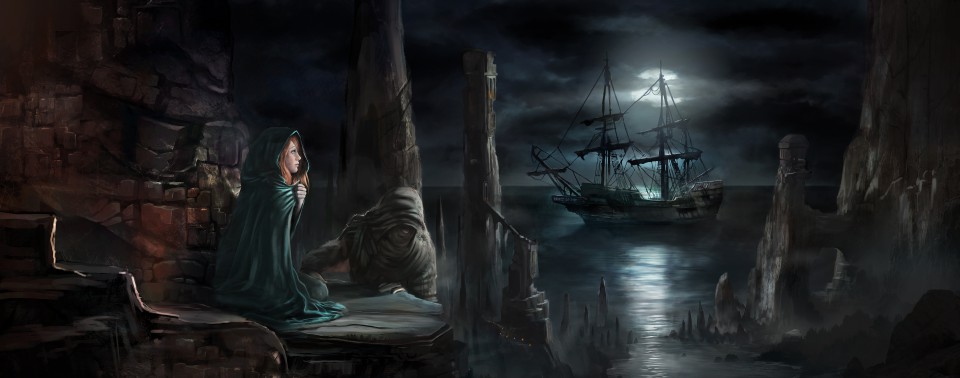
That said, Break the Beast is entirely Grendel’s story, and the female Grendel we meet on these pages has a Beauty and the Beast vibe in my trained eyes. Why? Have a look at quotes like these:
“It is the light that troubles me, not heat, for in the light I can see my shadow, and it is the shadow of a beast.”
: . . . .
“My voice is a thread. “I am a monster.”
Her voice is still gentle, as soft as the ripples lapping at the shale. “Who calls you a monster?”
I look to the mouth of the cave, the narrow slit between water and rock, where I can glimpse the light.
Beyond this mere, there are the dells full of the people of Frisia, and a settlement called Schrawynghop. And built in its center, in a place of pride, is the mead-hall called Trollhättan.
It is a beautiful place, but I am not welcome there. They have seen me in the night, and they chased me away.
I turn my gaze away from where a hideous hood trembles on the surface of the pool and answer her question. “It is the people who call me a monster.”
. . . . .
“My fear that there is something wrong with me, that I am the one unworthy, twists and snarls inside me like an animal, looking for something other than me to damage.”
It can’t be said that this retelling has significant Beauty and the Beast elements, because it is fundamentally a Beowulf retelling first and foremost. However, it’s not the elements in common that give off the vibe, because what this retelling gets the most from the fairy tale is the theme, the monster’s redemption.
Normally, what authors take the most from Beauty and the Beast regardless of the version they know is the romance, the love that transforms, but rarely do they address the redemptive theme of the fairy tale. Allison Tebo did: she took the Cain and Abel biblical story from the epic poem and decided to redeem Grendel through love. No, not romantic love. Goodness, no! Can you imagine a romance between Grendel and Beowulf? *quietly makes the ‘vade retro, Satana’ sign at the thought.*
Those of you that have read the epic poem, do you remember Grendel’s motives for being so murderous and destructive? It’s due to a curse on the monster. And do you remember Grendel’s mother eggs him on to destruction in the poem? She’s an even bigger monster than him. Tebo twists these two elements to create a tale of compassion for the cursed, the downtrodden, the fallen, and thus we see genuine love and care seeping into Grendel’s corrupted core and transforming her, redeeming her, making her rise above and beyond her twisted origins. I’m not going to describe it at length, but suffice to say that the Grendel you’ll meet in this book is like the Grendel in the poem in the beginning, but is different by the end. And that is also because she has something of another character from the poem that I won’t name to avoid spoilers.
You could argue this Grendel is Beast. Not the good-hearted soul of Villeneuve (the original fairy teller) but more the conflicted soul of Woolverton (the Disney screenwriter), but Beast nonetheless. This Grendel is a tormented soul, you can see the spark of light inside her, but her hatred snuffs that stubborn little inner light again and again. She sees all the corruption around her and thinks everyone is bad but herself.
“It has been a misery to see what others are blind to. It is a curse to look at a man and see his lies, to see the shadow of his true soul on his face, and to recognize that he does not mean what he speaks.
I have always hated the lies that people wrap themselves in. It is the one thing I can remember clearly about myself before Mother found me.
It is my curse of sight which birthed the anger, which in turn bred a beast.”
Grendel knows instinctively that goodness exists, but there’s nobody to show her what it is like, so she has a twisted concept of it. She’s more deserving of compassion than being put to the sword, but nobody approaches her out of terror. Until Beowulf battles her into submission.
“He can see me—without my hood.
The realization explodes in my mind, shriveling my thoughts under its blast.
I was not born a monster. I was born a girl.
I am a thing caught between two identities. And now my greatest enemy can see that. He can see me—stretched between woman and monster like a moth on a page.”
In the poem, Beowulf has three tasks to undertake, so the poem is divided in three parts dedicated to each monster he slays. This retelling is also divided in three parts, and follows the three monster-slaying narration structure, too, with necessary differences. Grendel is the first “slaying.”
“I was a monster before,” I whisper as I search his face, and I feel a lostness inside of me as wide and as barren as the sky. “What am I now?”
“You are free,” Beowulf answers, very gently.
This first part is the best for me, together with the majority of the second part, the most emotional and painful for character growth. We witness the transformation of Grendel, her learning what a true monster is like, and gaining an identity. Events occur differently, the timeline is altered in this book, because the poem spans more time and goes into Beowulf’s old age, which Break the Beast does not. The finale is also different to the epic’s ending, and this third part is the one I’m not entirely happy with. I’m happy with the completion of Grendel’s transformation, yes, it’s touching and well-written, but I’m not happy with Beowulf’s fate, and I believe that last-minute twist shouldn’t have been introduced.
In any case, I finished this mostly satisfied with it, niggling ending mindbug aside. I’ve had my large share of B&B retellings and at least one Beowulf retelling (that I didn’t like), but so far had not found one that hadn’t included romance of some sort, which is my biggest source of contentment with this book together with the character evolution of Grendel. “Wait,” you’ll say, “can B&B actually work without romance?” And my answer is a resounding It can! Because love isn’t only romance, love has more manifestations than that between two individuals for sexual purposes. “Love is patient and kind.” And it’s this patient kindness what makes Grendel become what she does here, to shed the monster for something more elevated, the same patient kindness that uncurses Beast in the fairy tale. So, yes, love doesn’t need to be romantic to break the beast, it only needs to exist and be freely given.
Now, on to the audiobook . . .
The narration by Bethany Wild is solid. She has a good cadence and rhythm whilst narrating, with a clear voice that sounds whispery and is touched by a light finger of drama when needed. She does changes in her intonation when changing characters, to differentiate them, but you can tell she’s in the skin of the POV and doesn’t break character.
She speaks with a British accent, that for me was a bit of a distraction as I was rereading the book in chunks alongside listening to the audiobook, so I felt the disconnect between the text in American English and the narration in British English. That’s purely me, though, I created the situation with my simultaneous reading/listening. I understand the industry trend of employing the UK Received Pronunciation accent when American authors take up European folklore and history, but had the case been that the narrator spoke with an American accent, I don’t think I’d have minded it because this retelling was written by an American in American English, plus it’s a Fantasy version of the real places. I mean, even Seamus Heaney in his reading of his Beowulf translation went with his native Irish accent, and people loved it.

I received a complimentary audiobook from the author in exchange for an honest review. Thank you!
What was the other retelling of Beowulf you read? Grendel by John Gardner?
No, it was “Strange Monsters In a Pond Aren’t the Way to Have Philosophical Debates.” 😛
(Yes, it was Gardner’s retelling. Ages ago, in my pre-reviewer days.)
The only other Beowulf “retelling” I can think of is ‘The Tower of Beowulf’ by Parke Godwin, and I can’t remember if it’s a retelling or an “inspired by” novel. I read it so long ago I don’t remember anything about it except the monk and the botched viking raid at the beginning.
Botched Viking raid sounds about right. 😀
Oh, by the way, El, since you asked the question, I accidentally found out I read another “Beowulf” retelling (of sorts) that I didn’t remember as a retelling of the epic either. Next author interviewed will talk about that one. 😉
I saw another Beowulf retelling on my GR feed with a female Beowulf due this year (“She-Wolf”), but . . . they went for a romance as per the comments. Ugh.
Gardner did tend to wax philosophical, didn’t he. 🤣
Yeah! He lost me there. 🤣
I don’t know anything about Beowulf, honestly, so I can’t speak to this. However, it sounds interesting. Is it something you think I would enjoy?
Girl, I am jealous of you not knowing “Beowulf,” because you could read this and have a different impression than mine precisely because you don’t know the foundational myth!
Mmm… I’m of two minds about it, I would say that you’d 70% like it but that last 30% could torpedo this ship for you. So my verdict is: sample it and see.
Makes sense. I think I got an ARC of it back in the day. But Im very…hesitant when it comes to retellings of classics. I think you understand that very well, haha.
Careful, amor, you might make me want to read my first ever retelling as an avowed adaptation purist…
A story I’m familiar with, but not so attached to aside from the broad strokes, and written in modern English which goes a long way towards overtaking my history nerd side?
Don’t do this to me, my heart…don’t turn me into an observant and flexible reader… Leave me as the uncultured barbarian you fell in love with, ye temptress 😭
Oh, but this has monster-slaying! Heroism! Bromance! Dragons! Epicness! 😀
Also, to entice you further: Frisia. 😉
Aha! You have convinced me–I must read this book! I’ve always loved Alli’s lighthearted Tales of Ambia, and I knew Break the Beast was wildly different in tone so I was initially unsure about it. But it sounds fantastic, and I’ve always loved Beowulf, so here we go!
You didn’t tell me Allison was your friend! She’s been lovely to me.
Careful with the finale, though. Take that one with a Big Picture mindset, or you might get stuck on the nit that is so tempting to pick. 😉
Haha, good to know!