2025 STATE OF THE TALE: The Best “Beauty and the Beast” Reads of the Year

Tags

, , , , , ,

Beauty and the Beast by sandara↗

Seven manga series.

Two graphic novels.

One picture book.

Forty-eight books (four of them anthologies, two not translated into English yet).

That’s the balance this year leaves me with: There has been a total of fifty eight Beauty and the Beast retellings.

“That many?!” I hear you gasp. Yes, my dear fellow fairy tellers, that many. And I’m only counting the books I personally own that were published in 2025. I’m not counting all the books published, naturally, which are probably many more.

Granted, not every single one of the fifty eight books was a retelling. As I said before, I am going to include books that aren’t proper retellings but that have the themes, so some of them were Folkloric Fantasy with Beauty and the Beast influences, intentionally or not.

“What do you mean, intentionally or not?” Oh, it’s simple! The other day, my friend Ellen McGinty was telling me that some readers had commented to her that one of her books reads like Beauty and the Beast even though she herself doesn’t see it nor did she intend it to have such a vibe. I read it afterwards, and I can say I am confidently siding with the readers. Her book does, indeed, have B&B vibes to those in the readership that are familiar with the tale as her sharp-eyed readers evidently are.

Meaning, some of the books weren’t intended to have any dash of B&B seasoning whilst their authors were cooking them, but the nature of folklore is such that they ended up having that seasoning by accident. And I, for one, am not complaining about this happy folkloric accident as it means more variety to my B&B diet, which would otherwise be too vegan and fat-free and decaf I’d end up folklorically malnourished if I adhered strictly to academically-sanctioned parameters for what a proper B&B retelling is.

But I’m not too flexible that I include everything that as much as smells of B&B/Animal Bridegroom. Of course not. Because of that, I do not include fanfiction and I do not include most erotica and romance, which means the thriving kitchen industry of “mafia beast” romances, taboo erotica, and the equally thriving kitchen industry of monster/furry books won’t have a space here. Those are, almost always, not B&B in the least or only use the tale as decoration; they go by genre rules and conventions of their own that differ from those of a fairy tale retelling.

And it’s a given that A Tale Transformed is a project dedicated to written and illustrated reimaginings, therefore it doesn’t include audiovisual (film, anime, TV, videogame, motion picture) retellings. Generally, those already have their dedicated spaces as well.

So, back to our books. Before I list the Best Of 2025 picks as voted by myself and a select group of authors and readers, I would like to make a few observations about this year’s crop, if you’ll let me. In part, because I found it interesting, and in part because this could help track trends in B&B retellings for authors, readers, and the stray academic lost in the woods that ends up on this humble site of mine.

Were all fifty eight books worth reading? No, of course not. According to my own private record-keeping (a.k.a. spreadsheet), about twenty two titles were frankly terrible and a few more were DNFs for being more useful as sleeping pills than as retellings. The rest were fine reads, and a few (the fewest) were great reads.

But all were worthwhile for the purposes of this project, taken together they all drew a full picture of the state of Beauty and Beast as of 2025, which was the enlightening part to me.

“And what did you observe? Don’t keep me waiting!”  Let’s see the trends, then, all neatly laid out:

  • Maidens are back on the Dragons’ Menu.

The ancient custom of sacrificing pretty lasses to firebreathing (or not) scaly beasts never went out of fashion, not entirely, but it had been dormant for a while. At least in Western-based retellings, because the Eastern-based ones have always had a dragon as a Beast figure (which explains the B&B vibe for your book, Ellen, if you’re reading this).

Oh, but the Maidens have grown a spine and all went to Feminist School, apparently, because it’s now the trend for the maiden to save herself and her lizard as a collateral win.

We in the Pawn to Player household applaud this fad and stan the Maidens saving the Dragons.

  • Manga’s idea of “Beauty and Beast” still is interspecies romance and will be so ad saecula saeculorum.

My dearest Japan, why are you so weird?

That’s the mystery every poor little otaku living outside the Land of the Rising Sun has to deal with. And that includes me, a non-otaku. Out of the seven manga series in my collection that released new volumes in 2025, only one doesn’t have a plot that pairs a human with a (non-cursed) beast. One! They simply don’t do curses, I suppose, and go for a plain “He’s really an animal/hybrid, what’s the problem?”

And yes, the Japanese are your Huckleberry if you’re into bestiality, too. Though at least this year they didn’t do straight bestiality with an Animal Bridegroom/B&B story like in past years.

  • Beastslaying is for Beauties.

The turns have tabled, and now it’s not Gaston who goes Beast-hunting but Belle.

Yeah, yeah, raise your eyebrows at me all you want! It’s true. This 2025 has brought us a breath of fresh air in the form of Beauty setting out to kill the Beast.

Both male Beauties and female Beauties alike, by the way. It’s probably part of or a derivative of the Maidens/Dragons switcheroo, and of course we stan this as well.

  • Fae Romantasy is the new Scarred Sexy British Lord in-house pet trope.

And we’re not amused, sir/m’lady, not in the least.

When the magic-free, no-curse B&B retellings in which all it took to make the MMC Beast was to give him a strategically-placed scar that didn’t spoil his handsomeness was the fad, I used to say that a pretty girl + a scarred chap didn’t make it B&B. Now, for the same reason I have to say: not every Fae/Human pairing out there is Beauty & Beast, no matter how much authors insist in calling the Fae character a “beast” to force them into the mould.

Or rather, especially if authors insist that the Fae’s inhumanity = Beast by default. Because, just like the strategically-placed scars and inconsequential disabilities of the Regency/Victorian setting retellings, these “Fae” are nothing but über-himbo humans. They have “magic,” because Fae, but other than that they’re just above-handsome human males.

A surprisingly large chunk of this year’s retelling output was Fae stories, and honestly they were unremarkable. Most times, you could tell a book would’ve worked better as original Fae Fantasy than have it masquerade as B&B. Maybe this is the Western equivalent to the Japanese interspecies interpretation of B&B, but highly humanised to conform to cultural norms. Fairy dicks work the same way as human ones.

  • “Tam Lin” and “East of the Sun & West of the Moon” retellings dominated amongst the derivative and adjacent Beauty & Beast tales.

I believe this is a byproduct of authors looking for active, take-charge heroines for their reimaginings, because both fairy tales have in their original version an active heroine that goes for what she wants and saves her man because she wants, unlike the more passive Beauty of the traditional B&B versions.

Neither is a new trend, especially not the former. “The Ballad of Tam Lin” has been popular to retell for decades already, and it has a large backlog of titles to rival B&B (I think there was a website that listed all “Tam Lin” retellings in existence), and although it’s too short, too bare-bones, and too straightforward for my personal tastes, I do like the aesthetics and atmosphere retellings of this one tend to have, so it’s nice to see it still going strong.

But “East of the Sun & West of the Moon”? It suffers from authors not knowing what to do with its idiosyncratic plotline and so they end up screwing the bear. Of the two retellings for this tale released this year that I’ve read, the first one is my number one worst retelling of the year and the second one will likely attract the wrath of Helicopter Mums for depicting a certain behaviour teens engage in that’s a parental nightmare.

  • Mixing Beauty & Beast with other fairy tales has fallen in popularity.

Although it’s not disappeared and will resurface in force again in the future. This trend is like the tides, it ebbs and flows.

In past years, it was popular to mix Beauty & Beast with other fairy tales, sometimes several fairy tales, with varied success. Usually, it was Little Red Riding Hood and Rumpelstiltskin, for obvious reasons (easy shapeshifter/curse framework to build on), at least in my experience. Now? I can think of only three or so books that did this tale combo. From my observations based on my own stash of books released in 2025, the popular fad of previous years to combine B&B with Classics has also gone down in popularity, and way more steeply than the fairy tale combo. I remember the days I couldn’t browse retelling releases without bumping into a Jane Austen/Jane Eyre and Phantom of the Opera retelling marketed for the B&B readership (those Classics do have shared themes), but this year I was either not paying much attention (unlikely) or the trend is gone, because I don’t have a single B&B/Classic mix in my collection for this year.

The new trend seems to be going for mixing B&B with myths instead, though. Greek myths, to be specific. I do have some of this kind in my 2025 archives, and can’t say the outcome of these reimaginings was impressive.

  • Going to exotic locations for retellings is becoming a new trend, even if the “exotic” location is Canada.

Since the original fairy tale is quintessentially French, retellings of it that are set in the real world tend to be European. I’m speaking of the real world, on this Earth, not of all those alternate European-like worlds that aren’t our Earth.

But this year, some authors seem to have thought of bringing the tale out of Europe and to the Americas. To the cold North, to be precise, and it simply didn’t work. The authors’ fault, not the Canada setting, which does have a following. Ir’s a pity, because North America is a fine setting for non-magic retellings of B&B derivatives.

  • Another reworking based on the “true story” of Beauty and the Beast was published.

For the past five years, there’s been an emerging, albeit still small, interest in Petrus and Catherine Gonsalvus’ true story from 1500s France that might be the real-life inspiration for the fairy tale by Madame de Villeneuve.

In theory, this should have me expectantly happy, given my interest in this family dates from before there was one single retelling even remotely inspired by them. But my disappointing experience with retellings that use their true story is that it’s used by authors to pour their own ideas of appearance and disability rather than highlight the real people with real struggles that the Gonzalvus couple were.

This time, it’s not been an exception. To date, only one of the three books based on the Gonsalvus family is in English, the new release is currently in French and Spanish only and is a picture book type of retelling more worthwhile for its artwork than for its storytelling.

Interesting trends, aren’t they? It’s one of the productive outcomes of this hyperfocus of mine on this tale. I learn so much more than expected by digging deeper and by keeping an alert eye out for what is released, slowly building an archive of pop culture trends in retellings that I hope to be proud of one day as more and more grows out of this little project.

Now, on to what you’ve been waiting for!

A TALE TRANSFORMED’S BEST RETELLINGS OF 2025

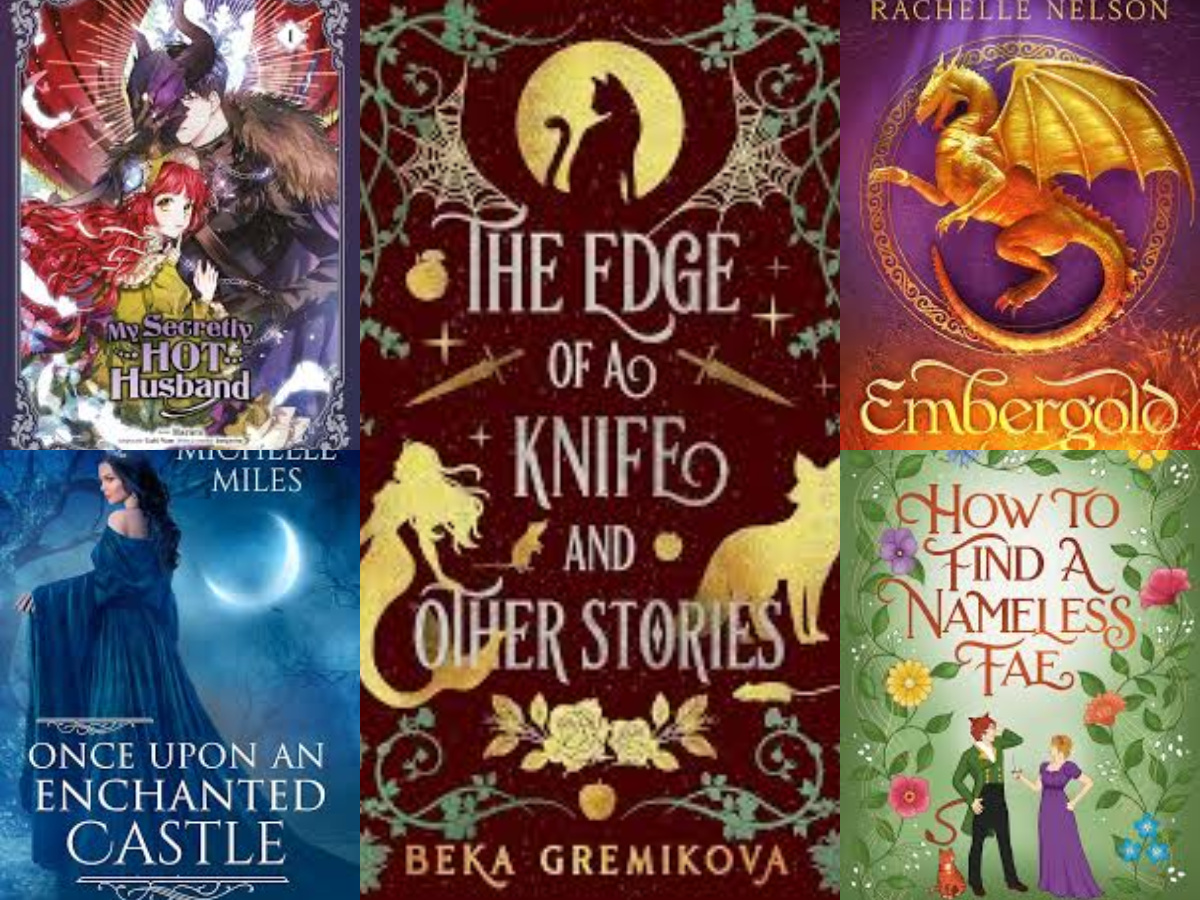
  1. The Wolf and His King by Finn Logman
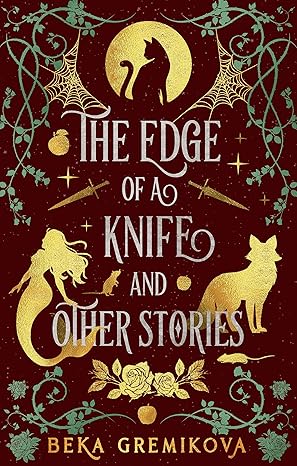
  2. The Edge of a Knife and Other Stories by Beka Gremikova
  3. Embergold by Rachelle Nelson
  4. Once Upon an Enchanted Castle by Michelle Miles
  5. Kill the Beast by Serra Swift

READERS’ CHOICE FOR BEST RETELLINGS OF 2025

  1. The Edge of a Knife and Other Stories by Beka Gremikova
  2. Embergold by Rachelle Nelson
  3. How to Find a Nameless Fae by A. J. Lancaster
  4. Once Upon an Enchanted Castle by Michelle Miles
  5. My Secretly Hot Husband by Gabi Nam & Harara

As you can see, there’s an overlap of 3 titles both we and our readers/authors voted for, and 2 titles we differed on. There were far more titles nominated, and these were the most voted to make the Top 5, and are listed in order. There’s definitely a Number One pick for 2025 Top Retelling by number of votes, and it is: “The Edge of a Knife and Other Stories” by Beka Gremikova, which got the most votes from our readers and thus is officially the READERS’ CHOICE BEST RETELLING OF 2025.

As for the choice for top position by the Pawn to Player, it is: “The Wolf and His King” by Finn Logman, officially declared A TALE TRANSFORMED’S BEST RETELLING OF 2025.

Congratulations to Finn Logman and Beka Gremikova! Excellent choices, if I say so myself.

In the coming days, I’m going to post full reviews of these as well as all the chosen titles one at a time, so you can look forward to that and more, as I also hope to be able to interview the authors, if available.

Happy New Year, my Dorothies! May 2026 bring us lots of great retellings.

AUTHOR INTERVIEW: Beka Gremikova

Tags

, , ,

Welcome to Conversations with Fairy Whisperers, Beka! As our first interviewee, it’s exciting to have you kickstart our space, where we hope to connect the fairy tale retellings readership with the creators of the stories they love. Tell us about yourself, what fascinates you about fairy tales and how did you begin writing retellings of them?

Thank you so much for having me; it’s an honour to be here! I’m Beka Gremikova, author of Folkloric Fantasy, fairy tale retellings, and closed-door Romantasy. I love to write stories that tackle deep, sometimes dark, themes that are balanced out by emotionally healthy romances and strong found family and friendship.


When I’m not writing, I’m hanging out with my nieces and nephews, reading tons of manga and mystery novels, or watching anime, KDramas, and baking shows. I’m also a gamer; currently, I’m playing through—and absolutely LOVING—Tales of Arise. It encompasses everything I love to write and read: nuanced worldbuilding and politics, lovable but imperfect characters, and sweet yet swoony tension. Highly recommend for any gamers amongst your readership here!

As for what fascinates me about fairy tales, I think one of the things that draws me to them the most is their weaving of the mythic and mundane. Often, it’s everyday people facing off against catastrophic odds with nothing but their determination and ideals. So, understandably, they have to lean upon the mythical for help. But this doesn’t take away from their heroism or agency. Nobody is going to deny the bravery of the human bride in “East o’ the Sun, West o’ the Moon” simply because she has to ask for help along her journey (at least, I certainly hope not)!

And this is something that I feel our current society could learn from fairy tales. We equate not being able to do something “all” by ourselves as some kind of weakness, when it’s really not—it’s realism. Despite their magic and crazy situations, I believe fairy tales capture the truth about human nature that many of us in Western society have forgotten: that we need each other to face down our dragons, and that is a beautiful and natural thing.

Speaking of needing each other, I somewhat owe my current fascination with fairy tales to other authors. Though I can’t recall a time when I wasn’t surrounded by fairy tales and folklore of some kind, I can’t say whether I would have ever started writing my own if I hadn’t stumbled across another particular fairy tale author when I was a burgeoning, youngling writer. (Said author will remain nameless here as they now write in a very different genre).

But at that time, learning about their Cinderella retelling—which seemed to have been woven with the epic threads of The Lord of the Rings—fascinated and inspired me. My brain started whirring with its own ideas, and soon an Epic Fantasy trilogy that retold The Little Mermaid had been born within my mind. I don’t know if those books will ever see the light of day, but it’s one of my earliest fairy tale retellings and it holds a special place in my heart, even as, writing-wise, my style has drifted from epic-scale Fantasy.

Of all the styles and formats retellings come in—pictorial, screen, graphic, illustrated, or written—which do you most favour?

Honestly, I don’t think I can choose a favourite. I’ve had some retellings I’ve enjoyed more in screen renditions than their original texts, and others the exact opposite. As long as I feel that something is well done, it will receive my admiration regardless of its style or format. I read and watch within a wide range, so I enjoy a lot of different styles.

Do you have a favourite fairy tale? What aspects of it appeal to you personally, and why?

“Beauty and the Beast”. . . and other variants of the “Animal Bridegroom” archetype such as “East o’ the Sun, West o’ the Moon.” I love how these tales in particular hinge upon the choices of their leading lady, whether for good or bad, and centre around the reclamation of one’s stolen humanity from the hands of abusers. Such themes are always timely, considering how people have treated each other throughout the ages.

On an even more personal note, due to my own chronic health issues, I’ve especially come to empathize with the Beast character and his physical, mental, and emotional isolation from society. I actually have a few retellings in development that explore the Beast curse from the chronic illness angle, though I won’t say much more than that right now as things are always subject to change.

In your opinion, what makes a retelling stand out? What do you consider the joys and challenges of writing in this specific subgenre?

For me, a retelling that will stand out is one that surprises me, manages to make me reconsider the original tale, or simply manages to expand upon the original tale in a way that brings further life and nuance to the characters. I also love retellings that weave multiple tales together in a natural way.

One of the joys of writing fairy tales is when readers are delightedly surprised by an approach you’ve taken, or when a reader mentions that they’ve enjoyed the reimagining even more than the original story. Sometimes, it can be difficult writing in this genre because people can view it as more “unoriginal,” so getting to surprise readers with twists, or challenge their take on certain stories through new viewpoints, can feel very rewarding as an author.

One of the challenges I’ve found is the sheer spectrum of what “fairy tale” means. To some, it’s equivalent to happy endings and sweet romance. To others, it’s a way to write about the horrors of the world and celebrate the sheer perseverance of survival. Both are necessary; both are inherently good.

But one should not cancel out the other, and sometimes I fear that authors (and perhaps readers sometimes) limit themselves and are afraid to stretch the conventions of the genre. I say this from personal experience; I’ve fought with myself over whether certain aspects of my stories would fit into the genre in which I’m writing. I’ve struggled with how to market darker books that aren’t “quite” dark enough to comp with, say, Christina Henry’s books, but are certainly too dark to comp with the cozier titles on the other end of our genre spectrum.

It’s something I’m still trying to puzzle out, haha!

In your opinion, what fairy tale is the most complicated to reinvent, and why?

So, my answer to this is multi-faceted. I actually think “Snow White” is one of the most complicated to reinvent, for a few different reasons.

One: if you’re looking to retell it beat-by-beat, you run into the issue of people struggling with Snow White’s naïveté, especially if the writer ages her up to be a teenager/adult when she first flees the Evil Queen. (If I recall correctly, she was a very young child in one of the earlier versions). And I don’t think naïve protagonists who have to rely on others for protection fit the bill for many readers nowadays.

Two: if your reimagining is more centred around the themes while also wanting to hit certain audience-familiar plot points in order to call it a retelling, you risk your plot twisting itself to fit those points instead of developing naturally.

Three: if you’re wanting to include romance, you have to figure out a way to include your romantic lead early enough that readers get attached while also avoiding the lead getting the chance to rescue your Snow White character too soon.

Four: there are so many different aspects of this story that are ripe for reinvention that I think it creates a trap for authors who may want to reinvent or explain everything. In my personal opinion—and this may make me more C. S. Lewis-leaning than Tolkien-leaning—not everything has to be explained. Sure, things should make sense and not feel out of place within your story . . . but readers can also connect the dots.

Five: audience expectation. I think, because of how ingrained in the cultural narrative “Snow White” tends to be, readers will already have their own ideas about what to expect from a retelling. And because everyone’s opinions about what makes “Snow White” are so different, it might create a chasm between reader expectations and authorial creative license.

Now, this is all just my opinion, and of course there are plenty of amazing “Snow White” retellings out there. But that doesn’t mean they were easy to write, or that authors for ages to come won’t have to struggle with deciding which elements to embrace or leave behind in their own versions . . . especially when audiences might have very specific ideas about how this fairy tale should look.

You recently published The Edge of a Knife and Other Stories, which includes a story inspired by “Beauty and the Beast,” our favourite tale on this site. How did you come across the idea for this story, and what can you tell us about its creative process?

I first wrote “Once Upon a Pumpkin,” as a flash fiction piece for gohavok.com about four years ago. The theme I was writing for centred around writing stories that showcased the colour orange, so it made sense to include pumpkins somehow. Understandably, it started out more as a Snow White/Cinderella mashup, with the identity of my Beast character, Lyo, remaining a bit vague as to whether or not he was the Beast from “Beauty and the Beast” or the Wolf from “Little Red Riding Hood.”

Then over the years, ideas gathered to expand it, and as I re-drafted it, it turned into a “Beauty and the Beast” story at its heart. While Lyo is obviously the Beast now, I’d say the protagonist of the tale—Tamrin, the Evil Queen from Snow White—embodies the emotional arc of the Beast as she struggles with her own ugliness and breaking free from its effects.

As for how I wrote a bunch of fairy tales into one story, the core threads just seemed to weave together naturally in my head. For example, if Cinderella and her fairy godmother are sneaking into someone’s garden to steal their pumpkins (which is part of the opening scene, for those who haven’t read it yet), it’d make sense if the garden belongs to the Evil Queen—she definitely wouldn’t put up with that! Oh, but how would she have a garden, if in the original tale she was supposed to be killed at the end? Unless she escaped her death somehow with the help of another “villain” . . . such as Beast and/or Big Bad Wolf . . .

And hence, “Once Upon a Pumpkin” is born.

Many authors who started their careers writing retellings later abandon fairy tale retellings for other genres and story ideas. Do you plan to continue writing retellings or will you move on to other projects?

I am happy to say that I have no intention of ever abandoning fairy tale retellings; they are too much a part of my brain for me to ever permanently leave them behind. I do intend to branch out into other fantasy sub-genres (Urban Fantasy, Gothic Fantasy/Horror), but even those books will still have some folkloric bent to them.

When I first read your stories, what struck me the most about your style was that it didn’t fit the mould of traditional retellings. Your stories feel as though they exist in a genre somewhere in-between Fairy Tale and Fantasy, with elements from both yet still a different type of fairy story. Later, I learnt that this style is known as Folkloric Fantasy, a concept I credit you for introducing to me. Is there a particular approach to fairy tales that creates the atmosphere of Folkloric Fantasy when you’re writing that what separates it from stories following the framework of traditional retellings?

That’s a good question! Honestly, it’s something I’ve been trying to define and haven’t quite been able to. But if I was to try, I think “Folkloric Fantasy” hinges around that meeting of the mythic and mundane, just like fairy tales, but without the adherence to the specific details/plot points that strict fairy tale retellings embrace. Rather, I’d say “Folkloric Fantasy” would centre around exploring the themes and archetypes found in many fairy tales without strictly adhering to a plot structure that would code it as a retelling. So while many fairy tale retellings could be considered Folkloric Fantasy, not all Folkloric Fantasy could be considered fairy tale retellings.

Therefore some of my stories will borrow fairy tale archetypes—sometimes, multiple in one—but they aren’t strict retellings or even reimaginings of a specific tale. For example, one of my short story works-in-progress tackles selkie lore . . . but it’s not retelling or reimagining any particular selkie tale. Instead, it’s using that folkloric lore as a springboard to explore a new point of view and grapple with certain aspects of that lore.

Do you ever see yourself writing an original fairy tale as opposed to a retelling of one?

Funny enough, I actually have written an original fairy tale! It started out as an assignment in one of my high school classes, and I hope to redraft it one day and release it into the wider world. It’s about the sun’s daughter, who is cursed by one of his jealous wives to only speak in mimicry. When this curse wreaks havoc upon her own marriage to a neighbouring king, the sun’s daughter sets out to break the spell and fight for her own happiness.

If there was a Hall of Fame for retold fairy tales, which would you consider the best retold stories books and why are they worthy of inclusion in said Hall of Fame?

Oh my goodness, this is a tough question! I’m going to list only three here, though there are many more that would be worthy as well. But these three books all shaped my writing career in some way or another:

  1. Cruel Beauty by Rosamund Hodge: Hodge combines “Beauty and the Beast” and “Tam Lin” with an undercurrent of Greek mythology. I especially love this book because of its take on the Beauty character—Nyx is openly bitter, angry, and sometimes spiteful, but she also fights fiercely for what she wants. Her character opened my eyes to the beauty of writing flawed, angry characters, and in my opinion, the ending scenes and the book’s central themes hit all that much harder because of Nyx.
  2. Masque by W. R. Gingell: A “Beauty and the Beast” retelling with Regency vibes and a whole lot of murder. Gingell’s genre-mashing book hits a lot of the original “Beauty and the Beast” plot points while being wildly different and delightful. I believe this book was my introduction to the notion of genre-blending . . . and, if you’ve read any of my work, you will know that I quite enjoy genre-blending, haha!
  3. The Goose Girl by Shannon Hale: I first found this book in elementary school, and it honestly changed my life. Back then, Hale’s Goose Girl was one of the first protagonists I truly saw myself in; and now that I’m older, I view this book as one of the best retellings because of how expertly she simply expanded and brought, as I mentioned in an earlier answer, nuance and life to these characters. She mostly doesn’t deviate from the source material . . . yet somehow still manages to make this story wholly, completely, her own, and in my opinion, it’s absolutely masterful.

Is there an author who you view as a role model for your own writing?

There are almost too many to list! It should come as no surprise, but I’ve learned so much from a wide variety of creators—mystery novelists, Japanese mangaka, video game creators—as well as from authors within my own genre, that I don’t know if I could narrow it down to one.

I will say that the books/authors listed in the last question—Cruel Beauty by Rosamund Hodge, Masque by W.R. Gingell, and The Goose Girl by Shannon Hale—could be considered models for my own writing, even as I carve out my own distinct style and voice.

Thank you for sharing your thoughts with us, Beka! We will be keeping an eye on your future books, which we hope shall be many more in the years to come.

BOOK REVIEW: “The Edge of a Knife and Other Stories” by Beka Gremikova

Tags

, , , , , ,

I’d like to start this début review for my A Tale Transformed project dedicated to reviewing fairy tale retellings with some general remarks on the author’s writing:

a. Beka Gremikova has a nice mix of cruelty and warm ‘n’ fuzzies in this anthology, and knows how to strike a balance between both. When she wants to do silly, she does it hilariously silly (so long as you like her brand of humour), and when she wants to be Very Bad to Characters, she makes everyone suffer.

b. Beka can do Mainstream Retelling and Peripheral Retelling both. A rare ability, in my reading experience, as most authors that tackle retellings of fairy tales and myths tend to master only one of them and either be passable or not good at the other.

c. She wrote some of these stories in a way that doesn’t quite fit the mould of traditional retellings. There should definitely be a new and officially-named subgenre to describe this kind of stories that aren’t retellings but feel so fairy tale-ish as if they were. If there’s not one already, I’m going to name this subgenre as Folkloric Fantasy and refer to it as such from now on, credit to this author for calling it so to me, regardless of who came up with the name first as I am not in the know yet.

Now, onto the stories themselves:

These nine short stories were originally published in various other anthologies and magazines, like it happened with her previous anthology. The author has been collecting all the short stories she has written so far in her career, and rewriting them for republication in new dedicated anthologies, of which she has several planned and this is the second to date.

I have read some of these stories in their previous versions, and in at least one case I didn’t recognise the new version at all. It had been so completely rewritten as if from scratch, and in my opinion for the better. I suspect that’s the reason why Beka is doing this massive rewrite, because she has had noticeable improvement in her craft as a writer since her early Indie days and the new versions do show this improvement over the rougher originals.

Of the nine short stories included in this collection, only three are proper fairy tale retellings, two Peripheral and one Mainstream. Another couple of them are retellings of Classics, and the remaining four aren’t retellings but Folkloric Fantasy stories. (Glad to see a few of my friends are catching onto this name and have started talking about Folkloric Fantasy like it’s the newfangled term du jour.)

THE EDGE OF A KNIFE

This one is easy to guess where the inspiration comes from: “The Little Mermaid,” but Hans Christian Andersen’s original tale and not Disney’s. It’s brutal and punchy, the first version already was but this remade one is worse, in a good way.

This was my first favourite, it poses interesting questions about free will, sacrifice, and whether to let our loved ones make their own mistakes or intervene. As I’ve told Beka, the mermaid in this one deserves her own book, not just because of how good the story is but also for the originality of swimming counter-current to Andersen’s dilemma.

THE STARDUST SMUGGLERS

I confess I groaned (and loudly!) at finding this right after the kick in the delicate parts that the prior story was, and protested to the author about it. There’s no tale or myth behind this, it reads like it drinks from all those space shows and films we grew up with, but a goofy drug smuggling in space story that is more Jar Jar Binks than Han Solo to me, more Spaceballs than Star Wars, so I’m guessing this one could be the least-loved story in the collection.

Ah, but it does have a certain charm by the end, when it goes from goofy to gallows humour and you can’t help snort at it.

GOLDEN CHILD

Another story where the inspiration behind it will take you by the throat and shake you till you ask for mercy. It’s that obvious.

Maybe it’s my familiarity with the myth of Midas, but this one didn’t have the emotional punch it should have given the tragic plotline. Maybe it’s that the plot is straightforward and happens quickly and very linearly, it feels like arriving at the end of ”Romeo & Juliet” with the reconciliation of the Montagues and Capulets without having the story of Romeo and Juliet onpage to witness it unfolding. But I do get the point is to show the price of ambition for Oros and Silvis, the parents of the characters, and I do think it works better with the added layer compared to the old version.

PAY THE PIPER

This was not only my second favourite story in the collection but is also one of my all-time favourite retellings of The Pied Piper of Hamelin. I think it’s perfect in length and emotional punch, and the wee tweak to the ending made it perfect to me.

Yes, you do know it’ll end like that, but its predictability isn’t the point. There’s one little, almost throwaway aspect this story contains that makes me want to beg, cajole, blackmail, or bribe Beka Gremikova to take it and develop in another story, preferably a full novel (don’t touch this little story), because it’s an extremely intriguing concept I have never seen any other author of Fantasy come up with. So, Beka, if you’re reading this, please state your price.

EVERY BONE IN THE BODY

Maybe the newer, better version makes it easier to see the inspiration, but the version I read first was a lesson in humility for me and the reason why I wholeheartedly believe the ancient Greek tragedians. The gods saw fit to punish my fan-mythicist Hubris and chose Beka Gremikova as my Nemesis. I pride myself in knowing my mythology inside and out, but I didn’t recognise the inspiration for “Every Bone in the Body.” Can you believe it? Disgraceful. And to twist the knife, it’s one of my top three favourite myths too.

Other reviewers might spoil it for those of you that didn’t guess, or the newest version will enable you to guess by yourself, but to me it would be too spoilery to tell. I suffered terribly reading this story, wishing all along it wouldn’t end and also not wishing to change a thing about how it ended. I think that, together with the titular story, this one is what makes the title of the book make sense in context. Expected brutality yet also unexpected is how I’d describe it.

LIKE A FOX

In my opinion, the version published here is better than the first one published years ago, and also very different. It does keep its clean plot, cheery tone, and overall wholesomeness, but the relationship between Veya and Mishak is developed better (I wasn’t a fan of how it was in the first version).

This one is Folkloric Fantasy in its purest form. Out of all the stories here, this is perhaps the one that reads the more YA, in the “for young audiences” sense, not less because the fox shapeshifter POV that narrates this is very young but also because its A-rated storyline makes it appropriate for children, and taken out of this collection it could very well be a children’s book of its own. It also has a very Disney animated motion picture vibe, I couldn’t stop picturing these characters as Disney characters of the old school: sweet, nice, and yes, if you’re one of the older and grumpier folks like me, it can feel a tad cloying. I wouldn’t be surprised if this was written back when the author was very young herself.

RATS IN THE GRAIN

This was another kick on the rump by my Nemesis: I disliked this story in its original version, Beka rewrote it and made me reread it years later in this anthology, and what do you think happened? I liked it, completely oblivious to the fact that I had hated it before. Disgraceful. But also bless my holey memory.

For me, that I liked it this time round was as much that the shapeshifter slave girl (hey, are you sensing a pattern with shapeshifters here?) has an engaging voice as the unrealised potential this story possesses. It isn’t a retelling of anything at all, I would say it can pass for either Folkloric Fantasy or Victorian-era magical urchin misery yarn, but given that it’s me and I have a tendency to pinpoint fairy tales where not even the authors may have placed them, I saw this one as a retelling for one fairy tale in its current finished state and as a potential retelling of two other separate tales if rewritten. The author knows which those tales are, courtesy of yours truly, so I wouldn’t be surprised if we were to see sequels of this story one day.

ECHO AMONGST THE STARS

I appreciate that the author didn’t have Kaz find out for sure what happened to Mira after the end and that he’s not fully sure he succeeded, as that  makes his sacrifice all the nobler in hindsight. But I also think that things go too much as planned for him, so smoothly and with many coincidences in his favour, which gave me a feeling of implausible ease to overcome challenges presented to him. This is probably another story Beka wrote when she was young, because it has maintained the style of her younger years before her writing matured.

You can tell space stories aren’t a hit with me by now, I suppose, because this one together with the space drug smuggler one were the pointiest “thorns” in this rosebush for me. But others might like this more, especially Sci-Fi fans that fancy haunted spaceships.

ONCE UPON A PUMPKIN

And now, we finally arrive to the big red, gorgeous, fragrant rose that is the jewel of this garden: a Beauty and the Beast retelling that ends this collection on a high, high note.

The Rose

This isn’t a pure B&B retelling but one that combines it with two other tales: Cinderella and Snow White. I’m still scratching my head in admiration at how precisely the author managed this combination of three tales in one, considering B&B is tricky to mix with other tales.

The fairy tales Beka used elements from here are the Grimms’ versions, which is why the Snow White inclusion is bloodier than you’ll expect (because that’s how it goes in the Grimms), and also explains the appearance of the Beast character. Cinderella appears to be Perrault with Disney, though.

Remarkably, Beast is neither from Villeneuve nor Beaumont, much less Disney, but from the Grimms as well. To me, he gives off vibes from the German version, and that would explain the absence of the traditional Beauty figure (which is French).

And I also loved the portrayal of the Evil Queen figure done without villainising Snow White or giving the Queen a sob story to justify her past evil. Bravo for that!

The thorn

I was about to say this was a perfect thornless rose, and then I remembered the pesky fairy godmother.

Whilst other characters also have a touch or two of goofiness, such as one of the princes that is a “no intelligence required” himbo and that Cinderella is his perfect match in terms of cute-silly, you can be more indulgent to those two as they are like that for comedic effect. But the fairy godmother, although she’s also like that for comedic effect, is a flavour of goofy that might be annoying to some readers. Not me, as she did nothing for me either way, but I’m aware that impressions vary widely whenever comedy is present. It all depends on your sense of humour aligning with the writer’s.

Since I opened with some overall positive remarks on the writing, I would like to close with some observations on what could’ve been done to improve this anthology: Taken as a whole, the stories are solid, and the quality is high for what you usually expect from collections. But there’s a mismatch of tone that is very noticeable and will not be to many readers’ liking.

What I mean by this is that because of the title and promotional description, readers are going to expect a certain atmosphere for all the stories here, in this case a dark one (the title is “Edge of a Knife,” after all, and that hints at tough themes), and they won’t find it consistently in every story here. That can lead to judging the “non-compliant” stories more harshly than they would otherwise. I know that has been true for me, I haven’t quite enjoyed the silly/comedic stories because they clashed with the darker and tougher ones that I was looking forward to and evidently liked.

Would I, and other readers, have liked the goofier stories more if we had known of their inclusion beforehand? Likely. If you come expecting comedic and fluffy, you’ll laugh. If you come expecting shock and suffering, you may feel bothered by the clowning about mixed in with the horribly tragic. Therefore, I recommend future collections mind the tone more carefully when considering what stories to include and that it all matches. It’s not only curating the themes, the story quality, or arranging a balanced mix of styles and story types that matters for a quality anthology; atmospheric consistency matters a lot too.

A Tale Transformed: Reexamining ‘Beauty and the Beast’

Tags

,

Once upon a time, in a vegetation-overrun cottage by the river in The Shire, there lived a little girl who didn’t read fairy tales.

But she knew them all.

Once upon a time, there was a mother who never bought her children a children’s book, let alone a fairy tale.

But she told them all.

Once upon a time, there was a little boy with a big imagination who wrote stories for his friends in exchange for pennies, even though they weren’t fairy tales.

But he grew up to write a great book series full of them.

Once upon a time, there was a kind young woman bright and cheery as the sunlight bathing her paradisiac island, who didn’t believe in songs and fairy tales.

But she put on her armour to defend a despised fictional girl who believed in them.

First of all, thank you for your interest in the backstory of this new project, which was not meant to be the journey of self-discovery that it became over the years. The genesis of the idea I am presenting here took place five years ago when, once Game of Thrones ended and we found ourselves without hopes for a sixth ASOIAF book to keep Pawn to Player active with consistent analytical pieces, it occurred to me to create a project dedicated to fairy tale retellings that would host an exclusive award for them. In the long preparation phase for it, I learnt a lot that I didn’t expect to, in addition to clarifying things that I had only vaguely intuited. Now I am going to share with you what this new project is about, after several lovely people that became aware of my plans helped me greatly with polishing them, and to whom I am very grateful, especially to Mariella Taylor and this site’s founder, Brashcandie, without whom this would have never become a reality.

My story with fairy tale retellings has been a series of events that coincided one after another in a successive chain, easy to trace. Unlike what is normal for many children, I didn’t have children’s books growing up; my voracious appetite for reading was satisfied with “tales for grown-ups,” as author Chufo Llórens calls adult literature. I wasn’t familiar with fairy tale books and films as a child, not even Disney’s (which I didn’t watch until my late teens), but I knew them by heart through oral transmission and had some favourites.

My mum was responsible for that. Many times, at bedtime or when I was sick in bed, she would come and tell me fairy stories to entertain me. She was born in difficult circumstances and she had to fend for herself alone in her youth, so she never had fairy tales or children’s stories to read either. But she had an innate curiosity, an alert mind, and a natural talent for storytelling and doing voices and character impersonations. She learnt many children’s stories and fairy tales by ear and told them all to me and my siblings. I still remember that my favourite of all the stories she told me was Little Red Riding Hood, mostly because of her hilarious impersonation of the Big Bad Wolf with a deep, frightening voice that scared and delighted little me. To this day, yelling “To better eat you with!” imitating Mum’s wolfish voice is an inside joke in my family.

You could say that I became familiar with fairy tales and their retellings without even trying. When I was older, I won a nice edition of Puss-in-Boots in a children’s contest as part of my rewards for participation, which was my first traditional fairy tale book, and my much-older siblings left me as inheritance of sorts a double edition of Alice in Wonderland and Peter Pan without a cover, a cracked spine, and loose pages with broken edges. I didn’t have more tales than these three.

But the seed had already been sown, and I took them up again in adulthood, when I was old enough for fairy tales, to paraphrase C. S. Lewis. In fact, all the fairy tales I’ve read I did as an adult, and I did it for myself. Normally, adult fans of children’s literature have children of their own to read to and find books for, or they work teaching young children, or they are academics in fields related to folklore studies. Few deviate from this pattern, from what I can see, and it is usually because they have a personal connection to fairy tales and mythology, as has been my case.

I’ve been focusing on fairy tales for years as a reader, amateur student of the subject, and reviewer/critic, and there are so many things I have learnt, rediscovered, and understood better in the process of reading as many as possible. The first lesson that stands out from all those years with fairy tales and retellings is that I honestly don’t like the genre as a whole. That is to say, my heart is set exclusively on one specific fairy tale and not on all fairy tales. This tale is, as you may have guessed, Beauty and the Beast.

The reason I became interested in fairy tales again as an adult was Beauty and the Beast, not fairy tales themselves. It has been a decade and a half since my love for this story was born, driven and stimulated by a couple of characters that fit the archetype of Beauty and the Beast perfectly, for their narrative arc, which touches on key themes and points in the original story’s plot. My interest in other fairy tales began as a secondary and complementary development, growing as an extension of my love for Beauty and the Beast, just as Beauty and the Beast was born out of my love for that story all of our regulars know so well. And from there I moved on to retellings. I didn’t start reading them because I love retellings in themselves, but because I wanted to read more Beauty and the Beast. So, for me, that was a second big revelation: I didn’t care about the retellings of Cinderella, Snow White, Sleeping Beauty, Rapunzel, The Goose Girl, etc. I can do without those and all the other types of retellings. I cared about Beauty and the Beast retellings.

It was my attempt at diversifying to cover all fairy tales that led to my complete reading exhaustion, a fatigue I couldn’t seem to shake off for a long time, which led to my third big revelation. If I had focused exclusively on B&B (I don’t use the more common abbreviation BatB) as I had in the beginning, such exhaustion wouldn’t have happened. I shot myself in the foot by trying to be inclusive to other tales and all the stories that I simply felt no passion for.

Now we’ve arrived to the raison d’être of this long personal account. Why host Beauty and the Beast on Pawn to Player if this place was built for ASOIAF content? Because Pawn to Player was the origin, the source, and the foundation of it all. When I joined the PtP’s Rereading Sansa and Rethinking Sansa discussion threads that Brashcandie had created and hosted at the w.org forums back in 2011, her discussions had already made relevant contributions to the fandom in terms of studying the character of Sansa Stark, who at the time was much vilified in the ASOIAF/GOT fandoms, and Pawn to Player had pioneered turning the tide. Of course, there were already some fans in those threads and elsewhere talking about Beauty and the Beast integrated into Sansa’s story, you would’ve had to be blind and dumb on top not to see the obvious, more so when George R. R. Martin himself was a fan of the fairy tale and had written an adaptation of it for TV before ASOIAF. He even had an illustration of Sandor and Sansa as Beauty & Beast from Jean Cocteau’s 1946 film hanging on the wall at his house! It was a no-brainer to notice that Sansa’s story with Sandor Clegane was Martin’s very own Beauty and the Beast retelling within ASOIAF, even if not everyone liked it. And it was also obvious that Jaime and Brienne had elements of Beauty and the Beast in their own arc.

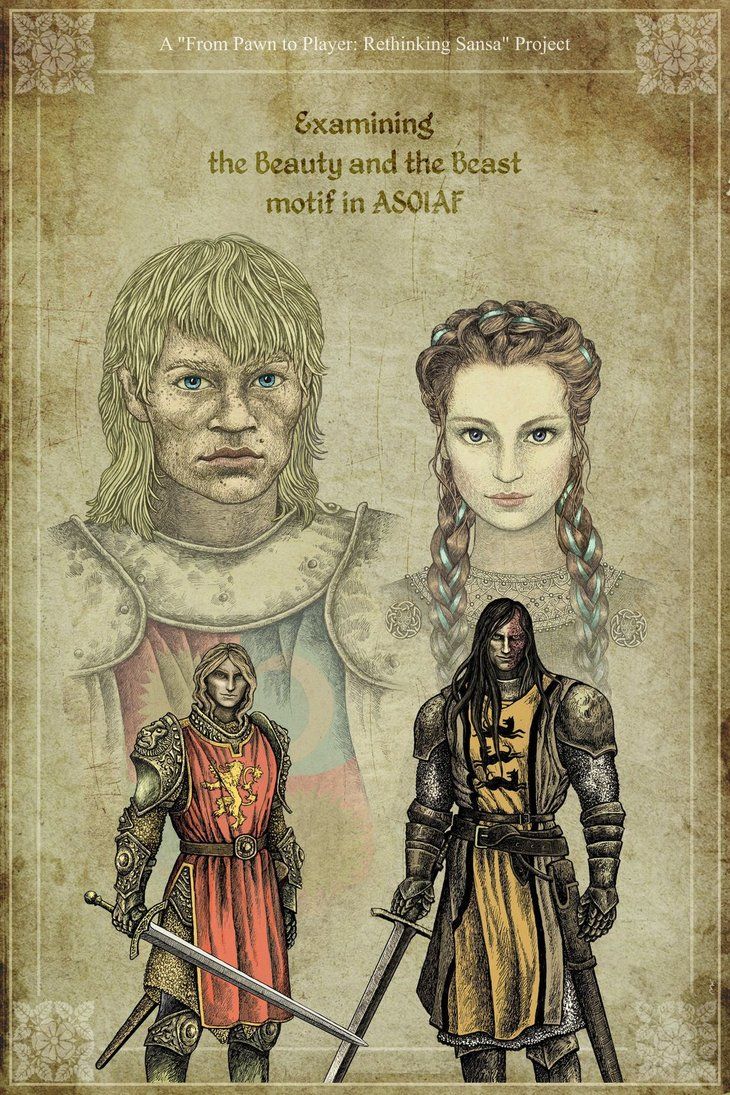
But at the time, there were many misconceptions, bad takes, and blatant misrepresentations of the Beauty and the Beast story. There was little serious analysis of it, and except for a fan here and there on social media, most people talked about how “toxic” the story was and some published articles about how the story excused Stockholm syndrome, abusive relationships, teaching women to be submissive, etc. That was the mainstream groupthink at the time. Now it’s hard to imagine all that, because now there are many good fan analysts who understand the story and defend it from the misconceptions of the past, but back then the outlook was disheartening. It was in this context that I proceeded to create the project “Examining the Beauty and the Beast Motif in ASOIAF” for Pawn to Player, with the enthusiastic participation of several regular PtPers and a beautiful poster by our friend Magdalena, the artist known as Bubug.

The best of that project is selected for permanent hosting on this site, although not everything had the depth we would’ve wanted and, our contributors and ourselves being mere fans and not trained experts, it may contain mistakes. I like to think that we were amongst the first defenders of B&B, and of course we had disagreements and disputes in defence of the tale, whether because of the original story itself or because of the story rooted in Sansa’s, because there’s always been controversy over SanSan. At times, that project was a discouraging experience, but time proved it worthwhile. A decade and a half later, I believe the fairy tale has a better reputation, although there are still misunderstandings about it circulating out there, and this is a victory won by the old-time B&B fans. Today’s casual readers of any B&B adaptation have no idea that they are standing on the shoulders of those old-time fans, they have no idea that when they say “a pretty girl + a hero with scars on his face does not equal Beauty and the Beast,” they are repeating concepts from the B&B pioneers. It’s all taken for granted, as if it had always been obvious and common knowledge, and not the product of painstaking work of years by several people.

For example, my interpretation of the Beast’s curse as the result of child molestation and grooming by the fairy godmother, based on the original French text by Madame de Villeneuve wasn’t the norm, I don’t recall even other B&B fan-experts knew it. I first published my observation on the PtP, and it was a surprise that caused some to message me in private about it, because they didn’t know about this from the original tale, and to this day there are even some folklore scholars I could name that tend to downplay it or dismiss it because the abuser is a woman and the abused is a minor male. There’s a clear need for a place to collect, organise, and preserve for posterity all the material related to Beauty and the Beast that I have outside of the PtP project. I have all of that on the Goodreads platform, but that site is likely to disappear one day, and my B&B material and reviews of fairy tale retellings would be lost.

So the way forward is: a permanent site to host a permanent project. What better place for it than Pawn to Player? To me, it feels like a natural development, circling back to where it all started and continuing there, regardless of whether we ever see TWOW or if ASOIAF is ever completed, the Pawn to Player evolves and lives on.

A Tale Transformed: Reexamining ‘Beauty and the Beast’ will be a modest endeavour at first, naturally. We will start with two regular features: a review of Beauty and the Beast retelling books or of one with similar elements/vibes and adjacent tales, and interviews with authors that have published something in the genre. Over time, we hope to add a Hall of Fame for the best retellings, and non-fiction, academic articles, and in the very, very long term, we would like the project to accommodate my one big dream: a writing contest, the sponsorship of an anthology, an award for B&B retellings. All under our brand name.

You might say that B&B is too limited and restrictive a niche, and I would say yes, it is. But that is the limited and restrictive niche that needs this investment of time, resources, and mental energy. And there’s also a pragmatic side: it’s a niche that I can easily fill because no one is. There are many critics, bloggers, Booktubers, Booktokers, and podcasters focused on fairy tales and their adaptations at large, and countless folklore enthusiasts who read retellings and review them all the time. But, as far as I know, almost no one focuses exclusively on B&B retellings, which is surprising for the most popular fairy tale in the world that has dozens of books published every year with it as the core theme.

Finally, there was a fourth big revelation on this journey, cemented by my latest book of fairy tales, ironically entitled “Requiem for Fairy Tales” (this was totally unintentional and fortuitous, one of those strange coincidences in my life that I’ll have to attribute to the Universe giving me a wink and nudge): What I really like, more than “pure” retellings, is what an author friend, Beka Gremikova, calls “Folkloric Fantasy.” I don’t know if it’s an official genre name or just what Beka Gremikova came up with to name it, but here’s what it is: Fantasy that reads like a fairy tale, but is neither a fairy tale nor a retelling of one. It may have elements from a specific tale or a handful of collective fairy tale motifs/themes/archetypes, either in general or from the tradition of a specific country. Does it make sense? I can cite examples of books that fit the description if you’re not sure of my meaning, but just to give a few clues, that’s essentially what authors like Naomi Novik or Katherine Arden do.

Folkloric Fantasy is much more varied and flexible than proper retellings because it doesn’t have to follow the plot of a fairy tale, it doesn’t depend on the framework of a fairy tale, and (something very important to me, as I am strict about respecting the core themes of a tale) it doesn’t have to respect a fairy tale’s core theme, as it isn’t subject to any. The genre can play more freely with themes, motifs, plots, and elements, and it can twist fairy tales much more impunity than retellings. In short, it’s like what Historical Fantasy is to Historical Fiction: more room for creative licence and historical anachronisms that would be unforgivable in traditional Hist-Fic. Similarly, in Folkloric Fantasy you can forgive what you can’t overlook in traditional retellings.

That flexibility allows me to enjoy not only Beauty and the Beast-adjacent stories, but also other fairy tales in a way that traditional retellings don’t allow. Many years ago, when I was looking for more books by a Spanish author, Laura Gallego, who had written a short retelling of Beauty and the Beast (more irony!), I got my initial suspicion that Folkloric Fantasy was my thing rather than retellings. I had loved Gallego’s short story and wanted more, and I found out she had written a book called “All the Fairies in the Realm.” Because of the title and her previous short retelling, I mistook it for a fairy tale retelling and spent the entirety of the book trying to guess which fairy tale she was rewriting. In the end, I felt foolish and ignorant because I couldn’t identify the fairy tale, as it had many motifs from various tales, and concluded that I didn’t possess enough knowledge to pinpoint such a complex mix of several tales. I had no idea that I had just discovered Folkloric Fantasy.

That book whetted my appetite for more books of that kind, although for years I continued to mistake Folkloric Fantasy for traditional retellings. It had the effect of broadening my scope of B&B to include books that were not “retellings” per se, but had the vibe in one way or another. My B&B collection thus became full of titles that aren’t retellings of the tale but that have so many similarities that anyone could mistake them for B&B retellings, and that subconscious association was probably the beginning of my eventual discovery of what I really want from this genre, as well as enabling me to have a personal definition of B&B that is probably more ample than most people’s, and that I don’t understand retellings the same way other readers do. But it wasn’t until I met Beka Gremikova and her circle of charming indie writers that I finally learnt a name for this.

All that said, the short-term goal for A Tale Transformed is to build a reputation before I can think about a larger, more ambitious project. Although I am fairly well known in the community of amateur book reviewers, outside of it I have no online presence and no reviews outside of Goodreads. Some popular Booktube and Booktok reviewers have a wide reach, and there are some who have been focusing on fairy tales and retellings in general for years and already have an established audience and reputation, but in my case, my reviews without a home of their own are all I have in terms of clout. Can you imagine what the sensible world of literary awards would think if an unknown girl suddenly burst onto the stage with a pretentious award for fairy tale retellings? They would laugh me out of the room!

The objective is that this becomes a “brand” for reviews of B&B retellings and, yes, Folkloric Fantasy books too, something with a name that the bookish public will easily recognise and authors will see and know as a reliable source of book reviews and analysis. That way, when the time comes to create an award for retellings as is my one overarching goal, it won’t be unexpected. Because by then, just by seeing the name of the award, people would immediately know that it is reliable, serious, and here to stay.

It’s exciting, but also scary, and perhaps rather ambitious. I’m used to anonymity, and I know that this expanding online presence would expose me more than I’m used to. Those that knew my work as Milady of York don’t know my reviewer persona as Marquise, and vice versa. But I know there’s loyal followers we can count on that have showed enthusiasm for this new direction, and at the very least, this will be useful in saving my material from loss,

We will see where the yellow brick road takes us, my Dorothies!

‘Pawn to Player’ is back!

After a years-long hiatus for reasons we all know (no book, no show, no PtP), we have the pleasure to announce that our beloved site is going to be active again with a new project we are now launching, which we hope will appeal to the lovely readership that accompanied us during this long winter.

Fancy a hint or three as to what is coming up?

Readers who followed us in the Rereading and Rethinking threads are aware of how passionate we were about one major, but by no means lone, theme in Sansa’s arc, a theme from a story George R. R. Martin is also a dedicated fan of. That theme is coming back, fresh and in a different context and with a different angle for this new project, called A Tale Transformed.

Stay tuned!

The Wages of Sin: The Religious Imagery of Forgiveness in The Hound’s Last Scene

Tags

, , , ,

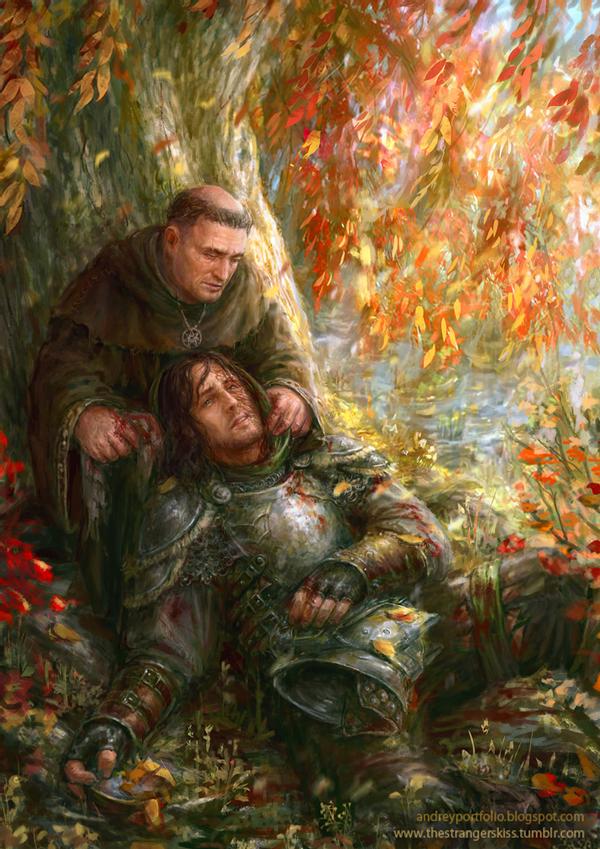
a_brother_s_mercy_by_allnamesinuse_d9h4fsq-fullview (1)

A Brother’s Mercy by Allnamesinuse

The present essay is a Feature Commentary corresponding to the AFFC/ADWD portion of “The Will to Change: Rereading Sandor.”


The Hound is dead and Sandor Clegane is at rest, were the words the Elder Brother chose to eulogise our favourite non-knight in what was seemingly the end of the road for him. The interpretation some see here is that this is as close as GRRM can come to a “happy ending” for a character; a retirement to a quiet life at a place where he’s not likely to be disturbed isn’t a bad outcome for someone with a story tragic until the very end, they argue. Another popular interpretation is that reborn Sandor will become a warrior for the Faith of the Seven in some capacity, for which his last scene could be laying out the groundwork to build a Warrior’s Son storyline on later.

But neither fits in with his character growth arc nor with what his potential future role linked to the Starks could be. Sandor doesn’t have it in him to become a Lancel 2.0 and neither does he have it in him to be Elder Brother 2.0. It’s hard to imagine a man who refused all his life to take an oath of knighthood doing a complete U-turn and taking a religious oath. And yet, the imagery for his rebirth being a spiritual one is so overwhelming. How do we interpret this imagery without making it about the possibility of him becoming permanently tied to the Faith Militant?

As they say, the Devil is in the details. Or, in this case, in the details in the Elder Brother’s words. Hound: dead. Sandor: resting. It sounds like the good old Brother is speaking of two different people, and not about the same man with different names. Why this specificity in separating him in two different halves at this precise stage, though? If he wanted finality, he would pronounce both Sandor and the Hound dead instead of engaging in wordplay that allows him to circumvent the Thou Shalt Not Lie commandment and keep plausible deniability if he ever were to be confronted with accusations of playing loose with the truth.

Whilst reading the story of Miyamoto Musashi, Japan’s most celebrated samurai, it caught my attention that there’s another way to look at Sandor’s last appearance, one more fitting into the redemption theme that runs throughout his storyline: forgiveness in the religious sense of the word. Miyamoto Musashi stood out as a larger-than-life figure amongst numerous other famous warriors not just because he had the skills with steel of an Arthur Dayne but also because he saw swordsmanship as a way of life, a path to walk in to achieve one’s best self, improving oneself along the way through combat and hardship. In the Way of the Sword, as he called it, knights are indeed not for killing, an idea Sandor would’ve scoffed at. But there’s a catch: in his beginnings, Musashi is like Sandor. To him, samurai are for killing.

Or at least that’s how the story goes in the most famous novel about him, Musashi by Eiji Yoshikawa, which has one striking parallel that provides a different reading of Sandor’s death. The novel doesn’t cover all of Musashi’s life, only his youth, since he was a feral child with rage issues and suffering from family-related trauma up until his late 20s when he finally becomes the sword-saint of Japanese legend with a myriad duels to this name. The manner in which this change occurs is what caught my eye, because initially it looks so blatantly obvious that Takezo, as he was called then, is destined to be a brute samurai with excessive rage and aggressiveness that stays alive only because he’s too good with a weapon to die. He had no formal training by a sensei, no Martial Arts style, no self-control, no philosophy, nothing. Just plain ol’ fight and kill, all instinct, all impulse, which lands him in several clashes with the villagers and the law. Orphaned at 7, he grew up fostered at a temple, learning the handling of weapons more by himself than with an instructor, killing his first man at 13, slaying a giant in his early teens, going to fight at and lose a big battle, and ending up outlawed for killing his way back to his town from there.

So we have our first parallel with Sandor: highly effective and talented swordsman, big and incredibly strong, temperamental and mouthy, traumatised and in love with a woman he can’t have. An emotionally-damaged ball of destruction. It couldn’t go but from bad to worse from here onwards.

Then enters salvation in the form of eccentric Buddhist monk Takuan Soho, who looks more fit for breaking skulls than healing souls and stops Takezo in his tracks from going even further down this destructive path. Takezo is being hunted down by the local lord’s soldiers for trespassing the barrier set up on the road to catch fugitives from the recent Battle of Sekigahara that decided who would be Japan’s shogun, and for killing soldiers to return to his home village to deliver news to family about his missing best friend that’d gone to Sekigahara with him. The soldiers can’t catch him for dear life, so Takuan strikes a deal with the officer in charge: if he catches Takezo by himself, he’ll earn the right to decide what to do with him, deal? Deal!

The too-clever monk devises a way to use Takezo’s childhood friend, the girl Otsu, as bait to lure the boy into showing himself at the woods he’s hiding in. It works. Takezo is captured, and as per the agreement now Takuan can decide his fate. Ignoring everyone’s bloodthirsty demands for his head, Takuan decides to hang the boy from a tree by the waist:

He took hold of the rope after freeing it from the railing and dragged Takezō, like a dog on a leash, to the tree. The prisoner went meekly, head bowed, uttering not a sound. He seemed so repentant that some of the softer-hearted members of the crowd felt a bit sorry for him. The excitement of capturing the “wild beast” had hardly worn off, however, and with great gusto everyone joined in the fun. Having tied several lengths of rope together, they hoisted him up to a branch about thirty feet from the ground and lashed him tightly. So bound, he looked less like a living man than a big straw doll.

The punishment is to leave him hanging like a Christmas decoration from the monastery’s tall tree until he dies, so everyone thinks. But Takuan has ulterior motives, and whilst Takezo is playing the part of the loudest tree decoration in history, the monk indulges in philosophising and verbal sparring with him:

“I would’ve been better off letting the villagers catch up with me. At least they’re human.”

“Was that your only mistake, Takezō? Hasn’t just about everything you’ve ever done been some kind of mistake? While you’re resting up there, why don’t you try thinking about the past a little.”

“Oh, shut up, you hypocrite! I’m not ashamed! Matahachi’s mother can call me anything she wants, but he is my friend, my best friend. I considered it my responsibility to come and tell the old hag what happened to him and what does she do? She tries to incite that mob to torture me! Bringing her news of her precious son was the only reason I broke through the barrier and came here. Is that a violation of the warrior’s code?”

“That’s not the point, you imbecile! The trouble with you is that you don’t even know how to think. You seem to be under the misconception that if you perform one brave deed, that alone makes you a samurai. Well, it doesn’t! You let that one act of loyalty convince you of your righteousness. The more convinced you became, the more harm you caused yourself and everyone else. And now where are you? Caught in a trap you set for yourself, that’s where!” He paused. “By the way, how’s the view from up there, Takezō?”

“You pig! I won’t forget this!”

“You’ll forget everything soon. Before you turn into dried meat, Takezō, take a good look at the wide world around you. Gaze out onto the world of human beings, and change your selfish way of thinking (…).”

Takezo is too combative for the monk’s lesson to easily penetrate his thick skull, so the back-and-forth continues for a good while:

“Just wait, Takuan, just wait! If I have to chew through this rope with my bare teeth, I will, just to get my hands on you and tear you limb from limb!”

“Is that a promise or a threat? If you really think you can do it, I’ll stay down here and wait. Are you sure you can keep it up without killing yourself before the rope breaks?”

“Shut up!” Takezō screamed hoarsely.

“Say, Takezo, you really are strong! The whole tree is swaying. But I don’t notice the earth shaking, sorry to say. You know, the trouble with you is that, in reality, you’re weak. Your kind of anger is nothing more than personal malice. A real man’s anger is an expression of moral indignation. Anger over petty emotional trifles is for women, not men.”

. . .

“It’s the same with your so-called courage. Your conduct up till now gives no evidence that it’s anything more than animal courage, the kind that has no respect for human values and life. That’s not the kind of courage that makes a samurai. True courage knows fear. It knows how to fear that which should be feared. Honest people value life passionately, they hang on to it like a precious jewel. And they pick the right time and place to surrender it, to die with dignity.”

Still no answer.

“That’s what I meant when I said it’s a pity about you. You were born with physical strength and fortitude, but you lack both knowledge and wisdom. While you managed to master a few of the more unfortunate features of the Way of the Samurai, you made no effort to acquire learning or virtue. People talk about combining the Way of Learning with the Way of the Samurai, but when properly combined, they aren’t two—they’re one. Only one Way, Takezō.”

Then, in pain and fearing that this torture will last much longer, Takezo finally sees the light. He declares to have understood how wrong he was, and begs to be taken down:

“Takuan! Save me!” Takezō’s cry for help was loud and plaintive. The branch began to tremble, as though it, as though the whole tree, were weeping.

“I want to be a better man. I realize now how important it is, what a privilege it is to be born human. I’m almost dead, but I understand what it means to be alive. And now that I know, my whole life will consist of being tied to this tree! I can’t undo what I’ve done.”

“You’re finally coming to your senses. For the first time in your life, you’re talking like a human being.”

“I don’t want to die,” Takezō cried. “I want to live. I want to go out, try again, do everything right this time.” His body convulsed with his sobbing. “Takuan . . . please! Help me . . . help me!”

Takuan refuses. However, he unwittingly makes it possible for Otsu to cut the rope and free Takezo. Boy and girl flee together, but become separated, and Takezo is caught by soldiers of the daimyo and taken before his lordship. Takuan interferes again by telling the daimyo that he was promised he’d decide Takezo’s punishment. Takezo is taken to a dungeon-like haunted room in the castle, where he’ll spend 3 years in solitary confinement, devoted to reading books on worthy subjects, a decision made by Takuan as part of his scheme to reform Takezo from the inside out:

“Think of this room as your mother’s womb and prepare to be born anew. If you look at it only with your eyes, you will see nothing more than an unlit, closed cell. But look again, more closely. Look with your mind and think. This room can be the wellspring of enlightenment, the same fountain of knowledge found and enriched by sages in the past. It is up to you to decide whether this is to be a chamber of darkness or one of light.”

When he reemerges from his confinement, Takezo is truly changed. He’s no longer full of rage and ready to kill anyone on sight, and tells Takuan he finally gets what he was trying to imprint on him when hanging from the tree: he was like a wild beast and now he’s human, and wants to be the best human possible. Takuan decides it’s time to release him:

“Even though you’ve had no one to converse with but yourself, you’ve actually learned to speak like a human being! Good! Today you will leave this place. And as you do so, hug your hard-earned enlightenment to your bosom. You’re going to need it when you go forth into the world to join your fellow men.”

In his solitude, Takezo has acquired a keen sense of self-awareness, recognising he’s still full of rough edges that he needs to smooth out in order to better himself. He declares he will take to wandering through the country to learn the Way of the Sword and reach enlightenment and perfection as a swordsman. Pleased, Takuan and the daimyo tell him he’s been reborn and that, to befit his rebirth, he should leave his old identity behind:

“It’s all right for him to roam about while he’s still young,” said Terumasa. “But now that he’s going out on his own—reborn, as you put it—he should have a new name. Let it be Miyamoto, so that he never forgets his birthplace. From now on, Takezō, call yourself Miyamoto.”

Takezō’s hands went automatically to the floor. Palms down, he bowed deep and long. “Yes, sir, I will do that.”

“You should change your first name too,” Takuan interjected. “Why not read the Chinese characters of your name as ‘Musashi’ instead of ‘Takezō’? You can keep writing your name the same as before. It’s only fitting that everything should begin anew on this day of your rebirth.”

Thus Shinmen Takezo dies and Miyamoto Musashi is born. His is a spiritual rebirth, like Sandor’s, and it’s also very explicitly stated in the novel, with the priest present to pronounce Takezo dead and Musashi born, just like the Elder Brother pronounced The Hound dead and Sandor at rest.

“Now there’s only this sword,” he thought. “The only thing in the world I have to rely on.” He rested his hand on the weapon’s handle and vowed to himself, “I will live by its rule. I will regard it as my soul, and by learning to master it, strive to improve myself, to become a better and wiser human being. Takuan follows the Way of Zen, I will follow the Way of the Sword. I must make of myself an even better man than he is.”

Thenceforward, the new Miyamoto Musashi, once called a wild beast, a raging tiger, a demon, hated and feared by everyone for his viciousness and physical invincibility, travels across Japan following in the steps of a Hero’s Journey quest, dueling the baddies and the goodies, helping distressed damsels, old ladies, and children, learning various arts, carving statuettes of a goddess, opposing worthy and unworthy rivals, saving villagers from bandits, tilling the land… All the things you’d expect of a knight-errant or a lone gunslinger if this were a Western tale. He matures, his temper mellows, he masters his impulses, sheds his selfishness, and becomes a man admired and followed, and envied, too. All of which was only possible because one day a perceptive priest looked into his soul and, like a sword-polisher, took it unto himself to polish the rust off it by teaching him the meaning of compassion, of forgiveness, of second chances. It isn’t merely a symbolical transformation; it’s a literal one and very faith-driven.

Sandor Clegane may not change his name, or at least it doesn’t look likely that he would, but The Hound has been written like a separate identity that no longer belongs to him. There’s already been two Hounds since the original “died”: Rorge and Lem Lemoncloak. Can we interpret that becoming just Sandor Clegane is his “Miyamoto Musashi” moment? Indeed, there are enough clues to contend that the Quiet Isle story for his baptismal-like death & rebirth is meant to be interpreted through the lens of sacramental forgiveness.

The imagery is there, uncharacteristically obvious for an author prone to keeping readers stumbling in the fog through subtlety and writerly sleights of hand. It’s the Catholic rite of pardon for one’s sins whose elements and symbology Martin has borrowed for Sandor, namely: conversion, confession, penance, forgiveness, and reconciliation. They don’t necessarily follow in this order, as it depends on individuals, but they all are present in whichever order an individual case unfolds, and Martin, a cultural Catholic, is certainly familiar with the rite, not to mention that the Faith of the Seven is just Fantasy Catholicism with fewer bells and whistles.

Let’s start with conversion. Generally, this refers to baptism, a step necessary to become a Christian since the dawn days of the religion, but in terms of purely referring to the act of committing a sin or a crime this is about the realisation that what you have done has unjustly visited harm on others. Essentially, the first step towards forgiveness is acknowledging you did wrong and you are the one that must pay for. Conversion is the will to break the cycle and make amends.

When did Sandor “convert”? Though it came from a longer process of chipping away at his self and not an overnight decision, it was the moment he decided to cut cleanly and irrevocably with his former life as a Lannister strongman at the Battle of Blackwater. He had risen high in his liege’s household, benefitted from it financially and socially, and was allowed the lifestyle of a foster Lannister. In sum, even though he never embraced the Lannister ethos, he was nevertheless part of and participant in their morally-challenged sphere. He had, to use the Biblical phrase, “reaped the wages of sin.” Both his and the sins of his masters’ House. To illustrate this point, just one example: he accepts the cloak of a Kingsguard, a position only made possible because of Jaime and Cersei’s sin in having a bastard child to illegitimately place on the throne with the full backing of their House.

But there’s two major differences between the Foster Lannister and the True Lannisters: participation in the cycle and forgoing the fruits of one’s sins.

On the first point, we have Cersei and Tyrion. Each one has deeply felt personal wounds often viewed as having been inflicted by another Lannister, their father Tywin. But instead of breaking the cycle, seek personal happiness outside Tywin’s sibling rivalry dynamic used to manipulate and control his children, or take any of thousands of other possible paths, the only thing Cersei and Tyrion (and to a lesser extent Jaime) do is perpetuate more of the same in an ever-escalating conflict destined to end in a self-inflicted Rains of Castamere on their own House. If Sandor were to act as a True Lannister, he would be involved in a Cersei/Tyrion-like struggle with Gregor. He’d burn larger villages than Gregor, rape more and younger women than Gregor, etc. He’d do this in an effort to gain Tywin’s favour as a means of destroying his brother just as the Lannister sibling dynamic plays out. But Sandor never entered this spiral of destruction despite his fratricidal hate for Gregor. He never identified with the aggressor and became an instrument of perpetuating the cycle in his heart. He accepted that the world was brutal and unfair, that it wasn’t a song, and did what he had to do to survive. He sinned in service to House Lannister, but there was punishment and suffering for him in those sins for his whole life.

On the second point, not a single True Lannister entertains giving up the spoils of sin. Giving up worldly possessions, paying restitution above and beyond what was stolen, exceeding the threshold of one’s wrongs in repenting—these are the core of every religious form of sin and forgiveness. But what do the Lannisters do? Cersei uses her own children to grab power that doesn’t belong to her or her House and allows the realm to be drowned in blood for the prize of having a Lannister on the throne; Jaime is all “I’ll confess to the incest and then marry Cersei while Tommen rules,” showing a willingness to be originator, enabler, and beneficiary of his family’s machinations; Tyrion the circus clown in exile wants to ravage Westeros with dragonfire, to rape his sister and become Tywin 2.0 in Casterly Rock. There is nothing but pure obsession with the spoils of sin amongst Tywin’s offspring.

On the other hand, the Foster Lannister took the first and mandatory step as well as the second on the Blackwater when he broke away and gave up all claim to Lannister spoils. He gave up a comfortable lifestyle and a plum position, and took nothing with him that he earned through the Lannisters. True, he did have the gold from the Hand’s tournament, but that was his outside of Lannister service and legitimately earned, and even that was taken away, too. His break is thus absolute, he can’t look back.

Confession comes next. We don’t know what Sandor told the Elder Brother, but it’s not that hard to guess the things he may have said in confession at the Quiet Isle. How? By looking at what he tells Arya at the cave after winning his trial by combat against Beric:

“You killed Mycah,” she said once more, daring him to deny it. “Tell them. You did. You did.”

“I did.” His whole face twisted. “I rode him down and cut him in half, and laughed. I watched them beat your sister bloody too, watched them cut your father’s head off.”

It’s curious that, of all horrible things he must have witnessed in his former life, it’s these three specific crimes that torment Sandor: killing an innocent boy, and standing by as an innocent man was executed and an innocent girl was abused. All these three crimes sprout from Lannister sins.

In the Catholic rite, penance is the repudiation of one’s own sin and an acknowledgement that one must satisfy for them. It won’t do to go about it in a spread-out evenly and generalised way but accepting that it’s been you who sinned. Sandor is judged guilty by association by the Brotherhood Without Banners and he rejects the more outrageous attempts by them to make him pay in Gregor’s stead, but he does accept the sins he feels were his, too, not just his former masters’. Killing Mycah wasn’t his idea, but he was the executioner. Beheading Ned wasn’t his doing, but he had a role in the downfall of House Stark. Beating Sansa black and blue he never did, but he witnessed it and couldn’t save her like he thinks he should have. How can he make amends and give satisfaction for them, then?

It’s at this point when the road to redemption becomes even more blatantly religious in-world. For his sin of killing an innocent boy on royal orders, Sandor is judged by the faith of Rh’llor. Note that, in spite of the dozens of charges the BwB hurl at him, it’s Mycah the only accusation that sticks and that Sandor must make amends for with his own life were he to perish in the trial by combat he’s sentenced to. And also note that the accuser who is able to bring him to task where the others have failed is Arya.

Arya is the recipient of Sandor’s confession to his three crimes. Arya is friend, daughter, and sister to all three victims. And so Arya is the one to figuratively throw the gauntlet at Sandor and demand satisfaction. But, for all she tries her damnedest to be his judge, jury, and executioner at once, she ends up becoming Sandor’s act of public penance.

Lem grabbed her wrist and twisted, wrenching the dagger away. She kicked at him, but he would not give it back. “You go to hell, Hound,” she screamed at Sandor Clegane in helpless empty-handed rage. “You just go to hell!

“He has,” said a voice scarce stronger than a whisper.

The trial was meant to punish Sandor for the sins of House Lannister undistinghsably from who committed which. But Sandor had lived his life already under penalty for those very sins. In Catholic theology, the wages of sin are death—as in damnation—and suffering. When Thoros says he’s a man enduring Hell, he’s referring to this suffering. Sandor’s face is a punishment. Serving those who enable Gregor to continue perpetrating the same crimes he’s done to Sandor has been a punishment.

Look at it like this: what’s more important to the three True Lannisters? Beauty, sword, Casterly Rock. Cersei, Jaime, and Tyrion each define themselves by these things respectively, which they have by birth or think are theirs by birth. And what happens? GRRM plays God, and Cersei ends up fat, shaven, and walking her sagging naked body through the streets, Jaime ends up a one-handed cripple, and Tyrion ends up a destitute slave in Essos. Some readers see in this a punishment for their sins, Jaime even says at one point that the loss of his hand is retribution for tossing Bran from the tower. But the Lannisters still cling to the spoils earned with the crimes of their House: As of ADWD, Cersei is most likely far from humbled by her experience and may stage a vengeful comeback, the supposedly on a path to redemption Jaime is still serving as (and reaping the benefits of being) Lord Commander of his bastard’s Kingsguard even as he severs ties with Cersei, and Tyrion is most definitely scheming a vengeful comeback. They want to claim the whole kingdom as a reward for confessing their sins, they want others to suffer as a result of their supposedly redeeming confessions.

So it can be said that the Lannisters aren’t being punished so much as suffering the natural consequences of their choices. Unrepentant is the key difference. While one is unrepentant there is no punishment, just suffering. Suffering ought to lead to reflection. Reflection to an understanding of cause and effect and a sense of humility and responsibility. Reflection then leads to being repentant for one’s role. Only afterwards is suffering really punishment from one’s own POV. The only other way it can be punishment is when it is imposed by an authority and proclaimed punishment.

What about Sandor? How does he define himself? Strength. Outwardly, he boasts to Sansa that all he needs is a longsword, that strong arms rule the world, the weak should just give up and go belly up, et cetera. All bravado, but this holds a seed of truth inside for him, given that he was burnt young, innocent, and powerless, and only survived because he grew up tall as a tree and made himself useful to Lord Lannister… and his penance hits him right in the core. How so? Because he’s made to use his strength to serve the purpose of paying back his debt.

In ASOIAF, the ultimate forgiveness mechanism for crimes is the Night’s Watch. The entry fee is giving up all claims to anything of worldly value, all allegiances and connections and riches, and the post entry reward is selfless service. So, following this in-world model, we already have established that Sandor met the first requisite (give up anything of value) when he broke away at Blackwater, so the forgiveness implied by the results of the trial by combat and Arya’s choice there was earned well before their last scene at the Trident plays out. So, what remains is the second requirement to reach forgiven status.

The Hound goes thus to protect Arya to make up for the sin of his role in Ned’s downfall, and by extension his role in Sansa’s abuse as well because House Stark’s downfall left her defenceless under the grip of Sandor’s masters. Granted, it didn’t start as selfless service, because he did kidnap her in retaliation for his gold and had intentions to ransom her to her family, but the pragmatics of that are self-evident: he clearly couldn’t just show up at Robb’s camp to offer his services and expect to be taken seriously without a bargaining chip the Northerners won’t ignore. Arya became truly his penitent service when she lost her bargaining chip value to him courtesy of the Red Wedding and he still continued to protect her until he can’t go on anymore due to the wound to his leg.

On the surface, you could argue his is the same kind of punishment as Jaime’s loss of a hand: cut him at the leg and he’s no longer the Hound. But it goes beyond such a superficial reading, because if for Jaime it’s merely the start of a path he may or mayn’t ultimately walk to completion, for Sandor dispossessing him of the last vestige of his past life at the hands of current liegemen of his former masters inflicting a crippling blow to the physical strength he so much relies on is the end of the road (for now, at least). By the time he is abandoned on the banks of the Trident, he’s been surrounded in the imagery of forgiveness of two of the three main religions in ASOIAF plus one:

  • As per Beric and Thoros, the Lord of Light has given him back his life, which implies forgiveness because the crime he was tried for was of the a life for a life, blood for blood sort.
  • As per Lord Eddard’s beliefs, Arya’s refusal to carry out Northern justice after hearing his confessions and looking him in the eye implicitly lays out that the Old Gods also give him back his life.
  • We could argue there’s a fourth religion involved: the Faceless Men, because by taking him off her prayer, Arya extended forgiveness in the name of the God of the Many Faces.

Now it’s time for the Faith of the Seven to have their turn at placing Sandor’s soul on the measurement scales and deciding whether he’s forgiven or condemned, and here subtlety goes out the window. GRRM lays out the religious imagery of forgiveness and redemption rather thick on the entire Quiet Isle sequence, starting well before we see the place, well before we find out there’s a Gravedigger there. Just look at these lines from the conversations that Brienne and Septon Meribald have on the road:

“Why do they call it the Quiet Isle?” asked Podrick.

Those who dwell here are penitents, who seek to atone for their sins through contemplation, prayer, and silence. Only the Elder Brother and his proctors are permitted to speak, and the proctors only for one day of every seven.”

A vow of silence is an act of contrition, a sacrifice by which we prove our devotion to the Seven Above. For a mute to take a vow of silence would be akin to a legless man giving up the dance.”

. . .

“Faith,” urged Septon Meribald. “Believe, persist, and follow, and we shall find the peace we seek.”

Penitence, atonement, finding peace… All the elements of being granted forgiveness. Martin couldn’t have made it clearer if he had placed a Here Be Redemption neon sign at the entrance to the Quiet Isle.

We can infer that Sandor confessed to the EB, either as he lay dying on the Trident or once he arrived to the QI, for otherwise the EB wouldn’t know all he knows about his life and in such detail. It’s relevant to highlight how the Elder Brother refers to the Hound as he pronounces him dead in contrast to how Brienne refers to him:

“I know a little of this man, Sandor Clegane. He was Prince Joffrey’s sworn shield for many a year, and even here we would hear tell of his deeds, both good and ill. If even half of what we heard was true, this was a bitter, tormented soul, a sinner who mocked both gods and men. He served, but found no pride in service. He fought, but took no joy in victory. He drank, to drown his pain in a sea of wine. He did not love, nor was he loved himself. It was hate that drove him. Though he committed many sins, he never sought forgiveness. Where other men dream of love, or wealth, or glory, this man Sandor Clegane dreamed of slaying his own brother, a sin so terrible it makes me shudder just to speak of it. Yet that was the bread that nourished him, the fuel that kept his fires burning. Ignoble as it was, the hope of seeing his brother’s blood upon his blade was all this sad and angry creature lived for . . . and even that was taken from him, when Prince Oberyn of Dorne stabbed Ser Gregor with a poisoned spear.”

“You sound as if you pity him,” said Brienne.

“I did. You would have pitied him as well, if you had seen him at the end. I came upon him by the Trident, drawn by his cries of pain. He begged me for the gift of mercy, but I am sworn not to kill again. Instead, I bathed his fevered brow with river water, and gave him wine to drink and a poultice for his wound, but my efforts were too little and too late. The Hound died there, in my arms.

“It is true, then,” she said dully. “Sandor Clegane is dead.”

“He is at rest.” The Elder Brother paused.

So here we have a figure of authority from the Faith describe Sandor Clegane (notice that this is how he calls him) as a “sinner who mocked the gods” and therefore in need of repentance and atonement, in contrast to how Brienne calls the Hound (also notice that this is how she calls him) a criminal she must execute, as she explicitly tells Brother Narbert. The law of men (the Crown) that Brienne represents has condemned Sandor, but the law of the gods (the Seven) that the EB represents has declared him “at rest.” And by this pronouncement of peace, we can only conclude that Sandor has met the confession requirement.

And the EB does have the authority to pronounce ego te absolvo. Traditionally, the Father Superior of a Catholic monastery can hear confession and absolve people same as an ordained priest, and the EB is just a Father Superior with a Fantasy name. That alone would give him the authority. The arrival of Septon Meribald to the QI for specific confession purposes is intriguing, because it seems to imply that in-world only Septons can hear confession:

He turned to Septon Meribald. “I hope that you have time to absolve us of our sins. Since the raiders slew old Septon Bennet, we have had no one to hear confession.”

That is true in real-life Catholicism, too, because not every priest has the authority to hear confession. However, Catholic canon law says that although only authorised priests can administer the sacrament of confession & absolution, any priest can hear the confession of a dying person because the danger of dying unconfessed trumps canon law. Sandor was dying (he thought) when the EB found him, so to consider the EB hearing his “final words” a valid confession is reasonable. And in any case, Meribald’s presence in the QI for the specific purpose of absolving the monks of their sins extends to Sandor in his capacity as a novice monk. The wording in the above passage is specific about absolution for this very reason.

Also, although we don’t know if Sandor and Meribald ever talked off-screen, we can’t ignore the symbolism of Meribald’s companion, Dog, being present when the good Septon hears confession:

“I shall make time,” said Meribald, “though I hope you have some better sins than the last time I came through.” Dog barked. “You see? Even Dog was bored.”

We can infer what penitence was imposed on Sandor after confession by looking at what he wears when he reappears on the QI. Would someone like him agree to wear monastic clothes if he’d not been talked into it? It had to be willing. His stay at the monastery itself is, going by my Miyamoto Musashi parallel, like staying secluded in the dungeon to study and reflect. His true penance is what he’s learning to do there: he’s been made a gravedigger.

… and higher still they passed a lichyard where a brother bigger than Brienne was struggling to dig a grave. From the way he moved, it was plain to see that he was lame. As he flung a spadeful of the stony soil over one shoulder, some chanced to spatter against their feet. “Be more watchful there,” chided Brother Narbert. “Septon Meribald might have gotten a mouthful of dirt.” The gravedigger lowered his head. When Dog went to sniff him he dropped his spade and scratched his ear.

“A novice,” explained Narbert.

Sandor Clegane, the man who lived by the sword and who left the dead to be food for dogs and wolves, is taught to give people humane burial. Let’s have a closer look at who the first grave he’s seen digging is for:

“Who is the grave for?” asked Ser Hyle, as they resumed their climb up the wooden steps.

“Brother Clement, may the Father judge him justly.”

“Was he old?” asked Podrick Payne.

“If you consider eight-and-forty old, aye, but it was not the years that killed him. He died of wounds he got at Saltpans. He had taken some of our mead to the market there, on the day the outlaws descended on the town.”

“The Hound?” said Brienne.

“Another, just as brutal. He cut poor Clement’s tongue out when he would not speak. Since he had taken a vow of silence, the raider said he had no need of it.

Sandor Clegane, the old Hound and the first of them all, is burying a victim of the new Hound. This is extremely significant, and from what the EB says, burials are Sandor’s primary occupation at the monastery:

“Too many corpses, these days.” The Elder Brother sighed. “Our gravedigger knows no rest. Rivermen, westermen, northmen, all wash up here. Knights and knaves alike. We bury them side by side, Stark and Lannister, Blackwood and Bracken, Frey and Darry. That is the duty the river asks of us in return for all its gifts, and we do it as best we can. Sometimes we find a woman, though . . . or worse, a little child. Those are the cruelest gifts.”

We don’t know if Sandor participates in the preparation of bodies for burial, but it wouldn’t be out of bounds to assume that it may very well be a part of his duties as gravedigger. If so, then the idea of this being his penance picks up steam. He does have other humble duties, too, like serving at the table:

The last of the food had been cleared away by the novices whose task it was to serve. Most were boys near Podrick’s age, or younger, but there were grown men as well, amongst them the big gravedigger they had encountered on the hill, who walked with the awkward lurching gait of one half-crippled.

He’s counted amongst “the novices whose task it was to serve.” Service is, indeed, what the Seven have imposed on Sandor via the Elder Brother as the way to make up for his sins, and his primary duty is laying to rest all those who this war has taken away, impartially and humanely, regardless of allegiance. Why this specific service, though? The EB’s words summing up Sandor’s former life illustrate the motive:

“I know a little of this man, Sandor Clegane. He was Prince Joffrey’s sworn shield for many a year, and even here we would hear tell of his deeds, both good and ill. If even half of what we heard was true, this was a bitter, tormented soul, a sinner who mocked both gods and men. He served, but found no pride in service. He fought, but took no joy in victory. He drank, to drown his pain in a sea of wine. He did not love, nor was he loved himself. It was hate that drove him. Though he committed many sins, he never sought forgiveness. Where other men dream of love, or wealth, or glory, this man Sandor Clegane dreamed of slaying his own brother, a sin so terrible it makes me shudder just to speak of it. Yet that was the bread that nourished him, the fuel that kept his fires burning. Ignoble as it was, the hope of seeing his brother’s blood upon his blade was all this sad and angry creature lived for . . . and even that was taken from him, when Prince Oberyn of Dorne stabbed Ser Gregor with a poisoned spear.”

Ser Kevan’s snarky words to Cersei about rabid dogs being the fault of their masters is precisely why Sandor felt no pride in serving House Lannister. Thoros and the EB coincide in considering this service his personal Hell, which only prolonged his childhood suffering well into adulthood. But he’d never sought—or found—atonement for his sins by breaking clean with his lieges, settling instead for stubbornly adhering to his own moral code and refusing to give in to the toxic dysfunctionality of Lannister dynamics. The Hound wouldn’t have sought forgiveness, that man had to die, and so he did:

That was another shock. “How did he die?”

“By the sword, as he had lived.”

There’s a very unsubtle baptism imagery wrapped around the Hound’s death: that of rebirth by water. In Catholic theology, the whole point of using water is to signify purification from evil, the cleansing of our outward actions, and the passage to spiritual rebirth:

Jesus answered him, “Truly, truly, I say to you, unless one is born again he cannot see the kingdom of God.”

Nicodemus said to him, “How can a man be born when he is old? Can he enter a second time into his mother’s womb and be born?”

Jesus answered, “Truly, truly, I say to you, unless one is born of water and the Spirit, he cannot enter the kingdom of God.

(John 3:3-5)

According to the EB himself, this is what he did first when he found a dying Sandor:

“I came upon him by the Trident, drawn by his cries of pain. He begged me for the gift of mercy, but I am sworn not to kill again. Instead, I bathed his fevered brow with river water, and gave him wine to drink and a poultice for his wound, but my efforts were too little and too late. The Hound died there, in my arms.”

The good Brother isn’t lying when he says the Hound died there, he’s simply speaking in religious metaphor. Circling back to Catholicism as our model for understanding the Faith of the Seven, this religion considers the act of baptism the birth of a “new man” to replace the “old man,” and goes as far as actually using death as a metaphor for this transformation, as this Biblical passage shows:

Therefore we are buried with him by baptism into death: that like as Christ was raised up from the dead by the glory of the Father, even so we also should walk in newness of life.

For if we have been planted together in the likeness of his death, we shall be also in the likeness of his resurrection:

Knowing this, that our old man is crucified with him, that the body of sin might be destroyed, that henceforth we should not serve sin.

(Romans 6:4-6)

Thus, baptism by water is the symbol of the death and burial of the old man who led a past life without forgiveness. Which also explains why the Elder Brother tells Brienne he personally “buried” the Hound:

I buried him myself. I can tell you where his grave lies, if you wish. I covered him with stones to keep the carrion eaters from digging up his flesh, and set his helm atop the cairn to mark his final resting place.”

And it also explains why the EB chose to bury the Hound’s “flesh” (his armour, sword, possessions, probably some of his literal flesh if he cut or cauterised his leg wound) and erect a grave. He wanted to make it as literal and irreversible as humanly possible that the Hound was well and truly dead, and have the fact sink in both into Sandor’s mind as well as the mind of anyone who ever came asking. And to drive across the point that he’s talking about a rebirth, the EB also tells Brienne about his own transformation after he “died in the battle of the Trident” fighting for Rhaegar:

“Instead I woke here, upon the Quiet Isle. The Elder Brother told me I had washed up on the tide, naked as my name day. I can only think that someone found me in the shallows, stripped me of my armor, boots, and breeches, and pushed me back out into the deeper water. The river did the rest. We are all born naked, so I suppose it was only fitting that I come into my second life the same way.”

He underwent the same process of being bathed in river water and ending up half-dead on the same isle where he’d be saved and given a second chance at life. He’s now in a position to give Sandor the same opportunity, and did so doubly, saving both his physical body by healing him from a wound that, as per his reputation, not even maesters would’ve healed, and most likely his soul too, by pushing Sandor towards a path of atonement that would lead to reconciliation. His involvement in the man’s rebirth makes it possible to pronounce Sandor Clegane finally at peace instead of dead like he didn’t hesitate to do for the Hound:

“It is true, then,” she said dully. “Sandor Clegane is dead.”

“He is at rest.”

The Elder Brother is simply following the “old man” vs “new man” religious phraseology when he makes this Sandor vs Hound distinction that Brienne doesn’t grasp. With the inclusion of this scene between the EB and Brienne that serves no other purpose than to let readers know the fate of Sandor Clegane, Martin has written him to be the only character in ASOIAF that is surrounded by the imagery of forgiveness from three major religions, a fact that isn’t accidental but has to serve a plot purpose. You don’t simply have a character be forgiven by Rh’llor, the Old Gods, and the Seven (and the God of Many Faces for additional pathos) for no reason and no future completion at all. We don’t know yet whether Sandor’s story will ultimately have him serve a new master or continue as a freelance non-knight, his own dog as he put it, but one thing this theme of tripartite forgiveness makes clear is that he won’t serve a bad cause ever again. Forgiveness, for Sandor Clegane, means service, specifically service that he can take pride in and pay it forward, just as the Elder Brother has found pride in being a healer famous for saving hopeless cases, making use of an ability he’d not have been able to if not for his second life. Clegane’s redemption arc is one of service and protection, one that makes use of his natural talents, so it makes literary sense that henceforward there’d be a continuation of this pattern but with the inclusion of a worthwhile cause.

What’s in a Name: Naming as a Technique in Sansa and Sandor’s Relationship Arc

Tags

, ,

To B.,

for the souls in blackberry pies,

and all the stories that can’t be lies.

by Milady of York

Sandor Clegane is called by his first name by only a few characters in the books, most always preferring to call him by his nickname, The Hound, or by his surname. But there’s one glaring omission amongst the very few on first-name terms with him: Sansa.

Given the story they share, this omission is intriguing and invites scrutiny to find an explanation to this. Because it has to be more than just an omission, and it hardly could be an authorial oversight. It eventually became apparent to me that there was a literary technique at play, but which one it might be wasn’t clear from the get-go, and merited a long search for hard proof. In trying to find a literary theory that would explain and exemplify what GRRM was doing, I was reminded of another very complex series, The Lymond Chronicles by late Scottish author Dorothy Dunnett, whose protagonist, Francis Crawford of Lymond and Sevigny, exhibits some startling similarities to Sandor.

Bold claim, I know. But do read on and see the evidence to support my point. To begin with, look at these coincidences between the two characters:

  • Both have a surname the authors invented based on real surnames: Dunnett said in a 1990 talk that she made up Lymond from an acquaintance’s surname of Lamont, and although GRRM hasn’t said so, we can guess Clegane comes from a similar real-life surname, such as perhaps the still existing Cleggan.
  • Both are second sons, and for a while heirs to their noble houses: Francis and Sandor each have one brother and one sister—though one more sibling to the former appears—and are heirs to the Baron of Culter and House Clegane respectively, for a time, due to their brothers’ childlessness.
  • Both were victims of childhood abuse and fled their homes: Francis was whipped by Lord Gavin, his father, and Sandor was burnt by his brother with the complicity of his father.
  • Both have a Cain-and-Abel dynamic with their elder brothers: Although not for the same reason, as Richard Crawford of Culter is the good egg of the Crawfords as opposed to Gregor being the rotten egg in the Clegane basket.
  • Both have a sister deceased before the series’ start, of whose death one of the brothers is thought to be the culprit: Gregor is a suspect in the Clegane sister’s death and Lymond is a suspect in the death of his sister, Eloise.
  • Both have a badass but sadly interrupted swordfight with their brothers: Francis duels Richard in The Game of Kings, and Sandor duels Gregor in A Game of Thrones. Even the books’ titles coincide!
  • Both débuted in battle at a tender age: When they were squires aged 12 and 14 respectively; Francis at the Battle of Solway Moss, and Sandor most likely at the Sack of King’s Landing going by the books’ timeline.
  • Both spent their boyhood in the court of an ironfisted ruler and fell in the schemes of power-hungry and seductive older noblewomen related to them: Francis with King Henry VIII’s niece Margaret Lennox, and Sandor with Lord Tywin’s daughter Cersei.
  • Both have similar paths to ennoblement: Saving a high-ranked noble’s life from a feline at a hunt, with a hound as the hero, led to getting a nobiliary title in each case. Francis saved Queen Mary of Scots from a cheetah at a hunt by sacrificing his wolfhound in the fight, which weighed in getting the title of Comte de Sevigny, and Sandor’s grandfather got a knighthood and lands for saving Lord Tytos from a lion with the sacrifice of his three hounds.
  • Both men serve child monarchs and their mothers: Francis goes on missions for Dowager Queen Mary of Guise and her child Mary, Queen of Scots, and Sandor guarded Cersei before he went on to guard Joffrey.
  • Both own a hot-tempered and combative animal blasphemously named after a deity, who also shares their same colouring: Blond Lymond has the golden eagle Slata Baba, named for a Slavic goddess, and dark-haired Sandor has the black warhorse Stranger, named for one of the Seven.
  • Both will eventually fall in love with much-younger women that grow up before their eyes in the course of the series: Lymond is 11 years older than Philippa, and Sandor is 15 years older than Sansa.
  • Both men’s first meeting with these women was when they were very young girls, practically still children, and their first scene together involves scaring the sweet Jesus out of the poor girls: Lymond, aged 21 at the time, sneaked into 10-year-old Philippa’s farmhouse at Flaw Valleys to force information out of her father by using her against him, frightened her and made her cry; and Sandor, aged 26 at the time, scared 11-year-old Sansa and got growled at for it by her direwolf at the Trident.
  • Both men give their ladies an animal nickname: Francis calls Philippa “Yunitsa” = heifer in Russian, Sandor calls Sansa “little bird.”
  • Both men have very characteristic and distinctive voices: They can be recognised merely by describing their voices without having to name them, and they have to disguise their voices to not be recognised, too. Lymond’s countertenor and Sandor’s rasp are impossible to misidentify.
  • Both are masters at disguise, from clothes to masking their speech, when in need of passing through enemies undetected: Lymond has several instances of disguising himself, the most hilarious is when he impersonates a pretty prostitute to fool the commander of an English garrison. Sandor has the Twins incident when he fooled the Bolton soldier about his identity to reach the castle.
  • Speaking of disguises, both have had to pass as clerics out of necessity: Francis did it twice, first as a priest and then as a Cardinal, and Sandor is currently passing for a novice monk at the Quiet Isle.
  • Both men are unjustly accused and sentenced by the Crown for crimes they didn’t commit: Lymond served time in the galleys for treason and is put on trial for treason again in the first book, and Sandor is attainted for treason and pillaging.
  • Both men’s arc is haunted by the appalling choices they made because of a boy that’s the product of brother/sister incest, in different contexts: Francis is haunted by what he is goaded into doing for Khaireddin “Crawford” and Sandor by what he is ordered to do in the service of Joffrey “Baratheon.”
  • Both men have a brave but suicidal last charge/last stand spurred on by dispiriting news about the real or perceived violation of their ladies, which nearly puts an end to their lives due to injuries sustained: Francis sets off a kamikaze explosion at a river mill a while after he learns what happened to Philippa with Bailey, and Sandor fights drunk and outnumbered at the Crossroads Inn after he learns what happened to Sansa with Tyrion.
  • Both men try and fail to goad someone else into mercy-killing them when gravely wounded: A wounded Lymond tries it with his brother in The Game of Kings, a wounded Sandor tries it with Arya in A Storms of Swords. Both are denied their wish.

These are too many coincidences to not wonder if GRRM has read Dunnett’s saga and drawn inspiration from it, a question an enterprising fan asked him once and, according to this SSM from 2001, Martin hasn’t read The Lymond Chronicles, but according to comments by Elio Garcia on westeros.org, he knows about Dunnett and has read her other series, The House of Niccolò, whose protagonist is an ancestor to Lymond, although that series is very different and doesn’t lend itself to be a supporting example for the case I’m building in the present essay. Hard to say if Martin read more of Dunnett’s books since the SSM, but my object here isn’t to prove any derivations or coincidences between ASOIAF and The Lymond Chronicles, and neither is it to prove that Lymond and Sandor are similar characters, which would be too long a shot anyways.

Instead, the intention is to prove that The Lymond Chronicles contains a story arc that can be extrapolated to ASOIAF: the relationship between Francis Crawford and Philippa Somerville—its beginning, development, and conclusion—can be used to theorise on the still unfinished story of the relationship between Sansa Stark and Sandor Clegane, specifically to provide answers to the puzzling matter of Sansa never using Sandor’s first name even in her own headspace, what it may mean now, and what it may mean for the future.

WHEN YOUR NAME WAS JUST ANOTHER NAME THAT ROLLED OUT OF MY TONGUE . . .

Like Sansa, little Philippa Somerville never addresses, or even thinks of addressing, Lymond as anything but “Mr Crawford” as she grows up under his nose. It’s Mr Crawford here and Mr Crawford there, everywhere and most of the time, in her inner monologue and when speaking.

This doesn’t stand out initially in the first book, The Game of Kings, half because nobody calls him “Francis” besides his mother, the Dowager Lady Culter, his brother, Lord Culter, and the femme fatale who seduced him as a boy, the Countess of Lennox—everyone else calls him by his title of Lymond, or “the Master” for his title of Master of Culter, or Crawford of Lymond, or simply Crawford. And the other half because Philippa hates him passionately after his break-in and cross-questioning at Flaw Valleys, so it looks like she’s justified in addressing him in this frosty manner.

But why “Mr Crawford” specifically? Probably it was influenced by the impression left by their first meeting, for in that meeting she learnt his name and heard how he’s called by Gideon Somerville as he’s interrogated:

“Then ask me anything you want. I can assure you that till the ridiculous performance tonight I’ve had no enmity for you, and have never, to my knowledge, done you an injury. I don’t even know your name.”

“My name is Lymond.”

It was unknown to them. “Well, Mr. Lymond—”

“Lymond is a territorial name. My family name is Crawford.”

“Then, Mr. Crawford—” said Gideon patiently, and broke off, for the yellow-haired man was looking beyond him.

“Philippa!” said Lymond.

And so this way of calling him must’ve stuck with her. But in this book, she doesn’t even want to call him anything at all; she’ll later settle for his surname and also his full name plus title in the second book whenever she has to mention him, but never his Christian name. You can detect a comical passive-aggressive ring to her stubborn refusal to name him in light of her family’s forgiving Lymond for Flaw Valleys and the fact that Gideon and Kate Somerville become friends with him. In the same vein, we could easily explain why Sansa never uses the Hound’s name based on this scene in A Game of Thrones, the first and only time she has called him “Sandor,” in which  he doesn’t allow her to use his first name because it’s preceded by “ser”:

Sansa could not bear the sight of him, he frightened her so, yet she had been raised in all the ways of courtesy. A true lady would not notice his face, she told herself. “You rode gallantly today, Ser Sandor,” she made herself say.

Sandor Clegane snarled at her. “Spare me your empty little compliments, girl … and your sers. I am no knight. I spit on them and their vows. My brother is a knight. Did you see him ride today?”

With their on-the-wrong-foot beginning as well as 16th century social conventions that discouraged first-name treatment and familiarity with your elders and social superiors, it’s easy to dismiss Philippa’s “Mr Crawford” as just following an ordinary custom dictating proper ways to address people one isn’t on intimate terms with, just like it’s easy to write off Sansa’s not using Sandor’s name because of the impression from the Hand’s Tourney incident that left her with no other option but call him The Hound or by his full name because he loathes “Ser Sandor,” and she can’t call him Ser Clegane because it’s incorrect: you never use a knight’s last name before the title, only the first.

This omission soon becomes a characteristic behavior for both girls in their respective series. With Philippa, it stands out big time from the second book on, as in Queens’ Play a larger number of characters begin to call him Francis: five other people call him so, when it was only three in the first book. But not Philippa. And in the third book, The Disorderly Knights, the total number of people calling him Francis is raised to nine. But still not Philippa . . .

It’s in The Disorderly Knights when the author brings attention in a deliberate, very obvious manner to Philippa’s refusal, and we first notice the hint that there’s more than her self-confessed grudge holding her back from the laid-back treatment the rest of her family engage in (her mother calls Lymond “my dear,” for example). It’s been years since Flaw Valleys, Philippa has been absent from the second book, and reappears as a 13-year-old girl still very much hostile to “Lymond,” as she calls him now, like she confides to Joleta Reid Malett in one scene:

She asked Philippa directly, at last, why she disliked Lord Culter’s younger brother and Philippa, hot-cheeked under three years’ silence, told of the wartime raid when Lymond had broken into the house and had questioned her, a child of ten, against her parents’ wishes.

Turns out she hasn’t upgraded him to the more respectful-sounding “Mr Crawford” yet. For the first half of the book, she’ll be calling him “Lymond” and thinking of him as “Lymond,” up until they meet again three years later, in inconvenient circumstances: at a ditch, on a pitch-dark night, and with a corpse in the midst, and she’ll then be calling him by his full name and title, which she’ll later shorten to just “Francis Crawford”:

Philippa turned to address him, the yellow flame bright on her thirteen-year-old face, and his horse stirred a bit, and was quiet. Then, before she could even speak, he said mildly, ‘Why, the heir of the Somervilles, with attendant. You have a problem, I see. May we help you? Is that your old lady, or someone else’s?’

She knew who it was before he rode forward; before the light fell on his hated face. His skin was dark brown, she saw, so that all its lines were imprinted in white, and his eyes and teeth shone as he smiled.

Philippa’s eyes filled with angry tears. He was Francis Crawford of Lymond, the only man who could airily jest about an old woman battered to death in a ditch.

By this time he’s been made a Count in France, and characters now address him as “M. le Comte,” “M. le Comte de Sevigny,” or more sarcastically “M. le bloody Comte,” including Lymond’s one-time lover and the men of his mercenary company, so Philippa’s emphasis on his Scottish title instead of his French one also makes her way of addressing him stand out from the crowd. And in case we needed further clues that Dunnett is doing this intentionally, it’s made explicit that Lymond doesn’t like to be called by his name by just anyone (sounds familiar?) when Sir Graham Reid Malett, a new character trying to ingratiate himself to him, asks for permission:

(…) ‘I desire,’ he said abruptly to Lymond, ‘to call you Francis. Is that permitted? It is out of affection and a … purely spiritual love.’

At the unexpected half-tone of mischief, even Lymond’s blue stare relaxed. ‘Of course,’ he said.

Without realising it, the Reid Maletts kickstart a new phase in Philippa and Lymond’s relationship. Sir Graham, alias Gabriel, is a Knight Hospitaller and a devious bastard well cloaked by the aura of an angel, and in his desire to have Lymond on his side to spearhead his ambitious schemes for the Hospitallers and grand-scale politics, his beautiful sister is the bait he uses to lure him with lust if persuasion fails. Philippa discovers a crucial aspect of this scheme by accident whilst Joleta is a guest at her farm, but being young and hating Lymond so much, she reacts to the Joleta/Lymond affair in a manner that might read like jealousy:

Philippa’s eyes were suddenly shining. ‘How nice,’ she said genteelly, ‘if your sister and Mr Crawford were married. Love often begins with a show of hate, doesn’t it?’

‘Only common mortals like the Somervilles have good old rotten hates, dear,’ said her mother. ‘Sir Graham manages to love everybody and wouldn’t know what you’re talking about. Have a bun.’

.  . .

Tact was not yet Philippa’s strongest point. ‘But Mr Crawford kissed her!’ she said.

‘Philippa!’ Kate could hardly keep the satisfaction out of her voice.

This is the time she finally moves to calling him Mr Crawford, and it’s fitting that she does it in front of Sir Graham, because everything happened due to this newcomer drawing her in as a subsidiary pawn in his games for the entrapment of Lymond. Readers familiar with The Lymond Chronicles will know that the Reid Malett siblings bring into existence one of the biggest—if not the biggest—tragedies of Lymond’s life in the form of Khaireddin “Crawford” and that Gabriel eventually becomes Lymond’s arch-nemesis. Philippa has a significant role to play in this tragedy. She learns early the truth about Joleta, but naïvely spills to Sir Graham her secrets and all she knows about his sister in confession, believing him a trustworthy man of the Church; and allows her hatred of Lymond to overpower her common sense and, to teach him a lesson, withholds crucial information passed on to her that Lymond badly needed to know, a decision that will enable the murders of certain characters and very nearly cost Lymond his own life. She does reveal the truth in the end, saving his life nigh on time as he’s tied to a post and whipped to bloody shreds by Gabriel, but that won’t be enough to appease her guilty conscience. And finally, she stops Lymond from killing Gabriel when he had the opportunity:

‘No, Mr Crawford!’ cried Philippa forbiddingly, and ducking under the snatching arms that tried to prevent her, she ran forward. ‘No! What harm can Sir Graham do now? What might the little boy become?’ And sinking on her knees, she shook, in her vehemence, Lymond’s bloodstained arm.

Her merciful intervention does lead to a lot of harm. So when Sir Graham’s escape sends Lymond on a prolonged wild goose chase across the Mediterranean coasts of Europe, Asia, and North Africa seeking punishment for the ex-knight and salvation for his alleged son, she flees her home with only a maid for company to impose herself on his mission. Convinced of her own usefulness by a guilty conscience and deaf to reasonable rejection, she follows the trail of Khaireddin on her own when Lymond turns her away. She does find Khaireddin “Crawford” all right—she’s the one to give him the surname without asking first—, but Gabriel’s scheme is so truly diabolical that it takes years for the chase to come full cycle and for everyone involved to meet at last in the palace of the Sultan in Constantinople, where the quarrel is settled by a high stakes human chess game (I highly encourage you to read the series to find out how this was possible).

By the end of the fourth book, Pawn in Frankincense, the now seventeen-year-old girl becomes Mistress Philippa Crawford, Comtesse de Sevigny. Love match, that? No. You see, she had travelled abroad unchaperoned and been in the company of men all this time, which in the 16th century meant a ruined reputation and unmarriageable status for a woman. And for Philippa, there’s the extra complication of having lived in the Sultan’s harem with his concubines. So Lymond, in a terrible state of mind after the horrendous experience of the past years, offers to make her his wife in name only so she can have the protection of his titles and his fortune if he didn’t get out of Constantinople alive due to the Sultana’s rancour. It’s significant that, when he’s asking for her hand in marriage, he doesn’t utter any of the conventional phrases a man would when asking a woman to marry him. Instead, he talks of “offering her his name”:

‘Philippa?’ said Francis Crawford. And this time, the tawny silk unrumpling slowly, she rose to her feet.

She had grown. Kate’s vicious friend, once so elevated, was taller by little more than a head. She drew her brows together, and studied the circles under his eyes. He said lightly, ‘My dear girl; it’s Almoner’s Saturday. With six frails of figs and a sackful of almonds, I am offering you my name.’

And it’s also significant that, whilst contemplating whether to accept or turn down his offer, she’s still thinking of him as “Mr Crawford”:

He had foreseen a difficulty, which was undeniable, although she could not see it as pressing. He had further felt he owed her a duty. He had talked of the benefits to her; he had not spoken of what he might be sacrificing. Was there some woman waiting, at home or in France, who might be mortally hurt by this gesture? What indeed would his mother, Sybilla, say? And what, oh, what, would Kate? … Dear Kate. You will be pleased to learn that my hand in marriage has been sought and received by Mr Crawford, and I am happy to inform you that you are now his …

In the course of this adventure, she has come to know him much better, more intimately, and has seen him at his worst, too, sharing experiences to break any man’s soul, and surviving enough misfortune to form a bond not dissimilar to that of comrades in arms. She has come to respect him, so obviously it’s now a respectful naming in her mind. And she accepts his proposal, showing she doesn’t find the idea of him as a husband repugnant. But she’s not calling him Francis.

And then it all changes.

Philippa Somerville by Unknown

Back to King’s Landing, how it’s going for Sansa since that “Ser Sandor”? Events in ASOIAF move slower than in the tighter-plotted and less peopled The Lymond Chronicles and the Philippa/Lymond relationship evolves over a longer period of time—a decade, thus the age gap is bridged in a timely fashion, all of which doesn’t occur with the other pair. For Sansa, it doesn’t stand out as particularly strange that she won’t use his name again in A Game of Thrones, where only two characters call him Sandor, the first one in AGOT Tyrion I:

“A voice from nowhere,” Sandor said. He peered through his helm, looking this way and that. “Spirits of the air!”

The prince laughed, as he always laughed when his bodyguard did this mummer’s farce. Tyrion was used to it. “Down here.”

It shouldn’t be surprising that it’s a Lannister who first uses his name. All three Lannister children call him Sandor—Tyrion in AGOT, Jaime & Cersei in AFFC—, and it makes perfect sense that they should given his pseudo-family status in the household. It’s the other character calling him Sandor who is the surprise, in AGOT Eddard VII:

Ned seldom put much stock in gossip, but the things said of Ser Gregor were more than ominous. He was soon to be married for the third time, and one heard dark whisperings about the deaths of his first two wives. It was said that his keep was a grim place where servants disappeared unaccountably and even the dogs were afraid to enter the hall. And there had been a sister who had died young under queer circumstances, and the fire that had disfigured his brother, and the hunting accident that had killed their father. Gregor had inherited the keep, the gold, and the family estates. His younger brother Sandor had left the same day to take service with the Lannisters as a sworn sword, and it was said that he had never returned, not even to visit.

.  . .

The Mountain pivoted in wordless fury, swinging his longsword in a killing arc with all his massive strength behind it, but the Hound caught the blow and turned it, and for what seemed an eternity the two brothers stood hammering at each other as a dazed Loras Tyrell was helped to safety. Thrice Ned saw Ser Gregor aim savage blows at the hound’s-head helmet, yet not once did Sandor send a cut at his brother’s unprotected face.

Ned has no love for The Hound, so it’s a meaningful switch that he is calling him by his first name instead of by his nickname or his full name, like he’s done up to this chapter, precisely when Sandor is doing a good, honourable deed. We have to keep this key detail in mind to better appreciate what’s going to happen in the rest of the books with regards to the use of Sandor’s name by the Starks, because how/when they use it differs from how/when others use it, and adds to the case this essay is building. Next, have a look at the following scene where he’s called Sandor in a Stark POV, Eddard XII, but this time by Littlefinger:

“Oh, returned with Joffrey, and went straight to the queen.” Littlefinger smiled. “I would have given a hundred silver stags to have been a roach in the rushes when he learned that Lord Beric was off to behead his brother.”

“Even a blind man could see the Hound loathed his brother.”

“Ah, but Gregor was his to loathe, not yours to kill. Once Dondarrion lops the summit off our Mountain, the Clegane lands and incomes will pass to Sandor, but I wouldn’t hold my water waiting for his thanks, not that one.”

So, we notice a certain pattern:

  • Tyrion calls him Sandor when he is making fun of the Imp to entertain Joffrey (negative), and Littlefinger refers to him as Sandor when he’s reminding the Hand of the King of The Hound’s desire to kill his brother (negative).
  • Ned calls him Sandor when he’s defending an unarmed knight from Gregor’s murderous rage (positive), and Sansa refers to him as Sandor, with a courtesy Ser added, in praise of his performance at the jousts (positive).

See the difference? GRRM establishes a positive spin for “Sandor” being used by House Stark members he interacts with early on, and will continue to develop it further in later books.

In A Clash of Kings, as their dynamic changes and she starts to lose her initial fear of him, Sansa struggles to find an acceptable way to call him, and falls short of it again. Naturally, she does try to call him something that doesn’t include ser, and tentatively addresses him as “my lord” instead, as seen in the scene where she’s returning from the meeting with Dontos at the godswood. But he hates it just as much as “Ser Sandor” for the same reason:

“It’s a long roll down the serpentine, little bird. Want to kill us both?” His laughter was rough as a saw on stone. “Maybe you do.”

The Hound. “No, my lord, pardons, I’d never.” Sansa averted her eyes but it was too late, he’d seen her face. “Please, you’re hurting me.” She tried to wriggle free.

.  . .

“The g-g-godswood, my lord,” she said, not daring to lie. “Praying . . . praying for my father, and . . . for the king, praying that he’d not be hurt.”

“Think I’m so drunk that I’d believe that?” He let go his grip on her arm, swaying slightly as he stood, stripes of light and darkness falling across his terrible burnt face. “You look almost a woman. . . face, teats, and you’re taller too, almost . . . ah, you’re still a stupid little bird, aren’t you? Singing all the songs they taught you . . . sing me a song, why don’t you? Go on. Sing to me. Some song about knights and fair maids. You like knights, don’t you?”

He was scaring her. “T-true knights, my lord.”

True knights,” he mocked. “And I’m no lord, no more than I’m a knight. Do I need to beat that into you?” Clegane reeled and almost fell.

However, later in this chapter, when he’s taking her to her bedchamber, he lets her know he doesn’t mind to be called by his nickname when she asks him about it:

The Hound escorted her across the drawbridge. As they were winding their way up the steps, she said, “Why do you let people call you a dog? You won’t let anyone call you a knight.”

“I like dogs better than knights (…).”

This is quite likely why “The Hound” is the name for him Sansa prefers: she calls him that seventy-three times from AGOT to AFFC, most frequently in her ACOK chapters. This indicates that she listens and respects that he loathes to be called a certain way as well as that he doesn’t mind to be called another way. “Sandor Clegane” is the second most common way she has of referring to him. Her least favourite is “Clegane,” which she uses only eight times in all, and it’s noteworthy that she refers to him as plain Clegane most repeatedly in the scene atop Maegor’s Holdfast, when they have a spat over gods & knighthood, the first time she stands up to and talks back at him. This fits with what people often say in real life that when they hear themselves be called by their surnames (or even their actual names for those accustomed to nicknames), they know for sure some serious talk is coming.

But all this she does only when thinking of him, talking about him to others, and describing him in her POVs; never to his face. Unlike Philippa, who actually does call Francis “Mr Crawford” to his face, Sansa can’t call him “The Hound” or ”Sandor Clegane” to his face. With Ser Sandor and my lord deemed unacceptable, whenever she talks to him for the rest of the book until he departs after Blackwater, she calls him you.

English lacks the formal/informal distinction of the personal pronoun you like it once had, so we don’t have the tú/usted, vous/toi, Sie/du differentiation of languages like Spanish, French, and German, etc., that denote the degree of formality and familiarity between two people. Because of this, we’re deprived of verifying whether Sansa is using the formal you or the informal you. We’re supposed to infer it is the formal you, her courtesy and her personality taken into account, and so translators of ASOIAF to other languages seem to understand it, too: my foreign language copies of ASOIAF show Sansa using the formal you when talking with Sandor. Also, although some authors have chosen faux-Medieval speech to mimic past times, Martin chose not to reflect Medieval speech, that was still very much employing the formal (you) and the informal (thou) pronouns, so we cannot see a case here like in James Clavell’s Shōgun either, where Blackthorne and Mariko use thou as their private byword for love.

It’s less complicated for the men, although not devoid of a wee dash of subtlety. Neither Lymond nor Sandor have any trouble calling the girls Philippa and Sansa respectively, but they do follow a pattern, too, one that’s complementary to the girls’ pattern as you will see. Lymond’s case is simpler: he’s always called her “Philippa” from day one. Nothing to raise an eyebrow at, really, he can do that as per the social norms of the period: he’s of higher status, over a decade older, and a nobleman talking to a commoner country gentry girl. And he will call her only Philippa for the longest time, until the fifth book, except for that time he patronisingly calls her “my dear child” when she attempts to join him to help with Khaireddin, and that other time he calls her “my dear girl” in a gentler mood when he proposes to safeguard her reputation.

With Sandor, it isn’t so simple. He famously flouts court conventions whenever he feels like it, regardless of the other person’s status. Ned was his superior, but he calls him “Hand;” Tyrion is his liege’s son and so his superior, but he calls him “Imp,” Joffrey is his king, but he refers to him as merely “Joff,” and so on. He addresses people by their titles and proper rank—ser, Your Grace, etc.—, just as he addresses them by their first names with the same ease. When approaching Sansa, despite knowing she’s higher-ranked and the Hand of the King’s daughter, he chooses informality to talk with her for the first time:

Strong hands grasped her by the shoulders, and for a moment Sansa thought it was her father, but when she turned, it was the burned face of Sandor Clegane looking down at her, his mouth twisted in a terrible mockery of a smile. “You are shaking, girl,” he said, his voice rasping. “Do I frighten you so much?

For the rest of AGOT, he will call her “girl,” or that one “pretty little talking girl,” with only two exceptions in a couple of emotionally-charged scenes. First when he tells her about his deepest secret:

She found his massive shoulder with her hand. “He was no true knight,” she whispered to him.

The Hound threw back his head and roared. Sansa stumbled back, away from him, but he caught her arm. “No,” he growled at her, “no, little bird, he was no true knight.”

And the next one when Joffrey goes to fetch her from her bedchamber to see her father’s head on the castle battlements, the only time Sandor calls her child in a compassionate attempt to steer her away from provoking the king:

“If you won’t rise and dress yourself, my Hound will do it for you,” Joffrey said.

“I beg of you, my prince …”

“I’m king now. Dog, get her out of bed.”

Sandor Clegane scooped her up around the waist and lifted her off the featherbed as she struggled feebly. Her blanket fell to the floor. Underneath she had only a thin bedgown to cover her nakedness. “Do as you’re bid, child,” Clegane said. “Dress.” He pushed her toward her wardrobe, almost gently.

Once we move on to A Clash of Kings, we have the first and only time The Hound calls her by her first name to her face:

The king was shaded beneath a crimson canopy, one leg thrown negligently over the carved wooden arm of his chair. Princess Myrcella and Prince Tommen sat behind him. In the back of the royal box, Sandor Clegane stood at guard, his hands resting on his swordbelt. The white cloak of the Kingsguard was draped over his broad shoulders and fastened with a jeweled brooch, the snowy cloth looking somehow unnatural against his brown roughspun tunic and studded leather jerkin.  “Lady Sansa,” the Hound announced curtly when he saw her.

I find it hilarious that the only times they call each other by their first names it had to be so formal and polite and . . . courtly. “Ser Sandor.” “Lady Sansa.” The knight and the lady. The visuals are there, out of one of Sansa’s songs, and knowing GRRM is playing with the knighthood theme, you know this was written intentionally. Were this another couple in a different series, you could almost visualise her curtseying and him bowing in return. But this being ASOIAF, the knight reacts with an infuriated snarl and the lady is so fearful of offending the king that she barely registers his words.

So, if the men using the names of their girls isn’t the way in which the genesis of a deep emotional connection will be made obvious, there has to be another.

. . . NOW, I CAN’T LOOK AT YOUR NAME WITHOUT AN ABUNDANCE OF SENTIMENT.

It was by observing the evolution of the ways characters talked to each other as their relationship progressed that I discovered a naming pattern that revealed the changes in their feelings towards each other, that worked like granite markers along the path. Because of seniority and their bolder, take-charge personalities, these markers appear on the men’s path first, by way of a nickname they bestow on the women.

This sees the light in Sandor’s arc before Lymond’s. ACOK is the book where the dynamic with Sansa takes shape over the course of her year as prisoner of the crown, and throughout the book whenever he steps forward to help her, we see he hasn’t stopped calling her “girl.” Except that . . . Look at their first private scene with no witnesses:

She was racing headlong down the serpentine steps when a man lurched out of a hidden doorway. Sansa caromed into him and lost her balance. Iron fingers caught her by the wrist before she could fall, and a deep voice rasped at her. “It’s a long roll down the serpentine, little bird. Want to kill us both?” His laughter was rough as a saw on stone. “Maybe you do.”

The Hound. “No, my lord, pardons.”

. . .

“And what’s Joff’s little bird doing flying down the serpentine in the black of night?” When she did not answer, he shook her.“Where were you?”

“The g-g-godswood, my lord,” she said, not daring to lie. “Praying . . . praying for my father, and . . . for the king, praying that he’d not be hurt.”

“Think I’m so drunk that I’d believe that?” He let go his grip on her arm, swaying slightly as he stood, stripes of light and darkness falling across his terrible burnt face. “You look almost a woman . . . face, teats, and you’re taller too, almost . . . ah, you’re still a stupid little bird, aren’t you? Singing all the songs they taught you . . . sing me a song, why don’t you? Go on. Sing to me. Some song about knights and fair maids. You like knights, don’t you?”

. . .

“Gods,” he swore, “too much wine. Do you like wine, little bird? True wine? A flagon of sour red, dark as blood, all a man needs. Or a woman.” He laughed, shook his head.  “Drunk as a dog, damn me. You come now. Back to your cage, little bird. I’ll take you there. Keep you safe for the king.

. . .

He cupped her under the jaw, raising her chin, his fingers pinching her painfully. “And that’s more than little birds can do, isn’t it? I never got my song.”

Then look at what he says after he rescues her from the bread riots in King’s Landing:

Clegane lifted her to the ground. His white cloak was torn and stained, and blood seeped through a jagged tear in his left sleeve. “The little bird’s bleeding. Someone take her back to her cage and see to that cut.”

Next, look at their second scene of a private nature:

She grabbed a merlon for support, her fingers scrabbling at the rough stone. “Let go of me,” she cried. “Let go.”

“The little bird thinks she has wings, does she? Or do you mean to end up crippled like that brother of yours?”

Sansa twisted in his grasp. “I wasn’t going to fall. It was only . . . you startled me, that’s all.”

“You mean I scared you. And still do.”

She took a deep breath to calm herself. “I thought I was alone, I . . .” She glanced away.

“The little bird still can’t bear to look at me, can she?” The Hound released her. “You were glad enough to see my face when the mob had you, though. Remember?”

. . .

“Aren’t you afraid? The gods might send you down to some terrible hell for all the evil you’ve done.”

“What evil?” He laughed. “What gods?”

“The gods who made us all.”

“All?” he mocked. “Tell me, little bird, what kind of god makes a monster like the Imp, or a halfwit like Lady Tanda’s daughter? If there are gods, they made sheep so wolves could eat mutton, and they made the weak for the strong to play with.”

. . .

Sansa backed away from him. “You’re awful.”

“I’m honest. It’s the world that’s awful. Now fly away, little bird, I’m sick of you peeping at me.”

Now, look at their exchange right before Sansa is beaten in public and he tries to stop Joff and give her his cloak to cover her nudity:

 “Tell me what I’ve done.”

“Not you. Your kingly brother.”

“Robb’s a traitor.” Sansa knew the words by rote. “I had no part in whatever he did.” Gods be good, don’t let it be the Kingslayer. If Robb had harmed Jaime Lannister, it would mean her life. She thought of Ser Ilyn, and how those terrible pale eyes staring pitilessly out of that gaunt pockmarked face.

The Hound snorted. “They trained you well, little bird.”

. . . and finally look at their last scene together:

Sansa opened her mouth to scream, but another hand clamped down over her face, smothering her. His fingers were rough and callused, and sticky with blood. “Little bird. I knew you’d come.” The voice was a drunken rasp.

. . .

“If you scream I’ll kill you. Believe that.” He took his hand from her mouth. Her breath was coming ragged. The Hound had a flagon of wine on her bedside table. He took a long pull. “Don’t you want to ask who’s winning the battle, little bird?”

“Who?” she said, too frightened to defy him.

. . .

“He’s dead, they say.”

“Dead? No. Bugger that. I don’t want him dead.” He cast the empty flagon aside. “I want him burned. If the gods are good, they’ll burn him, but I won’t be here to see. I’m going.”

“Going?” She tried to wriggle free, but his grasp was iron.

“The little bird repeats whatever she hears. Going, yes.”

. . .

“Why did you come here?”

“You promised me a song, little bird. Have you forgotten?”

. . .

 “Still can’t bear to look, can you?” she heard him say. He gave her arm a hard wrench, pulling her around and shoving her down onto the bed. “I’ll have that song. Florian and Jonquil, you said.” His dagger was out, poised at her throat. “Sing, little bird. Sing for your little life.”

. . .

Some instinct made her lift her hand and cup his cheek with her fingers. The room was too dark for her to see him, but she could feel the stickiness of the blood, and a wetness that was not blood. “Little bird,” he said once more, his voice raw and harsh as steel on stone. Then he rose from the bed. Sansa heard cloth ripping, followed by the softer sound of retreating footsteps.

What do you notice these five scenes have in common? The Serpentine steps, Maegor’s Holdfast, and the Battle of Blackwater are all emotionally-charged conversations they had alone and that left an impact on their relationship, and in all three milestones—just like in the Hand’s Tourney when he reveals a secret only she will know—he’s calling her “little bird.” The other two, the beating in front of the court and the King’s Landing riots are scenes in which he publicly and voluntarily stepped in to protect her, and there he’s also calling her “little bird,” one time even publicly. Why does he use her pet name specifically in these situations?

To answer this, let’s focus on his behaviour in these scenes: in the Serpentine, he’s flirting in an awkward manner, making it obvious through his observations on her maturing from child to woman that he’s attracted, but she’s so young and oblivious that he has to rein himself in and laugh it off when it flies over her head. Atop Maegor’s Holdfast, he’s contemplating life over a looming big battle and having a back-and-forth clash of worldviews with this girl he considers naïve but can’t help caring for, all permeated with a subtle erotic imagery. And in the Blackwater, he’s finally broken away from his masters, and is offering himself as a protector and potential partner to her. The other scenes are self-evident and need no further elaboration.

Like this article explains, “a relationship is like a ‘mini-culture’ unto itself reinforced by rituals and private language” that a couple create only for themselves, the most common and significant part of this so-called idiosyncratic communication being pet names, which “connote a special intimacy that’s reserved for” the significant other. Going by this, you don’t give a pet name to someone you wouldn’t care deeply for, and after judging the entirety of their scenes thus far, the existence of a pet name connotes all on its own that feelings have moved to the next level. In other words, a pet name is the literary equivalent of a neon sign that screams I have feelings for this person, a signpost commemorating these “micromoments that create relationships.”

Francis Crawford of Lymond by Unknown

Lymond is a more straightforward example of using nicknames to mark the moment a character’s feelings do a 180º turn, aided by the bridging of the age gap and the longer time the saga gives characters to grow. In the fifth book, The Ringed Castle, he’s gone sell his services to Ivan the Terrible in Russia and reforges his life as Frangike Gavinovich, the tsar’s hyper-competent mercenary commander, away from the shadow of Gabriel, away from Philippa, his family, his past. He’s doing as well as he could with a madman for a boss, and, never the one-woman type of man, he takes a lover, too. Nothing could be further from his mind than falling in love. But the past has a built-in GPS and an annoying tendency to catch up with you wherever you go, and one day the woman he sardonically calls “dear wife” writes to remind him that he promised a divorce once there was a good second marriage prospect, now she needs he sign the papers. Oh, and she also discovered some interesting tidbits about his bastardy, so come back, mon cher Comte, come back.

And come back to England does the dear Comte, finding Philippa Crawford of Lymond in a plum position as lady-in-waiting at the Tudor court. He does his best to interact with her as little as possible, but circumstances throw them together often, and, after a few adventures investigating Lymond’s true parentage plus a failed attempt at reconciling with the mother he’s avoiding to confront, the change of heart ambushes Lymond at a place called the Hall of Revels, where Philippa and friends go looking for material for upcoming royal festivities. They have such a good jolly time there that, coming out of the Hall carrying an unconscious Philippa in his arms, Lymond does something he hasn’t done before: take a good, hard look at her:

She was a quick-witted child. From Kate, of course. He stirred back the brown hair which had caught in her lashes. And that was Kate’s too. What did she take from Gideon? Honesty. That both her parents had. And courage. Riding through the night once, into unknown country, to find him, and pay some sort of debt she thought she owed to him, or her parents. And, of course, following him for the sake of the child. In spite of a good deal of uncivilized behaviour, he recalled clearly, on his part.

Courage from both parents, too. You would go far to find a woman braver than Kate. And music—from Gideon? Yes. Both studied and felt—that furious display on the harpsichord at Lady Mary’s, defiant though it had been, had been more than plain pyrotechnics. But then, she was no longer ten, and had put to use the years of study and practice. How old, then, was she?

The year he fought his brother, they had met. The year of Pinkie, or the spring just after. Which made her … nearly twenty.

He was aware of deep surprise. But of course, the mind which had comprehended and discussed with him all the intricacies of the present blunderings of nations was not, could not be a child’s. The loving spirit which could serve Queen Mary, seeing clearly all her weakness, had nothing immature about it, or the wit which Ascham had found worthy to teach.

Unlike Kate, this girl had broken from her setting. All that Kate was, she now had. And standing on Kate’s shoulders, something more, still growing; blossoming and yet to fruit.

All that he was not. He looked at her. The long, brown hair; the pure skin of youth; the closed brown eyes, their lashes artfully stained; the obstinate chin; the definite nose, its nostrils curled. The lips, lightly tinted, and the corners deepened, even sleeping, with the remembrance of sardonic joy.… The soft, severe lips.

You could say that this is Lymond’s “you are almost a woman” moment, the moment he realizes the child he knew has grown into a woman without him paying attention, and now that he finally does pay attention, he finds his feelings along the way. Feelings that hit him like a hammer:

And deep within him, missing its accustomed tread, his heart paused, and gave one single stroke, as if on an anvil.

Always prone to too much subtlety to the point of obscurity, Dunnett tosses it away here to instead wham readers with the fact that Lymond has fallen in love, using an anvil to describe the force of his epiphany. It’s Melodramatic with a capital M. But Lymond has always been so fond of theatrics that Melodramatic should be his middle name. The dramatic epiphany fits his personality, it fits his intensity.

Despite the Anvil Epiphany, he still insists in leaving for Russia again, believing the marriage dissolution is going to be dealt with just fine and, his feelings now threatening to become a torment, he wants to stay away for her own good. Before he departs, he gives her a pet name he’s just devised:

Francis Crawford stood with his back to the doorpost and said,‘Yunitsa, forgive me. My ailment will be the worse for it, and so shall I, but I am going to leave you.’

She had seen him look like that before once, at Volos, and she made no move to stop him. Only, ‘Yunitsa?’ she said.

He smiled, a glimmer in his darkened blue eyes. ‘What, after all Best’s Russian teaching? It means heifer,’ he said. ‘

. . .

He said again, without the smile, ‘Goodbye, Yunitsa,’ and turning walked out of the room.

Ludovic d’Harcourt, come to take his wistful leave, stood beside Philippa, as Lymond vanished. ‘Yunitsa?’ he queried.

She smiled, bringing her gaze back to her hand as he lifted and kissed it. ‘A stupid joke. It means heifer, he tells me.’

‘It means heifer,’ d’Harcourt agreed; and, since the others were becoming impatient, pressed her hand and abandoned the subject without informing her how much more it meant.

To Lymond this is what “little bird” is to Sandor, with larger implications than the literal meaning. It also means a young married woman who isn’t yet a mother, a maiden-wife figure from Russian mythology. Thus Philippa is associated with a divine Maiden figure like Sansa is, even though she’s currently married in name only and raising a child not her own, a situation that also sounds like Sansa’s.

But what does Philippa feel? Does she reciprocate? Now we arrive to the central point of this essay: the fact that when the same change befalls her, Dorothy Dunnett makes Philippa’s realisation and conscious acknowledgment of her newfound love for Lymond all obvious and evident by calling him by his first name for the first time ever.

She’s the sensible one, so no anvil-to-the-head moment of realisation for her. It evolves over months of living in a singular married-but-not-really situation in France, where Lymond was taken by friends with wifely support via the swift method of a blow to the head to thwart his return to Russia and the danger of one day the tsar’s axe connecting with Lymond’s head. Working in the French court, he finds time amidst numerous adventures serving the crown for yet another new lover, still intending to divorce Philippa, who stubbornly follows him there for her own reasons. Meeting him again in the sixth and last book, Checkmate, she asks if it’s finally time to call him by this name:

Trotting behind, Philippa found that her eminent escort was making better speed than she was; opened her mouth; closed it, and touched up her horse as soon as she could, to jog alongside him. She said peevishly, ‘Do you consider I’m old enough to stop calling you Mr Crawford?’

‘No,’ said Mr Crawford shortly. ‘What alternatives would you suggest? Master? Uncle?’

‘That would certainly unsettle the Maréchale, for one,’ said Philippa more cheerfully. ‘I shall call you “mon compère”, as the King does the Constable. You haven’t enough artillery, have you?’

So she’ll stick with “Mr Crawford” for a little while more. Philippa’s reasons for coming to France include to continue pursuing the truth about her husband’s parentage, against his wishes, and along the way she’s dragged into conspiracies against Lymond. One night, they’re followed and attacked by assassins in the fog-covered streets of Lyon, and have to fight back to escape, an exhilarating experience teaming up for survival that becomes a turning point for her. At the end of this, she impulsively calls him Francis:

Whooping, Lymond sprang to his feet and in his face was child and man; Kuzúm and Francis Crawford; triumph and mischief and a ridiculous, thoughtless delight that made her seize his hands and fling them apart and say, ‘Francis! Francis, you fool. This is what you should be!’

Again, Dunnett makes it clear that, right after this, Philippa becomes fully conscious of her feelings:

For a girl of twenty to fall in love with an experienced dilettante ten years her senior was nothing out of the way. It was perhaps rarer for such a girl to make up her mind, as did Philippa in Lyon in one night of bitterest soul-searching, that such a relationship was out of the question, and that henceforth his life and hers must lie in different directions.

I’m not fond of the soap-operatic drama the author turned their romance into from here onwards by making both sides deny their feelings and deem their relationship impossible, each thinking they don’t deserve the other and that the other is too good for them. But that’s how the last portion of their relationship is written, so melodramatically it’d make a telenovela proud. Anyhow, after deciding on self-restraint as the best course, Philippa attempts a return to the formal “Mr Crawford” of old.

But once you cross the Rubicon, there’s no going back. Philippa struggles, and struggles hard, to not call him by his name, making a conscious effort to rein herself in whenever she catches her self-control slipping. “Francis . . .no. . . Mr Crawford,” that sort of self-control, like it can be seen in these quotes:

Philippa, who was rarely favoured with the more dramatic ailments of this world, had a head cold of historic virulence.

It assailed her the morning after Francis … Mr Crawford had proposed in public to catalogue the bodily features of his Russian mistress; and by the time she reported for duty had thickened into a turgid, throat-rasping affair which recalled all Gideon used to say, cheerfully, about avoiding claret if your name began with a letter of the alphabet. Madame de Brêne quite rightly turned her away from the little Queen’s chamber, and she returned to blow her nose in her room, where Adam Blacklock presently found her.

. . .

Francis … Mr Crawford, she thought. No. Madame de Brêne would have told her. Not Kate, either: that would have to come to her direct. Then someone else from the Séjour du Roi: Marthe? Jerott? Danny? Or Austin …?

. . .

‘I know your upbringing,’ Adam said. ‘And I know something else. Francis has his divorce and his freedom in prospect, but the headaches have come back. Archie was worried last night. Philippa, this family business has to be laid bare and thrashed out with Sybilla. Not before Richard in a storm of stripped nerves, but with Sybilla, in calm and in privacy.’

‘He won’t,’ Philippa said. ‘And I can’t help. I don’t know the truth and I can’t see any way of finding it. I think F … Francis has reached it by guesswork and it is quite unacceptable. All I can suggest is that with time, the unacceptable usually becomes accepted.’

. . .

Célie called, ‘Madame! You have walked past the turning!’ and she saw, looking round, that she had. She also saw, discreetly strolling behind them, the red-headed bodyguard she had stopped once before. His name, she knew now, was Osias. He shared his duties with another man of Applegarth’s with a scarred cheek. Célie or her serving man took them in occasionally and gave them something hot in a cup if she had kept them out unduly in bad weather. It reminded her, in case she forgot from time to time, that Francis—Mr Crawford—felt that her association with him might bring danger to her.

. . .

The man—the person—the shapeless vessel of envy and malevolence seated opposite her believed that Francis … Mr Crawford … had learned the truth at Flavy, and had imparted it to her. Whereas what Lymond had written was that Béatris and Gavin Crawford were now proved his parents, and Béatris’s daughter Marthe his full sister.

The ‘Francis . . . no . .  Mr Crawford’ conflict continues up until a time when, prodded on by other characters that noticed the feelings are mutual, Lymond has to confess. And the moment couldn’t have been more inconvenient: they’re four weeks away from their divorce becoming official, he’s already promised to another girl, whose mother is his current lover, and Philippa is under the mistaken impression that Lymond is in love with Kate, her own mother. Melodrama, as I said. Lymond has to disabuse her of the latter notion by revealing it’s her he loves:

 ‘Kate loves you,’ Philippa said. ‘It’s all right. She has always …’

‘Philippa, no,’ he said. He stood in an island of space, as isolated as he must have been, directing his forces in Guînes or in Calais. ‘You were right to ask, and wrong only in your conjecture. Kate is my friend. That is true. But the songs were for her daughter. And the passion, for ever. That is why we are parting.’

The words reached her, without bringing the sense any nearer. He would think her very slow: even in the middle of the night; even with undried tears bloating her eyes and her cheeks. She appeared to be on her feet, facing him. ‘But I am her daughter,’ Philippa said.

Like some obscure and difficult text, the look in his eyes was too complex to read at a distance. She said, ‘You can’t mean …?’ and then, as he did not speak, answered herself. ‘No.’

In this chapter, just moments before the confession, she’s calling him Francis without immediately scolding herself. And right after, she’ll keep calling him Francis until the end of the book. This turning point holds additional significance because she’ll learn from his own lips all his secrets, from his early years to the present. But despite this proof of trust he’s not given anyone else, even his beloved mother, he’s still determined to free her from the marriage and leave, arguing he is “a warped hunchback whelped in the gutter,” too damaged by his past and his tragedies to be worthy of her. Philippa, however, is stubborn, and whilst Lymond is distracted by a court procession, decides to do him a favour by buying from greedy Bailey the documents he claims prove Lymond is illegitimate. Bailey demands more than just money, and Philippa, out of love for Lymond, pays him his price: her body.

This has tragic ramifications: she ends up with the same PTSD of rape victims, and, unable to annul their marriage absent the virginity requisite, Lymond is saddled permanently with a traumatised Philippa, whom he sends to his family in Scotland to recover. He stays behind to fulfill duties as marshal in the French king’s army during the war with Spain, and leads a brilliant but suicidal raid to blow a bridge. He’s looking for death at this point, knowing his wife is safe and taken care of through letters they exchange—which he signs I am thou thy selfe, Francis—and he would’ve got his wish if not for his mother’s interfering care as he lay dying of injuries. He recovers, and after a few extra complications and a dash of extra melodrama, goes back to Scotland, where Philippa all of a sudden decides she wants to sleep with him that very day, moments after he arrives, no matter that her third-wheel beau and Lymond’s half-sister have been killed in front of them just minutes ago (I did say it was melodramatic, didn’t I?), and the whole long saga ends with the Dowager Lady Culter listening happily to Lymond and Philippa playing music and singing and telling I love you to each other.
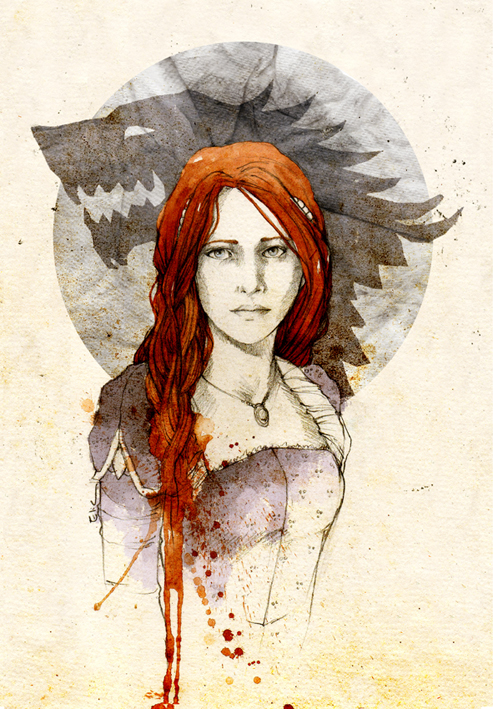
Sansa Stark by Elia-Illustration

Having this example all laid out and extrapolating it to ASOIAF, it dawned on me that Martin is doing this very thing with Sansa in relation to Sandor. How else could it be explained satisfactorily that she’s not called him by his name to date? All readers acquainted with her arc up to the last published book know that Sansa is missing his presence and inventing in her head a kiss Sandor never gave her, as seen in these passages from ASOS:

I wish the Hound were here. The night of the battle, Sandor Clegane had come to her chambers to take her from the city, but Sansa had refused. Sometimes she lay awake at night, wondering if she’d been wise. She had his stained white cloak hidden in a cedar chest beneath her summer silks. She could not say why she’d kept it. The Hound had turned craven, she heard it said; at the height of the battle, he got so drunk the Imp had to take his men. But Sansa understood. She knew the secret of his burned face. It was only the fire he feared. That night, the wildfire had set the river itself ablaze, and filled the very air with green flame. Even in the castle, Sansa had been afraid. Outside… she could scarcely imagine it.

. . .

 Sansa wondered what Megga would think about kissing the Hound, as she had. He’d come to her the night of the battle stinking of wine and blood. He kissed me and threatened to kill me, and made me sing him a song.

. . .

 The memory of her own wedding night with Tyrion was much with her. In the dark, I am the Knight of Flowers, he had said. I could be good to you. But that was only another Lannister lie. A dog can smell a lie, you know, the Hound had told her once. She could almost hear the rough rasp of his voice. Look around you, and take a good whiff. They’re all liars here, and every one better than you. She wondered what had become of Sandor Clegane. Did he know that they’d killed Joffrey? Would he care? He had been the prince’s sworn shield for years.

She even dreams of him in her bed in ASOS:

Sansa heard the soft sound of steel on leather. “Singer,” a rough voice said, “best go, if you want to sing again.” The light was dim, but she saw a faint glimmer of a blade.

The singer saw it too. “Find your own wench—” The knife flashed, and he cried out. “You cut me!”

“I’ll do worse, if you don’t go.”

And quick as that, Marillion was gone. The other remained, looming over Sansa in the darkness. “Lord Petyr said watch out for you.” It was Lothor Brune’s voice, she realized. Not the Hound’s, no, how could it be? Of course it had to be Lothor

That night Sansa scarcely slept at all, but tossed and turned just as she had aboard the Merling King. She dreamt of Joffrey dying, but as he clawed at his throat and the blood ran down across his fingers she saw with horror that it was her brother Robb. And she dreamed of her wedding night too, of Tyrion’s eyes devouring her as she undressed. Only then he was bigger than Tyrion had any right to be, and when he climbed into the bed his face was scarred only on one side. “I’ll have a song from you,” he rasped, and Sansa woke and found the old blind dog beside her once again. “I wish that you were Lady,” she said.

And in her AFFC chapters, she’s still comparing people to him, and imagining the kiss and the marriage bed:

Last of all came the Royces, Lord Nestor and Bronze Yohn. The Lord of Runestone stood as tall as the Hound

. . .

Before she could summon the servants, however, Sweetrobin threw his skinny arms around her and kissed her. It was a little boy’s kiss, and clumsy. Everything Robert Arryn did was clumsy. If I close my eyes I can pretend he is the Knight of Flowers. Ser Loras had given Sansa Stark a red rose once, but he had never kissed her . . . and no Tyrell would ever kiss Alayne Stone. Pretty as she was, she had been born on the wrong side of the blanket.

As the boy’s lips touched her own she found herself thinking of another kiss. She could still remember how it felt, when his cruel mouth pressed down on her own. He had come to Sansa in the darkness as green fire filled the sky. He took a song and a kiss, and left me nothing but a bloody cloak.

. . .

“Oh, yes. He died on top of me. In me, if truth be told. You do know what goes on in a marriage bed, I hope?”

She thought of Tyrion, and of the Hound and how he’d kissed her, and gave a nod. “That must have been dreadful, my lady. Him dying. There, I mean, whilst . . . whilst he was . . .”

In other words: there’s copious instances of Sansa daydreaming with and fantasising with kissing the man . . . and she still cannot bring herself to call him Sandor even in the privacy of her own head. It’s not embarrassment, as it’s not like someone’s going to spring out of nowhere to berate her for it or read her thoughts and make fun of her for her choice of dream lover. It isn’t like she has trouble calling people by their first names, either. She does it with Joffrey, Tyrion, Willas, etc., even with Baelish, for whom she also makes a devil-angel separation of his two personae. Something is quite definitely going on here with Sansa’s inability to call him anything but The Hound during these milestone scenes.

My theory is that Martin is doing just what Dunnett did: he’s deliberately writing Sansa holding back from calling him Sandor at least in her thoughts and dreams until the moment he chooses to make it obvious by having her say his name, outwardly or inwardly. And until the moment Sansa acknowledges her feelings in a conscious manner, he’ll be The Hound in her mind, a name she knows he doesn’t mind. For now, Sansa hasn’t made the conscious admission of her feelings, it’s still very much restricted to the fantasising and dreamlike realm.

This possibility isn’t unlikely to happen. Because GRRM already has done it in the books: he has used the technique of a first name to mark a change of heart from one character towards another twice already, so there’s proof in the books that he’s not only familiar with the technique but makes use of it, too.

Our first strong supporting example are Jaime and Brienne, whose relationship mirrors in many ways Sandor and Sansa’s. Brienne, another firm believer in true knights, begins her acquaintance deeply loathing Jaime for his soiled reputation and allegiance to his usurping House; she doesn’t deign to call him Ser Jaime but hurls at him his sobriquet of Kingslayer like an insult, as can be seen in their first conversation in ASOS:

She scowled again, her face all horse teeth and glowering suspicion. “You’ll wear your chains, Kingslayer.”

“You figure to row all the way to King’s Landing, wench?”

“You will call me Brienne. Not wench.”

“My name is Ser Jaime. Not Kingslayer.”

“Do you deny that you slew a king?”

“No. Do you deny your sex? If so, unlace those breeches and show me.” He gave her an innocent smile. “I’d ask you to open your bodice, but from the look of you that wouldn’t prove much.”

Convinced he’s an irredeemable rascal and no true knight, she denies him a respectful treatment by using his knightly title, or even addressing him with a frosty “Lannister,” and continually reminds him of his fallen status by only calling him Kingslayer during their trip back to King’s Landing. Until they’re captured by the Bloody Mummers and he loses his hand. In this situation of utter humiliation, she witnesses another side of the man she didn’t allow he possessed, and this pushes her towards a kinder disposition. She finally calls him by his name in an attempt to fish him out of his misery:

“Jaime,” Brienne whispered, so faintly he thought he was dreaming it. “Jaime, what are you doing?”

“Dying,” he whispered back.

“No,” she said, “no, you must live.”

From then on, you can see a change in the way Brienne treats him—and the way he treats her and calls her Brienne instead of “wench”—as well as the way she calls him: although she will still refer to him as Kingslayer occasionally, she starts using his title and talks to him in a more polite and respectful manner. It’s the effect of their shared experiences as much as her learning about his service under Aerys II. He becomes Ser Jaime, recovering his knightly status and his dignity in her eyes. And not only that, this change isn’t limited to only regained respect but also ushers in feelings of a romantic nature she starts to develop towards him. Which are evidenced in all her AFFC chapters, where she’s always thinking of him as Jaime or Ser Jaime. She even calls him by his name in her feverish dream in AFFC Brienne VIII whilst lying semi-conscious due to wounds from her fight with Biter:

She dreamt she was at Harrenhal, down in the bear pit once again. This time it was Biter facing her, huge and bald and maggot-white, with weeping sores upon his cheeks. Naked he came, fondling his member, gnashing his filed teeth together. Brienne fled from him. “My sword,” she called. “Oathkeeper. Please.” The watchers did not answer. Renly was there, with Nimble Dick and Catelyn Stark. Shagwell, Pyg, and Timeon had come, and the corpses from the trees with their sunken cheeks, swollen tongues, and empty eye sockets. Brienne wailed in horror at the sight of them, and Biter grabbed her arm and yanked her close and tore a chunk from her face. “Jaime,” she heard herself scream, “Jaime.”

So, we have an undeniable example of the technique’s use in ASOIAF, though Jaime and Brienne move faster because they have less time to grow as characters alongside each other than Sansa and Sandor. For them, the Kingslayer-to-Jaime and Wench-to-Brienne switches happen in approximately one month together, spread across a small handful of chapters. And, although the age gap is the same for the two couples, Brienne is older and doesn’t start off her story as a child growing up under Jaime’s nose, making it possible for GRRM to be more straight and obvious with her feelings, so they aren’t written as subtly or evolve as slowly as plot necessity requires for Sansa.

Sandor Clegane by Bubug

It should be noted that this technique isn’t used only for marking the passage from platonic to romantic feelings. In truth, as the second example will prove, it also works as a marker for a change of attitude from negative to positive, from hate or disrespect to respect and appreciation, without the presence or implication of romantic love.

Arya is the most important and best written example of the technique’s use by Martin, because it directly involves Sandor instead of just providing a mirror story and because it’s better fleshed out and with a better background, as well as fitting quite smoothly with the established precedent that the Stark family use “Sandor” in a positive manner, like I argued earlier in the essay.

Sandor is in her kill list not with his name but with his sobriquet, a sobriquet embodying what he is for the younger Stark daughter: the murderous Hound of the Lannisters who cleaved her friend Mycah in two. She doesn’t know the family history that paints the sobriquet with a veneer of honourability in Sandor’s estimation; for her it doesn’t have the same ring as for her sister, because she doesn’t know him for anything besides his crime and his allegiance to the House with the higher number of people she wants to kill: nearly everyone in her list is a Lannister or connected to the Lannisters in some fashion. The man Sandor is an unknown to Arya, only The Hound exists.

Arya is the only other Stark besides Ned that hears people call him by his name, before and after her own change of heart. The “before” occurs following the famous trial by the Brotherhood without Banners at which Clegane won his freedom and lost his gold:

Anguy strung his bow. Notch was doing the same. “Do you wish to die so very much, Sandor?” asked Thoros. “You must be mad or drunk to follow us here.”

The “after” happens in ASOS Arya XIII, when they run into Gregor’s men at the Crossroads Inn:

“Looking for your brother, Sandor?” Polliver’s hand was down the bodice of the girl on his lap, but now he slid it out.

“Looking for a cup of wine. Innkeep, a flagon of red.” Clegane threw a handful of coppers on the floor.

. . .

The Tickler leaned forward. “Would you put to sea without bidding farewell to your brother?” It gave Arya chills to hear him ask a question. “Ser would sooner you returned to Harrenhal with us, Sandor. I bet he would. Or King’s Landing . . . ”

“Bugger that. Bugger him. Bugger you.”

Like with the Lannister siblings, it makes sense that he’d be addressed familiarly by these people: Thoros lived at court for years and was King Robert’s drinking chum, so he’s known The Hound probably since adolescence; and Polliver and Tickler are in Gregor’s retinue, quite likely hail from the Clegane fief and know him since forever. The technique isn’t at play with Tyrion, Jaime, Cersei, Thoros, Polliver and the Tickler calling him Sandor, because it’s the acquaintanceship of years that entitles them to first name terms with Sandor, and, besides, they’re aware of how he reacts to “ser.”

It takes a tragic episode to turn Arya’s opinion of The Hound upside down and make her say his name at last. After his plan to ransom her to her family is drowned in blood at the Red Wedding, Arya doesn’t forgive him for fighting his way out of the Twins with her knocked out insensible, but it’s clear the experience has irreversibly changed their dynamic. No clearer evidence of it than her transition from calling him “The Hound” or “Clegane” or “Sandor Clegane” to calling him “Sandor”  right after the Twins. In ASOS Arya XII, she calls him by his name in her thoughts several times:

They had two now, Stranger and a sorrel palfrey mare Arya had named Craven, because Sandor said she’d likely run off from the Twins the same as them. They’d found her wandering riderless through a field the morning after the slaughter. She was a good enough horse, but Arya could not love a coward. Stranger would have fought.

. . .

They had passed a small pond a short ways back. Sandor gave Arya his helm and told her to fill it, so she trudged back to the water’s edge. Mud squished over the toe of her boots. She used the dog’s head as a pail. Water ran out through the eyeholes, but the bottom of the helm still held a lot.

. . .

 “Why?” Sandor said. “He don’t care, and we’ve got no spade. Leave him for the wolves and wild dogs. Your brothers and mine.” He gave her a hard look. “First we rob him, though.”

. . .

When morning came, the Hound did not need to shout at Arya or shake her awake. She had woken before him for a change, and even watered the horses. They broke their fast in silence, until Sandor said, “This thing about your mother . . . ”

“It doesn’t matter,” Arya said in a dull voice. “I know she’s dead. I saw her in a dream.”

. . .

Sandor’s mouth tightened. “So you do know who I am.”

“Aye. We don’t get travelers here, that’s so, but we go to market, and to fairs. We know about King Joffrey’s dog.”

“When these Stone Crows come calling, you might be glad to have a dog.”

“Might be.” The man hesitated, then gathered up his courage. “But they say you lost your belly for fighting at the Blackwater. They say—”

“I know what they say.” Sandor’s voice sounded like two woodsaws grinding together. “Pay me, and we’ll be gone.”

Sandor took it off the stick, ripped it apart with his big hands, and tossed half of it into Arya’s lap. “There’s nothing wrong with my belly,” he said as he pulled off a leg, “but I don’t give a rat’s arse for you or your brother. I have a brother too.”

There it is, the prelude to taking him off her list. How could you restore someone his humanity and his dignity by using his name and simultaneously keep him in your murder list? The entirety of ASOS Arya XIII is a testament to this The Hound/Sandor conflicting duality that is tearing at Arya’s insides:

“You know how long it’s been since I had a cup of wine?” Sandor swung down from the saddle. “Besides, we need to learn who holds the ruby ford. Stay with the horses if you want, it’s no hair off my arse.”

. . .

 “What if they know you?” Sandor no longer troubled to hide his face. He no longer seemed to care who knew him. “They might want to take you captive.”

. . .

The innkeep came scurrying back with two stone cups and a flagon on a pewter platter. Sandor lifted the flagon to his mouth. Arya could see the muscles in his neck working as he gulped. When he slammed it back down on the table, half the wine was gone. “Now you can pour. Best pick up those coppers too, it’s the only coin you’re like to see today.”

. . .

 “So Gregor took Harrenhal?” Sandor said.

“Didn’t require much taking,” said Polliver. “The sellswords fled as soon as they knew we were coming, all but a few. One of the cooks opened a postern gate for us, to get back at Hoat for cutting off his foot.” He chuckled. “We kept him to cook for us, a couple wenches to warm our beds, and put all the rest to the sword.”

Sandor said, “The Blackfish is still in Riverrun?”

“Not for long,” said Polliver. “He’s under siege. Old Frey’s going to hang Edmure Tully unless he yields the castle. The only real fighting’s around Raventree. Blackwoods and Brackens. The Brackens are ours now.”

. . .

The Tickler shrugged, straightened, and reached a hand behind his head to rub the back of his neck. Everything seemed to happen at once then; Sandor lurched to his feet, Polliver drew his longsword, and the Tickler’s hand whipped around in a blur to send something silver flashing across the common room. If the Hound had not been moving, the knife might have cored the apple of his throat; instead it only grazed his ribs, and wound up quivering in the wall near the door. He laughed then, a laugh as cold and hollow as if it had come from the bottom of a deep well. “I was hoping you’d do something stupid.” His sword slid from its scabbard just in time to knock aside Polliver’s first cut.

. . .

Polliver was a grim, methodical fighter, and he pressed Sandor steadily backward, his heavy longsword moving with brutal precision. The Hound’s own cuts were sloppier, his parries rushed, his feet slow and clumsy. He’s drunk, Arya realized with dismay. He drank too much too fast, with no food in his belly. And the Tickler was sliding around the wall to get behind him. She grabbed the second wine cup and flung it at him, but he was quicker than the squire had been and ducked his head in time. The look he gave her then was cold with promise. Is there gold hidden in the village? she could hear him ask. The stupid squire was clutching the edge of a table and pulling himself to his knees. Arya could taste the beginnings of panic in the back of her throat. Fear cuts deeper than swords. Fears cuts deeper . . .

. . .

Sandor gave a grunt of pain. The burned side of his face ran red from temple to cheek, and the stub of his ear was gone. That seemed to make him angry. He drove back Polliver with a furious attack, hammering at him with the old nicked longsword he had swapped for in the hills. The bearded man gave way, but none of the cuts so much as touched him. And then the Tickler leapt over a bench quick as a snake, and slashed at the back of the Hound’s neck with the edge of his short sword.

. . .

Polliver and the Tickler had driven the Hound into a corner behind a bench, and one of them had given him an ugly red gash on his upper thigh to go with his other wounds. Sandor was leaning against the wall, bleeding and breathing noisily. He looked as though he could barely stand, let alone fight. “Throw down the sword, and we’ll take you back to Harrenhal,” Polliver told him.

“If you want me, come get me.” Sandor pushed away from the wall and stood in a half-crouch behind the bench, his sword held across his body.

. . .

Her hands were red and sticky when Sandor dragged her off him. “Enough,” was all he said. He was bleeding like a butchered pig himself, and dragging one leg when he walked.

. . .

 “Good.” Sandor’s voice was thick with pain. “If these three were whoring here, Gregor must hold the ford as well as Harrenhal. More of his pets could ride up any moment, and we’ve killed enough of the bloody buggers for one day.”

It’s the effect of the “one death is a tragedy, a million deaths is a statistic” phenomenon. Give your intended target a name and a face and a backstory, and you can no longer kill him in cold blood. You’ve humanised him. This is precisely what happens to Arya, who, although she still uses his sobriquet, can no longer use the sobriquet to keep him at arm’s length as “a statistic.” When caring for his wounds before she leaves him, it’s Sandor the man she’s seeing. She practically has to force herself back into seeing him as The Hound in order to restore him to her list:

When he got the fire going, Sandor propped up his helm in the flames, emptied half the wineskin into it, and collapsed back against a jut of moss-covered stone as if he never meant to rise again. He made Arya wash out the squire’s cloak and cut it into strips. Those went into his helm as well. “If I had more wine, I’d drink till I was dead to the world. Maybe I ought to send you back to that bloody inn for another skin or three. “

. . .

Sandor laughed at the fear on her face. “A jest, wolf girl. A bloody jest. Find me a stick, about so long and not too big around. And wash the mud off it. I hate the taste of mud.”

. . .

Sandor moaned, and she rolled onto her side to look at him. She had left his name out too, she realized. Why had she done that? She tried to think of Mycah, but it was hard to remember what he’d looked like. She hadn’t known him long. All he ever did was play at swords with me. “The Hound,” she whispered, and, “Valar morghulis.” Maybe he’d be dead by morning . . .

. . .

I need silver. The realization made her bite her lip. They had found a stag and a dozen coppers on Polliver, eight silvers on the pimply squire she’d killed, and only a couple of pennies in the Tickler’s purse. But the Hound had told her to pull off his boots and slice open his blood-drenched clothes, and she’d turned up a stag in each toe, and three golden dragons sewn in the lining of his jerkin. Sandor had kept it all, though. That wasn’t fair. It was mine as much as his. If she had given him the gift of mercy . . . she hadn’t, though. She couldn’t go back, no more than she could beg for help. Begging for help never gets you any. She would have to sell Craven, and hope she brought enough.

“Sandor” never made it to Arya’s list, “Sandor” got The Hound off Arya’s list. Such is the humanising power of using a first name in literature.

It must be stressed that the strength of the emotional connection in this technique comes not from merely using someone’s first name but from two characters experiencing shared tragedies. It’s shared tragedies that create the bond, that forge and mould and refine the feelings of love or respect. It’s the same bond of deep comradeship that’s created in combat situations, when men have to go through hell and survive it, and the experience makes the connection between survivors of a Band of Brothers unique, a bond different than in any other relationship, different to that of friends who went to school together or that of sweethearts that have been together since school. It’s the outcome of shared tragedies that upset the balance towards a new understanding of the other in all literary examples listed. For Philippa, it was the grueling search for Khaireddin; for Brienne, it was the Bloody Mummers; for Arya, it was the Red Wedding; for Sansa, it was Joffrey’s brutal abuse. Sometimes it’s one big tragedy, other times it’s a string of tragic events as a whole.

That’s behind my choice of The Lymond Chronicles for my comparative analysis of the technique, whose name in formal Literature studies I am not aware of—I call it with a simple descriptive label: marking characters’ emotional bonding through the use of first names. Because characters go through these requisite shared experiences that shape their relationship, because it has the same level of complexity and subtlety in interpersonal dynamics that ASOIAF does, and because of similarities in key points between the main characters. GRRM doesn’t have to have read Dunnett’s historical epic to be acquainted with the technique. Because the technique isn’t unknown or of recent creation, much less began with Dorothy Dunnett.

It’s centuries old. You can find it in Jane Austen’s Pride and Prejudice (the “Miss Bennett” to “dearest, loveliest Elizabeth” switch on Darcy’s part that express his feelings towards Lizzy) and in other novels from the period and earlier, and in several 20th century classics by authors that influenced Dunnett, like Georgette Heyer’s Arabella and Those Old Shades or Dorothy L. Sayers’ Lord Peter Wimsey Mysteries. For more recent examples, it’s a trope in Japanese manga and anime that a character starting to use another’s first name signifies intimacy and romance. I don’t even need to elaborate on how common it is in contemporary romance novels.

But no other so perfect an example as The Lymond Chronicles can be found, not just because of the requisite elements I already mentioned but also because it’s not always possible to clearly distinguish if the Mister-to-First Name switch is done following the technique’s pattern to indicate feelings, and when it’s merely due to social conventions. For example, in Austen’s time, society deemed it bad manners to call someone by their first name if one wasn’t related and/or well-acquainted with them. And this social norm has to be respected in historical romance and historical fiction, too, because social customs of the past were different and you couldn’t simply start addressing any person by their name whenever you wanted. Our modern informality wouldn’t have been acceptable in polite society. In some cultures it still isn’t, like for the Japanese, which might account for why it’s a trope in their literature and visual media to reveal a character’s falling in love through having then call the beloved by their name.

We have ample proof that Martin is as skilled at this technique as Dunnett from our book examples, and capable of doing it for both outcomes, romance and respect. We have Jaime/Brienne and Arya/Sandor already done and completed, so there is no reason why Martin wouldn’t be currently doing the same for Sansa, too, and it’s only a matter of time that he’ll take the pattern to its logical conclusion, which is still in the future. If so, what lies ahead is to look up for just “Sandor” in a POV of hers in the book to come; because that’ll mark the moment Sansa consciously acknowledges what she has in her heart instead of just signaling it through all this subtlety, hints, and small clues we are left to pore over and interpret.
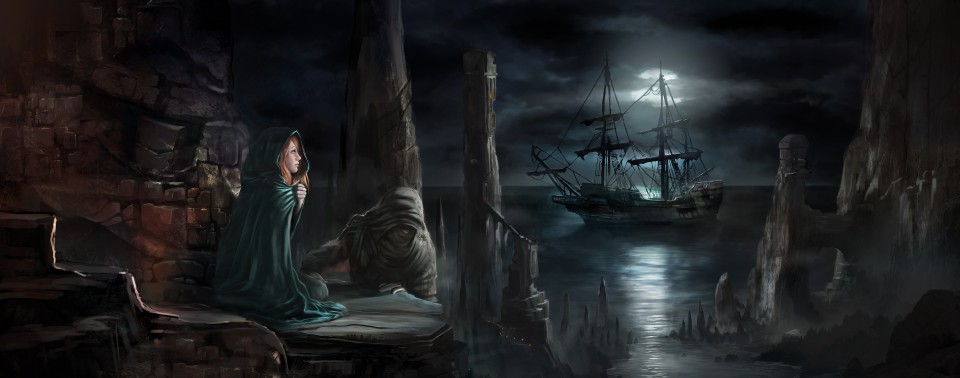
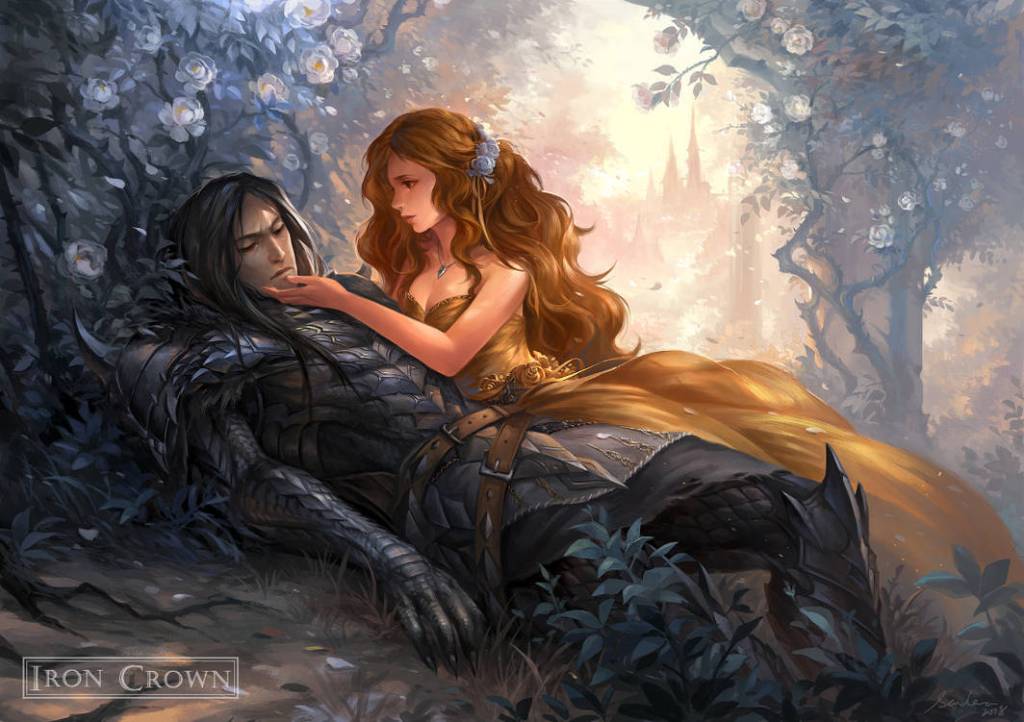
To Kill a Mockingbird, Part II

Tags

, ,

Littlefinger by Xin Xia

In Part I of our series analysing Petyr Baelish’s moves as a player on the Westerosi political chessboard, we saw that Littlefinger’s economics strategy has basically been to steal from the crown through fabricated expenses and his magical revenues are simply from cutting the treasury in on a percentage of his own graft.

In trying to puzzle out Littlefinger’s endgame it is very easy to get lost in the weeds.  He is the villain most fond of exposition, but his efforts to impress a thirteen-year-old girl with his brilliance only reveal the trail of his destruction and not a clear path forward to his own goals. He’s been granted Harrenhal and Lord Paramount of the Riverlands, yet he completely ignores his seat and his domain beyond the status it gives him to marry Lysa.  He eliminates Lysa and solidifies his hold over Sweetrobin, but then claims he wants the child eliminated in favor of the Vale passing to Harry the Heir with Sansa as his bride.  He has de jure control over one of the Seven Kingdoms and de facto control of another, and still his eyes look with lust toward some other horizon. What is Littlefinger’s envisioned end state?

Clearly he wants power, but his decisions to pass up power as he does in the Riverlands or use power he’s acquired as merely a stepping stone like he’s doing in the Vale show that he’s particular about the place, the amount, or the circumstances of the power he desires. The most apparent of these are the circumstances and the primary circumstance is through his relationship with Sansa. Throughout all of Littlefinger’s scheming, Sansa plays prominently and she seems to be the key to deciphering his ultimate goals. The current Part II aims to expose how he maneuvers to acquire the political power leading to the achievement ot such goals, or, more specifically, who he uses.

To Kill a Mockingbird, Part II

by Ragnorak

From the first time Petyr meets Sansa at the Hand’s Tourney, his interest is clear. We already have the backstory of his fixation on Catelyn as Littlefinger’s first words are that Sansa “must be one of her daughters.” Baelish makes Sansa feel “ill at ease” even before speaking. She notes that his eyes do not smile when his mouth does before he goes on to tell her that she has Cat’s hair as he strokes it, and that Cat was once “my queen of beauty.” She introduces herself as Sansa Stark, but Littlefinger goes on to state that she has the Tully look. These initial elements will repeat throughout Sansa’s arc.


Littlefinger will continue to display an interest that makes Sansa uncomfortable long before he imposes unwelcome kisses. When she is brought before the Small Council after Ned’s arres, his stares make Sansa feel as if she has no clothes on. In context, her father has just been arrested and the Stark household slaughtered, yet Cersei manages to fix her with a look that gives Sansa the illusion of kindness behind her green eyes compared to Petyr’s lecherous gaze. Again, Baelish asserts that “She reminds me of the mother, not the father” as he comments on her hair and eyes.

It is not until A Dance with Dragons treats us to one of Cersei’s what-if laments that we receive the information to fully interpret these scenes.

Petyr Baelish had offered to wed the girl himself, she recalled, but of course that was impossible; he was much too lowborn.

Offering to marry the king’s betrothed is a guaranteed way to earn a date with Ilyn Payne, so some context seems in order. During the meeting, when Sansa is asked to write the letter home, the issue of whether or not the daughter of a traitor could still be allowed to marry the king is raised by Cersei. Given Cersei’s later recollection of Petyr’s offer, it seems likely that, in the meeting the Small Council had prior to bringing Sansa in to persuade her to write the letter, the issue of the betrothal and potential alternate matches for Joffrey were raised. Petyr seems to have offered himself as an option should the betrothal be set aside, and would likely have raised the small benefits of keeping Sansa at Court long-term as a hostage as well as his ability to sway Catelyn Stark on the peaceful merits of such a union. So Sansa’s chapter where Petyr is undressing her with his eyes is, for him, the moment where he believes the opportunity for him to marry Sansa is being decided.


Given the way Littlefinger’s path to power plays out, this is a deeply important revelation. Petyr’s birth as a lord, even the lowest of lords with fewer assets than most landed knights, was a permission slip for entry into the power circle of Westeros. It is what allowed for his fostering at Riverrun, and what allowed for him to be eligible for offices such as his Gulltown post and Master of Coin. Still, his birth status as a lord only prevented his denial of these offices by station; it did nothing to ensure him a place at the table. It was only through Lysa’s intervention that he was ever able to rise above the meager height of Lord of Sheepshit to his lofty perch on Aegon’s High Hill. Knowing Lysa’s reaction to the Snow Winterfell kiss, we can safely assume that a marriage to Sansa would have burned the Lysa bridge and left him with a very unstable woman scorned looking to prove certain truths about hell’s fury. That Baelish was willing to risk such a thing at this early stage speaks volumes about the degree of importance Sansa plays in his goals.


Littlefinger’s plan always seems to have involved obtaining a title sufficient to justify a marriage to Lysa to usurp control of the Vale through Sweetrobin. This has been Lysa’s impression all along. While Petyr would lie to her and lead her on with no reservations, it does happen to fit with his chess moves and the schemes he plays out. He deliberately used Lysa to keep the Vale out of the fighting, which would generally only be a smart move if his plans included the Vale as one of his eventual pieces. Why leave a future adversary untouched by the ravages of war?

Littlefinger is from the Vale and his initial powerbase was established in Gulltown. He as much as comes out and says this to Sansa:

“The solar.” She should have stopped with that, but the words came tumbling out of her. “If you gave them Robert…”

“…and the Vale?”

“They have the Vale.”

“Oh, much of it, that’s true. Not all, however. I am well loved in Gulltown, and have some lordly friends of mine own as well. Grafton, Lynderly, Lyonel Corbray…”

Houses Grafton and Corbray both sided with Aerys Targaryen in Robert’s Rebellion against the choice of their liege lord Jon Arryn. Both fought against Robert in the Battle of Gulltown, and Marq Grafton, the then Lord of Gulltown, was personally slain by Robert Baratheon in that battle. It may well be that Lord Grafton had ambitions to be raised to Lord Paramount of the Vale. Lord Godric Borrell tells Davos of the temptation to send Ned Stark’s head to Aerys:

“Our maester urged us to send Stark’s head to Aerys, to prove our loyalty. It would have meant a rich reward. The Mad King was open-handed with them as pleased him.”

Whatever Lord Grafton’s motivations, and despite his son switching sides and supporting Robert after the defeat at Gulltown, it must have left them more than a little out of favor with Jon Arryn when the rebellion was over. Sending Petyr Baelish, the lowest of possible lords, to manage a port that is the very heart of House Grafton was likely as much a message to House Grafton as it was a gesture to appease Lysa. Even if Jon Arryn held no grudge, it would be difficult for House Grafton to not interpret the appointment as such.

So the young Petyr Baelish would have arrived in Gulltown appearing the darling of the high lord and Hand of the King to serve as salt in the wound of the new Lord Grafton’s recently dead father. Littlefinger’s modus operandi would make him the type to play up on that insult and use it to drive a wedge in-between Houses Grafton and Arryn in order to exploit the rift. Baelish would also have appealed to vice, in this case likely greed and envy of other Houses in Arryn’s favor, to attempt to make House Grafton one of his pieces. Lysa tells Sansa that Littlefinger increased the revenues in Gulltown by tenfold, which is curiously the same figure he is credited with as Master of Coin. This tells us that Littlefinger was almost certainly engaged in the same wage and market manipulation scams in Gulltown as he was in King’s Landing, and was likely buying House Grafton with a cut of the corruption. They are named House Grafton.


Littlefinger’s ability to effortlessly switch sides from Stark to Lannister to Tyrell gives the impression of a man with no assets to defend and no roots to tie him down. However, this is not entirely the case. He has roots in Gulltown, and relationships in the Vale with both merchants and lords. He has set Lysa up to make her willing and eager to grant him Lord Protector of the Vale for Sweetrobin’s minority. He has essentially set up a lesser version of the Varys/Aegon scheme. Gulltown is his Illyrio financing, with Littlefinger being the puppet master in hiding and Sweetrobin the heir in plain sight in a reversal of Varys and Aegon. Marrying Sansa would put all this in jeopardy, and have the immediate risk of driving Lysa’s Vale back into the camp of the North and Riverlands with Lysa’s knowledge of the twincest. This is before Ned is executed, before Robb marches south, before Riverrun falls to Jaime’s host or the Westerland army even attacks the Riverlands, and before either Stannis, Renly or Highgarden declare their intentions. Baelish makes this offer to marry Sansa while Lysa has Tyrion sitting in a sky cell over his dagger lie. It is hard to conceive of a worse chess move, and difficult to read this information as anything other than a blinding obsession with Sansa.

When Tyrion offers him Harrenhal, it seems clear that Baelish already has the plans made to marry Lysa and is simply waiting for an enabling title and opportunity. Before Tyrion has a chance to lay out his offer, Petyr preemptively tries to sabotage a Jaime for Sansa trade:

 “That would depend on the words. If you mean to offer Sansa in return for your brother, waste someone else’s time. Joffrey will never surrender his plaything, and Lady Catelyn is not so great a fool as to barter the Kingslayer for a slip of a girl.”

Of course, Cat is completely willing and even desirous of making this very trade. She not only tries to persuade Robb to make this deal, she frees Jaime on her own to try and force Robb’s hand. The question left for the reader is only whether or not Littlefinger knows this about Cat or if he has an agenda in swaying Tyrion from this course. Given his successful manipulation of Cat from Lysa’s letter, to the dagger, and using her to get Ned to trust him, the agenda seems far more likely. On the simplest level, such a trade might lead to a peace which a man who thrives on the chaos of war would not want. Looking at Littlefinger’s reaction to Tyrion’s offer provides a more specific reason—Sansa. “Come to the godswood tonight, if you want to go home” is the first line of the very next chapter following Tyrion’s offer. The first thing Baelish does after being offered Lord of Harrenhal, Paramount of the Riverlands, the opportunity to control the Vale through a marriage to Lysa, and custody of a royal heir for his scheming is to put in effect a plan to steal Sansa from King’s Landing.

After negotiating the Tyrell alliance, Littlefinger asks Tywin for the very same reward Tyrion promises in his fake offer. It is possible that Baelish came upon his scheme through Tyrion’s offer, but it is also possible he had this in mind all along. Lord of Harrenhal is the same prize that he arranged for Janos Slynt in exchange for betraying Ned Stark. Tywin may fall on the more extreme side of valuing class and birth status, but his bewilderment and outrage at offering a seat of kings to a butcher is hardly abnormal amongst Westeros nobility. The likelihood of Janos Slynt ever claiming Harrenhal or keeping it for long if he managed to enter its gates was always extraordinarily low. It is quite possible Baelish was arranging to keep it off the table so that it could become available for himself at some future date. Such a reward following Ned’s treason accusation is as good as advertising one’s complicity, and it is possible Petyr Baelish did not want to be so publicly pronounced a Lannister lackey at this stage of the game. It is also possible that the Harrenhal reward was his to dispense. Slynt was Littlefinger’s man, and it was Petyr and not Cersei who arrived at terms with Slynt. If Cersei had called off the betrothal and offered Sansa to Baelish, perhaps he would have taken Harrenhal as his own prize. Cersei’s thoughts only reveal that she believed Petyr was too lowborn for Sansa, which in her value system would still apply even if he were granted a sufficient title such as Harrenhal to warrant the match. There isn’t sufficient information in the text to know for sure, but Petyr was involved in three Harrenhal offers and all three involved an attempt to claim or snatch Sansa for his own, which is rather telling in itself.

One of the elements that is consistently intertwined with Littlefinger’s Sansa fixation is his repeated denial of her identity as a Stark. The text intentionally mirrors this with Sansa physically resembling Cat and Arya resembling Ned, as well as Sansa’s initial fascination and association with Southron life and the Seven at the beginning of the series. As the story unfolds, it is Arya who begins to more resemble Cat’s personality, and Arya whose story and direwolf tie her to her mother’s place in the Riverlands. Sansa’s personality is revealed to be far more like Ned’s and she finds herself drawn to the godswood, and literally and figuratively following in his footsteps as her story unfolds. This denial of Sansa as a Stark is possibly the single most important clue as to Littlefinger’s fate.

The scene where Littlefinger betrays Ned plays out as a mockery of First Men justice. Baelish looks Ned in the eyes, passes sentence, but has no interest in hearing his last words. His true “crime” in Littlefinger’s eyes is stealing Cat, so it is really about vengeance and not justice from his perspective. Instead of swinging the sword himself, Baelish waits for the next chapter to carry out the sentence with a dagger to the back while again not looking Ned in the eyes while the “sentence” is carried out.

He leaned back and looked Ned full in the face, his grey-green eyes bright with mockery. “You wear your honor like a suit of armor, Stark. You think it keeps you safe, but all it does is weigh you down and make it hard for you to move. Look at you now. You know why you summoned me here. You know what you want to ask me to do. You know it has to be done… but it’s not honorable, so the words stick in your throat.”

Littlefinger laughed. “I ought to make you say it, but that would be cruel… so have no fear, my good lord. For the sake of the love I bear for Catelyn, I will go to Janos Slynt this very hour and make certain that the City Watch is yours. Six thousand gold pieces should do it. A third for the Commander, a third for the officers, a third for the men. We might be able to buy them for half that much, but I prefer not to take chances.” Smiling, he plucked up the dagger and offered it to Ned, hilt first.

As his men died around him, Littlefinger slid Ned’s dagger from its sheath and shoved it up under his chin. His smile was apologetic. “I did warn you not to trust me, you know.”

The circumstance Ned found himself in was Lord Protector without an army and under an illusion born of Cat that he could trust someone. Several books later, Petyr Baelish finds himself in that same awkward position of Lord Protector with no army and under a not dissimilar illusion born of Cat that he can trust Sansa. Given Littlefinger’s repeated willful blindness regarding Sansa’s heritage as Ned’s daughter, he may well have quipped his own epitaph to Ned:

Littlefinger sighed. “I fear I did forget, my lord. Pray forgive me. For a moment I did not remember that I was talking to a Stark.

From his earliest introduction in A Game of Thrones, the foundation has been laid for Littlefinger’s downfall at Sansa’s hands within the metaphorical context of First Men justice. That leaves a great deal of room in terms of plot-specific speculation, but we do get some strong prophetic hints straight from the Old Gods. The first is Bran’s vision of the giant, which at first bears little resemblance to Littlefinger.

He looked south, and saw the great blue-green rush of the Trident. He saw his father pleading with the king, his face etched with grief. He saw Sansa crying herself to sleep at night, and he saw Arya watching in silence and holding her secrets hard in her heart. There were shadows all around them. One shadow was dark as ash, with the terrible face of a hound. Another was armored like the sun, golden and beautiful. Over them both loomed a giant in armor made of stone, but when he opened his visor, there was nothing inside but darkness and thick black blood.

On a first read, the giant seems closer to Gregor Clegane, and speculation of an undead headless Gregor only reinforces that impression. Giants and shadows are some of Martin’s frequent in-story metaphors, and even Tyrion is referred to as a giant on multiple occasions, so the vision need not be literal. Speculation that Littlefinger might be the giant of Bran’s vision comes with the information that his original sigil was the stone Titan of Braavos. It is further fueled by the Ghost of Highheart and her vision of a maid slaying a giant in a castle made of snow.

“I dreamt a wolf howling in the rain, but no one heard his grief,” the dwarf woman was saying. “I dreamt such a clangor I thought my head might burst, drums and horns and pipes and screams, but the saddest sound was the little bells. I dreamt of a maid at a feast with purple serpents in her hair, venom dripping from their fangs. And later I dreamt that maid again, slaying a savage giant in a castle built of snow.

The first part is the Red Wedding and the second part seems to be the Purple Wedding and the poisoned hairnet, which makes Sansa the maid to slay the savage giant in the castle made of snow. Littlefinger as the savage giant is hinted at again as Arya first sees the Titan of Braavos:

Arya could see the arrow slits in the great bronze breastplate, and stains and speckles on the Titan’s arms and shoulders where the seabirds nested. Her neck craned upward. Baelor the Blessed would not reach his knee. He could step right over the walls of Winterfell.

Stepping over the walls of Winterfell is exactly what the man born with the Titan of Braavos as his sigil did when Sansa was rebuilding Winterfell in snow.

When he had enough, he stepped over both walls with a single long stride and squatted on his heels in the middle of the yard.

During that Snow Winterfell scene, Sansa figuratively slays a giant in the form of Sweetrobin’s doll by beheading it and mounting the head on the walls of Snow Winterfell. It is doubtful the Ghost of Highheart prophesized the death of a spoiled child’s toy amidst scenes of the death of kings, so the Snow Winterfell scene is likely more symbolism for the eventual slaying of the savage giant. The castle made of snow could be Winterfell given that Sansa remade it in snow and it is already buried in snow by the end of A Dance with Dragons and likely to stay that way until Spring. It could also be the Eyrie, which Sansa describes as “a castle made of snow” on her descent at the end of A Feast for Crows. From a plot perspective, Littlefinger’s death at the Eyrie would be far more imminent, while a death at Winterfell would make for a comparatively longer and more drawn out plotline.

Sansa’s Choice to Wear her Favour: The Case for Ser Byron the Beautiful

Tags

15th_century_joust_by_kristinagehrmann_ddioox3-pre

15th century Joust by Kristina Gehrmann

by Brashcandy

Who would ask to wear a bastard’s favor?”

“Harry, if he has the wits the gods gave a goose… but do not give it to him. Choose some other gallant, and favor him instead. You do not want to seem too eager.

Such is the advice Littefinger gives to Sansa Stark, acting as his bastard daughter Alayne Stone, when she comes to find him in the vaults at the Gates of the Moon after the arrival of her betrothed Harry the Heir. It is not the usual guidance one would think a father would impart to his daughter, but this is not a traditional father/daughter relationship and Petyr Baelish is no ordinary mentor. While he does not specify the “gallant” Sansa should bestow her favour on, his reasoning is clear: he wants her to entice and tease Harry, but to still withhold some show of outright preference, thereby serving to keep the Young Falcon enthralled and interested. When she later dances with Harry at the pre-tourney feast, we see that Alayne has taken her father’s words to heart; she is decidedly more bold and playful with Harry, questioning him about his bastard children, their mothers, and making the very suggestive assertion that she will be all the “spice” he wants. The hapless Harry, predictably entranced, goes on to ask for Alayne’s favour, but she denies him, replying “You may not. It is promised… to another.”

Just who this “another” will be has intrigued the fandom since the release of the sample chapter five years ago. The chapter doesn’t contain any major revelations or dramatic scenes, but this ending acts as a sort of cliffhanger, setting up the reader’s expectation that Alayne’s favour will have considerable narrative significance. In choosing her knight, we know that Alayne is quite spoilt for choice, as Martin gives us a litany of potential options from her list of dance partners at the feast, and not to be forgotten, from her conversations with two unpredictable characters earlier in the day: Ser Shadrich of the Shady Glen and Ser Lyn Corbray of Heart’s Home. While Ser Lyn remains a viable contender, however volatile and risky for Alayne to choose, we can safely rule out Ser Shadrich for now, as he tells Alayne and Randa that he does not intend to compete for wings at the tourney. Of course, readers know that the Mad Mouse has been searching for Sansa Stark for quite some time, finally entering Littlefinger’s service as a hedge knight along with two others, and meeting Sansa after she departs from the Eyrie in her final chapter of AFFC. As their conversation in the training yard reveals, Ser Shadrich now knows for certain that the Lord Protector’s bastard daughter is really the missing Stark girl, and while his stated purpose was to gain the ransom being offered for her return to KL, readers are as yet still unclear about what his true motivations are and what he will seek to do with this knowledge. Sansa’s favour, operating in this simmering hotbed of escalating tensions and subterfuge, is no longer relevant as a mere affectionate courtly gesture, but has now been transformed into a potentially game changing strategy by an emerging player.

Thus, which knight would make the best strategic decision, both from Sansa’s perspective (being mindful of her character growth) and from the larger consideration of plot developments involving other characters and events? These questions have led us to seriously consider Ser Byron the Beautiful, the hedge knight we are first introduced to as one of a trio of men LF hires into his service at the end of AFFC. To begin, a small confession is in order: This theory owes its development due to my frustration in trying to figure out the real identity of Ser Byron, as I am working from the assumption that both Ser Morgarth and Ser Shadrich are operating under false pretenses as it relates to their true identities/purposes in coming to the Vale of Arryn. We already know Ser Shadrich is hiding the fact that he was searching for Sansa, but could he also be someone else entirely, as yet an unknown figure who has his own motives in this search? A popular theory in the fandom suggests that he is Howland Reed, but that is outside the scope of our inquiry for now. Concerning Ser Morgarth, one of our “crackpot” theories here at Pawn to Player alleges that he is really the Elder Brother of the Quiet Isle. It makes narrative sense, therefore, that Byron is also not who he would appear to be, and is certainly not there to give loyal service to the Lord Protector.

An important aspect of this theory is that these hedge knights appear to be working together. With the exception of Sansa meeting Shadrich alone in the yard in the TWOW sample chapter, Martin reinforces the image of the three men as a unit from their first appearance in Littlefinger’s solar to when we last see them dancing with Alayne at the feast:

Just as Petyr had promised, the young knights flocked around her, vying for her favor. After Ben came Andrew Tollett, handsome Ser Byron, red-nosed Ser Morgarth, and Ser Shadrich the Mad Mouse.

In particular, Martin seems to want us to focus on their appearances, almost as if there are clues to be discerned from these descriptions. This echoes our first introduction to them in AFFC when readers were meant to immediately recognize the wily Ser Shadrich:

She hugged him dutifully and kissed him on the cheek. “I am sorry to intrude, Father. No one told me you had company.”

“You are never an intrusion, sweetling. I was just now telling these good knights what a dutiful daughter I had.”

“Dutiful and beautiful,” said an elegant young knight whose thick blond mane cascaded down well past his shoulders.

“Aye,” said the second knight, a burly fellow with a thick salt-and-pepper beard, a red nose bulbous with broken veins, and gnarled hands as large as hams. “You left out that part, m’lord.”

“I would do the same if she were my daughter,” said the last knight, a short, wiry man with a wry smile, pointed nose, and bristly orange hair. “Particularly around louts like us.”

Alayne laughed. “Are you louts?” she said, teasing. “Why, I took the three of you for gallant knights.”

Leaving aside their physical attributes for the moment, we should also pay attention to how “coordinated” and prepared their responses to Alayne’s arrival appear to be. There is no hesitation or delay. One after the next, they each build on the other’s statement, ending with Shadrich’s suggestive comment about “louts like us.” What we get is a singular impression of the three knights, despite their varying descriptions, leading to a reasonable conclusion that they have decided to combine their efforts and resources towards a mutual goal. If the goal is simply kidnapping Sansa and returning her to captivity in KL as Shadrich led Brienne to believe, then the presence of the Elder Brother as Morgarth would certainly undermine that undertaking. Furthermore, while Shadrich had offered to split his bounty with Brienne, the requirement to split it three ways would seem less than ideal, to say nothing of the risk of involving untrustworthy mercenary types who might seek to steal Sansa away and gain the full ransom for themselves. We are not told the details of how exactly they came to be hired by LF in Gulltown, but that all three appear comfortable in each other’s company is notable and suggests some kind of prior familiarity or connection.

Ser Byron, by the very nature of how Martin describes him, is the easiest one to overlook, especially in light of Sansa’s experiences, which have taught her that golden and beautiful exteriors can often be misleading, and that it is much better to judge someone on their character and actions. That Byron’s appearance recalls the prototypical Lannister is likely a deliberate authorial choice, highlighting how Sansa is no longer blinded by or even attracted to that ideal of beauty anymore—one that caused her considerable misery and pain. But just what do we make of Byron and why is he included in this group of potential Sansa helpers appearing very much like the odd man out at this stage of her development? In trying to figure out his identity, I quickly realised it might be more beneficial to focus on the specific role he could play in the plot and that is where the idea of him being the one to receive Alayne’s favour took shape.

From the moment he meets Alayne, Byron plays the performance of the dashing knight, complimenting her looks and kissing her hand as he departs the room. She describes him as “elegant” and “young,” and later at the feast as “handsome.” There is no sense, however, that Alayne’s interest in Ser Byron goes any further than her appreciation of the fact that he has been hired to bolster LF’s guard at the Gates. So why would she choose him to wear her favour of all the other available options? The most obvious reason is that he’s the perfect choice to achieve her apparent goal of making Harry the Heir jealous as LF advises her to do during their conversation in the vaults. Left to her own devices, Sansa may have given her favour to someone like Ser Wallace, Anya Waynwood’s son, whom she clearly empathises with and seeks to save from embarrassment when he dances with her at the feast. Or, another choice could have been Ser Lyn Corbray, whom she appreciates as a vicious fighter and is certainly set to make his mark on the tourney. That Ser Lyn Corbray might no longer be loyal to her father is something that piques Alayne’s curiosity, a potential bit of knowledge that she could exploit in the future. However, both Ser Wallace and Ser Lyn are not likely to make Harry jealous, as the former is someone he’s grown up with all his life, who is awkward and shy, whereas the latter is well-known to be uninterested in the charms of women, and whose selection might only serve to set off LF’s alarm bells. Byron, with his noted good looks, elegant bearing, and courtly manners is the ideal knight to make Harry feel annoyingly insecure. After her repartee with Harry at the feast, Sansa knows even better than before that he is a shallow sort, one who values looks above all else by the way he talks about his lovers, and altogether someone that is fairly easy to manipulate. Her first impression of Harry is revealing:

Ser Harrold Hardyng looked every inch a lord-in-waiting; clean-limbed and handsome, straight as a lance, hard with muscle. Men old enough to have known Jon Arryn in his youth said Ser Harrold had his look, she knew. He had a mop of sandy blond hair, pale blue eyes, an aquiline nose. Joffrey was comely too, though, she reminded herself. A comely monster, that’s what he was. Little Lord Tyrion was kinder, twisted though he was.

We’ve seen no evidence yet that Harry is a “comely monster” in line with the likes of Joffrey, but the comparison is significant nonetheless. It underscores the theme of appearance vs. reality that runs through Sansa’s arc, and emphasises the irony of Byron being the one to receive her favour at this juncture. Unlike the Sansa of old, who swooned at the Knight of Flowers during the Hand’s tourney, this Sansa could be set to choose a gallant knight for an altogether different purpose, using her favour not as a decorative declaration of affection but as a deliberate decoy. This aligns perfectly with the covert role that Ser Byron could already be engaged in, and renders not just Harry, but also Petyr Baelish, as the duped figures. The choice of Ser Byron would tie together the relevance of these mysterious hedge knights, and present an opportunity for Sansa to learn their true purpose. So far, the three appear to be keeping a low profile, but Ser Shadrich’s remarks to Sansa in the yard suggest that he is planning to make a move soon. Choosing Ser Byron, despite Sansa having no knowledge of what they are planning as yet, could be seen as a symbolic blessing of their clandestine mission. It also expands the scope of agency she has exercised throughout the planning and execution of the winged knight tourney.

Byron’s selection also presents an opportunity for Martin to explore the very compelling parallels to the Hand’s tourney and the last time Baelish bet against a knight who had received Sansa’s “favour.” LF’s confidence in his scheming is reminiscent of his certainty at the Hand’s tourney about the reason the Hound would lose to Jaime, told through Ned’s POV:

A hundred golden dragons on the Kingslayer,” Littlefinger announced loudly as Jaime Lannister entered the lists, riding an elegant blood bay destrier. The horse wore a blanket of gilded ringmail, and Jaime glittered from head to heel. Even his lance was fashioned from the golden wood of the Summer Isles.

“Done,” Lord Renly shouted back. “The Hound has a hungry look about him this morning.”

Even hungry dogs know better than to bite the hand that feeds them,” Littlefinger called dryly.

Has Littlefinger grown wiser since then? The barely contained rage of a Ser Lyn Corbray would argue that he has not, and that he has forgotten that hungry dogs can indeed bite or even savage their masters. His conversation with Alayne after the trio depart in AFFC provides additional evidence that he has kept the same faulty mindset and could have unwittingly ensured his own downfall:

Hedge knights?” said Alayne, when the door had closed.

Hungry knights. I thought it best that we have a few more swords about us. The times grow ever more interesting, my sweet, and when the times are interesting you can never have too many swords. The Merling King’s returned to Gulltown, and old Oswell had some tales to tell.”

During the Hand’s Tourney, we saw Sansa through her father’s POV silently supporting the Hound during his match with Jaime. She watches their joust “moist-eyed and eager” according to Ned, and later declares “I knew the Hound would win.” Prior to this event, Sandor is tasked with escorting Sansa back to her chambers and on the way they have the very profound conversation that marks a new phase in their relationship. There is every reason to believe that Sansa’s support of him during that match is informed by her learning the truth of how he was injured by Gregor and the resulting affinity that arises between them. Sansa even predicts that he will be the overall champion when he saves Loras Tyrell from Gregor’s wrath. To reiterate, Littlefinger in effect loses his bet to Sansa at the Hand’s Tourney, as he thinks the Hound will be too wary of beating his Lannister lords. This provides an illuminating parallel to what we might see play out during the Winged Knights tourney, where we have Harry the Heir as the knight Littlefinger has placed his bets on, confident that he has succeeded in gaining Alayne’s complicity in the plot, and likely having a few more tricks in place to assure Harry wins a place in the winged knights. Harry, therefore, assumes the role of Jaime Lannister in this comparison. How did his joust with Sandor Clegane end for Jaime? Well, here is the passage:

The Hound just managed to stay in his saddle. He jerked his mount around hard and rode back to the lists for the second pass. Jaime Lannister tossed down his broken lance and snatched up a fresh one, jesting with his squire. The Hound spurred forward at a hard gallop. Lannister rode to meet him. This time, when Jaime shifted his seat, Sandor Clegane shifted with him. Both lances exploded, and by the time the splinters had settled, a riderless blood bay was trotting off in search of grass while Ser Jaime Lannister rolled in the dirt, golden and dented…

Jaime Lannister was back on his feet, but his ornate lion helmet had been twisted around and dented in his fall, and now he could not get it off. The commons were hooting and pointing, the lords and ladies were trying to stifle their chuckles, and failing, and over it all Ned could hear King Robert laughing, louder than anyone. Finally, they had to lead the Lion of Lannister off to a blacksmith, blind and stumbling.

Now consider how this fits with what Sansa wishes for Harry after he is rude to her during their initial conversation when he arrives to the Gates:

A lady’s armor is her courtesy. Alayne could feel the blood rushing to her face. No tears, she prayed. Please, please, I must not cry.“As you wish, ser. And now if you will excuse me, Littlefinger’s bastard must find her lord father and let him know that you have come, so we can begin the tourney on the morrow.” And may your horse stumble, Harry the Heir, so you fall on your stupid head in your first tilt. She showed the Waynwoods a stone face as they blurted out awkward apologies for their companion. When they were done she turned and fled.

Sansa essentially wishes for the same thing to happen to Harry that we see taking place with Jaime when he falls and can’t get the helmet off his head. Will we be treated to a similar scene where Harry does indeed end up dented and bruised in the dirt, humiliated at the tourney by his betrothed’s champion? That he has now been associated with two Lannisters certainly does not inspire confidence that we’re going to see a marriage taking place between him and Sansa as Baelish is banking on.

Ultimately, what Littlefinger appears fundamentally unable to grasp is that people are motivated by other things besides money. Even someone as callous and cold-hearted as Ser Lyn wants a lordship and not simply boys to sate his desire. What do honourable men and women want? Those who remember the bonds of loyalty, family honour, and possess values that cannot be bought or traded? Men like Bronze Yohn and those who are trudging through the snow to rescue “Ned’s girl” at Winterfell? Unlike LF, it is Sansa whom we’ve seen employing her empathetic skills to determine people’s true desires and inspire them towards better ends.

As an intriguing aside, it would be remiss not to mention Pawn to Player’s contributor Ragnorak’s theory that compares LF’s hiring of three hedge knights to the three Kettleblacks who were secured in KL to spy on Cersei and Tyrion and report back to him in secret. In the above quote about “hungry knights,” we learn that Oswell has “some tales to tell,” since the Merling King has returned to Gulltown, likely of the unfolding conflict between Cersei and the Faith in KL and how his sons have been implicated. Ragnorak notes in a discussion of our Morgarth theory:

So Littlefinger is mirroring Cersei with her hiring the three Kettleblacks and her plot to hide Tommen. I tie this into his betrayal of Ned where another Lord Protector found himself without an army amidst political intrigue. There may well be a theme here that the “weaknesses” Littlefinger exploits are more inherent in the needs of a Lord with assets to defend than something born of foolishness. It is a different game when you have something to lose, holdings to protect, and you are on everyone else’s radar. Coming back to our current crackpot, if the Cersei parallels are intentional then viewing these three knights as pseudo-Kettleblack figures may be helpful especially since we’re given enough to know that at least one has ulterior motives.

With great power comes great responsibility and the most remarkable aspect of the sample chapter might just be how absent LF is from start to finish. Despite him clearly still being in charge as the Lord Protector, it is Alayne we see with the considerable freedom of movement, allowing her to notice troubling developments like Ser Lyn’s slipping allegiance to her father, and to have a very distressing first introduction to the boy she is supposed to eagerly marry. Arguably, it is Lothor Brune’s brusque words of support – “He’s just some upjumped squire” – that give her more comfort than LF’s menacing flattery below in the vaults. Baelish’s biggest weakness, glimpsed all the way back at the Hand’s Tourney is his obsession with Catelyn Stark that he has transferred to her daughter. No one is positioned to exploit this weakness better than Sansa, and choosing a knight to wear her favour could be the crucial first step in gaining control of her own network of allies who have gathered at the Gates.

Littlefinger has no reason to be suspicious of the handsome hedge knight Ser Byron—indeed, by all appearances, Sansa is following his advice to the letter, choosing “some other gallant” to show favour to instead of giving her betrothed the expected honour. Further, as we’ve established, he thinks that “hungry dogs know better than to bite the hand that feeds them,” and in his estimation, Byron is his hungry knight, whose basic needs can be satisfied with coin, lodging and food, as he serves to protect LF’s dominance in the Vale from any outside threats. Yet, these external threats have made their way inside despite the region’s vaunted isolation and security, and Byron could turn out to be a key figure in this opposition along with Ser Morgarth and the Mad Mouse.

Littlefinger has ignored Sansa’s reluctance to marry again; her reluctance to accept his “fatherly” kisses and touches; her complete disinterest in the type of suitor Harry the Heir represents. For all his astute game playing, he can be wilfully blind when it comes to matters of the heart, leading to a self-destructiveness that was evident in his near fatal challenge to Brandon Stark for Cat’s hand. His machinations at the tourney would represent the third time he has lost relating to the object of his affection choosing someone else to wear their favour. It’d be a thematically fitting development as well if, just like it was one of the three Kettleblacks he hired—Osney—who led to Cersei’s arrest by the Faith, so Littlefinger’s own downfall were to be brought about using one of the three hungry knights he also hired.

In conclusion, despite owing its origins to the elusive question of Byron’s true identity, this theory does not propose an answer, but rather attests to the role he can play in Sansa’s arc as an ally of hers together with Ser Morgarth and Ser Shadrich. Ultimately, whether or not Morgarth is really the Elder Brother or Shadrich is Howland Reed, there is enough evidence in the text that suggests these men will contribute to the undoing of Littlefinger’s carefully laid plans. We’ve seen Shadrich emerge from the background to engage Alayne in conversation, and all three make it a point of dancing with her at the feast. The little we know about Byron establishes him as the natural choice to be selected for both his appearance and likely skill as a young knight in his prime. We don’t tend to think of ladies’ favours as potential Chekhov’s guns, but Martin has provided copious evidence from tourneys past of these events being tinderboxes of intrigue and unexpected developments. Byron the Beautiful could prove to be just the right kind of match.

tian-dm- (7)

Handsome knights that evoke Ser Byron’s description. Art by Tian DM

Ser Morgarth is the Elder Brother: A Pawn to Player Q&A Discussion

Tags

, , , , , ,

a_brother_s_mercy_by_allnamesinuse_d9h4fsq-fullview

A Brother’s Mercy by Allnamesinuse; The Elder Brother tends to a gravely wounded Sandor Clegane.

Back in 2013, Milady of York and I had the crazy idea during one of our conversations that there might be another knight in the group entering into Petyr Baelish’s service who was hiding his true identity. We couldn’t find any existing theory in the fandom that analysed Ser Morgarth the Merry as a potential interloper, as all the debate up to that point tended to focus on Ser Shadrich, and the startling realisation that he had succeeded in finding Sansa Stark after revealing to Brienne of Tarth his search for the missing girl. It seemed so unbelievable at the time that we labelled the theory a crackpot and posted it in our Pawn to Player thread at Westeros.org in order to receive feedback from members at the forum.

It’s this subsequent discussion that we’re highlighting in the Q&A portion after the theory, along with some expanded posts, since we believe most fans have not read a lot of the very elucidating analysis that followed which helped to refine and clarify the main ideas and presented additional points for future investigation and development. We should add that some of our views have slightly changed since these initial answers were provided seven years ago, for example, we now think that it’s more likely that all three of the knights are working together and not on separate missions. It’s noteworthy that the TWOW sample chapter does not disprove the theory and indeed gives further credence to the belief that the men will have an important role to play in Sansa’s story as Martin highlights their presence at two distinct points in the chapter: Ser Shadrich’s conversation with Alayne and Randa prior to Harry the Heir’s arrival, and later all three are shown dancing with her at the feast in celebration of the upcoming tourney.

There’s a lot of thought-provoking material to get through, so we suggest going slow and thinking carefully. Later this week we’ll be back to feature a new offshoot of this theory, examining the role of Ser Byron the Beautiful. We’d love to hear your thoughts on Ser Morgarth, whether you agree with our central argument or not, and what other ideas are sparked by this discussion.

Who is Ser Morgarth the Merry? An Original Pawn to Player Crackpot

by Brashcandy and Milady of York

When Sansa leaves the Eyrie in her final chapter of AFFC, she is sent to Littlefinger’s solar at the Gates of the Moon and there she encounters three knights, all of whom display pleasure at meeting the Lord Protector’s beautiful daughter. After the men depart, Littlefinger explains his reason for hiring these “hungry knights”:

“… I thought it best that we have a few more swords about us. The times grow ever more interesting, my sweet, and when the times are interesting you can never have too many swords. The Merling King’s returned to Gulltown, and old Oswell had some tales to tell.”

For a man with no martial ability and currently overseeing contentious factions in the Vale, hiring more swords is a smart move, and Littlefinger is certainly correct in his assertion that these are interesting times. The news of a dragon queen in the East would have made its way to his ears via the port in Gulltown, and probably informs his later talk of the three queens. But the men he contracts are also quite interesting, as one is Ser Shadrich, the Mad Mouse, who is searching for Sansa in order to gain the ransom offered by Varys:

Ser Shadrich laughed. “Oh, I doubt that, but it may be that you and I share a quest. A little lost sister, is it? With blue eyes and auburn hair?” He laughed again. “You are not the only hunter in the woods.

I seek for Sansa Stark as well.”

Brienne kept her face a mask, to hide her dismay. “Who is this Sansa Stark, and why do you seek her?”

“For love, why else?”

She furrowed her brow. “Love?”

“Aye, love of gold. Unlike your good Ser Creighton, I did fight upon the Blackwater, but on the losing side. My ransom ruined me. You know who Varys is, I trust? The eunuch has offered a plump bag of gold for this girl you’ve never heard of. I am not a greedy man. If some oversized wench would help me find this naughty child, I would split the Spider’s coin with her.”

So we know that Shadrich has succeeded where Brienne has not, and managed to find himself in the same location of Sansa Stark, even though there’s no indication that he has recognised Alayne Stone as the missing girl he seeks at this point in time. For readers, the Mad Mouse is meant to stand out for the risk he presents to Sansa’s security and Littlefinger’s carefully laid plans. But has Martin pulled one over on us? Has he secreted another interloper in this group who’s also interested in finding Sansa Stark? This is the crux of our crackpot. Let’s look again at the descriptions of the men:

She hugged him dutifully and kissed him on the cheek. “I am sorry to intrude, Father. No one told me you had company.”

“You are never an intrusion, sweetling. I was just now telling these good knights what a dutiful daughter I had.”

“Dutiful and beautiful,” said an elegant young knight whose thick blond mane cascaded down well past his shoulders.

“Aye,” said the second knight, a burly fellow with a thick salt-and-pepper beard, a red nose bulbous with broken veins, and gnarled hands as large as hams. “You left out that part, m’lord.”

“I would do the same if she were my daughter,” said the last knight, a short, wiry man with a wry smile, pointed nose, and bristly orange hair. “Particularly around louts like us.”

Alayne laughed. “Are you louts?” she said, teasing. “Why, I took the three of you for gallant knights.”

The first knight is young and handsome, and is the one who kisses Alayne’s hands before leaving the room. Of the three hedge knights, the second one going by the name of Ser Morgarth passes virtually unnoticed. His description, however, is curious, not only because of the “thick beard” that could indicate someone trying to conceal their identity, but particularly the “red nose bulbous with broken veins.” The description first recalls Ser Dontos, who happens to be the man that is rumoured to have helped Sansa escape and believed to be still in her company. The Mad Mouse tells Brienne:

“A certain fool vanished from King’s Landing the night King Joffrey died, a stout fellow with a nose full of broken veins, one Ser Dontos the Red, formerly of Duskendale. I pray your sister and her drunken fool are not mistaken for the Stark girl and Ser Dontos. That could be most unfortunate.”

But unless Dontos has risen from the dead, and both Alayne and Littlefinger are suffering from acute memory loss, we know that Ser Morgarth is not the former knight turned court jester. There is someone else who matches the description, though. Someone who knows of Sansa Stark and that she’s missing:

The Elder Brother was not what Brienne had expected. He could hardly be called elder, for a start; whereas the brothers weeding in the garden had had the stooped shoulders and bent backs of old men, he stood straight and tall, and moved with the vigor of a man in the prime of his years. Nor did he have the gentle, kindly face she expected of a healer. His head was large and square, his eyes shrewd, his nose veined and red. Though he wore a tonsure, his scalp was as stubbly as his heavy jaw.

He looks more like a man made to break bones than to heal one, thought the Maid of Tarth, as the Elder Brother strode across the room to embrace Septon Meribald and pat Dog.

There are a few coincidences to highlight:

  • Like Ser Morgarth, the Elder Brother has a veiny red nose.
  • Brienne notes that the Elder Brother looks as though he would break bones, not heal them, which could accord with the “hands as large as hams” of Morgarth.
  • The Elder Brother may be an older man, but he’s a former knight and still fit and capable enough to impress Brienne—a warrior herself. He would have no problem convincing Littlefinger to hire him for protection, and Morgarth is described as “burly.”
  • At the time of Brienne’s visit, the Elder Brother’s jaw has stubble on it. Is this the beginning of the thick beard we see later on?

During their conversation, the Elder Brother reveals knowledge of Sansa once Brienne tells him the standard description she’s been repeating along her quest. His quick confirmation would indicate prior familiarity with Sansa’s appearance, which we can assume came from Sandor Clegane, who is being sheltered on the island, unbeknownst to Brienne. He tells her that the Hound died on the banks of the Trident, a tortured man who gave and received no love, but only lived to kill his brother. His advice for the Maid of Tarth is to go home and reunite with her father. But Brienne stubbornly insists that she cannot do so, she has sworn an oath and must keep it:

“I have to find her,” she finished. “There are others looking, all wanting to capture her and sell her to the queen. I have to find her first. I promised Jaime. Oathkeeper, he named the sword. I have to try to save her . . . or die in the attempt.”

This is apparently the last we see of the Elder Brother, and Brienne moves on to the Crossroads Inn, to kill “the Hound,” and her eventual meeting with Lady Stoneheart. But just why would the Elder Brother leave the peaceful enclave of the QI and travel to the Vale? Resuming his old occupation is no problem as Brienne tells him “you look more like a knight than you do a holy man,” yet that life was aimless and unfulfilling, fighting on Rhaegar’s side of the war only by chance, and so desperate to regain a horse that he kept on fighting even whilst injured. All of this changes when he washes up on the QI, born again into the Faith of the Seven. It doesn’t sound like a man who would willingly get back into the political arena, but this appears to be his intention:

“The riverlands are still too dangerous. Vargo Hoat’s scum remain abroad, and Beric Dondarrion has been hanging Freys. Is it true that Sandor Clegane has joined him?”

How does he know that? “Some say. Reports are confused.” The bird had come last night, from a septry on an island hard by the mouth of the Trident. The nearby town of Saltpans had been savagely raided by a band of outlaws, and some of the survivors claimed a roaring brute in a hound’s head helm was amongst the raiders. Supposedly he’d killed a dozen men and raped a girl of twelve.”

Why would the Elder Brother choose to send a report to the Crown of all people about the events of Saltpans, and which mentions a roaring brute in a hound’s helm? This is like a papal Nuncio reporting to the Pentagon instead of the Vatican, so why did the Elder Brother not report to his superiors instead, to the High Sparrow? Why to Cersei, the former boss of the Hound? This is strange, as the Elder Brother knows that the Crown wants Sandor’s head, and sending this information is basically an official attempt to “clear his name.” These words to Brienne after he talks about Saltpans and before he discloses that he “buried the Hound” are also telling about the purpose of writing to the Crown:

“Wolves are nobler than that . . . and so are dogs, I think.”

“I see.” Brienne did not know why he was telling her all of this, or what else she ought to say.

Whatever the Elder Brother is involved in or planning, it likely has to do with Sandor Clegane as well. It may explain why he tries so hard to convince Brienne that the Hound is dead and to give up her quest. We have not overlooked the possibility that the Elder Brother could be invested in finding Sansa Stark, and Brienne’s final words are a poignant outpouring of emotion in support of finding the girl and protecting her from the captors in the capital. However, we think his efforts have more to do with clearing Sandor’s name because he needs him for his still undisclosed plans and infiltrating the Vale’s political workings as Littlefinger is the Lord Paramount of the Riverlands. That he was already prepared for this mission before Brienne’s arrival can be surmised by the growth of hair on his head and jaw despite wearing a tonsure. And he might have made Brother Narbert privy to some of these plans, as the proctor has given at least two indications that he may know the true identity of the Gravedigger:

“Lady Brienne is a warrior maid,” confided Septon Meribald, “hunting for the Hound.”

“Aye?” Narbert seemed taken aback. “To what end?”

Brienne touched Oathkeeper’s hilt. “His,” she said.

The proctor studied her. “You are . . . brawny for a woman, it is true, but . . . mayhaps I should take you up to Elder Brother. He will have seen you crossing the mud. Come.”

He is “taken aback” when Meribald tells him she’s looking for the Hound, and when she tells him she wants to kill him, he assesses her critically, as if he’d seen the Hound face to face and knew his size and his prowess not just by reputation. Then, talking of Saltpans, he describes the (real) Hound as “brutal,” which he might know by fame only, but then he closes his speech with “some wounds do not show.” This would hint that Narbert helped Elder Brother with Sandor, because no matter how strong the latter is, Sandor is extremely big and heavy, and he’d have needed some assistance whilst nursing him back to health, but due to the perils of hiding a wanted fugitive, he could only trust, to an extent at least, his proctor. That line fits so well with Sandor that makes one wonder if the Proctor knows some of the things he confessed to the Elder Brother.

The timeline also fits, as according to two timeline sources, there’s an average of approximately 3 weeks to one month between the time of Brienne’s arrival at the Quiet Isle and Sansa’s meeting with the knights. Plus, based on the close proximity of the QI to the Vale, this would have been enough time for the Elder Brother to reach the Gates of the Moon.

Finally, the statements by the knights upon seeing Sansa may also hold clues for analysis. Ser Byron is the first to respond, and his words indicate an immediate attraction to Sansa, based on her looks. He later kisses her hand, making his affection clear. But it’s the two with hidden agendas whose statements are most provocative:

“Aye,” said the second knight, a burly fellow with a thick salt-and-pepper beard, a red nose bulbous with broken veins, and gnarled hands as large as hams. “You left out that part, m’lord.”

“I would do the same if she were my daughter,” said the last knight, a short, wiry man with a wry smile, pointed nose, and bristly orange hair. “Particularly around louts like us.”

Ser Morgarth’s words are an implicit challenge almost, a sly suggestion that Littlefinger has not been upfront about the true nature of this beautiful daughter. The Mad Mouse on the other hand pretends to support such an evasion, citing their loutish behaviour as the reason. It’s all meant to be light-hearted and good-natured teasing, but everyone in the room is playing a game and a part. Have Ser Morgarth’s suspicions been raised? If he truly is the Elder Brother, then he knows the exact appearance of Sansa Stark, and more significantly, if he’s been privy to remembrances by Sandor Clegane, he also knows more personal qualities that Sansa might not think to conceal. Has Littlefinger only succeeded in hiring daggers instead of swords?

Gates of The Moon

The Gates of the Moon by Paolo Puggioni

Q & A Discussion with Pawn to Player Posters

Q: Are you operating under the theory that EB went downriver to Gulltown? It seems like the fastest and easiest way for him to enter the Vale. Do you recall if there was mention of a boat on the QI? Not that there had to be, but if GRRM mentioned it you can bet it would be significant.

Also, do you think Ser Shadrich could be under the impression that Morgarth is Ser Dontos?

A: When Septon Meribald and the others arrive at the Isle, Brother Narbert asks if they’ll require the ferry in the morning, so there is transport that could have taken the EB to Gulltown.

We are working from the assumption that the Mad Mouse is not connected to the other two knights, although it’s certainly a possibility we can’t rule out, given that he offered to team up with Brienne in order to find Sansa and split the ransom. If both the Mad Mouse and Morgarth are keeping secrets, does this mean something similar might be up with the handsome Ser Byron? Is he in league with Morgarth or Shadrich or out for his own glory?

Q: What if somehow Sandor accompanied the EB in some sort of disguise so that he could verify for the EB that Alayne is Sansa?

A: We don’t believe Sandor is travelling with the EB, for the simple fact that when we last saw him he hasn’t fully recovered and still has the lurching gait that would draw attention to him, if the ridiculously tall monk who never removes his hood didn’t do the trick. And the roads are still dangerous. Perhaps the EB is on a strict fact finding mission, and there’s the likelihood that it has nothing to do with Sansa, although it’s hard to imagine that she won’t be involved now.

But let’s say if Sandor had gone, for the sake of argument. . .

We’ve considered if Sandor’s limping would be a reason for him to not leave the monastery with the Elder Brother as well. His limp means that he can’t fight with a sword as proficiently as usual, but the work he’s doing as a gravedigger is arduous in that terrain, suggesting that he’s recovered enough to perform some demanding physical activities, therefore is in an acceptable shape for travelling, more so if it’s by boat or by horse, that don’t require him to walk as much and therefore wouldn’t burden the leg at all. He can even fight on horseback right now, limp and all, with a sword, a mace, a lance, a hammer, a morningstar, an axe, etc. Also, approximately one month has passed since the arrival of Brienne to the Quiet Isle until the appearance of the three knights at the Gates, time enough for his limping to have improved, if not reasonably healed (if GRRM doesn’t decide the contrary). So, taking that into account, yes, from a purely physical standpoint, he would’ve been fit to have gone.

There’s the question of whether the Elder Brother would’ve wanted to bring him on this trip, and if so the difficulty of concealing his six feet eight inches crowned with a scarred face is not necessarily something that rules out Sandor accompanying the Elder Brother. He’s good at disguise, as he proved with Arya in front of someone who knew him, so he could pass unnoticed by others as well. I mentioned the possibility that the limping could’ve improved, yet in case it didn’t, even so people see what they want to see and this isn’t a characteristic that any would associate with the Hound. Considering the reputation he’s gotten recently due to Saltpans, the robes of a monk would be the last thing under which they’d look for the Hound, more so if he is accompanied by someone like the Elder Brother. So, if both went to the Vale through the Gulltown route, it’d have been as monks, and from then to the Gates of the Moon as men-at-arms looking for a job.

We wondered if he could have expressed to the Elder Brother a desire to go search for Sansa after he recovered. He knows she’s alive and escaped, and is hiding somewhere. He didn’t have time to process the news he heard at the Crossroads Inn and decide what to do with regard to that, because he was wounded and “died” soon after; but his last words were so full of regret about failing to help and protect Sansa… So, could it be that once he came back to his senses at the Quiet Isle after passing out from fever, after he was told by the Elder Brother what his prognosis was, he voiced a wish to go search for the little bird and protect her as the new and nobler purpose of his life? And if the Elder Brother more or less had agreed, or at the very least understood his rationale, then he’d have allowed him to go with him on this trip to the Vale even if the purpose on his part wasn’t related to Sansa. It’d have been on Sandor’s part. Remember where he and Arya were going to when he was wounded: to the Vale by boat from Saltpans. When she left him to die, Arya was heading towards Saltpans still, and Sandor, though feverish, would’ve guessed her destination, and he has no reason to believe she’d go to Essos. Arya might not be a good motivation for him to go to the Vale, but she’s the little bird’s sister and if he thinks Arya could’ve gone to the Vale, to her aunt, then Sansa could have too, since she has nowhere else to go. Even the Mad Mouse seems to have suspicions that Sansa could’ve gone to the Vale, where she has relatives, so why would Sandor not think the same?

Q: Any textual clue that would point to a possible motive for the EB to go to the Vale?

A: There’s one such passage on the QI chapter. Notice Brienne’s thoughts about “true knights” and that Ser Quincy’s actions were terrible. Although Septon Meribald tries to give an excuse, the EB is much more in line with Brienne’s kind of thinking, so much so that he cannot even bring himself to offer forgiveness to Cox:

The smile vanished. “They burned everything at Saltpans, save the castle. Only that was made of stone . . . though it had as well been made of suet for all the good it did the town. It fell to me to treat some of the survivors. The fisherfolk brought them across the bay to me after the flames had gone out and they deemed it safe to land. One poor woman had been raped a dozen times, and her breasts . . . my lady, you wear man’s mail, so I shall not spare you these horrors . . . her breasts had been torn and chewed and eaten, as if by some . . . cruel beast. I did what I could for her, though that was little enough. As she lay dying, her worst curses were not for the men who had raped her, nor the monster who devoured her living flesh, but for Ser Quincy Cox, who barred his gates when the outlaws entered the town and sat safe behind stone walls as his people screamed and died.”

“Ser Quincy is an old man,” said Septon Meribald gently. “His sons and good-sons are far away or dead, his grandsons are still boys, and he has two daughters. What could he have done, one man against so many?”

He could have tried, Brienne thought. He could have died. Old or young, a true knight is sworn to protect those who are weaker than himself, or die in the attempt.

“True words, and wise,” the Elder Brother said to Septon Meribald. “When you cross to Saltpans, no doubt Ser Quincy will ask you for forgiveness. I am glad that you are here to give it. I could not.”

This is interesting to consider. It demonstrates that this is a man not as comfortable in holy solitude as the wisdom he dispenses implies. We can imagine a Sandor Clegane would espouse that it amounts to doing nothing and is just another form of cowardice at some point in their conversation (even if in the end Sandor is persuaded to adopt the lifestyle for a time). The accusation is likely to sting a man like the Elder Brother on some level given his views of Cox. He isn’t likely to change his lifestyle over a verbal rebuke from Sandor, but…

As for this beast who wears his helm, he will be found and hanged. The wars are ending, and these outlaws cannot survive the peace. Randyll Tarly is hunting them from Maidenpool and Walder Frey from the Twins, and there is a new young lord in Darry, a pious man who will surely set his lands to rights. Go home, child.

The Ironborn bring more war instead of peace (aside from whatever Dany, Aegon, or other war rumors might reach the Quiet Isle). The very first line of the next chapter is “A thousand ships” in Cersei’s POV spoken by Margaery about the Ironborn attack. Tarly goes south to King’s Landing after Margaery is imprisoned and does not continue to hunt outlaws. The new Darry lord does not take up the title but joins the Faith Militant, and the Freys offer their own breed of problem aside from the number of them turning up hanging from trees. The war that was over just isn’t and each of these outside people he mentions that will address the horrors like the Saltpans have yet again withdrawn into political struggles rather than protecting the smallfolk. The genesis of the Faith Militant being reformed lies in incidents like the Saltpans and the failures of noble men like Cox to stop them.

So there’s an excellent case to be made for the Elder Brother picking up the sword again given the views he expresses, that his hope for the “proper authorities” to bring peace are crushed straight down the list, and that the Faith he uses to cloak himself in peace is calling for him to wield the sword. We can’t build a rock solid case that he go to Sansa, but Sandor and Brienne both came into his life expressing “knightly” desires to protect her and we have Brienne’s refusal to heed his advice to go home:

Q: What are your thoughts on the letter the Elder Brother sent to King’s Landing about the Saltpans massacre?

A: The hypothesis is that it was well-intentioned and that it could’ve been an attempt to clear Sandor’s name by establishing that it wasn’t him at Saltpans, an information that would’ve concerned the Crown, and that the resulting order to hunt down and kill the Hound stemmed from Cersei’s faulty logic. In other words, that it didn’t turn out as the Elder Brother had intended.

Let’s take the first mention of Clegane’s supposed whereabouts, in AFFC Cersei III. Kevan seems to be doubtful and asks Cersei if it’s the Hound she knew, and even if she admits reports are “confused,” she doesn’t question the identity of the man. She assumes it’s Sandor Clegane without as much as a passing thought, and we don’t know exactly what was in the letter, what words the Elder Brother used, if he did, so we only have Cersei’s assumption that the reports by “some of the survivors [that] claimed a roaring brute in a hound’s head helm was amongst the raiders” is Clegane beyond a doubt. And Cersei then taunts her uncle to hunt the outlaws, doesn’t order him to do so:

“No doubt Lancel will be eager to hunt down Clegane and Lord Beric both, to restore the king’s peace to the riverlands.”

Ser Kevan stared into her eyes for a moment. “My son is not the man to deal with Sandor Clegane.”

We agree on that much, at least. “His father might be.”

The Queen doesn’t care whether it really is her former shield or not; and Jaime, who knows his sister well, muses about her real motivations for telling her uncle to finish him off:

Though perhaps Cersei was hoping that the Hound might do her work for her. If Sandor Clegane cut down Ser Kevan, she would not need to bloody her own hands. And he will, if they should meet. Kevan Lannister had once been a stout man with a sword, but he was no longer young, and the Hound . . .

Jaime is the only one that doubts the reports, because he knows the true Hound wouldn’t do what he’s accused of regardless of his famed brutality. However, even he is ordered by Cersei to get rid of the outlaws and the Hound, after she goes to the High Sparrow to plead for an official anointing ceremony for Tommen, where the High Sparrow reproaches her about Clegane:

“Some of my sparrows speak of bands of lions who despoiled them . . . and of the Hound, who was your own sworn man. At Saltpans he slew an aged septon and despoiled a girl of twelve, an innocent child promised to the Faith. He wore his armor as he raped her and her tender flesh was torn and crushed by his iron mail. When he was done he gave her to his men, who cut off her nose and nipples.”

“His Grace cannot be held responsible for the crimes of every man who ever served House Lannister. Sandor Clegane is a traitor and a brute. Why do you think I dismissed him from our service? He fights for the outlaw Beric Dondarrion now, not for King Tommen.”

So this is how the High Sparrow found out about Saltpans, by word of mouth and not from the Elder Brother as it should have been, and he too assumes it’s Clegane. But it’s been one month since Cersei got that letter from the Quiet Isle, according to the ASOIAF Timeline, so there was time for the assumption that it was Clegane to have been spread around by survivors and gossip-mongers, without Cersei even paying a second thought to it after her talk with Kevan until the encounter with the High Septon.

And after this comes the Brienne chapter in which she arrives to the Quiet Isle and meets the monk that had written that letter. He reveals a great deal about the Hound to Brienne, and there’s no reason for believing that he could’ve written anything much different in his letter where Saltpans is concerned, and that he expresses regret at leaving the hound’s helm on the grave of the Hound to be picked up by someone that “soiled” his reputation even further with atrocities he knows that Clegane wouldn’t have committed could be another clue. I don’t see anything particularly dubious in this action, perhaps due to familiarity with ancient and medieval history, as burying a soldier with his arms or placing them as markers for his grave wasn’t that uncommon, but as it was stolen by a monstrous criminal it has proven to have been a grievous error which the Elder Brother regrets. What to do, then? It’s not the competence of the Faith to deal with outlaws, it’s the Crown’s, and they’re also the ones that want Clegane’s head for desertion and the ones that’ll add the new atrocities to their list of grievances against him. However, desertion can be pardoned after a change of regime, and even if not and Sandor were to be out whilst the Lannisters are still in power, his status as a novice would offer him a measure of protection, because—and this is purely a speculation of mine—it might be that joining the Faith could be akin to joining the Catholic Church’s monastic orders or the monkish knights crusader during the Middle Ages, which allowed the impious and the criminals to “redeem” themselves fighting for God’s cause, and those who joined the Church’s monasteries as simple non-combatant monks were also protected, and the secular authorities couldn’t touch them. Hence why the Elder Brother doesn’t seem overly worried about giving refuge to a man wanted by the Crown. But a crime like Saltpans doesn’t expire so easily with a change of regime, it blackens Sandor Clegane’s name beyond any possibility of a royal pardon, something a man with the wisdom of the Elder Brother couldn’t in good conscience let pass without trying to right the wrong he himself is responsible for. So, he writes to the Lannisters, and the Lannister queen doesn’t get his point rightly, but he still has the opportunity to explain to Brienne, who right after that meeting goes to kill the fake Hound on-page, with all the gruesome details included, as if GRRM didn’t want to leave any doubts floating around, and she can pass the information to Jaime, who’s en route to finding another fake Hound as Brienne leads him to the BwB; so assuming they don’t die too soon, there would be three important witnesses to vouch for Sandor’s innocence in the Saltpans massacre if he were to reappear somehow: the Elder Brother, with the letter as proof (there could be a copy at the monastery), Brienne and Jaime.

Q: The Elder Brother is known to be a healer, might he be able to help Sweetrobin as well as Sansa?

A: There is a possibility that we could see him utilizing that talent, although right now his cover has to be grounded in being a mercenary knight. He is called Ser Morgarth the Merry though, so it may be a clue that like Ser Dontos, he’s going to play a jovial, unassuming type of character.

The EB’s presence in the Vale also aligns nicely with the motif of non/ex-knights being re-inspired through their association with Sansa and actively involved in helping her somehow.

Further Expansion on the Theory by the Pawn to Player Hosts & Contributors

ON THE PARALLELS BETWEEN LITTLEFINGER’S THREE HEDGE KNIGHTS AND CERSEI’S THREE KETTLEBLACKS

(Ragnorak)

kettleblacks

O.K., O.K. and O.K. by Pojypojy

I’ve always connected Littlefinger’s hiring three hedge knights to his planting the three Kettleblacks (there’s even an irony built into the name) for Cersei. Littlefinger also tells Tyrion, before being dispatched to negotiate the Tyrell marriage, that he fears the sheep and not the shepherds. Here he is bringing three sheep into his fold to protect him against shepherds. There’s also his method of hiding Sansa which has come up before:

“The queen intends to send Prince Tommen away.” They knelt alone in the hushed dimness of the sept, surrounded by shadows and flickering candles, but even so Lancel kept his voice low. “Lord Gyles will take him to Rosby, and conceal him there in the guise of a page. They plan to darken his hair and tell everyone that he is the son of a hedge knight.”

Face it, Riverrun is under siege, Winterfell is sacked, and Moat Cailin being held by Ironborn blocks any land access to any hypothetically loyal Northern bannermen—Lysa Arryn in the Vale isn’t exactly rocket science.

So Littlefinger is mirroring Cersei with her hiring the three Kettleblacks and her plot to hide Tommen. I tie this into his betrayal of Ned where another Lord Protector found himself without an army amidst political intrigue. There may well be a theme here that the “weaknesses” Littlefinger exploits are more inherent in the needs of a Lord with assets to defend than something born of foolishness. It is a different game when you have something to lose, holdings to protect, and you are on everyone else’s radar. Coming back to our current crackpot, if the Cersei parallels are intentional then viewing these three knights as pseudo-Kettleblack figures may be helpful especially since we’re given enough to know that at least one has ulterior motives.

There’s one more parallel between these two. Here’s Cersei, thinking of the failed betrothal to Rhaegar and how Princess Rhaenys could’ve been her daughter:

Margaery’s clumsy attempts at seduction were so obvious as to be laughable. Tommen is too young for kisses, so she gives him kittens. Cersei rather wished they were not black, though. Black cats brought ill luck, as Rhaegar’s little girl had discovered in this very castle. She would have been my daughter, if the Mad King had not played his cruel jape on Father. It had to have been the madness that led Aerys to refuse Lord Tywin’s daughter and take his son instead, whilst marrying his own son to a feeble Dornish princess with black eyes and a flat chest.

The memory of the rejection still rankled, even after all these years.

And the Mockingbird, speaking of the woman he never had and of how Sansa could’ve been his daughter:

“But she gave me something finer, a gift a woman can give but once. How could I turn my back upon her daughter? In a better world, you might have been mine, not Eddard Stark’s. My loyal loving daughter…”

I think this is even a better parallel than the other two. If memory serves, they are the only such explicit surrogate child delusions. Mormont gives Jon Longclaw which is a clear foster father gesture, and there are instances where someone like Cat will witness something and think of her own children; but despite all the could have been marriages, I don’t think we have any other such delusional adoptions of the mind. Cersei attributes Jaime’s Kingsguard acceptance to a madness of Aerys when we know from Jaime that this was purely the result of her own scheming. Littlefinger is delusional about sleeping with Cat, but I wonder if there isn’t a better parallel to Cersei’s delusion buried somewhere. He certainly bears culpability in his exile from Riverrun, which seems a sore point based on his Paramount of the Riverlands drooling at Tyrion’s offer. Maybe there’s an angle to view Sweetrobin as his son that makes a better comparison?

If there is more to the Littlefinger/Cersei parallels that adds a level of interest to the Elder Brother showing up in the Vale, Cersei is experiencing a downfall as a result of her own scheming (which sounds like LF’s eventual end state) but also one strongly intertwined with the Faith. Littlefinger has his home on that curious spot the Faith first landed in Westeros and Sansa has a great deal of religious symbolism surrounding her. The Elder Brother as a force in LF’s downfall obviously adds to any such intentional role of religion surrounding their own self-destructions. Aside from the immediate Sansa angles, I find Martin intentionally doing Littlefinger/Cersei parallels to have fascinating implications.

ON THE REASONS THAT MIGHT’VE COMPELLED THE ELDER BROTHER TO INFILTRATE THE VALE

(Ragnorak)

Looking through the text, he does tell Brienne:

“He begged me for the gift of mercy, but I am sworn not to kill again.”

Martin does pit morality vs. Oaths, but that puts a limiting quality on his scheming absent a deep moral dilemma. The warrior turned holy man forced by injustice to pick up the sword again would have been a common theme in literature and television during Martin’s formative years. The concept is the essence of The Quiet Man that was a Saint Patrick’s Day staple of American television for years. In-between Brienne’s meeting the Elder brother and the appearance of the three knights the Faith Militant is reformed, so that would give the Elder Brother a plausible cause to revisit that vow. That requires a lot of speculation, but this is a crackpot theory.

The letter by raven to King’s Landing is a little peculiar. House Cox has a seat at the Saltpans and we’re told Ser Quincy Cox locked himself in his keep and didn’t come out to help the smallfolk. He lived. So why didn’t the letter to King’s Landing come from Cox? I can’t imagine that there wouldn’t be ravens near a port to send word inland of news that arrives by sea. So Cox should have sent word to King’s Landing and the Elder Brother ought to have sent word to the High Septon. Martin could very easily have simply referred to it as “the news” about The Hound had only arrived last night without specifically attributing it to the Quiet Isle through description sans name.

There are interesting parallels laid out between the Elder Brother and Sandor.

“I had women too, and there I did disgrace myself, for some I took by force. There was a girl I wished to marry, the younger daughter of a petty lord, but I was my father’s thirdborn son and had neither land nor wealth to offer her… only a sword, a horse, a shield. All in all, I was a sad man. When I was not fighting, I was drunk. My life was writ in red, in blood and wine.”

Sandor was a second-born son, so it isn’t exact, but the spirit of the passage is very much in line. Sandor does seem to be the Gravedigger and, based on what the Elder Brother shares, we can reasonably assume he “confessed his sins” and that the Elder Brother knows everything Sandor knows. There is an easy case to make that Sandor’s pain over Sansa (everything from wanting a girl above his station to his failure to protect her) strikes chords with the Elder Brother. Translating that into the Elder Brother going to the Vale in the guise of a hedge knight requires a bit more (but, hey, this is a crackpot theory).

“I see.” Brienne did not know why he was telling her all of this, or what else she ought to say.

“Do you?” He leaned forward, his big hands on his knees. “If so, give up this quest of yours. The Hound is dead, and in any case he never had your Sansa Stark. As for this beast who wears his helm, he will be found and hanged. The wars are ending, and these outlaws cannot survive the peace.

There’s the “big hands” description, which could fit with the “ham” description of our hedge knight. Brienne wonders why the Elder Brother is telling her this, which is a good sign the reader ought to be pondering it as well. (Martin seems to do this often—Jon wondering why Aemon tells him about Ravens and Doves is the first example that comes to mind). This could just be limited to being a clue about the Gravedigger’s identity.

“I have to find her,” she finished. “There are others looking, all wanting to capture her and sell her to the queen. I have to find her first. I promised Jaime. Oathkeeper, he named the sword. I have to try to save her… or die in the attempt.”

Brienne warns him that others are looking for Sansa too, so there may be reasons in what the Elder Brother hears from Sandor and Brienne that could play into his motivations.

“Wolves are nobler than that . . . and so are dogs, I think.”

“Dogs” most certainly seems to be a nod at Sandor, and though “wolves” seems to be a reference to the scavengers a few lines earlier, it could also be a nod at Sansa (and a clue in the phrasing). Aside from the various ways helping Sansa could play into “redeeming” Sandor, there is his likely confession that he failed to protect Sansa which could be the Elder Brother’s motivation. It could also be that Sansa is known or believed to be of decent moral character and he thinks she could offer leadership, a symbol or some other means of dealing with the broken men who fall under the “wolves” category, which is in keeping with the Elder Brother’s own story and priorities as well as Septon Meribald’s.

There’s also the Arya angle.

I think we can assume that the Elder Brother knows what Sandor knows. So he knows about Arya, including that they were destined for the Saltpans prior to her leaving Sandor. Arya is also publicly known to be heading North to marry Ramsay, so if the EB believes Sandor, he knows the Crown is sending a false Arya North.

The bird had come last night, from a septry on an island hard by the mouth of the Trident. The nearby town of Saltpans had been savagely raided by a band of outlaws, and some of the survivors claimed a roaring brute in a hound’s head helm was amongst the raiders. Supposedly he’d killed a dozen men and raped a girl of twelve.

Who knows that Arya is “fake?” Who knows the real Arya has been about the Riverlands? Lady Stoneheart and the BwB know. Is that a well kept secret? Did he and/or Sandor—the gravedigger—go to Saltpans and bury the dead to see that Arya was not among them? If the Elder Brother knows that Arya was alive and headed to the Saltpans (which is likely), that last line can be read as an Arya reference. The Elder Brother has to know that Ramsay’s Arya is fake and that the Crown knows this too, but I can’t reason out any way that he has reason to suspect that King’s Landing knows the travels of the real Arya. Assuming it is a message about Arya, it does not specify that the raped girl was murdered—only raped. So it could be a ploy to make the Crown think a real Arya is alive and in the Riverlands, or it could be a ploy to make the Crown think the real Arya is dead. I can’t see who (other than Varys) he might think possesses knowledge or will soon possess knowledge of the real Arya’s itinerary such that this coded information would be impactful. Brienne does allude to looking for Arya if I recall and does mention Jaime set her on the quest, which ties back to KL and knowledge of a living Arya, but that strikes me as a dead end since Jaime was acting on his own in that regard.

I first thought of Arya when I read that passage and thought it was odd since we already knew Arya’s fate and it wasn’t really a cliffhanger. I tried to think of who might get that word and think the Arya that lived might be dead at the Saltpans and how that might matter. I like the Arya disinformation angle more and more as I ponder it, but I can’t fit it into an agenda that makes any sense yet.

All in all, I can’t piece it together into a coherent scheme, but at the same time I think there are several elements here that are almost certainly part of a “something” or maybe multiple “somethings.” There’s also the story of Rhaegar’s rubies washing up on the Quiet Isle and speculation that Jon is the seventh ruby that will eventually arrive there. If that’s accurate, we may be seeing the early seeds of that eventual plotline which very well could run through Sansa.

ON THE ELDER BROTHER AND RHAEGAR’S RUBIES

(Bran Vras)

tridentbattle

Battle of the Trident by Justin Sweet

When Brashcandy communicated to me the discovery she made with Milady, my immediate feeling was that they were right about the Elder Brother reappearance at Sansa’s side. What follows is my reaction to their suggestion. I have been encouraged by Brashcandy to post my thinking here.

We start from what the Elder Brother tells Brienne.

When Brienne complimented them, he said, “My lady is too kind. All we do is cut and polish the wood. We are blessed here. Where the river meets the bay, the currents and the tides wrestle one against the other, and many strange and wondrous things are pushed toward us, to wash up on our shores. Driftwood is the least of it. We have found silver cups and iron pots, sacks of wool and bolts of silk, rusted helms and shining swords… aye, and rubies.”

That interested Ser Hyle. “Rhaegar’s rubies?”

“It may be. Who can say? The battle was long leagues from here, but the river is tireless and patient. Six have been found. We are all waiting for the seventh.” (AFfC)

What could that mean?

Where do Rhaegar’s rubies come from?

When can we expect the seventh ruby to show up?

First, recall how early we became acquainted with Rhaegar’s rubies, which are mentioned in Ned Stark’s internal monologue during Robert’s visit to Winterfell. We were reminded of those rubies numerous times: by Ned Stark when he recalled the great tourney at Harrenhal, by Arya and Mikken at the Ruby Ford, by Daenerys’ dreams in the House of the Undying, by Jaime in the memory of his last conversation with the crown prince.

Of course, rubies are as valuable and impressive in Martin’s world as they are in our own world. Moreover, they are sometimes the vehicles of certain sorceries. Here is a brief inventory of the rubies we see in the story: Lannisters, especially Tywin, have a great fondness for rubies, that they set as eyes on their golden lions. We have Melisandre’s great square-cut ruby, the lesser stone she gave Mance Rayder and the greater stone she gave Stannis. Lord Celtigar and Euron have both a treasure chest containing rubies. Illyrio has a ruby on his fingers, and has given three large rubies to Aegon. There is a heart-shaped ruby on Lyn Corbray’s sword.

Let’s consider the sentence: We are all waiting for the seventh. Waiting in order to do what? Would the monks of the Quiet Isle, or at least the EB, feel released from their vows by the miraculous appearance of the final ruby? I am not sure the EB necessarily expects the seventh stone to be brought by the tide or the river, though.

It might be possible that the rubies sought by the EB have landed on the Quiet Isle when the EB mentioned his expectation. Indeed, here is Brienne in her conversation with the EB:

The Elder Brother sat in one, and put the lantern down. “May I stay a while? I feel that we should talk.”

“If you wish.” Brienne undid her swordbelt and hung it from the second chair, then sat cross- legged on the pallet. (AFfC)

Let’s have a look at the sword and scabbard that go along the swordbelt. Brienne started her quest for Sansa with a common sword on open display, and

But she had another longsword hidden in her bedroll. She sat on the bed and took it out. Gold glimmered yellow in the candlelight and rubies smoldered red. When she slid Oathkeeper from the ornate scabbard, Brienne’s breath caught in her throat. (AFfC)

At the Whispers, Brienne started to use the Valyrian blade. She seemed to carry the sword as her primary weapon from that point on. In particular, here she is with brother Narbert upon her arrival at the Quiet Isle:

“Lady Brienne is a warrior maid,” confided Septon Meribald, “hunting for the Hound.”

“Aye?” Narbert seemed taken aback. “To what end?”

Brienne touched Oathkeeper’s hilt. “His,” she said. (AFfC)

The sword has been given by Jaime:

“Brienne of Tarth.” Jaime sighed. “I have a gift for you.” He reached down under the Lord Commander’s chair and brought it out, wrapped in folds of crimson velvet.

Brienne approached as if the bundle was like to bite her, reached out a huge freckled hand, and flipped back a fold of cloth. Rubies glimmered in the light. She picked the treasure up gingerly, curled her fingers around the leather grip, and slowly slid the sword free of its scabbard. Blood and black the ripples shone. A finger of reflected light ran red along the edge. “Is this Valyrian steel? I have never seen such colors.” (ASoS)

In turn, Jaime has received the sword from his father:

Tyrion put down Joffrey’s sword and took up the other. If not twins, the two were at least close cousins. This one was thicker and heavier, a half-inch wider and three inches longer, but they shared the same fine clean lines and the same distinctive color, the ripples of blood and night. Three fullers, deeply incised, ran down the second blade from hilt to point; the king’s sword had only two. Joff’s hilt was a good deal more ornate, the arms of its crossguard done as lions’ paws with ruby claws unsheathed, but both swords had grips of finely tooled red leather and gold lions’ heads for pornmels.

“Magnificent.” Even in hands as unskilled as Tyrion’s, the blade felt alive. “I have never felt better balance.”

“It is meant for my son.”

No need to ask which son. Tyrion placed Jaime’s sword back on the table beside Joffrey’s, wondering if Robb Stark would let his brother live long enough to wield it. Our father must surely think so, else why have this blade forged?

“You have done good work, Master Mott,” Lord Tywin told the armorer. “My steward will see to your payment. And remember, rubies for the scabbards.” (ASoS)

Who is this Master Mott? We met him through Ned Stark:

The slim young serving girl took quick note of Ned’s badge and the sigil on his doublet, and the master came hurrying out, all smiles and bows. “Wine for the King’s Hand,” he told the girl, gesturing Ned to a couch. “I am Tobho Mott, my lord, please, please, put yourself at ease.” He wore a black velvet coat with hammers embroidered on the sleeves in silver thread, Around his neck was a heavy silver chain and a sapphire as large as a pigeon’s egg. “If you are in need of new arms for the Hand’s tourney, you have come to the right shop.” Ned did not bother to correct him. “My work is costly, and I make no apologies for that, my lord,” he said as he filled two matching silver goblets. “You will not find craftsmanship equal to mine anywhere in the Seven Kingdoms, I promise you. Visit every forge in King’s Landing if you like, and compare for yourself. Any village smith can hammer out a shift of mail; my work is art.” (AGoT)

It might be boasting, but I tend to believe Thobo Mott’s claim of being unequalled in the Seven Kingdoms.

Ned sipped his wine and let the man go on. The Knight of Flowers bought all his armor here, Tobho boasted, and many high lords, the ones who knew fine steel, and even Lord Renly, the king’s own brother. Perhaps the Hand had seen Lord Renly’s new armor, the green plate with the golden antlers? No other armorer in the city could get that deep a green; he knew the secret of putting color in the steel itself, paint and enamel were the crutches of a journeyman. Or mayhaps the Hand wanted a blade? Tobho had learned to work Valyrian steel at the forges of Qohor as a boy. Only a man who knew the spells could take old weapons and forge them anew. (AGoT)

Let’s look now at Loras Tyrell armor.

Ser Loras Tyrell was slender as a reed, dressed in a suit of fabulous silver armor polished to a blinding sheen and filigreed with twining black vines and tiny blue forget-me-nots. The commons realized in the same instant as Ned that the blue of the flowers came from sapphires; a gasp went up from a thousand throats. Across the boy’s shoulders his cloak hung heavy. It was woven of forget-me-nots, real ones, hundreds of fresh blooms sewn to a heavy woolen cape. (AGoT)

Return now to Rhaegar’s fabled armor.

The crown prince wore the armor he would die in: gleaming black plate with the three-headed dragon of his House wrought in rubies on the breast. A plume of scarlet silk streamed behind him when he rode, and it seemed no lance could touch him. (AGoT)

Note the silk assorted to the gemstones for both Rhaegar (red) and Ser Loras (blue). The suggestion is clear: Master Mott has made Rhaegar’s armor. He has been in King’s Landing for some time, since Gendry has been brought to his workshop as an infant. If indeed Tobho Mott crafted the armor, then the rubies in Rhaegar’s armor and those of Oathkeeper originate from the same place. It is even conceivable that some of Rhaegar’s rubies, it they were recovered and perhaps sold back, ended on Brienne’s sword.

So we arrive at the notion that Brienne’s rubies are of the type expected by the EB. Of course, the EB’s expectation seems to be of a single additional ruby, perhaps not the two gemstones that serve as eyes of the golden lion on Brienne’s sword or the stones set on the scabbard. So we are left to wonder what the EB was thinking when he glanced at the rubies on the scabbard and pommel of Oathkeeper, and whether he felt that the time had arrived.

Still concerning Rhaegar’s rubies, I am intrigued by the heart-faced ruby on Lynn Corbray’s sword. Lynn Corbray fought at the battle of the Trident, and was around when the rubies fell from Rhaegar’s armor. So? The heart shape recalls of course the sigil of house Corbray.

Returning to the monks of the Quiet Isle, it is tempting to conjecture that a fair number of them are Targaryen loyalists who fought on the Trident, and had to find (or chose to find) a new life after the battle. The battle of the Trident was not without consequence for the Isle, as the following exchange seem to imply:

“The war has never come here?” Brienne said.

“Not this war, praise the Seven. Our prayers protect us.”

“And your tides,” suggested Meribald. Dog barked agreement. (AFfC)

The monks were even perhaps devotees of Rhaegar, who retreated to the life on the Isle to escape Robert’s wrath. The EB himself fought for Rhaegar, but dismisses his involvement as a mere historical accident. However, note that the EB fought fiercely, and he stresses the devotion of the combattants on both sides. Who would want to appear a Targaryen fanatic after the rebellion? I do not doubt the devotion of the monks to the faith of the Seven. When the monks saw rubies reappearing on the Isle, they might have conceived the notion of Rhaegar’s return with the seventh stone.

However, the story of the Elder Brother is the following: he found himself on the shore naked (without any visible mark of allegiance) and was welcome by a previous Elder Brother. He spent ten years in silence, before perhaps becoming a proctor or the new EB. So, the EB did not become the immediate leader. He might only be the front figure.

There is another little sign of a devotion to Rhaegar.

Nor was the meal a somber one. Meribald pronounced a prayer before the food was served, and whilst the brothers ate at four long trestle tables, one of their number played for them on the high harp, filling the hall with soft sweet sounds. (AFfC)

Of course, the high harp was a hallmark of the Prince of Dragonstone. It is not completely unconceivable that the harp is Rhaegar’s. Indeed Rhaegar seemed to travel everywhere with his harp, as his sojourns in Harrenhal, Summerhall, Lannisport and Griffin’s Roost show. It’s likely that Rhaegar had the harp with him on the eve of the battle. So the instrument might have been carried away by loyalists after the defeat. But there is no sign that the harp of the Quiet Isle has any silver string. If the harp playing is intended to recall Rhaegar, then the monks appear to hear the music every day, which seems like an interesting endoctrinement.

The rubies expected on the Quiet Isle might be on the Shy Maid.

When the lad emerged from the cabin with Lemore by his side, Griff looked him over carefully from head to heel. The prince wore sword and dagger, black boots polished to a high sheen, a black cloak lined with blood-red silk. With his hair washed and cut and freshly dyed a deep, dark blue, his eyes looked blue as well. At his throat he wore three huge square-cut rubies on a chain of black iron, a gift from Magister Illyrio. Red and black. Dragon colors. That was good. “You look a proper prince,” he told the boy. “Your father would be proud if he could see you.” (ADwD)

Aegon’s sponsors want to play on the ruby imagery for passing Aegon as Rhaegar’s heir. Illyrio seems to be the one that insisted on the rubies. Septa Lemore, a woman of the faith, might be connected to the men of the faith in the Seven Kingdoms, and might have slept once in one of the cottages in the eastern side of the Isle.

I do not know for sure whether the EB has considered his prophecy fulfilled when he saw Oathkeeper’s rubies. I am not sure whether the seventh ruby is expected as another gift of the river or as Aegon’s landing in Westeros or some other ruby (perhaps Jon Snow wearing one of those rubies we see in the north, if we want to believe that he could represent Rhaegar’s return) or as a sign that someone would send to the Quiet Isle (and that the EB would have understood as such on Brienne).

A few more points on the sociology of the septry. The Quiet Isle seems to have old monks and novices of all ages. The EB has spent ten years in silence. Since the Battle of the Trident happened sixteen years ago, he became EB over the last six years. Interestingly he wasn’t the oldest monk at the septry, since Brother Clement just passed away as the age of forty eight. Brother Narbert says that the EB knows more about Brother Clement, but he wouldn’t divulge what would disturb the peace of the community. That seems an invitation to reflect on what happened to Clement in Saltspans. We see novices that joined, we can presume, during the War of the Five Kings. Indeed some of them are grown men. The brothers seem older than the EB.

Septon Meribald says that he would invite broken men to visit the Quiet Isle. So we shouldn’t take the stories of the EB and of Sandor Cleganes as exceptional tales. When Brienne reached the island, beside Brother Narbert, two brothers were hiding their faces, which could mean that they feared recognition. What happened to Sandor might be the standard recruitment process at the Quiet Isle.

Here is a sign that some members of Rhaegar’s entourage might have ended at the Quiet Isle. We know that the Prince of Dragonstone had a devoted following:

Ser Kevan wished that he could share his certainty. He had known Jon Connington, slightly—a proud youth, the most headstrong of the gaggle of young lordlings who had gathered around Prince Rhaegar Targaryen, competing for his royal favor.

(ADwD)

I presume those lordlings fought at the Trident. The only ones I can identify are Richard Lonmouth and Myles Mooton, who had been Rhaegar’s squires. Myles Motoon was killed by Robert at the battle of the Bells. But the whereabouts of Lonmouth, the knight of skulls and kisses, are unknown. Could he have ended up at the Isle?

There seems to be a certain amount of Targaryen loyalty in the vicinity of the Quiet Isle. Indeed, Nimble Dick says that Cracklaw Point is all for the Targaryens. The current Lord of Maidenpool, Myles Mooton’s brother, has just married his daughter to the Tarly heir.

I don’t think Septon Meribald is part of the cult of Rhaegar I am positing. Indeed, the good septon has walked the Riverlands for forty years. However, he might be quite knowledgeable about the Blackfyre rebellion, since he has fought during the War of the Ninepenny Kings.

On the question of what the EB could be up to. The most natural thing that comes to mind is the following: Ser Morgath (possibly the EB) seems associated to Ser Shadrich, who says he has been hired by Varys to seek Sansa. Why would Varys seek Sansa, if not to find a bride to Aegon? Of course, we already have Arianne Martell as possible queen. But it seems perfectly natural to me that Rhaegar’s heir would attempt to marry both the Stark daughter and the Martell daughter (or at least play with the idea), accomplishing thus what was prevented by his father’s untimely death.