Welcome to Conversations with Fairy Whisperers, Beka! As our first interviewee, it’s exciting to have you kickstart our space, where we hope to connect the fairy tale retellings readership with the creators of the stories they love. Tell us about yourself, what fascinates you about fairy tales and how did you begin writing retellings of them?
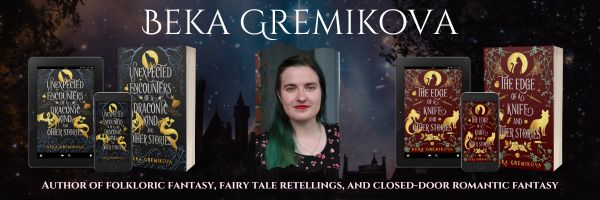
Thank you so much for having me; it’s an honour to be here! I’m Beka Gremikova, author of Folkloric Fantasy, fairy tale retellings, and closed-door Romantasy. I love to write stories that tackle deep, sometimes dark, themes that are balanced out by emotionally healthy romances and strong found family and friendship.
When I’m not writing, I’m hanging out with my nieces and nephews, reading tons of manga and mystery novels, or watching anime, KDramas, and baking shows. I’m also a gamer; currently, I’m playing through—and absolutely LOVING—Tales of Arise. It encompasses everything I love to write and read: nuanced worldbuilding and politics, lovable but imperfect characters, and sweet yet swoony tension. Highly recommend for any gamers amongst your readership here!
As for what fascinates me about fairy tales, I think one of the things that draws me to them the most is their weaving of the mythic and mundane. Often, it’s everyday people facing off against catastrophic odds with nothing but their determination and ideals. So, understandably, they have to lean upon the mythical for help. But this doesn’t take away from their heroism or agency. Nobody is going to deny the bravery of the human bride in “East o’ the Sun, West o’ the Moon” simply because she has to ask for help along her journey (at least, I certainly hope not)!
And this is something that I feel our current society could learn from fairy tales. We equate not being able to do something “all” by ourselves as some kind of weakness, when it’s really not—it’s realism. Despite their magic and crazy situations, I believe fairy tales capture the truth about human nature that many of us in Western society have forgotten: that we need each other to face down our dragons, and that is a beautiful and natural thing.
Speaking of needing each other, I somewhat owe my current fascination with fairy tales to other authors. Though I can’t recall a time when I wasn’t surrounded by fairy tales and folklore of some kind, I can’t say whether I would have ever started writing my own if I hadn’t stumbled across another particular fairy tale author when I was a burgeoning, youngling writer. (Said author will remain nameless here as they now write in a very different genre).
But at that time, learning about their Cinderella retelling—which seemed to have been woven with the epic threads of The Lord of the Rings—fascinated and inspired me. My brain started whirring with its own ideas, and soon an Epic Fantasy trilogy that retold The Little Mermaid had been born within my mind. I don’t know if those books will ever see the light of day, but it’s one of my earliest fairy tale retellings and it holds a special place in my heart, even as, writing-wise, my style has drifted from epic-scale Fantasy.
Of all the styles and formats retellings come in—pictorial, screen, graphic, illustrated, or written—which do you most favour?
Honestly, I don’t think I can choose a favourite. I’ve had some retellings I’ve enjoyed more in screen renditions than their original texts, and others the exact opposite. As long as I feel that something is well done, it will receive my admiration regardless of its style or format. I read and watch within a wide range, so I enjoy a lot of different styles.
Do you have a favourite fairy tale? What aspects of it appeal to you personally, and why?
“Beauty and the Beast”. . . and other variants of the “Animal Bridegroom” archetype such as “East o’ the Sun, West o’ the Moon.” I love how these tales in particular hinge upon the choices of their leading lady, whether for good or bad, and centre around the reclamation of one’s stolen humanity from the hands of abusers. Such themes are always timely, considering how people have treated each other throughout the ages.
On an even more personal note, due to my own chronic health issues, I’ve especially come to empathize with the Beast character and his physical, mental, and emotional isolation from society. I actually have a few retellings in development that explore the Beast curse from the chronic illness angle, though I won’t say much more than that right now as things are always subject to change.
In your opinion, what makes a retelling stand out? What do you consider the joys and challenges of writing in this specific subgenre?
For me, a retelling that will stand out is one that surprises me, manages to make me reconsider the original tale, or simply manages to expand upon the original tale in a way that brings further life and nuance to the characters. I also love retellings that weave multiple tales together in a natural way.
One of the joys of writing fairy tales is when readers are delightedly surprised by an approach you’ve taken, or when a reader mentions that they’ve enjoyed the reimagining even more than the original story. Sometimes, it can be difficult writing in this genre because people can view it as more “unoriginal,” so getting to surprise readers with twists, or challenge their take on certain stories through new viewpoints, can feel very rewarding as an author.
One of the challenges I’ve found is the sheer spectrum of what “fairy tale” means. To some, it’s equivalent to happy endings and sweet romance. To others, it’s a way to write about the horrors of the world and celebrate the sheer perseverance of survival. Both are necessary; both are inherently good.
But one should not cancel out the other, and sometimes I fear that authors (and perhaps readers sometimes) limit themselves and are afraid to stretch the conventions of the genre. I say this from personal experience; I’ve fought with myself over whether certain aspects of my stories would fit into the genre in which I’m writing. I’ve struggled with how to market darker books that aren’t “quite” dark enough to comp with, say, Christina Henry’s books, but are certainly too dark to comp with the cozier titles on the other end of our genre spectrum.
It’s something I’m still trying to puzzle out, haha!
In your opinion, what fairy tale is the most complicated to reinvent, and why?
So, my answer to this is multi-faceted. I actually think “Snow White” is one of the most complicated to reinvent, for a few different reasons.
One: if you’re looking to retell it beat-by-beat, you run into the issue of people struggling with Snow White’s naïveté, especially if the writer ages her up to be a teenager/adult when she first flees the Evil Queen. (If I recall correctly, she was a very young child in one of the earlier versions). And I don’t think naïve protagonists who have to rely on others for protection fit the bill for many readers nowadays.
Two: if your reimagining is more centred around the themes while also wanting to hit certain audience-familiar plot points in order to call it a retelling, you risk your plot twisting itself to fit those points instead of developing naturally.
Three: if you’re wanting to include romance, you have to figure out a way to include your romantic lead early enough that readers get attached while also avoiding the lead getting the chance to rescue your Snow White character too soon.
Four: there are so many different aspects of this story that are ripe for reinvention that I think it creates a trap for authors who may want to reinvent or explain everything. In my personal opinion—and this may make me more C. S. Lewis-leaning than Tolkien-leaning—not everything has to be explained. Sure, things should make sense and not feel out of place within your story . . . but readers can also connect the dots.
Five: audience expectation. I think, because of how ingrained in the cultural narrative “Snow White” tends to be, readers will already have their own ideas about what to expect from a retelling. And because everyone’s opinions about what makes “Snow White” are so different, it might create a chasm between reader expectations and authorial creative license.
Now, this is all just my opinion, and of course there are plenty of amazing “Snow White” retellings out there. But that doesn’t mean they were easy to write, or that authors for ages to come won’t have to struggle with deciding which elements to embrace or leave behind in their own versions . . . especially when audiences might have very specific ideas about how this fairy tale should look.
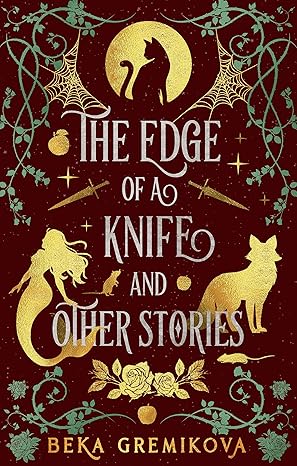
You recently published The Edge of a Knife and Other Stories, which includes a story inspired by “Beauty and the Beast,” our favourite tale on this site. How did you come across the idea for this story, and what can you tell us about its creative process?
I first wrote “Once Upon a Pumpkin,” as a flash fiction piece for gohavok.com about four years ago. The theme I was writing for centred around writing stories that showcased the colour orange, so it made sense to include pumpkins somehow. Understandably, it started out more as a Snow White/Cinderella mashup, with the identity of my Beast character, Lyo, remaining a bit vague as to whether or not he was the Beast from “Beauty and the Beast” or the Wolf from “Little Red Riding Hood.”
Then over the years, ideas gathered to expand it, and as I re-drafted it, it turned into a “Beauty and the Beast” story at its heart. While Lyo is obviously the Beast now, I’d say the protagonist of the tale—Tamrin, the Evil Queen from Snow White—embodies the emotional arc of the Beast as she struggles with her own ugliness and breaking free from its effects.
As for how I wrote a bunch of fairy tales into one story, the core threads just seemed to weave together naturally in my head. For example, if Cinderella and her fairy godmother are sneaking into someone’s garden to steal their pumpkins (which is part of the opening scene, for those who haven’t read it yet), it’d make sense if the garden belongs to the Evil Queen—she definitely wouldn’t put up with that! Oh, but how would she have a garden, if in the original tale she was supposed to be killed at the end? Unless she escaped her death somehow with the help of another “villain” . . . such as Beast and/or Big Bad Wolf . . .
And hence, “Once Upon a Pumpkin” is born.
Many authors who started their careers writing retellings later abandon fairy tale retellings for other genres and story ideas. Do you plan to continue writing retellings or will you move on to other projects?
I am happy to say that I have no intention of ever abandoning fairy tale retellings; they are too much a part of my brain for me to ever permanently leave them behind. I do intend to branch out into other fantasy sub-genres (Urban Fantasy, Gothic Fantasy/Horror), but even those books will still have some folkloric bent to them.
When I first read your stories, what struck me the most about your style was that it didn’t fit the mould of traditional retellings. Your stories feel as though they exist in a genre somewhere in-between Fairy Tale and Fantasy, with elements from both yet still a different type of fairy story. Later, I learnt that this style is known as Folkloric Fantasy, a concept I credit you for introducing to me. Is there a particular approach to fairy tales that creates the atmosphere of Folkloric Fantasy when you’re writing that what separates it from stories following the framework of traditional retellings?
That’s a good question! Honestly, it’s something I’ve been trying to define and haven’t quite been able to. But if I was to try, I think “Folkloric Fantasy” hinges around that meeting of the mythic and mundane, just like fairy tales, but without the adherence to the specific details/plot points that strict fairy tale retellings embrace. Rather, I’d say “Folkloric Fantasy” would centre around exploring the themes and archetypes found in many fairy tales without strictly adhering to a plot structure that would code it as a retelling. So while many fairy tale retellings could be considered Folkloric Fantasy, not all Folkloric Fantasy could be considered fairy tale retellings.
Therefore some of my stories will borrow fairy tale archetypes—sometimes, multiple in one—but they aren’t strict retellings or even reimaginings of a specific tale. For example, one of my short story works-in-progress tackles selkie lore . . . but it’s not retelling or reimagining any particular selkie tale. Instead, it’s using that folkloric lore as a springboard to explore a new point of view and grapple with certain aspects of that lore.
Do you ever see yourself writing an original fairy tale as opposed to a retelling of one?
Funny enough, I actually have written an original fairy tale! It started out as an assignment in one of my high school classes, and I hope to redraft it one day and release it into the wider world. It’s about the sun’s daughter, who is cursed by one of his jealous wives to only speak in mimicry. When this curse wreaks havoc upon her own marriage to a neighbouring king, the sun’s daughter sets out to break the spell and fight for her own happiness.
If there was a Hall of Fame for retold fairy tales, which would you consider the best retold stories books and why are they worthy of inclusion in said Hall of Fame?
Oh my goodness, this is a tough question! I’m going to list only three here, though there are many more that would be worthy as well. But these three books all shaped my writing career in some way or another:
- Cruel Beauty by Rosamund Hodge: Hodge combines “Beauty and the Beast” and “Tam Lin” with an undercurrent of Greek mythology. I especially love this book because of its take on the Beauty character—Nyx is openly bitter, angry, and sometimes spiteful, but she also fights fiercely for what she wants. Her character opened my eyes to the beauty of writing flawed, angry characters, and in my opinion, the ending scenes and the book’s central themes hit all that much harder because of Nyx.
- Masque by W. R. Gingell: A “Beauty and the Beast” retelling with Regency vibes and a whole lot of murder. Gingell’s genre-mashing book hits a lot of the original “Beauty and the Beast” plot points while being wildly different and delightful. I believe this book was my introduction to the notion of genre-blending . . . and, if you’ve read any of my work, you will know that I quite enjoy genre-blending, haha!
- The Goose Girl by Shannon Hale: I first found this book in elementary school, and it honestly changed my life. Back then, Hale’s Goose Girl was one of the first protagonists I truly saw myself in; and now that I’m older, I view this book as one of the best retellings because of how expertly she simply expanded and brought, as I mentioned in an earlier answer, nuance and life to these characters. She mostly doesn’t deviate from the source material . . . yet somehow still manages to make this story wholly, completely, her own, and in my opinion, it’s absolutely masterful.
Is there an author who you view as a role model for your own writing?
There are almost too many to list! It should come as no surprise, but I’ve learned so much from a wide variety of creators—mystery novelists, Japanese mangaka, video game creators—as well as from authors within my own genre, that I don’t know if I could narrow it down to one.
I will say that the books/authors listed in the last question—Cruel Beauty by Rosamund Hodge, Masque by W.R. Gingell, and The Goose Girl by Shannon Hale—could be considered models for my own writing, even as I carve out my own distinct style and voice.
Thank you for sharing your thoughts with us, Beka! We will be keeping an eye on your future books, which we hope shall be many more in the years to come.
 PAWN TO PLAYER