
First thought upon finishing this book: This is the best use of the Seven Deadly Sins I’ve read since “Fullmetal Alchemist.”
Second thought upon finishing this book: That ending is too tragic to be presented as an HEA.
The book left me with mixed feelings that have taken me a while to process, and even now I’m not entirely sure what to think about certain plot points. It’s been a rollercoaster of emotions and thoughts; at times I wanted to give it all the stars, and at other times I took away one or two stars for twists that left my mind blank. I was on the verge of simply leaving the review unrated because of this, and as I write these lines, I’m still not 100% convinced that my rating is final. Perhaps in the long run I won’t think the same way, as my thoughts finally settle.

If it were only for the way the author incorporated the Seven Deadly Sins into this atypical but thrilling and creatively-developed Beauty and the Beast story, this would undoubtedly have got five stars. This plot element is truly excellent, amongst the best and most original I’ve read in years.
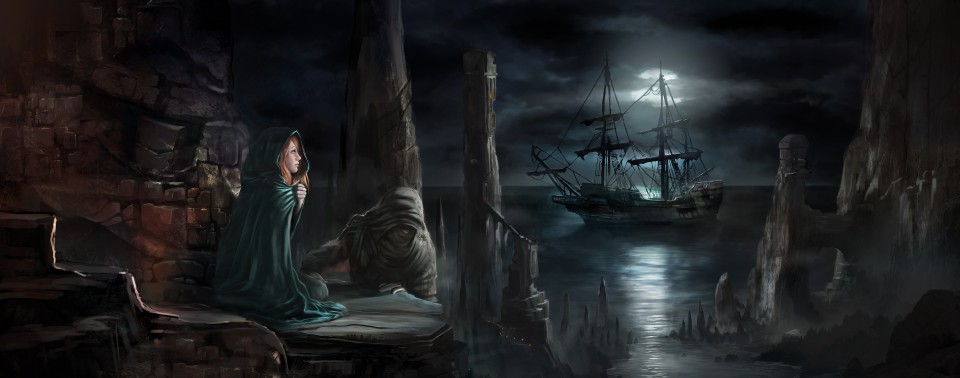
In this book, the plot revolves round Sophina Devereaux, the lonely and unloved illegitimate daughter of a wealthy Southern gentleman (must we assume he’s a British expat in America, given his aristocratic title?). She decides to participate in the trials at Kingsley Manor, an ancient haunted mansion inhabited by ghosts and the Kingsley family, who for centuries have held contests that include seven deadly trials. If you survive them all, the house will grant you your heart’s desire. That’s the rumour that has persisted for centuries, and hundreds of the ambitious, the desperate, and the adventurous have entered the trials, none of whom have survived.
How do we know that no one has survived? Because, aside from the prize for the winner, the very fact that someone wins all the trials and emerges alive would break the curse on the house and the Kingsleys. And as far as Sophina knows, that hasn’t happened, which is why trials are still held there regularly.
And why does Phina want to participate? Because she longs to belong in a family and have a home, a wish she thinks Kingsley Manor can grant. She’s very lonely; her father merely tolerates her, her stepmother and stepsisters don’t like her, and she barely has her governess for any affection. What does she have to lose? According to her, it doesn’t matter what happens in the trials; no one will miss her if she dies, and if she wins, she’ll have what she wants most in life. It’s a win-win for her.
Once inside, she immediately realises the house is sentient and has its own personality and opinions, alternately helpful or capricious. Since she’s a good-natured young woman, she wins the house over with her kindness. And along the way, she captures the attention, and then the heart, of James, one of the four children of the Kingsley couple, a family of seven cursed and chained to the house, unable to leave. It’s said that they inherited a cursed house possessed by a dark force that killed them (not a spoiler, it’s in the title). To free themselves from this curse, they preside over a series of trials for volunteer contestants, but they no longer have any hope of anyone winning, as the trials are very, very bloody.
Extremely bloody, in fact. With all the gore and brutality of the trials, this book could easily be classified as Horror. It has nothing to envy Hunger Games and Battle Royale in terms of gore and cruelty, but has touches of humour and lightness that the former don’t have.
I quite enjoyed these trials, the best thing in this book for me. There are seven of them, and each one is structured round one of the Seven Deadly Sins: one trial is related to Sloth, the next to Envy, the third to Gluttony, the fourth to Lust, the fifth to Pride, the sixth to Greed, and the last to Wrath. The order of these trials isn’t a spoiler, by the way; the Table of Contents lays out in which chapter each trial tied to which sin will be taking place.
What would be a huge spoiler, however, is telling what contestants have to do in each trial, and who lives or dies, so I’ll just reiterate that these trials can turn your stomach.
And yet I say I liked them? Well, yes! Partly because they’re creative and well-executed, and partly because there’s added philosophy and morality aspects to them. It’s not brutality for the sake of brutality; each trial has a purpose and a message to convey. Take for example this intro to one of my favourite trials, Pride:
“Pride,” he said, and the word settled like a verdict. “Is not arrogance.”
A few contestants shifted.
“It is the belief that you are exempt.” He paused.
“That survival has made you safe. That understanding has made you immune.”
Each trial, with its corresponding Deadly Sin, contains this kind of philosophical musings and warnings. For someone like me who hates the “deadly trials” trope of the HG/Battle Royale variety overpopular in YA books precisely because of gratuitous shock violence with no substance or depth, this matters a great deal.
No, I don’t necessarily agree with the message of some of them, and I would have changed the order in at least two trials, but everything doesn’t have to be to my liking for me to acknowledge the good execution of the idea. Something similar happened to me with Fullmetal Alchemist, where the Seven Deadly Sins are flesh-and-blood personifications, because there were some I didn’t particularly like, and it’s been a good intellectual exercise to compare and contrast my reactions to both.
For example, in FMA, my favourite Sins were Lust and Greed, but in Beauty and the Deceased, the trials connected to Lust and Greed were my two least favourite (due to personal tastes and other reasons that you’ll have to read for yourselves). On the other hand, my favourite trials/Sins in Beauty and the Deceased were Envy and Pride, precisely the Sins I disliked in FMA (due to personal taste and disagreements with some plot points). It’s kind of funny, isn’t it?
And I, of course, was absolutely delighted with these contrasts.
The second best thing about the book is the characters. First place goes to Sophina, who has a “special girl” touch, as is always the case in these kinds of stories, but she’s not overly Special Snowflake-like. She’s kind and perceptive, and she doesn’t let herself be intimidated or manipulated. Second place goes to one of the contestants, Gertrude, who has a lot of backstory to unravel and about whom I won’t say much because there are many surprises. As for the Kingsleys, they are each well-defined regarding personality and quirks, but as a whole they are the typical fictional upper-class family: all too beautiful, too cool, too perfect. None of them impressed me, not even James. Maybe the youngest daughter, Liana, did a little because she has potential for more, but that’s about it.
And it’s precisely with the Kingsleys that this book almost lost its charm for me at several points in the story . . .

The first major misstep, for me, was the Lust trial. I’m fed up with the insta-love trope, especially when it’s accompanied by its “you’re practically wetting your knickers for each other” twin trope. All the exaggerated sexual tension that authors cram into love-at-first-sight plots. And the relationship between Sophina and James, whilst not exactly slow-burn, was at least free of this detestable trope up until the point where this trial occurred. Neither of them was desperate to get the other’s undies off and get into bed together; and in the context of the deadly trials and that they had only known each other for a few days, it was perfect that way. The attraction between them was palpable, but it was discreet and appropriate to the circumstances.
Until Lust came along and threw this perfect balance out the window. What happens between Phina and James after the Lust trial made me furious, and I almost abandoned the book right there. When will authors learn that men aren’t superhuman, especially when they’re horribly injured? Have you ever seen a man in a hospital bed, half-dead and covered in bandages, yet still with the strength and pain endurance to sleep with a woman right there and then? And to write this immediately after they had resisted the lethal temptations of the Lust trial feels like . . . Well, insult to injury.
I didn’t like the Greed trial either, because the someone who dies in that trial torpedoes a part of the story that’s thus left unanswered, creating a plothole the size of a pit that still bothers me. The author tries to explain that death at the end, and she succeeds in broad strokes, but for me, it doesn’t close the plothole at all.
The second major misstep was the curse’s timeline. According to the book, the curse on Kingsley Manor and the family has lasted 400 years. That timeframe seems rather arbitrary and poorly thought out, because it creates significant plotholes, such as:
- How is it that in 400 years there haven’t been any attempts to do anything against the house from the outside? In four hundred years, that’s thousands of people participating and dying, and nobody did anything? Are there no authorities and law in this world? Because, conservatively speaking, let’s say 20-50 people participate each year; that over 400 years adds up to about 8,000-20,000 people dead. It’s a massacre!
That’s the problem with many Fantasy writers: they throw in figures of hundreds or thousands of years in the timeline of their stories, and to Hell with plausibility and credibility. If I had been the editor, I would have suggested a more sensible figure, say 50 to 100 years tops.
- In 400 years, the Kingsleys don’t know, nor have they been able to find out, what caused the curse. All they know is that there was a pact with a demon unsubtly called Sathanas, and on top of that, it’s merely their speculation. Seriously? They’re either incredibly stupid or incredibly naïve. I can’t believe this supposedly intelligent family didn’t even bother to investigate the curse, even though at least two family members seemed like they could have known or unmasked the villain with a little push. But they don’t know or suspect, because plot armour.
- In 400 years, it’s very unlikely that not a single person has survived or completed the seven trials. It’s statistically impossible, unless there were winners but they ended up being murdered instead of rewarded. Even in Hunger Games/Battle Royale there were winners, and those games weren’t held for centuries.
It can’t be that Sophina is such a Special Snowflake that she achieves on her first try what no one could in almost half a millennium. The suspension of disbelief melts here.
The third major misstep was what happens with Gertrude. She’s introduced in the story as a recurring contestant and veteran of several trials, which creates intrigue about why she participates so often and how she survived before. Is it through abandonment? Because it’s said that participants can abandon the contests (but we never see them do it). During the Envy trial, the way she survives the deadly traps suggests that she’s a woman like Sophina, a similarity that leads them to care for each other, and I’d have liked to see them interacting more. But in the end . . . In the end, things are revealed that torpedo everything we knew and had seen about Gertrude, leaving plotholes that remain unresolved. The most important one: if she is as she turns out by the end, how on Earth did that scene in Envy happen? It’s not believable taken together with the revelation by the end. And we already know the Kingsleys are idiots who don’t bother to rack their brains to find answers, but the fact that they never ask questions about Gertrude or wonder about ANYTHING related to her despite seeing her participate so many times is comically bad.
I think that was an authorial oversight; after all, this is a début book, and it has the expected flaws of one: editing issues, a lot of plotholes and loose ends.
The ending of Beauty and the Deceased isn’t a misstep, nor is it bad by itself. It’s understandable that it ended that way given the build-up, and within this storyline, it’s a good conclusion. But what I see is that this attempt to present the ending as “happy” doesn’t correlate to what would naturally happen after such deadly trials and so much tragedy. With 400 years of grotesque deaths in forced trials, going on living as ghosts after their cruel deaths, and that final revelation about what caused the curse, all the Kingsleys and Sophina should be unsound of mind. At the very least, they’d have epic PTSD. The ending should have been presented as the tragedy it truly is—there’s no way to interpret what happens to Sophina as “happy”—but instead, the ending is rather breezy, cheery, happy. There’s no sense of “the price of victory,” no trauma from the horrors endured for so long, no trauma from what the villain caused, no reflection on what was learnt from it all. Nothing at all. The trials end, the curse is broken, and everyone lives happily ever after.
I wasn’t expecting a psychological study of trauma; this isn’t that kind of story. But the ease with which the characters “recover” as if all that happened was no biggie feels so odd. All that happened was a tragedy, and tragedies don’t end with a saccharine, vaudeville-style finale.
In the end, all of this erased the potential five stars the book seemed destined to earn in the first half. From thence on, it ended up being bittersweet and full of mixed feelings, but of course, other readers may react differently depending on how they process these contradictions.

Interesting review, although not my kind of book. The Seven Deadlies, collect the set. Although, as usual, my sloth (ραθυμία) saves me from the other six.
Hahaha, that’s funny!
The Seven Deadlies are amongst my favourite motifs, but much to my dismay they’re often not done well or quite misunderstood. Even in non-fiction, I think I have a review on GR about a non-fic boook on the Sins that was plain terrible and, to me personally, baffling as to how an educated person would misframe them so badly.
A large part of the problem is religious (that one author was Jewish, and they have a different view of ‘sin’ than Christians, as you know), but even so that’s no excuse! I mean, of the 2 best portrayals I’ve read so far, one is by a Shintoist (‘Fullmetal Alchemist’) and this one here is by a Mormon. So . . . plain lazy. 😀
Always grateful that you read me even though I review books you have no interest in, Fred-sense. It’s very motivating to me. 🙂
I have mixed feelings on this too now. There are a lot of parts of it that I think, like you, I would love. And there are a lot at the bottom that make me do that angry scowling snort that we all do when we’ve reached our limited of suspension of disbelief. It sounds like it’s not bad for a debut but I have that itchy feeling where I wish I could’ve gotten my hands on the thing before I found it and saved some readers a lot of frustration. XD (Which sounds prideful, but I don’t mean it that way.)
I try to be fair and start with what I find was well done first, and I did love the Deadly Sins and the first half very much, so there’s that to console myself with. 😀
I used to have a shelf named “Imperfect Favourites,” where I place books I loved a lot but that have something I simply can’t get over. I think I told you about it before?
I think you did, yes. This is one of those I’m guessing?
Correct!
I wish you didn’t make that quote on Pride, the exact kind of pride I have to consciously fight against in myself T_T
How was the portrayal of Wrath (one of my personal favorites in FMA)? Just because I’m a snoop and I know we can talk about it during a date night ^_^
Hey! At least I didn’t include the quote on Lusty. 😀 In hindsight, I should’ve included the quotes on all the Deadlies, they’re so quotable!
I can give you details in private so as to not spoil the ending for my readers here, but to give you a hint I know you’ll get: Wrath in this book is what Father was in FMA. There’s also an interesting commentary on parenthood to contrast with Hohenheim and the Elrics that I think you’d like.
This book isn’t your kinda story, but I’m willing to bet you a platter of your best pasta dish that you’d love to read it just for the FMA comparisons (and that essay I want you to write…).
I am WHEEZING at this review. First off, THANK YOU SO MUCH FOR READING I LOVE YOU IT MEANS SO MUCH TO ME!!!!!! Second, thank you for your candor and honesty!! This is giving me good things I can use for the next books in the series. If I could address a few things, though.
1. You are absolutely right about the plot holes. By the time this was published (and as you said, it is indeed my debut novel) I had gone through the manuscript myself at least 20 times, and I feel like I had blinders on at that point, somewhat like “I wrote this, therefore it makes sense.” (I know, logic is not my strong suit, nor the Kingsleys. (WHEEZE)) So I will definetly take that into account for the future.
2. You also mentioned that if I had sent you an ARC, you would have been able to point things out (like the 400 year gap, which I honestly only put in there because I felt like it was funny if Edward said “we’ve been here for 400 years… etc” (Again, I know, not the smartest tool in the shed)) to which I say YES!!!!! I only had a few people read before publishing (and this isn’t any of their style of book, so they didn’t really have feedback for me) so if you’re interested in my manuscripts for the next few books, I will HAPPILY send them to you.
3. I have to say is that I appreciate you reading so much, and I will happily take my 3 1/2 roses rating. 🙂
4. I literally have no argument against the Kingsley’s being idiots. I didn’t realize I wrote them that way until you pointed it out. AND THEY ARE. Granted, I feel like when I was writing, my thought process was “They’re just tired at this point. So many people have tried and failed, if we try, we disappear or suffer painful consequences” but that doesn’t excuse the idiocy. So thank you for that!
I truly enjoyed reading this review, and thank you again for your constructive criticism and taking time to read! I truly appreciate it so much!!!!!
Thank you so much for your gracious reply, Summer! I’m glad you found something useful in my critique, which was constructively meant. 🙂
I will be contacting you soon.