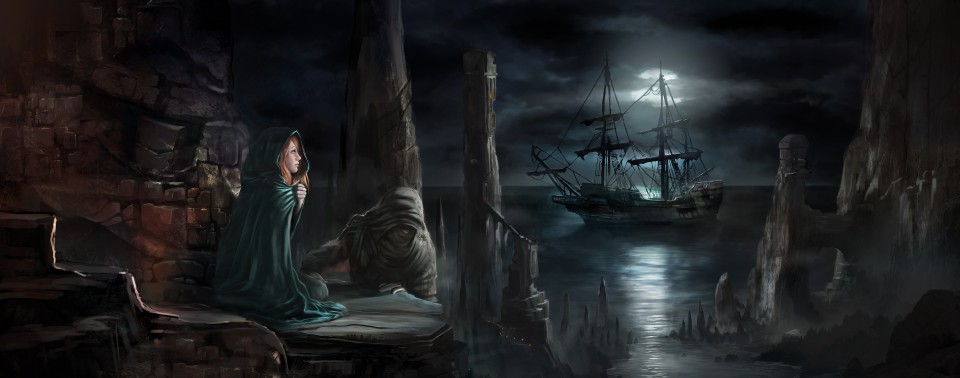

I’m a fan of Benjamin Lacombe’s style and own several books illustrated by him, so I’m accustomed to the high-quality artwork he brings to everything he illustrates, but I can’t hide my dismay at seeing how he nor Roumiguière handled “Beauty and the Beast” for this picture book retelling, whose artistic beauty doesn’t overwrite its problematic contents.
The first red flag is in the author’s notes, in which Lacombe says airily that he doesn’t like neither the Madame de Villeneuve original fairy tale nor the shortened Madame de Beaumont version, both of which he calls outmoded and moralistic.
And the second red flag came from scriptwriter Cécile Roumiguière, who stated on her page that she knew the fairy tale not from the original or the shortened version but from the Jean Cocteau film from 1946, and that Lacombe (who in his own words hated the original fairy tale) is a huge Disney fan that adores their animated motion picture.
Which such alarming unfamiliarity with and contempt for the source material, I pose a very valid question about why exactly these two were hired to create a “Beauty and the Beast” retelling?
The end product speaks for itself: such ignorance about and contempt for the source material have produced a profoundly offensive portrayal of Beast that is pure and unfiltered ableism.
So disgustingly ableist and even eugenicist a take on the nature of Beast that I would like to think the authors didn’t mean to do it on purpose, because the alternative doesn’t place them in a good light personally or professionally. Considering that Lacombe says in the author’s notes that he got convinced to illustrate a Beauty & Beast retelling that he never wanted to do before after visiting a Loire palace in which the portrait of Antonietta González is displayed, I embrace Hanlon’s Razor and assume no ill-intentions, even though that doesn’t erase the issue of ableism.
My regular readers know well my fascination for Petrus Gonsalvus/Pedro González, the 16th century Spaniard with hypertrichosis (excessive body hair that covers all the body like animal fur) who was gifted to King Henri II of France for his amusement, and who got married off to a beautiful woman named Catherine with whom he had several children, some of which inherited his hypertrichosis. This is the purported real case that is speculated to have inspired Madame de Villeneuve to write the fairy tale (which makes it all the odder that Lacombe dislikes it), and Antonietta is one of the couple’s hairy children.
According to Lacombe, Antonietta’s portrait made him want a different Beauty & Beast story that was based on the true story of the Gonsalvus family, particularly their youngest child that had been gifted as a circus “animal” to powerful Italian nobles. He endeavoured to do art for a story based on her to do her suffering justice—he claims grandly—not merely another picture book regurgitating Villeneuve or Beaumont.
And he ended up creating a collage built over the Beaumont version (without knowing it, I’m sure) with a heavy aesthetic loan from Disney (which has a troubling interpretation of the curse), and crowned with undeniable ableism that’s going to be a stain on his reputation and Roumiguière’s.
“Marquise, surely you exaggerate and it can’t be that terrible,” you’ll exclaim. “What could be so bad as to make you call a respectable artist and his scriptwriter ableist and borderline eugenicist?”
Well, for a start: the fact that they made Beast an actual human being born with the very real disability of severe hypertrichosis like Petrus and Antonietta, and made their condition a “curse” that needs to be lifted by the love of a beautiful woman.
The plot is that a Venetian lady born with hypertrichosis—presumably based on Antonietta González—gives birth to a baby boy with her same condition, and in her desperation she makes a deal with a mage to “cure” her baby from hypertrichosis in exchange for her life. The mage then imprisons the boy in a tenebrous and isolated castle and says that when he meets a pretty girl who falls in love with him, then his disability will magically disappear.
Surely you can see how offensive this is? Disability isn’t a curse that needs to disappear from the sight of able-bodied society so the disabled can be loved like healthy people.
And yet, this is exactly the message Lacombe and Roumiguière are broadcasting. The fact that they used the true suffering of a real disabled person as their framework is morally repugnant. Petrus Gonsalvus, for all that he was unfairly treated, wasn’t some uneducated boor, and neither was his daughter. Their disability made them be treated like circus ponies, but they weren’t treated brutally or neglectfully, and they didn’t live in some sort of human zoo. They made as good a life through service to powerful nobles as they could, because in the 1500s there were simply no other options for the disabled than be entertainers/clowns/buffoons/curiosities or starve. It was either you attracted the attention of a noble that would fancy you enough to add you to his retinue as his pet or poverty and hunger in the street. No anti-discriminatory laws, no bill of rights, and at best maybe the Church helped you out of compassion if you were lucky, but that was it.
Even now, with all our anti-discrimination and pro-disabled laws, there’s still people with disabilities, such as dwarfism, who have no other way to earn a living but as entertainers because society is still not fair in many parts of the world. I have seen it with my own eyes in third world countries, it’s a sad reality and not just a historical footnote we can feel morally superior over.
As things stood, the Gonsalvus family did well for themselves. Much better than the immense majority of people with disabilities in their time, in fact. They weren’t the only cases of hairy folks serving as court entertainment, there were many more, so the simple fact that we know their names and family history whilst the rest died in misery or obscurity is already historically significant and underscores their privileged status. You have no idea how huge it is that a non-noble, non-ruler common man has this much historical records about him.
Should Petrus and his hairy children have been treated like human beings with dignity? Of course! It would’ve been humane and moral, and it’s perfectly fine to do a retelling with that as a motivation. But that such humane and moral treatment only comes with the condition that their disability has to disappear is unacceptable. Lacombe and Roumiguière could’ve written a retelling in which this Beast with hypertrichosis was loved IN SPITE OF his ugly appearance due to hairiness. That would’ve done justice to the Gonsalvus’ suffering: to be used in a story teaching about unconditional acceptance of the disabled with unconditional acknowledgement of their disability.
But oh, no, this book had to make their disability disappear so they can be accepted and loved.
This is absolutely not what “Beauty and the Beast” teaches. The curse on Beast isn’t a disability (he is born healthy) and it isn’t his nature (he isn’t a shapeshifter). The curse on Beast is a punishment, in all 3 main versions: Villeneuve (he’s punished for rejecting a female child molester/groomer who had also been obsessed with his father), Beaumont (the motive is omitted but he says it was an evil fairy that did it), and Disney (a disguised enchantress unfairly punishes him for a childish refusal to shelter her). There’s injustice and uncalled-for, disproportionate-to-the-offence suffering in all three versions, and the curse has to be lifted as a remedy to that injustice after Beast works his way to redemption.
But disability isn’t something that needs making amends for. The disabled don’t owe you to accommodate your sensibilities to deserve your love and respect. Villeneuve never made Beast disabled, she made him a victim of a sexual predator. Beaumont didn’t make him disabled, she made him a victim of evil. Disney didn’t make Beast disabled, they made him overpay for a mistake as a child. But Lacombe and Roumiguière made him disabled, they made him get rid of his disability to be loved. In believing they could make something “better” than the outdated original, they don’t seem to at least have thought of care of getting a sensitivity focus group for feedback on disability representation.
Even beyond the ableism, this adaptation has several plot details that run contrary to the message of the fairy tale. Too many of them; there seemed to be one or two per page, so let me list only a few of the most absurd:
- There’s a ghostly masked lady on a gondola that doesn’t seem to go anywhere or have a purpose in the story and appears at random points. By the end, it’s revealed she is Beast’s mother. Wasn’t she said to be dead, though? Why does she come and go aimlessly on that gondola?
- When the father steals the rose from the castle, Beast says his daughter owes him for the crime. Say what again? The tale is specific that the one who owes Beast is the father, Beauty goes in his stead only afterwards and is never obligated to go (the curse won’t be lifted if she were forced).
- Beast was born hairy, and couldn’t be educated and is left unnamed and wild. Why exactly can he not be educated if he’s otherwise whole and sound of intellect? The entire Gonsalvus family were educated, and they had names and a surname. Somehow, the mother forgot to name her beloved child, or what?
- Beast joins a circus of grotesqueries for a while. Why? He doesn’t have to since he’s isolated at the enchanted castle. Does this mean he can leave freely? And how is he now educated all of a sudden and can read and speak correctly? This seems like an excuse to insert a nod to the entertainers with deformities that were common in the past.
- The sisters are far harsher and actually evil, whilst in the tale they’re merely envious and petty. One of them mocks that Beauty doesn’t like to doll up for men but still attracts monsters, and calls her shameless insinuating she’s a slut. I’m shocked at the authors’ display of sexism here.
- The artwork is easy on the eyes but incoherent in terms of thematic consistency: there’s life-size garden statues like in Cocteau’s film, as well as chandeliers and disembodied hands like in the film. Beauty arriving to the palace has the same aesthetics as Disney. The colour palette for Beast and Beauty is the same yellow/blue as for Prince Adam and Belle in the ball scene. Lacombe even copy-catted the Disney library scene, he overindulged himself.
- Beauty is extremely wimpy and faint-hearted instead of brave and quietly firm in her boundaries like in the tale. Here, she faints at seeing Beast the first time, she looks at him with repugnance, she refuses to take his hand or look at his face because she finds it gross, she explicitly says he makes her nauseous to think of kisses or sharing the marriage bed with him. The dream sequence from the tale is also upturned, Beast doesn’t appear there. With all these alterations and her always emphasising how repulsive she finds him, it’s incomprehensible that she could’ve fallen in love with him.
And, more troublingly, considering that Beast is disabled, what does this constant reaction of repulsion and reject say about the authors’ mindset? Did they even research how a person with hypertrichosis looks like if they think the mere sight of one would make a woman faint or vomit?
- Beast isn’t kind and meek like in the tale, he’s a grovelling simp, behaves like a beaten animal and is always anxious that Beauty not look at his face if she doesn’t want to. He’s also inconsistent because after humiliating himself to please her, he brusquely tells her she doesn’t want her pity.
- We are told that Beauty is smart, she can talk about silkworms and loves entomology (which makes it stranger that she’s wanting to barf at the sight of Beast, I mean, you love insects but a human with extra hairiness scares you?) and is a nerd, but on the actual page she is rather unthinking and stupid. She never seems to realise what she is reading is important and never reflects on what she has read.
For example: she reads “The Story of the Fairies from the Island of Happiness,” in which the punishment for the daughter of a Fairy and a Human for being the product of a forbidden love is to marry a monster. Beauty reads this and shrugs it off with zero thoughts. Later, when visiting her father, she reads the story of the Gonsalvus family and learns about Antonietta. She wonders what relationship is there with Beast, but doesn’t reflect on it at all and this is never mentioned again.
So does this mean the Gonsalvus family exist in this fictional world? Looks like a ham-fisted insertion of the family to support the claim that this book is based on their story.
- Beauty is truly a prisoner with no freedom of movement in Beast’s castle, which in the tale doesn’t happen. She can’t even go outside to the gardens because Beast told her she can’t go out as he’s afraid she’ll flee. What a charmer, this fellow.
- When Beauty tells her father about marriage to Beast, her father salivates about Beast’s riches and says that will give dowers to her sisters. Beauty whines that if he had a son, he wouldn’t have married him off, but she never thinks of what she can do and only thinks “I’m being sacrificed.”
- Then she has a sudden U-turn and goes from “Waaah, Dad is sacrificing me to the Beast for gold” to “Oh, I love him and can’t live without him and his chats,” and runs back to the castle. In the tale, Beauty isn’t sold off by her father for money, in fact he falls ill because of the burden of knowing his daughter went to the castle in his stead. And Beauty returns because she dreams Beast is dying.
- When his disability is “lifted” (barf!) and she sees how handsome Beast is, Beauty gives a speech that if their kids are born hairy like he used to be, she’ll teach them to “be different.” I burst out laughing at this. She needed Beast to be handsome to even look at him without throwing up, and now that he’s this hairless pretty boy she self-righteously pretends she’ll teach her kids what she herself couldn’t do. Also, presumably the now cured Beast wouldn’t pass his hypertrichosis to his children, the magic eliminated his disability as specified by the mage, remember? Unless Lacombe and Roumiguière were using magic as merely a super duper epilator and the disability remains in Beast’s DNA. Hiring a mage and paying him with your life seems too much trouble to simply lose all body hair, depilation was already known since the ancient Egyptians, you know?
For all the above and more, this is going down in my records as one of the worst of the worst Beauty & Beast retellings of all time, I can only think of one other retelling that is worse. It should serve as a cautionary tale for authors whose moral would be as follows: Do not strive to rewrite an existing story you don’t like nor understand, write about a story that you will like instead.

NOTE: This picture book isn’t translated into English, and only has editions in French and Spanish.
It is I, the one with the penchant for hot, brooding Underworld deities and pomegranates. I just got back on Goodreads today. You’re still MIA. I need my fellow Gilmore Girl. Anyway, great review. Sorry you had to endure a wimpy Beauty and a simpy Beast.
Hey, darling Persy! You made my day by dropping by my lil’ bloggie. Thank you so much!
Hahaha, your old friend Lorelai Victoria Lucy Ricardo Gilmore misses you lots and lots too, but she doesn’t miss Goodreads at all. 😛 She’s thinking of taking until Summer to even consider returning, but ya know, “as long as everything is exactly the way I want it, I’m totally flexible.” 😛
Love you, Persy.
Love you, too. You’re not missing out on much. I’m happy to chat with the few good friends I have there, but other than that, it’s the same old malarkey. 😄 I hope you’re getting plenty of sun and exercise, because that’s what I’ve been doing. 🤘
I’ll be peeking on your stuff from time to time, and of course you can message/email me anytime!
I haven’t forgotten our plan to buddy-read H&P, I’ve had rotten luck with that myth this year. It has crept into some B&B retellings as an additional mix, but terribly done. 🙁
We need to find a good H&P retelling. I tried to reread some of my favorites a few months ago but couldn’t get past the first few chapters of either one. It probably has to do with maturity and the fact that I’ve read many other books since then. I’ve also noticed that many romance authors today, both fantasy and contemporary, use H&P as a selling point. Most of them have little knowledge of Greek mythology and mention the famous couple in their book blurbs or tags simply to sell their stories.
I always get a good chuckle out of looking back at what I or my friends used to love just a decade ago, and now are horrified we even entertained the idea of reading. 😀 Isn’t it funny? My GR is full of youthful peccadilloes like you describe yours.
I’ve never been a fan of the myth, and I tried. 🙁 My compromise is that I like it aesthetically, as part of the Monster/Maiden motif, one of my favourites, but the story itself . . . meh. And I say that as someone aware of the cultural and religious context of H&P, which most fans and retellers aren’t.
Speaking of, you can check my old DeviantArt account (on the ‘Illustrating Westeros’ tag), and see what I mean by the H&P aesthetics. I have some lovely stuff pinned on my fan gallery, which I want to collect little by little. (I’m Aesara Dayne over there, the account is inactive, but who knows…)
Oh, I’ll check it out. DeviantArt has so many talented artists. That’s where I discovered my favorite Tolkien art. Elena Kukanova, Sara Morello, danielosu, and steamey have created incredible illustrations of Tolkien’s elves, humans, and deities. Remember, we have to buddy read Styx by Nikita Gill, which is coming out in a few months. I hope you read the first book in the series because it’s amazing, and I think you would really enjoy it.
All excellent authors I had the pleasure to find there too! I have a dedicated Tolkien gallery there as well, with some of my favourites (but others missing).
I haven’t forgotten, but I haven’t read anything by her yet. My plate is really full. You have no idea of how large the volume of retellings is, and I’m only tackling Beauty & Beast ones but still falling so behind. I review fewer books than I read. 🙁
Be careful not to burn yourself out by reading too many books and writing too many reviews. You don’t need to post often if you don’t feel like it. I stopped feeling guilty about not reading as much as my friends a long time ago. Reading should be fun. For many people on Goodreads, reading and reviewing have become more like a chore to keep up with others, which is never a good thing. Pace yourself, and remember to take breaks between books.
I’m trying, doll! But I have a Stubborn German work ethic permanently at war with my Lorelai laziness. 😀 I’m so methodical and organised that I end up burning myself too often, everyone tells me that, even Btashcandie (my co-host here) and the Cub.
I’m making changes, though, I’ve cut off 2 fairy tales already, and I’ve severely cut on Folkloric Fantasy to the point I only am posting my negative experiences at this rate. 🙁 I have also created a shelf for retellings I don’t intend to read, which I didn’t have before, and it’s helping with the “read everything” FOMO impulse.
Retellings are to you what orca books are to me. I have a few that I still haven’t read, including the one I just finished, which made me cry like a baby. There’s a reason I took a break from reading about orcas. I’m too emotionally invested in these animals. You definitely need to take the advice of everyone who told you to slow down and take a breather. 😄
If you ever stumble upon an orca retellings, it’ll be glorious! (I found retellings with bunnies and other animals, so there’s hope some marine aficionado who also loves fairy tales exists somewhere in the world…)
I’m definitely going to take a breather! The FIFA World Cup is about to start (bet you didn’t know football is another of my interests), and I gotta be cheerleading my team and my adoptive team and my crush team. 😀 So, after summer it is…
Oh, football is a big deal in my family. I feel like most European and South American kids grew up watching football with their dads. You know what you must do now, right? You must name all three of those teams.
Hahaha, yeah! Same in my tribe. I’ll have to do that when we chat. 😉
As Frodo says in the movie : Alright then, keep your secrets. 😄
Send a message via eagle. 😉
Yiiiiikes. Where is my ZERO STARS button? This sounds offensive as hell even if you aren’t someone who falls in the category of offense.
I don’t recall if this was over at Goodreads or elsewhere, but I recall having a discussion with someone who pointed out that ableism is so normalised still that even people that normally jump at other -isms don’t even detect it in fiction. 🙁 And I can agree with that, I’ve seen so many reviewers who never miss a chance to virtue-signal about racism/sexism who simply overlook or stay mute when the disabled/different abilities are portrayed insensitively in fiction. Same for domestic violence, I have a poor opinion of a number of reviewers for this reason, because they only seem attuned to the “cool” -isms that carry a social validation aspect on social media.
Like with this book. I saw the French reviewers were the first ones to mention the framing of the curse but . . . curiously, none of them said it was offensive. o.O When I saw the early reviews in France, I was worried and hoped it was maybe exaggeration. And now I know they simply overlooked how offensive this book is. As far as I know, I’m the only one who has calling this for what it is, but I hope others will follow now. But I’m not holding my breath, I know the reviewing community well by now.
Mmmm yeah. I think, in my experience, there are some things that are “cool” to be mad about and some things that people are strangely collected over and choose to ignore. It annoys me, too.
One reason I appreciate retellings by authors with disabilities or who have good disability representation.
By the way, what makes it all the more baffling that this was published is that this is part of a collection called Classiques Illustrés. Illustrated Classics.
Which begs the question: why retell the fairy tale at all? Why not just illustrate one of the versions as is? It’s not like Lacombe hasn’t already illustrated a Classic before (Hunchback of Notre Dame), so he should know better than to act as if he can do ‘better’ than the original.
Key word being “should” in this case, it seems. *side eyes* Once again, yikes
Ugh, I don’t understand publishing decisions sometimes.
Getting sensitivity readers to vet books pre-pub isn’t hard either. This isn’t some small, obscure publisher, or they’d not have had the means to hire an artist of Lacombe’s calibre.
Unfortunately a lot of larger publishers don’t bother tot use sensitivity readers. That’s more common in smaller publishers or indies. Though I do know a few authors who will hire them before the book enters the formal publishing process for a larger press.
Sigh… I’d have thought it would be the other way round, since they have more money to allocate to the finer points of book-making. But it doesn’t surprise me.
Bit sad that Lacombe’s rep has suffered a massive hit with this insensitive retelling. I never thought I’d see one of my favourite illustrators do this, and have this book inaugurate my “Illustrating Beauty & Beast section” when I’m trying to be positive and showcase the best.
I’m glad the smaller pubs and the indies are more careful, and this is also one of the reasons I’m happy over the existence of disabled authors like Meredith Burton, even when they write stuff that’s not my cuppa.
All very true points. I wish more people would put care into such things, but the most that many of the larger publishers are willing to do is add it to the books trigger warnings page anymore. Inaccurate/poor representation disappoints me immensely. It’s why I try to offer my services for sensitivity reading where I can when I can as well, but there’s only so many hours in a day, as you well know.
I don’t know that I’ve ever really read anything of Meredith’s personally, but I hear good things.
I feel tempted to offer myself as a sensitivity reader as well, particularly because I have a long experience with the disabled. But I already had to cut on beta-ing because I was piling up too much work. I’ll be glad to do it when I have time and an author asks me, though. It’s a worthwhile cause.
Merry is a great girl. Needs help with the editing and story structuring to polish her style, because she has talent and enthusiasm.
Also, it’s worth noting that there are authors who do have firsthand experience with disability and health issues, but do not like to talk about it or even mention it because it’s a painful topic they live with on the daily. And health is such a personal thing to open up about online.
It absolutely is, and I absolutely agree. Not everyone feels safe, physically or emotionally, writing about personal experiences, especially in regards to something they’re continuously dealing with.