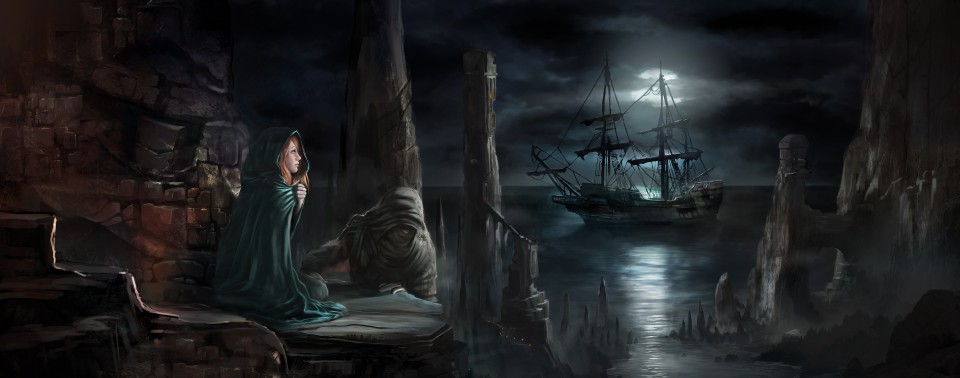

This book reminded me a little of The Ritual, although they aren’t similar beyond being stories about a dragon and a maiden. It’s the part the maiden spends at the dragon’s castle that reminded me of the Dyachenkos’ book, but this story isn’t humorous like theirs, and although the romance is sweet, it doesn’t reach the same level of tenderness. And the ending is different, and somewhat conflicting.

In retellings of Beauty and the Beast, the father is usually loving towards his daughters, because the father in the fairy tale is too, albeit weak-willed, but in versions where the animal bridegroom is a dragon, I have noticed that he usually is not. I suppose authors tend to see giving your daughter away to be eaten by a flying lizard as very cruel and so they highlight it. In Embergold, this negative side of the father figure is emphasised on to the point that the father of the female main character is a physical and emotional abuser, so we begin this story in a domestic context of apparent peaceful life in the marshes that masks the familial violence suffered by the girl, Gilde.
What’s most striking is that Gilde doesn’t seem to understand well that she is an abused child. She has a mentality common amongst victims of domestic violence that makes her desperate to please her father, to hear him say he loves her, and to be convinced that when her father exhibits this controlling behaviour and punishes her, it’s because she must have done something wrong and it’s her fault. This is very realistic, and not seen often in Fantasy. Gilde isn’t the typical “strong woman” who is quick to talk back and gets slapped for being loud-mouthed and ill-tempered; she really believes that this is normal and lives like a little mouse that has to be careful not to accidentally anger the cat (and there’s another drunk cat in the household). To make matters worse, she has no positive role models to teach her that what is happening to her isn’t normal. She knows nothing but toxic relationships, because even Isadora, her companion who lives and works in the marsh cottage, is verbally abusive and doesn’t treat her well, even though she’s also a victim of beatings. Everyone here is mean to Gilde.
It isn’t until she is betrayed and handed over to a dragon in exchange for certain powers that only black magic can give that we begin to see signs that the girl could have PTSD from all this. And it’s because Wil shows her the other side of the coin: he treats her well, reveals to her the harsh truth about her father that she isn’t aware of, tells her stories, teaches her to read (how often do you find an illiterate girl in Fantasy? They all know how to read even when realistically they shouldn’t due to their social status or familial circumstances), protects her, and helps her even when she goes TSTL and disobeys his order not to open certain doors in the castle. I loved this part, the time Wil and Gilde spend in the castle full of trapped black magic and a mine underneath that produces a certain rare material called “embergold,” highly coveted by wizards like her father. It’s this part, which is definitely reminiscent of The Ritual, that makes me wonder if Rachelle Nelson has seen the film, because the book hasn’t been translated yet.
And it’s also this part that gives context to why the girl falls in love a bit soon. I mean, if you’ve always been treated as if you have no value as a person, of course you’re going to develop feelings for someone who shows you that you do have value, and whether you fall in love or not is just a bonus.
If it were up to me, they should’ve stayed there in the castle, if not for the whole story, at least for much longer than they did, because once they leave, the story is no longer so beautiful. Necessary for plot advancement, yes, because Gilde had to open her eyes and mature, and Wil had to fight to regain his humanity and resolve the issue of the curse and the troublesome mines, but that could perhaps have been done without dragging them to Xantic.

What would become of stories of dragons and maidens without dragonslayers! Every self-respecting dragon has to face a dragonslayer, that’s the law in dragonhood and knighthood alike, and here the person in that role is Gilde’s father, a man that would sell not only his daughter but his own soul for the power of dragonfire. Magic, or rather his excessive ambition to possess fire magic, has corrupted him so much he will do anything to destroy the dragon and take its magic for himself, regardless of how the dragon has treated his daughter and what she thinks about the matter. It’s clear that the wretch won’t hesitate to sacrifice her again.
The worst thing is that Gilde forgives him and still loves him.
I know that forgiving those who mistreat you and loving your enemies is very virtuous and all that, and it does happen that victims of abuse still maintain ties with their abusers. No two victims of abuse react the same way: one may forgive and another may hold a grudge for life; there are many factors that influence the outcome, and I’m not going to dive into a lengthy analysis of the complex psychology of post-domestic abuse, but one thing does have me concerned: mixing forgiveness with maintaining ties with the abuser, especially if the abuser isn’t remorseful and doesn’t ask for forgiveness. The verse is “forgive us for our trespasses as we forgive those who trespass against us,” for goodness’s sake, not “justify our trespasses as we justify those who trespass against us.” Forgiving means letting go, getting rid of the burden in your heart; it doesn’t mean you have to maintain ties with that person to prove that your forgiveness is genuine.
And Gilde doesn’t get it. Even after finding out what a bastard her father is and learning about the barbaric human sacrifices practised by wizards of his kind, she still loves him when he returns. Fine, you’re not obliged to hate him and wish for him to be crushed by an elephant, and no one wants to see you as a spiteful bitch hardened by abuse (which is also realistic, not everyone becomes bitter because of their tragic life experiences), but you didn’t have to be SO NICE to that old bastard and still love him after he threw you at a dragon. If I were you, I’d let the dragon eat him for a snack without batting an eye.
But as much as I disliked it, this was consistent with Gilde’s character: she’s empathetic, meek-tempered, has a big heart, a gentle strength, and cares for others even if they don’t care back. It would’ve been strange if she had reacted differently, it’s true, but I still don’t like the subliminal message.
One little thing that did bother me more than expected was Xantic. It’s supposed to be Rome, right? Of course Xantic is Rome. You can’t show me all that Roman Empire paraphernalia, including Latin names, and expect me not to realise where the inspiration came from. But then, what is the land of marshes and dragon castles? Germania or Britannia? It seems to me that it’s mostly a bit of a Germanic world, because some of the names (Gilde, Guntor, etc.) and the type of dragon lore and gold mining lore here are Germanic, and the English element is just a tiny bit. Ah, right, so we have Rome and Germania in a Fantasy version, what’s the problem? None really, except that we see almost nothing of Xantic apart from the trial that takes place there to decide the future of Gilde and Wil, which makes it look superfluous.
I love Rome, it’s one of my favourite historical periods, but for what it was used for here, it would’ve been best if the world was entirely Germanic. You just had to send a couple of tall, blond, beer-drinking soldiers to grab those two brats accused of forbidden magic and take them before the tall, blond, beer-drinking magistrate Pontius von Pilatusberg. What did it matter? There was no need to use Roman aesthetics as make-up.
Is this enough to ruin my enjoyment of this book? No, it’s just that my Rome-loving side wasn’t impressed by this part compared to the parts in the marsh and the castle.

The final verdict on the resolution of this story will depend greatly on individual taste because the plot itself is the kind that some will find sweet and others will find bland; that’s how these stories with a clear purpose that speaks to their target audience work. I think the ending will appeal more to those who have understood the purpose of the story, and those who haven’t will find something to nitpick in the details of the ending.
I have no objection to the ending, at least none of any significance. My main complaint, as I said above, was moving the second part of the story to Xantic, which detracts from the atmosphere and aesthetics established up to that point, but that is a mixed bag for me rather than an issue. Nor do I disagree with how the curse is resolved, or the involvement of that weird Ghost character, who I found more amusing than anything else.
Oh, but Gilde’s bastard of a father deserved a sound beating at the very least, that’s for sure. He got off lightly, and I like to see characters like him pay more dearly. That’s what I would’ve liked was different in the ending. I say, since you’ve faux Rome here, then why not also apply to the bad father some good old Roman customs like crucifixion or something?
Anyway, I liked practically everything here, which is something I can rarely say about a B&B retelling. It’s sweet, entertaining, the characters are likeable, and it honours the fairy tale’s core themes; you can’t ask for more.

This sounds like a really fun story! This is one of the ones I was actually interested in reading, so I might go pick it up.
As someone who both loves analyzing the psychoanalysis of PTSD and trauma in relationships, as well as someone who has survived abusive domestic relationships, what you said about that was really important to me.
I think it’s SO easy for people to forget, as you said, that forgiving someone is not the same as forgetting. And even if you choose to forgive and forget what has happened and work through that trauma to make yourself a more healthy person, people–especially in Christian, conservative, or family-centric households–often forget that it takes two people to heal a relationship. And if an abuser is not remorseful and continues to treat his or her victim/s as the ones in the wrong and gaslight or otherwise manipulate those victims or try to make themselves out as a hero or victim rather than the one they hurt…yeah, the best thing you can do is set clear boundaries and walk away.
And so often in fiction we either see that as people learning to forgive and just stepping back into an unhealthy relationship or characters who are written to be “tough” and approaching the relationship in other equally unhealthy manners.
Yeah, I’ve always had trouble with this specific take on “forgive us for our trespasses.” I can tell that Gilde does learn, but it takes her so long and all the while she’s so nice to a chap that is begging to be dipped in tar.
Oh, I got an interview with the author! Let’s see what she has to say, this should be interesting.
As for you reading this, when you’re in a very good mood is best. 🙂