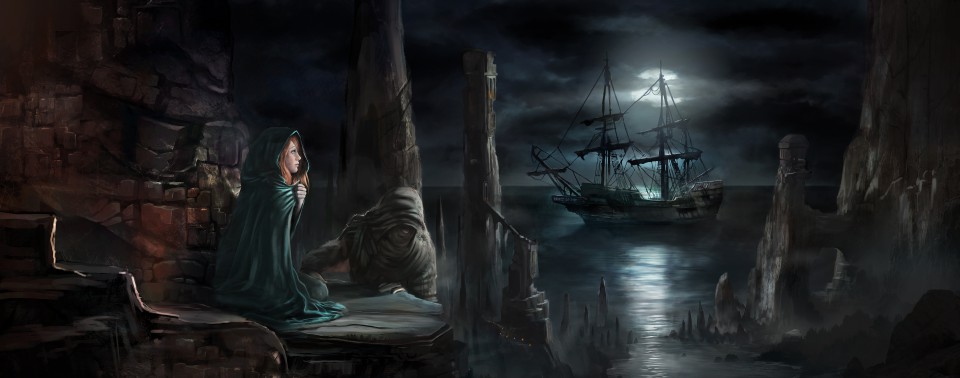

Do you think such a thing as a “meta-retelling” exists, my dear Vicomte? The encyclopedias tell me there’s metanarrative as a formal academic name for this kind of storytelling technique that I discovered in today’s reading. It’s not striking me as fitting this story quite as nicely as “meta-retelling,” though, so I think I shall be formally coining the term for this style of storytelling from now on.
The book I wanted to share my thoughts on with you is a graphic novel, Angelica and the Bear Prince, that was marketed as a retelling of the Norwegian fairy tale “East of the Sun and West of the Moon,” one of those links in the evolutionary chain from Greek myth to French fairy tale that you can spot in the history of Beauty and the Beast. But I would call it a meta-retelling because it isn’t a retelling, not even a loose one, nor is it a parallel story to mark the main story’s beats. It’s a fairy tale that has been placed within the book’s plot and is already retold independently of Angelica and Gable’s story (yes, bet you didn’t notice that the fairy tale is presented here as already retold on its own) and that evolves on its own with only the slightest touches of the main plot.

In other words, the fairy tale here isn’t supposed to retell Angelica and Gable’s story as a modernised “East of the Sun and West of the Moon,” nor does it intend to. Rather, what it actually does by its very existence is describe how the theatrical adaptation of the fairy tale is staged according to the script the Log House Theatre are rehearsing. Indeed, that is the reason and purpose of the Nordic fairy tale in this story: to exist as an internal theatrical adaptation. And that’s why it’s not “complete” within the timespan of the graphic novel, nor is it supposed to be. That’s what those who complain that this is incomplete and incomprehensible haven’t realised.
And how do I know that the fragments of the fairy tale are an in-story adaptation for the stage and not a retelling? Well, because the first line of the book already begins as a retelling. In the original, the polar bear doesn’t ask the father to make his daughter his “girlfriend,” he wants her for his wife. Furthermore, in the fairy tale both (bear and girl) sleep together, whilst here each goes to their own room to sleep, and so on. It’s all already been retold and sanitised for a young audience, which indicates that it’s an adaptation that the people at Mrs Jorgensen’s theatre company have written for the stage and changed to make it suitable for a young public (teens). And besides, the artwork for the fairy tale fragments shows theatre props anyone who has been behind the scenes at theatre companies would recognise. With all this, it’s obvious that what’s being told is the play Gable and Chrissy are acting out.
In short: this play is a meta-retelling. Simple conclusion to reach, isn’t it, my dear Viscount? But so few people know how to grasp the nuances of fairy tales.
And then, you might ask, if this book isn’t a retelling and the storyline isn’t a parallel narrative, what is Angelica and the Bear Prince supposed to be? Let me quote this passage from the author’s notes:
I realized Angelica and the Bear Prince is about grief. I pitched it as a modern retelling of EotS, WotM, but it wound up being an exploration of how the experience of mourning feels so lonely and unwieldy simply because there appears to be no right way to do it.
I had heard this book talked about as a story about burnout when it was marketed pre-release, and I had heard that it didn’t do quite a satisfying job of it because it only touched on this topic superficially. And now that I’ve read it myself, I can say that I’m going to disagree with that opinion. I don’t think this is a story about merely the typical burnout experienced by overachiever teenagers and that it does a bad job of exploring this experience or that it does so superficially. Why?
To begin with, the fact that the author, Nguyen Trung Le, says he based this story on his own experience of suffering extreme exhaustion a few years ago, and that he says the theme is grief and not burnout, makes me think that the mental condition afflicting Angelica isn’t burnout but depression. In real life, the author suffered from depression, and in the story, Angelica enters a very severe depressive period of grief after her grandmother dies, and in both cases (author and character), burnout is a manifestation of that depression, not the root cause. One leads to the other, and they feed off each other; they aren’t mutually exclusive and can coexist, but depression is usually the root cause.
So I think that Angelica suffers from severe depression that resulted in burnout and led her to abandon the countless extracurricular activities she enjoyed. It’s a very common reality for teens and adults. Why does this book seem to avoid delving deeper into a topic of such importance and interest, one that thousands of readers will surely find easy to empathise with?
Because we are already at the tail end of Angelica’s depression, not at its peak.
When the story begins, Angelica is starting to emerge from her grief, beginning to revive, and she’s applying for theatre internships and figuring out how to resume some of her hobbies without stressing herself out again. The worst is over. If the story took place when Angelica was still in the depths of her exhaustion and sadness, readers’ complaint that the treatment is superfluous would be understandable. But at this point, when she’s recovering, it makes about as much sense as seeing a cancer patient at the end of chemotherapy and complaining about them having hair. It’s all about paying attention to the internal timing of the plot, my dear Vicomte, and for me, the fact that Angelica’s mental health is discussed infrequently and in the past tense has a purpose.
Personally, what I liked about this part about burnout and depression is that it implies Angelica’s mother bears some responsibility for what happened to her daughter. The woman is the typical Asian tiger mom who wants to do everything perfectly and pressures her children to be perfectionists. It’s clear that Angelica inherited her overachieverism and perfectionism from her and parental pressure, because her father is chill and loving (and, in my opinion, the best character), not at all a fan of the capitalist, over-educating rat race that his wife and daughter embrace to the point of hurting themselves. In these kinds of stories with teenagers suffering from mental health breakdowns due to the unrealistic demands from parents and culture, the parents’ culpability is often overlooked. In reading this, it’s easy to get caught up in trivialities like Angelica talking online with a boy that her parents don’t know about (forgetting that there’s a difference between descriptive and prescriptive portrayals of teen behaviour in fiction, and teens do this more often than parents would like), and not take note of the overbearing mother because that might feel like holding a mirror up to themselves. This isn’t just an issue with Asian parents, unfortunately.
Nguyen Trung Le gently and softly makes them confront their role in their children’s burnout, without lecturing or reproach. But whether they want to see it is another matter. I would have liked him to delve deeper and for his message to be stronger, but this author seems to be this way by nature, saying things quietly and gently, understating it and letting readers catch or miss his drift. Nguyen has chosen to focus on Angelica’s grandmother’s death as the trigger for her burnout, and I understand why, although I don’t think it’s the cause, but rather the catalyst. I know this from ample experience.
Now, of course, there were things I didn’t like.
While the story as a whole is beautiful and easy to understand, you only realise this at the end, once you’ve finished reading it. Because whilst you’re reading it, it’s not easy and it can either bore you or make you abandon it because you don’t see what it’s about. The way Nguyen Trung Le writes it is like a jumble of everyday scenes that don’t seem to have a connecting thread. One moment you’re with Angelica and her friend Chrissy, and suddenly a fragment of the fairy tale appears. Another moment, you’re with Angelica’s parents and suddenly you’re taken to the theatre. There doesn’t seem to be a cohesive story, and that’s infuriating.
Aside from the lack of a more cohesive plot, the author doesn’t handle scene transitions well. The shifts from one slice-of-life scene to another are so abrupt. And to make matters worse, the characters tend to emote into the void as if they’re talking to a camera, without any context (what in writing would be called “tell and not show,” and in illustration it’s even worse because the point of illustration is precisely to show). And finally, there are scenes that are simply unnecessary and don’t contribute anything. Some can be understood in the context of the big picture, like Chrissy’s relationship struggle, which I didn’t care about at all but can see it makes sense if you consider that she’s the girl with the polar bear in the meta-retelling, but… what on earth was Angelica’s mother’s food cart doing there, and what was that silly scene with the white woman talking about DEI and health permits? Not much.
At times, I thought that the author, being a man, perhaps didn’t know how to handle a teenage girl’s emotional story on its own and instead threw into the plot practically half the town—even the neighbourhood gay couple, even more useless to the plot than the food truck scene—to help him construct a somewhat understandable story from a collage of experiences and situations that are half loose and half related. It’s like you want to tell your personal story and end up including your entire street in the book because you don’t know what else to do.
It might have been better if the main character to narrate had been Per the Bear instead of Angelica, because Nguyen Trung Le could tell his story (remember that his own mental health struggles inspired this) with more confidence through a boy than a girl. Gable would have been a better canvas for pouring the author’s emotions and experiences. It’s very complicated to tell a story of depression and burnout through a child, and all things considered, the author didn’t do such a bad job. But he did it with a significant number of blunders that I couldn’t help but notice.
And yes, it’s true that the ending is very predictable. I’m referring to the revelation of the bear prince’s identity, and it’s not like it was going to be some great, unfathomable mystery, but even so, it could have been more… I don’t know, subtle? Because Angelica even comes across as foolish for not guessing sooner.
Something I did like about the ending is that Angelica and Gable’s story concludes the tale they’re adapting for the stage. I don’t know if others will see it this way, but for me, the fact that we don’t see the end of the story in the plot is because the plot itself concludes it. And that’s when the meta-retelling becomes strong and obvious: it begins by telling the story as a play and ends with the story finishing the play we no longer see. Of course, you have to know the original fairy tale to see it this way, and many won’t, so it wouldn’t have been a bad idea to end the story as a play, just as it began.
But then it wouldn’t have been a true meta-retelling, would it? It would have simply been showing us what the play looked like, just another slice-of-life scene to add to the collage.
I found it a beautiful graphic novel, my dear Vicomte, despite its many and stark flaws. Meta-retellings are a fascinating philosophical exercise to me. And I do hope that, in some way, these musings will help you to better understand in what ways I see and interpret fairy tale motifs and themes in real life and in many people’s lives, something you have asked me about before.
I sign off with one last look at the lovely artwork, which I’m thinking does a lot to earn the book its four stars.

March 14th, 2026.
___________________________________________________
This review is dedicated with all my love and admiration to Cub, who inspired me to write in this ‘Dangerous Liaisons’ style when he offhandedly asked the question that led me to discover fairy tale “meta-retellings” to describe a certain type of retellings I had previously found difficult to describe analytically.
Happiest of birthdays to you, my Little Red Riding Cub! I love you in all the languages and all the lives.
Marquise, I enjoyed the epistolary form of this review; it proved to be a very effective rhetorical device. That is to say, that it did in fact move me to be a bit more receptive to narrative displays of grief and recovery.
And, to change the subject…I can not just press the like button without logging in, which I can not do because apparently I do not have a cite of my own (and don’t want one) or a password (that I was never asked to create). Hence, the need for my silly responses.
Hehehe, thank you so much, Arnold! Glad that you liked it. I think I’ll be using this epistolary form on occasion from now on, when the inspiration strikes and/or the Cub gives me food for thoughts (he’s the Vicomte de Beaumont. :))
WordPress is so unwieldly! I’ve done what I could to make the comments section more accessible, but it’s not stable. I’ll see what I can do, and in the meantime, are you subscribed? That might make it easier for you, perhaps.
So this is your secret little project you’ve been working on and keeping me in the dark about! I’m happy I’ve inadvertently inspired you. I love watching you develop and celebrate the things you enjoy!
It was a wonderful birthday despite that bit of hard news I got the day before, and you’re the entire reason why <3
Yes! I’m so glad you’ve enjoyed your little present, my dear Vicomte. <3
I do hope this answers your question as well as the one about what fairy tale applies to you. Bêteuil and Beaumont, that's us. Almost sounds like a title for a series of B&B shenanigans like the "Beaumont and Beasley" retellings but based on our own comical misadventures. 😀
I actually like this style for your reviews, too. It flows like a conversation. And I think that might work well for some pieces, especially those that are more discussion-like in nature over strictly summary and review.
That said, this seems like a sweet little book with important things to say, even if the format is a little messy.
Haha, thank you! You’re not the first person to tell me this, the Cub also says I review like I’m talking to someone. 😀 I’ll definitely do this again, I like having a bit of variety in my reviewing style, helps me to not get stuck in a rut, important when one’s always reading the same ol’, same ol’ genre.
I have a little private tag for my favourite retellings, “Imperfect Favourites” (wanted to name them Imperfect Masterpieces. :P), that means they are so flawed they wouldn’t earn full marks but they’re so good for something unique they have, like a cake that’s all messily splattered over with the cream and the cherry but the flavour is so good you don’t mind the presentation. 😀 If you’ll forgive me the corny sweet-tooth metaphor!
I think that’s smart–having several styles you write reviews in. It not only helps you as the reviewer, but it will hopefully also keep other people engaged, as well. I also have always liked that quality about your reviews, that it feels as if we’re sitting to coffee or tea and I’m just listening to you tell me about what you’ve been reading. It feels natural and calming to me.
I love the idea of that! Favorite little books that maybe don’t deserve all the marks but are still important to you for one reason or another because they made some impact on you with something they did well. I should make a shelf of my own like that perhaps.
Thank you, Mari!
Yeah, it would be a nice idea for yourself too. I came up with it years ago when I was organising my shelves and saw that I had too many tags but nothing specific for this kind of books, so I created this category and keep them with the favourites but with their own special lil’ lable. 😀
I may have to do that next time I’m organizing my books. There’s probably a lot of stuff sitting on my shelves that needs reorganized, haha. Right now it’s just by year and a few shelves of “top recomendations” so I can make easy grabs when people ask for them.
Guess I have the soul of a librarian & archivist, because I’ve always been arranging and rearranging everyone’s books besides my own. 😉
Haha, well, as a past librarian, I will say we do enjoy making lists that are easy to hand off to others. 😛