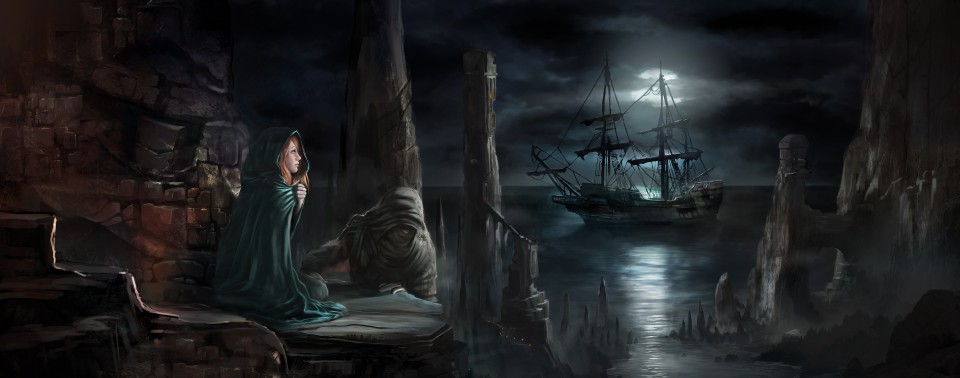

It took me quite a while to get into this story, and I almost didn’t make it. I was about to give up halfway through, and that was avoided only because I ended up liking the two main characters and got hooked on the revenge plot.
I’m very demanding when it comes to how Greek mythology is handled in retellings. I pay a lot of attention to worldbuilding in such cases, and although this book is more of a folkloric fantasy yarn than a mythological retelling, the alternate world that has been invented here is clearly a fictionalised version of the Greek islands of the Aegean. Therefore, the gods, myths, and legends that abound here are those of Ancient Greece with altered names.
I did not particularly appreciate the blending of myths here. I am not opposed to combining them with fairy tales when they are compatible and done well, although it is not my preference, and I certainly don’t like it when several Greek myths that have nothing to do with each other are mixed together: each myth has its own context and symbolism, and they are neither interchangeable nor combinable like clothes or shoes, something that not all authors understand. In the case of The Trident and the Pearl, the author has mixed Greek myths that are fundamentally at odds with each other.
On the one hand, there’s the beginning of the book, which seems to be taken from “King Thrushbeard”—my least favourite B&B-adjacent fairy tale for how misogynistic it is—but not entirely, because it also seems to be inspired by the beginning of “Eros and Psyche” when Psyche is sacrificed to the monster. And as the plot develops, an absurd jumble of intermingled Greek myths begins to emerge: Oceanus and Thetys, Poseidon and Amphitrite, Eros and Psyche, Orpheus and Eurydice, etc., etc. So many myths thrown into the pot like vegetables into soup! There are even hints of Dido and Aeneas, elements of “The Odyssey,” something from the myths of Dionysus, something from Hades & Persephone, the Japanese tale of “The Crane Wife” (mixed with Eros & Psyche), and even the Arthurian legend of the Fisher King.
And strangest of all: the gods in this world have souls. Apart from their physical bodies, they have souls. The Greek gods didn’t have souls (or they would’ve been mortal) because they were incorporeal and spiritual beings.
The author is a Christian, which may explain some of these oddities. No offence intended, but Evangelical Christians are not usually the best at understanding ancient mythology, for they judge it through the lens of their beliefs. And so, a polytheistic mythology as ancient as the Greek one isn’t going to fare well if judged through monotheism: either it is sanitised to suit their own “clean” requirements or it comes out worse in some way.
And as if to confirm my suspicions, when I reached the Acknowledgement, I read the author thanking God “for not being like the gods I have created.”
This has been a major obstacle for me, but it won’t necessarily be for others. If you can overlook all this, and I imagine most readers will since my demands regarding lore aren’t the norm, the chances of your liking this book increase. What helps is that you probably won’t even notice the inconsistencies with the myths unless you are very, very knowledgeable about Greco-Roman mythology (and many are not or only know the basics), that this isn’t supposed to be a retelling of any of the myths (it only borrows the clothing, so to speak), and that the author avoided being preachy (an important point for readers who tend to avoid books written by Christian authors for this reason).
The hook in this book is the characters, as it is a very character-driven story told in first person POV by the female protagonist. Coralys is brave, strong, and determined. She cares deeply about her islanders and desperately wants to protect them and solve their misfortunes, even at her own expense. But she’s also emotionally inconsistent, angry, vengeful, quarrelsome for no reason, sometimes rude, and makes terrible decisions. In other words: a good person full of flaws. Oke, on the other hand, is the opposite: kind as can be, loving, calm, and longing for a good life and true love, which his status as an imposter god makes impossible.
(Speaking of them, because I can read some Greek, I find it very grating that Coralys and Okeanos go by the nicknames “Cora” and “Oke.” The Greeks didn’t abbreviate their names in the style of 21st-century English speakers. And yes, I know this isn’t Greece, but it is pseudo-Greece.)
The relationship between Coralys and Okeanos is a very slow burn and depends almost entirely on her taking the initiative (which she does late in the plot, half a dozen chapters from the end). In a way, it’s good that it goes so slowly, because she was married before and is still in love with her late husband, and this new marriage was forced upon her against her will. For his part, Okeanos is a bit childish, loving like a teenager who has just discovered that hormones are good for something: all longing and more yearning. It’s all a bit corny, but at least the rival is dead, so there’s no love triangle.
“Win a god’s oath,
Marry the drowned queen,
Collect the dead to serve.
Fill a thimble with riches.
Heal the crown of the sea.
Turn the betrayer’s heart.
Mend time with golden stitches.
Drink the ocean dry.
Spin moonlight into silver.
Split the seven seas in twain.“
The arc of the five impossible tasks to rescue a soul from the Underworld, which are ten but in this volume only goes through the first five, is very Psyche-like. But I liked these better than Psyche’s impossible tasks because: one, they are more complicated, and two, Coralys is aware that there are “cheat codes” to completing them. This woman isn’t helpless at all, she knows her stuff, and the mix of myths in this particular case has worked very well. I think it’s the best part of the book, honestly.
But boy, is the ending depressing! So much investment in seeing whether she’ll succeed at those five tasks, only to end up wanting to strangle that idiot god. I’m not going to tell you what happens, only that the ending is slightly cliffhangery, but it’s a cliffhanger you can live with until the next book.
Will I read the next book? I don’t know yet. This first instalment was almost fifty-fifty for me, and if it ended up being fifty one-forty-nine, it was by a hair’s breadth. It will depend a lot on my mood when the next book comes out, but given how things have turned out with Coralys and how she almost, almost managed to take revenge on the idiot god responsible for her husband’s tragedy, I’m not entirely lacking in enthusiasm, so I’ll leave it at a maybe.

I received an ARC through NetGalley in exchange for an honest review.
I’m supposed to “hate-read” this with a friend this summer when it comes out, and I think it’s going to be good for that. XD But maybe the characters will be surprisingly likeable even if the world itself annoys me. I guess we’ll see.
There was a planned reading party and I wasn’t invited? I’m feeling unloved here, dear. :'( 😀
I can give you the details about some stuff that I left out, if you’d like. But maybe it’s best you form your own opinion, too. I’d be curious to see what you think!
Haha, well, in my defense it wasn’t meant to not include anyone and I don’t think you know the person in question since she’s not on GR?
I think I’ll read it first and then we can discuss thoughts? If that works for you anyway. I don’t mind spoilers, obviously, but a happy medium is probably good.
Of course! I’ll wait till you read it, it only a few days until release day anyway. I’m curious about what you’ll think of certain parts.
She’s a widow? You’ve intrigued me! (Not that that’s rare in the world of romance, but I don’t see it often in the fantasy or romantasy genres.) I may check this one out…
She is, yeah, her widowhood and remarriage are an integral part of the plot.
I don’t think you’ll like this one, though. There are things I know for sure you’ll dislike (it’s in the review, but if you need more deets, feel free to message me.)