• Home
  • Reread
    • AGOT
    • ACOK
    • ASOS
    • AFFC
  • Rethink
    • Female Influences I
    • Female Influences II
    • Male Influences I
    • Male Influences II
    • Beauty and the Beast project
    • Mini-projects
    • Standalone Essays & Posts
  • GOT Analysis
  • Rereading Sandor
    • AGOT
    • ACOK
    • ASOS
    • AFFC
  • The Winds of Winter
  • Illustrating Westeros
  • Submissions
  • About us
  • Contact

PAWN TO PLAYER

~ A Rethinking Sansa Stark Resource

PAWN TO PLAYER

Tag Archives: beauty and the beast

2025 STATE OF THE TALE: The Best “Beauty and the Beast” Reads of the Year

01 Thursday Jan 2026

Posted by Marquise in A Tale Transformed

≈ 1 Comment

Tags

beauty and the beast, best of 2025, book-reviews, books, fantasy, retellings, year in review

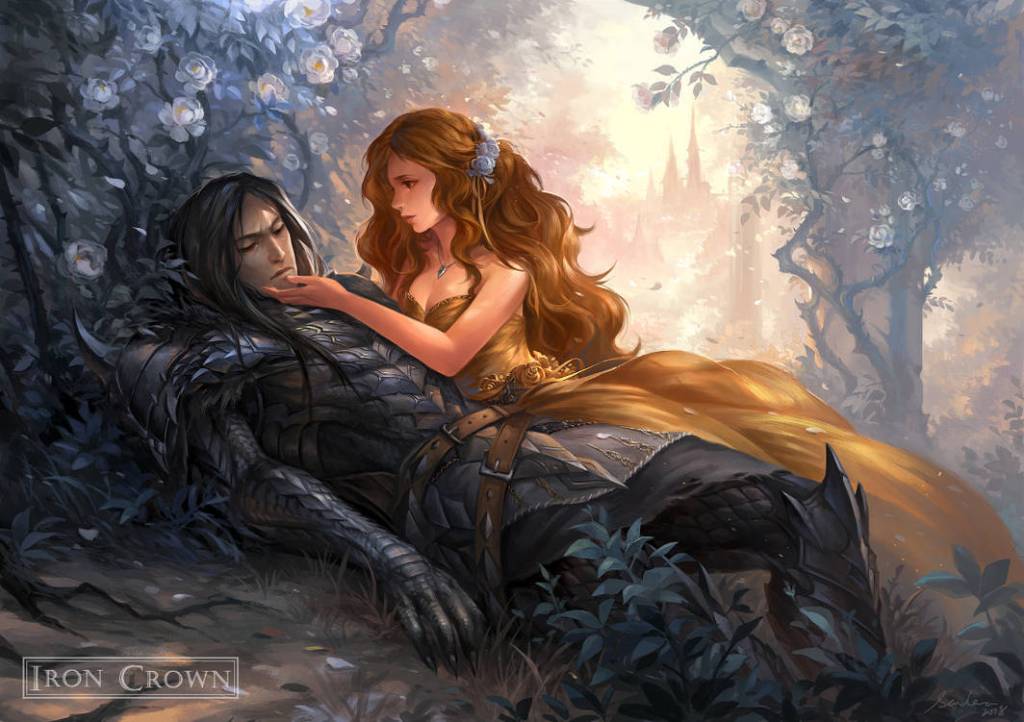
Beauty and the Beast by sandara↗

Seven manga series.

Two graphic novels.

One picture book.

Forty-eight books (four of them anthologies, two not translated into English yet).

That’s the balance this year leaves me with: There has been a total of fifty eight Beauty and the Beast retellings.

“That many?!” I hear you gasp. Yes, my dear fellow fairy tellers, that many. And I’m only counting the books I personally own that were published in 2025. I’m not counting all the books published, naturally, which are probably many more.

Granted, not every single one of the fifty eight books was a retelling. As I said before, I am going to include books that aren’t proper retellings but that have the themes, so some of them were Folkloric Fantasy with Beauty and the Beast influences, intentionally or not.

“What do you mean, intentionally or not?” Oh, it’s simple! The other day, my friend Ellen McGinty was telling me that some readers had commented to her that one of her books reads like Beauty and the Beast even though she herself doesn’t see it nor did she intend it to have such a vibe. I read it afterwards, and I can say I am confidently siding with the readers. Her book does, indeed, have B&B vibes to those in the readership that are familiar with the tale as her sharp-eyed readers evidently are.

Meaning, some of the books weren’t intended to have any dash of B&B seasoning whilst their authors were cooking them, but the nature of folklore is such that they ended up having that seasoning by accident. And I, for one, am not complaining about this happy folkloric accident as it means more variety to my B&B diet, which would otherwise be too vegan and fat-free and decaf I’d end up folklorically malnourished if I adhered strictly to academically-sanctioned parameters for what a proper B&B retelling is.

But I’m not too flexible that I include everything that as much as smells of B&B/Animal Bridegroom. Of course not. Because of that, I do not include fanfiction and I do not include most erotica and romance, which means the thriving kitchen industry of “mafia beast” romances, taboo erotica, and the equally thriving kitchen industry of monster/furry books won’t have a space here. Those are, almost always, not B&B in the least or only use the tale as decoration; they go by genre rules and conventions of their own that differ from those of a fairy tale retelling.

And it’s a given that A Tale Transformed is a project dedicated to written and illustrated reimaginings, therefore it doesn’t include audiovisual (film, anime, TV, videogame, motion picture) retellings. Generally, those already have their dedicated spaces as well.

So, back to our books. Before I list the Best Of 2025 picks as voted by myself and a select group of authors and readers, I would like to make a few observations about this year’s crop, if you’ll let me. In part, because I found it interesting, and in part because this could help track trends in B&B retellings for authors, readers, and the stray academic lost in the woods that ends up on this humble site of mine.

Were all fifty eight books worth reading? No, of course not. According to my own private record-keeping (a.k.a. spreadsheet), about twenty two titles were frankly terrible and a few more were DNFs for being more useful as sleeping pills than as retellings. The rest were fine reads, and a few (the fewest) were great reads.

But all were worthwhile for the purposes of this project, taken together they all drew a full picture of the state of Beauty and Beast as of 2025, which was the enlightening part to me.

“And what did you observe? Don’t keep me waiting!”  Let’s see the trends, then, all neatly laid out:
  • Maidens are back on the Dragons’ Menu.

    The ancient custom of sacrificing pretty lasses to firebreathing (or not) scaly beasts never went out of fashion, not entirely, but it had been dormant for a while. At least in Western-based retellings, because the Eastern-based ones have always had a dragon as a Beast figure (which explains the B&B vibe for your book, Ellen, if you’re reading this).

    Oh, but the Maidens have grown a spine and all went to Feminist School, apparently, because it’s now the trend for the maiden to save herself and her lizard as a collateral win.

    We in the Pawn to Player household applaud this fad and stan the Maidens saving the Dragons.

    • Manga’s idea of “Beauty and Beast” still is interspecies romance and will be so ad saecula saeculorum.

    My dearest Japan, why are you so weird?

    That’s the mystery every poor little otaku living outside the Land of the Rising Sun has to deal with. And that includes me, a non-otaku. Out of the seven manga series in my collection that released new volumes in 2025, only one doesn’t have a plot that pairs a human with a (non-cursed) beast. One! They simply don’t do curses, I suppose, and go for a plain “He’s really an animal/hybrid, what’s the problem?”

    And yes, the Japanese are your Huckleberry if you’re into bestiality, too. Though at least this year they didn’t do straight bestiality with an Animal Bridegroom/B&B story like in past years.

    • Beastslaying is for Beauties.

    The turns have tabled, and now it’s not Gaston who goes Beast-hunting but Belle.

    Yeah, yeah, raise your eyebrows at me all you want! It’s true. This 2025 has brought us a breath of fresh air in the form of Beauty setting out to kill the Beast.

    Both male Beauties and female Beauties alike, by the way. It’s probably part of or a derivative of the Maidens/Dragons switcheroo, and of course we stan this as well.

    • Fae Romantasy is the new Scarred Sexy British Lord in-house pet trope.

    And we’re not amused, sir/m’lady, not in the least.

    When the magic-free, no-curse B&B retellings in which all it took to make the MMC Beast was to give him a strategically-placed scar that didn’t spoil his handsomeness was the fad, I used to say that a pretty girl + a scarred chap didn’t make it B&B. Now, for the same reason I have to say: not every Fae/Human pairing out there is Beauty & Beast, no matter how much authors insist in calling the Fae character a “beast” to force them into the mould.

    Or rather, especially if authors insist that the Fae’s inhumanity = Beast by default. Because, just like the strategically-placed scars and inconsequential disabilities of the Regency/Victorian setting retellings, these “Fae” are nothing but über-himbo humans. They have “magic,” because Fae, but other than that they’re just above-handsome human males.

    A surprisingly large chunk of this year’s retelling output was Fae stories, and honestly they were unremarkable. Most times, you could tell a book would’ve worked better as original Fae Fantasy than have it masquerade as B&B. Maybe this is the Western equivalent to the Japanese interspecies interpretation of B&B, but highly humanised to conform to cultural norms. Fairy dicks work the same way as human ones.

    • “Tam Lin” and “East of the Sun & West of the Moon” retellings dominated amongst the derivative and adjacent Beauty & Beast tales.

    I believe this is a byproduct of authors looking for active, take-charge heroines for their reimaginings, because both fairy tales have in their original version an active heroine that goes for what she wants and saves her man because she wants, unlike the more passive Beauty of the traditional B&B versions.

    Neither is a new trend, especially not the former. “The Ballad of Tam Lin” has been popular to retell for decades already, and it has a large backlog of titles to rival B&B (I think there was a website that listed all “Tam Lin” retellings in existence), and although it’s too short, too bare-bones, and too straightforward for my personal tastes, I do like the aesthetics and atmosphere retellings of this one tend to have, so it’s nice to see it still going strong.

    But “East of the Sun & West of the Moon”? It suffers from authors not knowing what to do with its idiosyncratic plotline and so they end up screwing the bear. Of the two retellings for this tale released this year that I’ve read, the first one is my number one worst retelling of the year and the second one will likely attract the wrath of Helicopter Mums for depicting a certain behaviour teens engage in that’s a parental nightmare.

    • Mixing Beauty & Beast with other fairy tales has fallen in popularity.

    Although it’s not disappeared and will resurface in force again in the future. This trend is like the tides, it ebbs and flows.

    In past years, it was popular to mix Beauty & Beast with other fairy tales, sometimes several fairy tales, with varied success. Usually, it was Little Red Riding Hood and Rumpelstiltskin, for obvious reasons (easy shapeshifter/curse framework to build on), at least in my experience. Now? I can think of only three or so books that did this tale combo. From my observations based on my own stash of books released in 2025, the popular fad of previous years to combine B&B with Classics has also gone down in popularity, and way more steeply than the fairy tale combo. I remember the days I couldn’t browse retelling releases without bumping into a Jane Austen/Jane Eyre and Phantom of the Opera retelling marketed for the B&B readership (those Classics do have shared themes), but this year I was either not paying much attention (unlikely) or the trend is gone, because I don’t have a single B&B/Classic mix in my collection for this year.

    The new trend seems to be going for mixing B&B with myths instead, though. Greek myths, to be specific. I do have some of this kind in my 2025 archives, and can’t say the outcome of these reimaginings was impressive.

    • Going to exotic locations for retellings is becoming a new trend, even if the “exotic” location is Canada.

    Since the original fairy tale is quintessentially French, retellings of it that are set in the real world tend to be European. I’m speaking of the real world, on this Earth, not of all those alternate European-like worlds that aren’t our Earth.

    But this year, some authors seem to have thought of bringing the tale out of Europe and to the Americas. To the cold North, to be precise, and it simply didn’t work. The authors’ fault, not the Canada setting, which does have a following. Ir’s a pity, because North America is a fine setting for non-magic retellings of B&B derivatives.

    • Another reworking based on the “true story” of Beauty and the Beast was published.

    For the past five years, there’s been an emerging, albeit still small, interest in Petrus and Catherine Gonsalvus’ true story from 1500s France that might be the real-life inspiration for the fairy tale by Madame de Villeneuve.

    In theory, this should have me expectantly happy, given my interest in this family dates from before there was one single retelling even remotely inspired by them. But my disappointing experience with retellings that use their true story is that it’s used by authors to pour their own ideas of appearance and disability rather than highlight the real people with real struggles that the Gonzalvus couple were.

    This time, it’s not been an exception. To date, only one of the three books based on the Gonsalvus family is in English, the new release is currently in French and Spanish only and is a picture book type of retelling more worthwhile for its artwork than for its storytelling.
    Interesting trends, aren’t they? It’s one of the productive outcomes of this hyperfocus of mine on this tale. I learn so much more than expected by digging deeper and by keeping an alert eye out for what is released, slowly building an archive of pop culture trends in retellings that I hope to be proud of one day as more and more grows out of this little project.

    Now, on to what you’ve been waiting for!

    A TALE TRANSFORMED’S BEST RETELLINGS OF 2025

    1. The Wolf and His King by Finn Logan
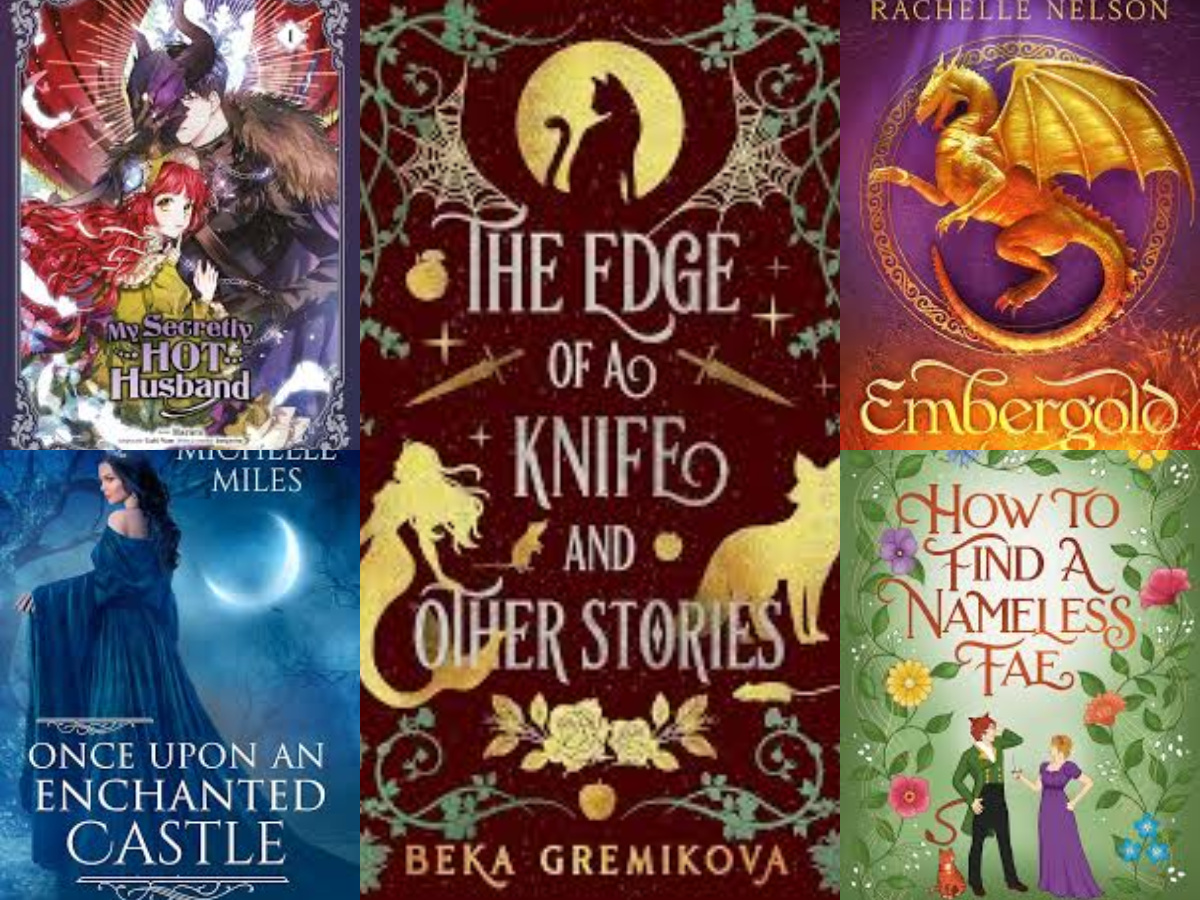
    2. The Edge of a Knife and Other Stories by Beka Gremikova
    3. Embergold by Rachelle Nelson
    4. Once Upon an Enchanted Castle by Michelle Miles
    5. Kill the Beast by Serra Swift

    READERS’ CHOICE FOR BEST RETELLINGS OF 2025

    1. The Edge of a Knife and Other Stories by Beka Gremikova
    2. Embergold by Rachelle Nelson
    3. How to Find a Nameless Fae by A. J. Lancaster
    4. Once Upon an Enchanted Castle by Michelle Miles
    5. My Secretly Hot Husband by Gabi Nam & Harara

    As you can see, there’s an overlap of 3 titles both we and our readers/authors voted for, and 2 titles we differed on. There were far more titles nominated, and these were the most voted to make the Top 5, and are listed in order. There’s definitely a Number One pick for 2025 Top Retelling by number of votes, and it is: “The Edge of a Knife and Other Stories” by Beka Gremikova, which got the most votes from our readers and thus is officially the READERS’ CHOICE BEST RETELLING OF 2025.

    As for the choice for top position by the Pawn to Player, it is: “The Wolf and His King” by Finn Logan, officially declared A TALE TRANSFORMED’S BEST RETELLING OF 2025.

    Congratulations to Finn Logan and Beka Gremikova! Excellent choices, if I say so myself.

    In the coming days, I’m going to post full reviews of these as well as all the chosen titles one at a time, so you can look forward to that and more, as I also hope to be able to interview the authors, if available.

    Happy New Year, my Dorothies! May 2026 bring us lots of great retellings.
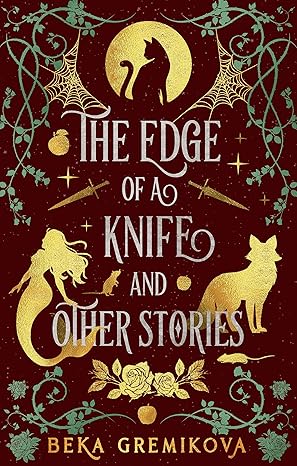
    BOOK REVIEW: “The Edge of a Knife and Other Stories” by Beka Gremikova

    01 Monday Dec 2025

    Posted by Marquise in A Tale Transformed

    ≈ Leave a comment

    Tags

    beauty and the beast, book review, book-reviews, books, fairy tale retellings, fairy-tales, fantasy

    I’d like to start this début review for my A Tale Transformed project dedicated to reviewing fairy tale retellings with some general remarks on the author’s writing:

    a. Beka Gremikova has a nice mix of cruelty and warm ‘n’ fuzzies in this anthology, and knows how to strike a balance between both. When she wants to do silly, she does it hilariously silly (so long as you like her brand of humour), and when she wants to be Very Bad to Characters, she makes everyone suffer.

    b. Beka can do Mainstream Retelling and Peripheral Retelling both. A rare ability, in my reading experience, as most authors that tackle retellings of fairy tales and myths tend to master only one of them and either be passable or not good at the other.

    c. She wrote some of these stories in a way that doesn’t quite fit the mould of traditional retellings. There should definitely be a new and officially-named subgenre to describe this kind of stories that aren’t retellings but feel so fairy tale-ish as if they were. If there’s not one already, I’m going to name this subgenre as Folkloric Fantasy and refer to it as such from now on, credit to this author for calling it so to me, regardless of who came up with the name first as I am not in the know yet.

    Now, onto the stories themselves:

    These nine short stories were originally published in various other anthologies and magazines, like it happened with her previous anthology. The author has been collecting all the short stories she has written so far in her career, and rewriting them for republication in new dedicated anthologies, of which she has several planned and this is the second to date.

    I have read some of these stories in their previous versions, and in at least one case I didn’t recognise the new version at all. It had been so completely rewritten as if from scratch, and in my opinion for the better. I suspect that’s the reason why Beka is doing this massive rewrite, because she has had noticeable improvement in her craft as a writer since her early Indie days and the new versions do show this improvement over the rougher originals.

    Of the nine short stories included in this collection, only three are proper fairy tale retellings, two Peripheral and one Mainstream. Another couple of them are retellings of Classics, and the remaining four aren’t retellings but Folkloric Fantasy stories. (Glad to see a few of my friends are catching onto this name and have started talking about Folkloric Fantasy like it’s the newfangled term du jour.)

    THE EDGE OF A KNIFE

    This one is easy to guess where the inspiration comes from: “The Little Mermaid,” but Hans Christian Andersen’s original tale and not Disney’s. It’s brutal and punchy, the first version already was but this remade one is worse, in a good way.

    This was my first favourite, it poses interesting questions about free will, sacrifice, and whether to let our loved ones make their own mistakes or intervene. As I’ve told Beka, the mermaid in this one deserves her own book, not just because of how good the story is but also for the originality of swimming counter-current to Andersen’s dilemma.

    THE STARDUST SMUGGLERS

    I confess I groaned (and loudly!) at finding this right after the kick in the delicate parts that the prior story was, and protested to the author about it. There’s no tale or myth behind this, it reads like it drinks from all those space shows and films we grew up with, but a goofy drug smuggling in space story that is more Jar Jar Binks than Han Solo to me, more Spaceballs than Star Wars, so I’m guessing this one could be the least-loved story in the collection.

    Ah, but it does have a certain charm by the end, when it goes from goofy to gallows humour and you can’t help snort at it.

    GOLDEN CHILD

    Another story where the inspiration behind it will take you by the throat and shake you till you ask for mercy. It’s that obvious.

    Maybe it’s my familiarity with the myth of Midas, but this one didn’t have the emotional punch it should have given the tragic plotline. Maybe it’s that the plot is straightforward and happens quickly and very linearly, it feels like arriving at the end of ”Romeo & Juliet” with the reconciliation of the Montagues and Capulets without having the story of Romeo and Juliet onpage to witness it unfolding. But I do get the point is to show the price of ambition for Oros and Silvis, the parents of the characters, and I do think it works better with the added layer compared to the old version.

    PAY THE PIPER

    This was not only my second favourite story in the collection but is also one of my all-time favourite retellings of The Pied Piper of Hamelin. I think it’s perfect in length and emotional punch, and the wee tweak to the ending made it perfect to me.

    Yes, you do know it’ll end like that, but its predictability isn’t the point. There’s one little, almost throwaway aspect this story contains that makes me want to beg, cajole, blackmail, or bribe Beka Gremikova to take it and develop in another story, preferably a full novel (don’t touch this little story), because it’s an extremely intriguing concept I have never seen any other author of Fantasy come up with. So, Beka, if you’re reading this, please state your price.

    EVERY BONE IN THE BODY

    Maybe the newer, better version makes it easier to see the inspiration, but the version I read first was a lesson in humility for me and the reason why I wholeheartedly believe the ancient Greek tragedians. The gods saw fit to punish my fan-mythicist Hubris and chose Beka Gremikova as my Nemesis. I pride myself in knowing my mythology inside and out, but I didn’t recognise the inspiration for “Every Bone in the Body.” Can you believe it? Disgraceful. And to twist the knife, it’s one of my top three favourite myths too.

    Other reviewers might spoil it for those of you that didn’t guess, or the newest version will enable you to guess by yourself, but to me it would be too spoilery to tell. I suffered terribly reading this story, wishing all along it wouldn’t end and also not wishing to change a thing about how it ended. I think that, together with the titular story, this one is what makes the title of the book make sense in context. Expected brutality yet also unexpected is how I’d describe it.

    LIKE A FOX

    In my opinion, the version published here is better than the first one published years ago, and also very different. It does keep its clean plot, cheery tone, and overall wholesomeness, but the relationship between Veya and Mishak is developed better (I wasn’t a fan of how it was in the first version).

    This one is Folkloric Fantasy in its purest form. Out of all the stories here, this is perhaps the one that reads the more YA, in the “for young audiences” sense, not less because the fox shapeshifter POV that narrates this is very young but also because its A-rated storyline makes it appropriate for children, and taken out of this collection it could very well be a children’s book of its own. It also has a very Disney animated motion picture vibe, I couldn’t stop picturing these characters as Disney characters of the old school: sweet, nice, and yes, if you’re one of the older and grumpier folks like me, it can feel a tad cloying. I wouldn’t be surprised if this was written back when the author was very young herself.

    RATS IN THE GRAIN

    This was another kick on the rump by my Nemesis: I disliked this story in its original version, Beka rewrote it and made me reread it years later in this anthology, and what do you think happened? I liked it, completely oblivious to the fact that I had hated it before. Disgraceful. But also bless my holey memory.

    For me, that I liked it this time round was as much that the shapeshifter slave girl (hey, are you sensing a pattern with shapeshifters here?) has an engaging voice as the unrealised potential this story possesses. It isn’t a retelling of anything at all, I would say it can pass for either Folkloric Fantasy or Victorian-era magical urchin misery yarn, but given that it’s me and I have a tendency to pinpoint fairy tales where not even the authors may have placed them, I saw this one as a retelling for one fairy tale in its current finished state and as a potential retelling of two other separate tales if rewritten. The author knows which those tales are, courtesy of yours truly, so I wouldn’t be surprised if we were to see sequels of this story one day.

    ECHO AMONGST THE STARS

    I appreciate that the author didn’t have Kaz find out for sure what happened to Mira after the end and that he’s not fully sure he succeeded, as that  makes his sacrifice all the nobler in hindsight. But I also think that things go too much as planned for him, so smoothly and with many coincidences in his favour, which gave me a feeling of implausible ease to overcome challenges presented to him. This is probably another story Beka wrote when she was young, because it has maintained the style of her younger years before her writing matured.

    You can tell space stories aren’t a hit with me by now, I suppose, because this one together with the space drug smuggler one were the pointiest “thorns” in this rosebush for me. But others might like this more, especially Sci-Fi fans that fancy haunted spaceships.

    ONCE UPON A PUMPKIN

    And now, we finally arrive to the big red, gorgeous, fragrant rose that is the jewel of this garden: a Beauty and the Beast retelling that ends this collection on a high, high note.

    The Rose

    This isn’t a pure B&B retelling but one that combines it with two other tales: Cinderella and Snow White. I’m still scratching my head in admiration at how precisely the author managed this combination of three tales in one, considering B&B is tricky to mix with other tales.

    The fairy tales Beka used elements from here are the Grimms’ versions, which is why the Snow White inclusion is bloodier than you’ll expect (because that’s how it goes in the Grimms), and also explains the appearance of the Beast character. Cinderella appears to be Perrault with Disney, though.

    Remarkably, Beast is neither from Villeneuve nor Beaumont, much less Disney, but from the Grimms as well. To me, he gives off vibes from the German version, and that would explain the absence of the traditional Beauty figure (which is French).

    And I also loved the portrayal of the Evil Queen figure done without villainising Snow White or giving the Queen a sob story to justify her past evil. Bravo for that!

    The thorn

    I was about to say this was a perfect thornless rose, and then I remembered the pesky fairy godmother.

    Whilst other characters also have a touch or two of goofiness, such as one of the princes that is a “no intelligence required” himbo and that Cinderella is his perfect match in terms of cute-silly, you can be more indulgent to those two as they are like that for comedic effect. But the fairy godmother, although she’s also like that for comedic effect, is a flavour of goofy that might be annoying to some readers. Not me, as she did nothing for me either way, but I’m aware that impressions vary widely whenever comedy is present. It all depends on your sense of humour aligning with the writer’s.

    Since I opened with some overall positive remarks on the writing, I would like to close with some observations on what could’ve been done to improve this anthology: Taken as a whole, the stories are solid, and the quality is high for what you usually expect from collections. But there’s a mismatch of tone that is very noticeable and will not be to many readers’ liking.

    What I mean by this is that because of the title and promotional description, readers are going to expect a certain atmosphere for all the stories here, in this case a dark one (the title is “Edge of a Knife,” after all, and that hints at tough themes), and they won’t find it consistently in every story here. That can lead to judging the “non-compliant” stories more harshly than they would otherwise. I know that has been true for me, I haven’t quite enjoyed the silly/comedic stories because they clashed with the darker and tougher ones that I was looking forward to and evidently liked.

    Would I, and other readers, have liked the goofier stories more if we had known of their inclusion beforehand? Likely. If you come expecting comedic and fluffy, you’ll laugh. If you come expecting shock and suffering, you may feel bothered by the clowning about mixed in with the horribly tragic. Therefore, I recommend future collections mind the tone more carefully when considering what stories to include and that it all matches. It’s not only curating the themes, the story quality, or arranging a balanced mix of styles and story types that matters for a quality anthology; atmospheric consistency matters a lot too.

    A Tale Transformed: Reexamining ‘Beauty and the Beast’

    30 Sunday Nov 2025

    Posted by Marquise in A Tale Transformed

    ≈ 3 Comments

    Tags

    beauty and the beast, new project

    Once upon a time, in a vegetation-overrun cottage by the river in The Shire, there lived a little girl who didn’t read fairy tales.

    But she knew them all.

    Once upon a time, there was a mother who never bought her children a children’s book, let alone a fairy tale.

    But she told them all.

    Once upon a time, there was a little boy with a big imagination who wrote stories for his friends in exchange for pennies, even though they weren’t fairy tales.

    But he grew up to write a great book series full of them.

    Once upon a time, there was a kind young woman bright and cheery as the sunlight bathing her paradisiac island, who didn’t believe in songs and fairy tales.

    But she put on her armour to defend a despised fictional girl who believed in them.

    First of all, thank you for your interest in the backstory of this new project, which was not meant to be the journey of self-discovery that it became over the years. The genesis of the idea I am presenting here took place five years ago when, once Game of Thrones ended and we found ourselves without hopes for a sixth ASOIAF book to keep Pawn to Player active with consistent analytical pieces, it occurred to me to create a project dedicated to fairy tale retellings that would host an exclusive award for them. In the long preparation phase for it, I learnt a lot that I didn’t expect to, in addition to clarifying things that I had only vaguely intuited. Now I am going to share with you what this new project is about, after several lovely people that became aware of my plans helped me greatly with polishing them, and to whom I am very grateful, especially to Mariella Taylor and this site’s founder, Brashcandie, without whom this would have never become a reality.

    My story with fairy tale retellings has been a series of events that coincided one after another in a successive chain, easy to trace. Unlike what is normal for many children, I didn’t have children’s books growing up; my voracious appetite for reading was satisfied with “tales for grown-ups,” as author Chufo Llórens calls adult literature. I wasn’t familiar with fairy tale books and films as a child, not even Disney’s (which I didn’t watch until my late teens), but I knew them by heart through oral transmission and had some favourites.

    My mum was responsible for that. Many times, at bedtime or when I was sick in bed, she would come and tell me fairy stories to entertain me. She was born in difficult circumstances and she had to fend for herself alone in her youth, so she never had fairy tales or children’s stories to read either. But she had an innate curiosity, an alert mind, and a natural talent for storytelling and doing voices and character impersonations. She learnt many children’s stories and fairy tales by ear and told them all to me and my siblings. I still remember that my favourite of all the stories she told me was Little Red Riding Hood, mostly because of her hilarious impersonation of the Big Bad Wolf with a deep, frightening voice that scared and delighted little me. To this day, yelling “To better eat you with!” imitating Mum’s wolfish voice is an inside joke in my family.

    You could say that I became familiar with fairy tales and their retellings without even trying. When I was older, I won a nice edition of Puss-in-Boots in a children’s contest as part of my rewards for participation, which was my first traditional fairy tale book, and my much-older siblings left me as inheritance of sorts a double edition of Alice in Wonderland and Peter Pan without a cover, a cracked spine, and loose pages with broken edges. I didn’t have more tales than these three.

    But the seed had already been sown, and I took them up again in adulthood, when I was old enough for fairy tales, to paraphrase C. S. Lewis. In fact, all the fairy tales I’ve read I did as an adult, and I did it for myself. Normally, adult fans of children’s literature have children of their own to read to and find books for, or they work teaching young children, or they are academics in fields related to folklore studies. Few deviate from this pattern, from what I can see, and it is usually because they have a personal connection to fairy tales and mythology, as has been my case.

    I’ve been focusing on fairy tales for years as a reader, amateur student of the subject, and reviewer/critic, and there are so many things I have learnt, rediscovered, and understood better in the process of reading as many as possible. The first lesson that stands out from all those years with fairy tales and retellings is that I honestly don’t like the genre as a whole. That is to say, my heart is set exclusively on one specific fairy tale and not on all fairy tales. This tale is, as you may have guessed, Beauty and the Beast.

    The reason I became interested in fairy tales again as an adult was Beauty and the Beast, not fairy tales themselves. It has been a decade and a half since my love for this story was born, driven and stimulated by a couple of characters that fit the archetype of Beauty and the Beast perfectly, for their narrative arc, which touches on key themes and points in the original story’s plot. My interest in other fairy tales began as a secondary and complementary development, growing as an extension of my love for Beauty and the Beast, just as Beauty and the Beast was born out of my love for that story all of our regulars know so well. And from there I moved on to retellings. I didn’t start reading them because I love retellings in themselves, but because I wanted to read more Beauty and the Beast. So, for me, that was a second big revelation: I didn’t care about the retellings of Cinderella, Snow White, Sleeping Beauty, Rapunzel, The Goose Girl, etc. I can do without those and all the other types of retellings. I cared about Beauty and the Beast retellings.

    It was my attempt at diversifying to cover all fairy tales that led to my complete reading exhaustion, a fatigue I couldn’t seem to shake off for a long time, which led to my third big revelation. If I had focused exclusively on B&B (I don’t use the more common abbreviation BatB) as I had in the beginning, such exhaustion wouldn’t have happened. I shot myself in the foot by trying to be inclusive to other tales and all the stories that I simply felt no passion for.

    Now we’ve arrived to the raison d’être of this long personal account. Why host Beauty and the Beast on Pawn to Player if this place was built for ASOIAF content? Because Pawn to Player was the origin, the source, and the foundation of it all. When I joined the PtP’s Rereading Sansa and Rethinking Sansa discussion threads that Brashcandie had created and hosted at the w.org forums back in 2011, her discussions had already made relevant contributions to the fandom in terms of studying the character of Sansa Stark, who at the time was much vilified in the ASOIAF/GOT fandoms, and Pawn to Player had pioneered turning the tide. Of course, there were already some fans in those threads and elsewhere talking about Beauty and the Beast integrated into Sansa’s story, you would’ve had to be blind and dumb on top not to see the obvious, more so when George R. R. Martin himself was a fan of the fairy tale and had written an adaptation of it for TV before ASOIAF. He even had an illustration of Sandor and Sansa as Beauty & Beast from Jean Cocteau’s 1946 film hanging on the wall at his house! It was a no-brainer to notice that Sansa’s story with Sandor Clegane was Martin’s very own Beauty and the Beast retelling within ASOIAF, even if not everyone liked it. And it was also obvious that Jaime and Brienne had elements of Beauty and the Beast in their own arc.

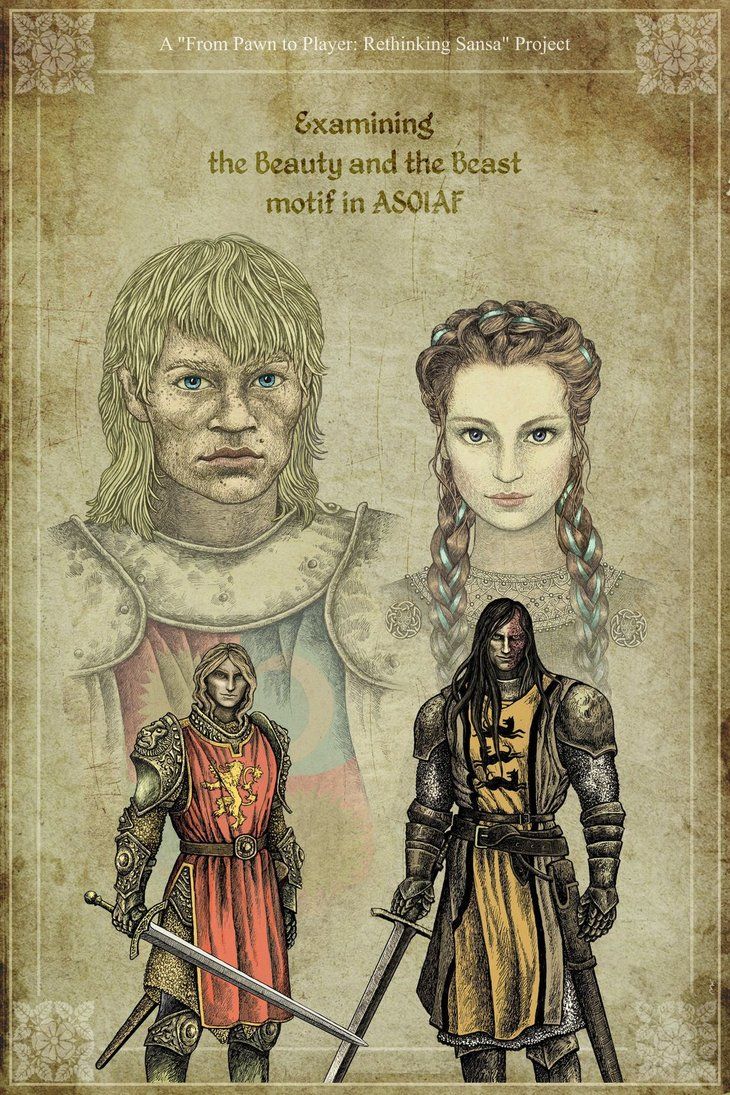
    But at the time, there were many misconceptions, bad takes, and blatant misrepresentations of the Beauty and the Beast story. There was little serious analysis of it, and except for a fan here and there on social media, most people talked about how “toxic” the story was and some published articles about how the story excused Stockholm syndrome, abusive relationships, teaching women to be submissive, etc. That was the mainstream groupthink at the time. Now it’s hard to imagine all that, because now there are many good fan analysts who understand the story and defend it from the misconceptions of the past, but back then the outlook was disheartening. It was in this context that I proceeded to create the project “Examining the Beauty and the Beast Motif in ASOIAF” for Pawn to Player, with the enthusiastic participation of several regular PtPers and a beautiful poster by our friend Magdalena, the artist known as Bubug.

    The best of that project is selected for permanent hosting on this site, although not everything had the depth we would’ve wanted and, our contributors and ourselves being mere fans and not trained experts, it may contain mistakes. I like to think that we were amongst the first defenders of B&B, and of course we had disagreements and disputes in defence of the tale, whether because of the original story itself or because of the story rooted in Sansa’s, because there’s always been controversy over SanSan. At times, that project was a discouraging experience, but time proved it worthwhile. A decade and a half later, I believe the fairy tale has a better reputation, although there are still misunderstandings about it circulating out there, and this is a victory won by the old-time B&B fans. Today’s casual readers of any B&B adaptation have no idea that they are standing on the shoulders of those old-time fans, they have no idea that when they say “a pretty girl + a hero with scars on his face does not equal Beauty and the Beast,” they are repeating concepts from the B&B pioneers. It’s all taken for granted, as if it had always been obvious and common knowledge, and not the product of painstaking work of years by several people.

    For example, my interpretation of the Beast’s curse as the result of child molestation and grooming by the fairy godmother, based on the original French text by Madame de Villeneuve wasn’t the norm, I don’t recall even other B&B fan-experts knew it. I first published my observation on the PtP, and it was a surprise that caused some to message me in private about it, because they didn’t know about this from the original tale, and to this day there are even some folklore scholars I could name that tend to downplay it or dismiss it because the abuser is a woman and the abused is a minor male. There’s a clear need for a place to collect, organise, and preserve for posterity all the material related to Beauty and the Beast that I have outside of the PtP project. I have all of that on the Goodreads platform, but that site is likely to disappear one day, and my B&B material and reviews of fairy tale retellings would be lost.

    So the way forward is: a permanent site to host a permanent project. What better place for it than Pawn to Player? To me, it feels like a natural development, circling back to where it all started and continuing there, regardless of whether we ever see TWOW or if ASOIAF is ever completed, the Pawn to Player evolves and lives on.

    A Tale Transformed: Reexamining ‘Beauty and the Beast’ will be a modest endeavour at first, naturally. We will start with two regular features: a review of Beauty and the Beast retelling books or of one with similar elements/vibes and adjacent tales, and interviews with authors that have published something in the genre. Over time, we hope to add a Hall of Fame for the best retellings, and non-fiction, academic articles, and in the very, very long term, we would like the project to accommodate my one big dream: a writing contest, the sponsorship of an anthology, an award for B&B retellings. All under our brand name.

    You might say that B&B is too limited and restrictive a niche, and I would say yes, it is. But that is the limited and restrictive niche that needs this investment of time, resources, and mental energy. And there’s also a pragmatic side: it’s a niche that I can easily fill because no one is. There are many critics, bloggers, Booktubers, Booktokers, and podcasters focused on fairy tales and their adaptations at large, and countless folklore enthusiasts who read retellings and review them all the time. But, as far as I know, almost no one focuses exclusively on B&B retellings, which is surprising for the most popular fairy tale in the world that has dozens of books published every year with it as the core theme.

    Finally, there was a fourth big revelation on this journey, cemented by my latest book of fairy tales, ironically entitled “Requiem for Fairy Tales” (this was totally unintentional and fortuitous, one of those strange coincidences in my life that I’ll have to attribute to the Universe giving me a wink and nudge): What I really like, more than “pure” retellings, is what an author friend, Beka Gremikova, calls “Folkloric Fantasy.” I don’t know if it’s an official genre name or just what Beka Gremikova came up with to name it, but here’s what it is: Fantasy that reads like a fairy tale, but is neither a fairy tale nor a retelling of one. It may have elements from a specific tale or a handful of collective fairy tale motifs/themes/archetypes, either in general or from the tradition of a specific country. Does it make sense? I can cite examples of books that fit the description if you’re not sure of my meaning, but just to give a few clues, that’s essentially what authors like Naomi Novik or Katherine Arden do.

    Folkloric Fantasy is much more varied and flexible than proper retellings because it doesn’t have to follow the plot of a fairy tale, it doesn’t depend on the framework of a fairy tale, and (something very important to me, as I am strict about respecting the core themes of a tale) it doesn’t have to respect a fairy tale’s core theme, as it isn’t subject to any. The genre can play more freely with themes, motifs, plots, and elements, and it can twist fairy tales much more impunity than retellings. In short, it’s like what Historical Fantasy is to Historical Fiction: more room for creative licence and historical anachronisms that would be unforgivable in traditional Hist-Fic. Similarly, in Folkloric Fantasy you can forgive what you can’t overlook in traditional retellings.

    That flexibility allows me to enjoy not only Beauty and the Beast-adjacent stories, but also other fairy tales in a way that traditional retellings don’t allow. Many years ago, when I was looking for more books by a Spanish author, Laura Gallego, who had written a short retelling of Beauty and the Beast (more irony!), I got my initial suspicion that Folkloric Fantasy was my thing rather than retellings. I had loved Gallego’s short story and wanted more, and I found out she had written a book called “All the Fairies in the Realm.” Because of the title and her previous short retelling, I mistook it for a fairy tale retelling and spent the entirety of the book trying to guess which fairy tale she was rewriting. In the end, I felt foolish and ignorant because I couldn’t identify the fairy tale, as it had many motifs from various tales, and concluded that I didn’t possess enough knowledge to pinpoint such a complex mix of several tales. I had no idea that I had just discovered Folkloric Fantasy.

    That book whetted my appetite for more books of that kind, although for years I continued to mistake Folkloric Fantasy for traditional retellings. It had the effect of broadening my scope of B&B to include books that were not “retellings” per se, but had the vibe in one way or another. My B&B collection thus became full of titles that aren’t retellings of the tale but that have so many similarities that anyone could mistake them for B&B retellings, and that subconscious association was probably the beginning of my eventual discovery of what I really want from this genre, as well as enabling me to have a personal definition of B&B that is probably more ample than most people’s, and that I don’t understand retellings the same way other readers do. But it wasn’t until I met Beka Gremikova and her circle of charming indie writers that I finally learnt a name for this.

    All that said, the short-term goal for A Tale Transformed is to build a reputation before I can think about a larger, more ambitious project. Although I am fairly well known in the community of amateur book reviewers, outside of it I have no online presence and no reviews outside of Goodreads. Some popular Booktube and Booktok reviewers have a wide reach, and there are some who have been focusing on fairy tales and retellings in general for years and already have an established audience and reputation, but in my case, my reviews without a home of their own are all I have in terms of clout. Can you imagine what the sensible world of literary awards would think if an unknown girl suddenly burst onto the stage with a pretentious award for fairy tale retellings? They would laugh me out of the room!

    The objective is that this becomes a “brand” for reviews of B&B retellings and, yes, Folkloric Fantasy books too, something with a name that the bookish public will easily recognise and authors will see and know as a reliable source of book reviews and analysis. That way, when the time comes to create an award for retellings as is my one overarching goal, it won’t be unexpected. Because by then, just by seeing the name of the award, people would immediately know that it is reliable, serious, and here to stay.

    It’s exciting, but also scary, and perhaps rather ambitious. I’m used to anonymity, and I know that this expanding online presence would expose me more than I’m used to. Those that knew my work as Milady of York don’t know my reviewer persona as Marquise, and vice versa. But I know there’s loyal followers we can count on that have showed enthusiasm for this new direction, and at the very least, this will be useful in saving my material from loss,

    We will see where the yellow brick road takes us, my Dorothies!

    Recent Posts

    • 2025 STATE OF THE TALE: The Best “Beauty and the Beast” Reads of the Year
    • AUTHOR INTERVIEW: Beka Gremikova
    • BOOK REVIEW: “The Edge of a Knife and Other Stories” by Beka Gremikova
    • A Tale Transformed: Reexamining ‘Beauty and the Beast’
    • ‘Pawn to Player’ is back!

    Archives

    Categories

    Blogs I Follow

    • Martin Studies International Network
    • Race for the Iron Throne
    • lucifermeanslightbringer
    • Wars and Politics of Ice and Fire
    • Radio Westeros

    Blog at WordPress.com.

    Martin Studies International Network

    Race for the Iron Throne

    You Win or You Die - Historical and Political Analysis of Game of Thrones by Steven Attewell

    lucifermeanslightbringer

    The Mythical Astronomy of Ice and Fire

    Wars and Politics of Ice and Fire

    Political, Military and Historical Analysis of A Song of Ice and Fire

    Radio Westeros

    ASoIaF Podcasts

    • Subscribe Subscribed
      • PAWN TO PLAYER
      • Join 74 other subscribers
      • Already have a WordPress.com account? Log in now.
      • PAWN TO PLAYER
      • Subscribe Subscribed
      • Sign up
      • Log in
      • Report this content
      • View site in Reader
      • Manage subscriptions
      • Collapse this bar
     

    Loading Comments...