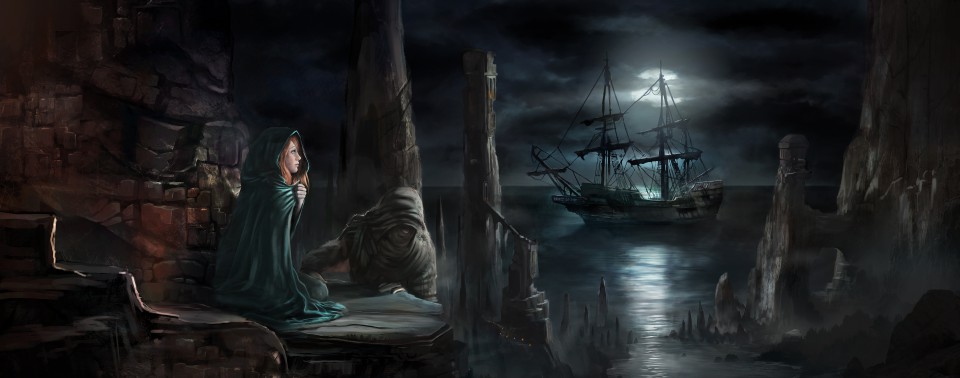

MESTRA
“So my father sold me to the man for seven roasted chickens.”
Imagine that, being sold for food and not because your father is truly starving.
This short story is about Mestra, daughter of the king of Thessaly, who has been cursed by a goddess with insatiable hunger as punishment for a grave offence. Her father has eaten everything and is still hungering for more and more, and because he only has his child left, Mestra is sold for seven chickens to someone promising to rid him of the affliction. But as she is taken to her new husband’s home, she invokes the god Poseidon, who had forced himself on her recently, and gets an unexpected gift.
With the ability to metamorphose into anything, man or woman or animal, Mestra escapes her forced marriage. But back home, her dad decides to sell her off as a bride again for a price over and over, as he’s afflicted by uncontrollable greed besides hunger.
It’s not too long before the father realises this scheme isn’t working well, that his hope about the gift of the god overwriting the goddess’ curse is dangerous for his daughter too, as other shapeshifters have paid dearly for the ability, so he comes up with an idea to rid Mestra of it. His “solution” is so terrible that Mestra shapeshifts upon realising she’ll die and be eaten otherwise, and flees to live away with a cousin, with whom she can be free and relatively content, still keeping her metamorphosis powers.
That’s it, that’s all there is to Mestra. It’s short and straightforward, with no pretensions.
Read more: Two Stories of Transformation: “Mestra” & “Galatea” by Madeline MillerWell, it does have one pretension: it presumes that the reader already knows the Greek myth of King Erysichthon, the vain and greedy ruler of Thessaly, who in a moment of hubris built a gorgeous hall to the greater glory of himself, and because he needed materials, he went and felled the sacred oak from a grove consecrated to the goddess Demeter, who cursed him to perennial, all-consuming, and torturous hunger. If the reader doesn’t know the myth, or doesn’t Google it after finishing the short story, many things won’t make sense for lack of context. For example, in Miller’s short story, the king isn’t named at all; the author doesn’t even clarify who cursed him and for what, she assumes the readership has to know the background of the king’s “affliction” (as she calls it in-book).
The part that corresponds to Mestra’s own story, which she is the sole POV for, doesn’t necessarily require foreknowledge of the myth, and in a way it might even be better if you don’t know it and learn the true plot afterwards. Because if you happen to already know the myth, as I do, then Mestra will read as too straightforward a retelling, and rather unsatisfying for how underdeveloped and unimaginative it is.
Because, really, I don’t believe this can be called a fresh or original take. What changes there are in relation to the myth are minimal, but three in particular are rather curious: the entire Poseidon/Mestra relationship is described as a one-time rape when she was a teen, not as an abduction and a long affair that produced children (in some versions); Erysichthon marries her off for food instead of selling her into slavery the first time; and, more curious of all, Erysichthon tries to eat Mestra, which is what prompts her to flee.
I’m not sure I understand Miller’s rationale for the last change. The point of Demeter’s curse is that Erysichthon ends up eating himself to death, and only then his daughter leaves because she’s finally freed of her misplaced filial loyalty. He never tries to eat her or break her “curse” (that is so profitable to him), and she doesn’t break free from her shackles whilst he’s alive. Her tragedy is that she is too devoted to an undeserving parent, so excessively loyal she sacrifices herself in such a way that changing shapes becomes her liberation.
She is a victim of her father’s hubris, but here she works also as a nemesis. I’m not sure I can see a real need for this.
The other changes are to be expected from Miller. She has a track record of making things worse for women than they were (and goodness knows the past was ugly for us women as is) in order to make them greater victims than they really were, thus when their moment of freedom, their moment of empowerment, or their happy ending, finally arrive it’s all the more triumphal. Her making the men worse villains is also expected for the same reasons (Poseidon is a bigger bastard here, as is Erysichthon), but I raised an eyebrow at Miller not making any distinction between slavery and marriage; and I resent that she absolves Mestra of her one fatal flaw: self-destructive loyalty.
Mestra’s isn’t a story about feminine freedom, it’s about a woman so emotionally co-dependent on an exploitative and selfish father that she becomes a victim of and remains a victim of his foibles until his passing frees her, even though she has the tools to free herself much before. It’s like the woman in a toxic relationship that keeps coming back and financially supporting the abuser, the alcoholic, the drug addict, etc., at her own expense and against all good judgment. In the myth, Mestra never realises this, she’s too loyal and too caring, and misuses Poseidon’s gift to return again and again for more exploitation by her father, never breaking the cycle. Her gift is double-edged: it frees her from the unwanted suitors, but it enslaves her to her father’s whims. In Mestra, though, her gift is made to be her ultimate empowerment.
As this is the third short story retelling of hers that I read, I think Madeline Miller is a better writer in long form than in short form. When she does short form, her stories tend to follow the major plot beats but in a way that never lets the reader know what’s going on without previous familiarity with the myth she is rehashing. There’s no sense of them being actual myth retellings when it’s short stories, they could be regular short stories placed anywhere, and you get the sense that they’re myth retellings mostly from the Greek names and the gods mentioned (plus the titles, all pointing to what myth is used).
In her novels, however, she manages a sense of time and place that makes you go, “Ah, this is a Greek myth retold!” She can pad up context to her changes in novel form, too, so mythology-educated readers aren’t going to be left scratching their heads because at least the changes will make sense within the storyline.
I think the story of Mestra should’ve been a full novel. I heard Miller is working on an Eros & Psyche book, a myth with Beauty and the Beast themes, but if she wanted a really unique retelling carrying this motif, the story of Mestra is pure gold. Think about that: a genderbent B&B-style story in which beastliness isn’t a curse nor a punishment but salvation. I have read some proper B&B retellings that have tried the “beastliness is a gift, not a curse” plot twist and most failed miserably in the execution because of the motive for the transformation not being adequate for the plot twist. In the case of Mestra, the motive for the transformation works perfectly as lifesaving and empowering (she’d have remained a slave if not for Poseidon enabling her to morph into animals to escape), and that it’s compounded by her one fatal flaw (boy, did the Greeks love their fatal flaw plot twists!) makes it all the more complex.
But who would be Mestra’s “Beauty”? Depends on which source you side with. Miller is using Ovid’s version from Metamorphoses, and the Roman poet recounts a Beast & Beast pairing for her, as her eventual husband Autolycus is also a shapeshifter. You see, this makes the potential even more interesting, because Autolycus’s gift of metamorphosis is used for ill purposes (he’s a thief), unlike hers.
As it stands, though, Mestra is a missed opportunity: a brilliant premise squeezed into a handful of pages, and the one flaw that made the myth tragic, and interesting, traded for an easy triumph. A novel would have given Miller the room to build Mestra’s loyalty, let it hurt her, and make the gift cost her something before it set her free. Whoever her Beauty turned out to be, I would have read that book in a heartbeat. This one I will mostly remember for sending me back to revisit the myth.

GALATEA

“I’m always this color,” I said. “Because I used to be made of stone.”
In this retelling of the Greek myth of Galatea and Pygmalion, Galatea is the sheltered wife of a sculptor who keeps her homebound and bedbound like she’s sick whilst she longs to go out and walk. A gift from the goddess Aphrodite, in answer to the sculptor’s prayers, turned her from stone to flesh, a state she still remembers, but her husband denies it and tells her caretakers that she’s prone to flights of fantasy whenever she says she used to be stone.
This story is basically about what life is like for Galatea after she turns into a living woman, and to be honest, Madeline Miller has changed the myth in ways that don’t make much sense. Pygmalion and Galatea is one of the rare Greek myths with a happy, functional couple, and by all accounts they were a loving couple, they had a son, and lived normally. Nothing in the mythology hints at anything problematic, which is something in a mythical corpus like the Greek, so full of rape, kidnapping, murder, fratricide, and all sorts of horrible stuff.
Which is why I’m surprised that Miller would take this myth and twist it to make Galatea’s story a complete tragedy and Pygmalion the villain.
Not only does Pygmalion keep her confined at home, but he also doesn’t treat her well. Thanks to his gift for sculpting, he’s rich now (in the myth, he was a king, so he didn’t get his fortune from sculpting), and he keeps a secret sculpture of a perfect girl because now that Galatea is flesh, she’s no longer perfect: her husband even makes a cruel remark to her about having stretch marks (she had a child, which Miller changes from a son to a daughter). He makes her feel like she’s no longer desirable, that she’s too fragile to go out and raise her daughter or play with her.
And he makes her abort. Because pregnancy would ruin her perfect body.
When Galatea disobeys and goes exploring in the house, she discovers the perfect sculpture of a perfect girl and thinks it is her substitute, because it’s a young girl and he hints at wanting perfect youth and virginity again. She runs away one day, but is brought back and scolded. Then, due to the treatment she is given as if she were an aging doll, she escapes a second time with the intention to drown herself. Pygmalion (who is never named here) runs after her to bring her back, but she drags him into the sea with her and he drowns as she sinks into the deep water.
I’m at a loss for words at this take. My first thought is: why? What is Miller trying to say here? To critique male obsession with beauty and unblemished female bodies? I’m not sure, but if that was the intention, the delivery has the subtlety of a kick to the teeth, and feels like a perversion of a nice love story. Pygmalion fell for his own creation and felt he could never find a woman like that even before he made Galatea, but there’s no context of him ever bullying Galatea for getting all the normal flaws of a woman growing old. Everything in the myth indicates they were happy. So I think this was the wrong take for this myth.
If anything, this reminds me of Nathaniel Hawthorne’s short story The Birthmark, in which the protagonist, Aylmer, is so obsessed with a crimson hand-shaped facial birthmark very visible on his otherwise stunningly beautiful wife, Georgiana. By all accounts, she’s perfect, gorgeous, jaw-droppingly beautiful, but Aylmer can’t look past that birthmark, and being a talented man of science, he runs experiments in his lab until he finds an alchemical elixir that will erase that red birthmark. He makes Georgiana drink it, and the birthmark disappears indeed, much to his joy.
But Georgiana dies.
Maybe Miller had this story and its morale in mind and decided to juxtapose it on the Galatea/Pygmalion myth? I can only speculate. I don’t think these two stories are compatible, but if you interpret Pygmalion’s desire for beauty and perfection in his craft negatively along the lines of Aylmer’s pathological obsession with perfection, then you might see where the author might be coming from. But nonetheless, and whatever Miller had in mind, the fact remains that Galatea and Pygmalion aren’t a negative story in any way whatsoever. Hawthorne’s, on the other hand, definitely is.
Between the two, Galatea is the one that bothers me more. Mestra at least gives its heroine a triumph to work towards, however unearned, but here there is no triumph at all: just a woman disappearing into the sea and one of the few happy couples in Greek mythology warped into a cautionary tale the myth never asked for. If Miller wanted to write about men who can’t love a woman as she really is, there is no shortage of myths (and Hawthorne) that already do it from which to draw inspiration instead of this one.
