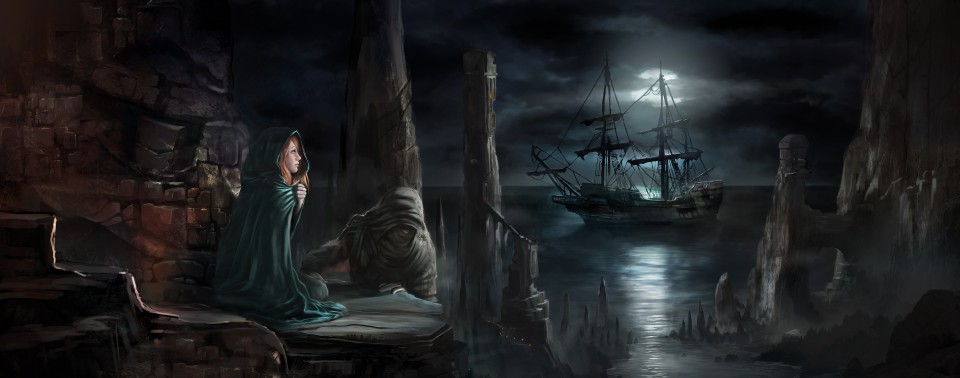

As I read this book, I kept telling myself I must be hallucinating because the plot looked increasingly like a retelling of Hans Christian Andersen’s “The Snow Queen.” And since I tend to see fairy tales and fairy tale motifs where they weren’t intended, as several authors have already told me, I had to make sure I was still in my right mind. At around the 40% mark, I asked the book’s editor if she saw it too, or if it was just me.
It turns out that yes, Wild Hunt did draw a good amount of inspiration from that fairy tale, and blended it with the mythology of the Wild Hunt in its German version.
I didn’t expect it at all, but this was the best book in the Nightmare Saga yet. Largely thanks to the mythology of the Wild Hunt, but not exclusively, because it’s also because all characters are strong and well-developed, especially the character of the Mennonite girl, Esther Reinhardt.
It took me a while to get into this saga. I was barely hanging on to the first book, Water Horse, because I never warmed to the female main character, Meg, and I liked the villain Sigurd more. When you end up liking the bad guy more than the heroine, you’re in trouble. I fared better with the second book, Black Dragon, because I liked Shufen, and the themes were more serious and better developed in the plot, but as a counter Jack drove me crazy more than is reasonable. With Wild Hunt, I got hooked on sight, and I liked both the plot and the characters from the start.
Even Meg, whom I struggled to sympathise with until now, finally won me over in this book.
So what is it about this third book in the Nightmare Saga that deserves such praise? Let’s go look at it one gallop at a time . . .
First, the writing. After these few books, Katie Hanna has matured as a writer, polishing the beginner’s rough edges that were more noticeable in her early work, and apparently she has better editors or the ones she got are stricter now—though they still let her get away with her penchant for capitalisation. Second, with this new literary maturity comes a better command of characterisation: the protagonists, the secondary characters, and the villains. They are all better defined, even those who are débuts, like Frau Hulda. And third, the whole mad adventure of the Wild Hunt is thrilling and full of scenes that deserve to be illustrated.
My favourite character was Esther, which didn’t seem likely to happen at first because of her religious rigidity, her closed-mindedness, and her very German lack of a sense of humour. She was so stubborn! You wanted to shake her until her fleas fell off. In the end, it is this very stubbornness that helps save those trapped in the Wild Hunt and to confront Sigurd Mahres to beat him at his own game. I saw Cam as a bit too reckless and goofy for her, just as I saw Jack as very much too Jack for Shufen. He falls for her too quickly for my tastes, but you can accept it because this goofy cowboy needs a tall, outspoken German woman with a pragmatic approach to magic for balance. You don’t get ahead in the Wild West without women like Esther.
When her sister is forcibly committed to the Nebraska State Lunatic Asylum, it’s Esther who comes up with the idea of escaping her Mennonite colony to go rescue her because she knows she’s not insane. She’s the first to find out what’s happening to Cam when he’s caught by the Wild Hunt, and she plays the role of Gerda to his Kai, helping to break the spell cast by the villain leading the hunt, which to me was her crowning scene.
“I know you’re afraid, Cam!” I shout. “I’ve been afraid, too! Afraid my whole life! But the people in this world who force you to run and cower—those people don’t even want to fight. And you don’t have to fight them!” Tears prickle my eyes, and I draw a ragged breath. “Cam, you just have to face them. And then WALK AWAY!”
She’s not perfect, but she’s by far the best character and the one who evolves the most in the book, despite the fact that the plot doesn’t lend itself so much to a character study-style story, given the circumstances. The story favours action and adventure. The Wild Hunt begins ominously, with Meg hearing something odd in the whistling wind and Cam seeing the enormous black hound as the Winter winds howl and a tremendous snowfall descends. But things aren’t non-stop action from the start but move slowly at first, because Cam refuses to acknowledge what he sees and refuses to run, thus avoiding being chased by the hunters of Die Wilde Jagd.
However, once he is forced to run, it becomes a mad hunt with some truly impactful scenes. If this series were to publish a special hardcover edition with illustrations and other embellishments, this third book would be the one to feature them. There are many great scenes to inspire Fantasy artists: the appearance of the ghostly black hound, the Calhoun Ranch’s cattle driven half-mad by the sinister light of the Wild Hunt, the phantasmagorical hunters tormenting Cam, the phantom memory of Cam’s alcoholic father inserted into the Hunt, Frau Hulda on her black horse like a cross between Perchta and a SS-Helferin, the crossing of the frozen river, all the scenes in the cavern where they find Cam, the train chase, the stampede that baby Róisin stops, the aerial dogfight between the Chinese dragon and Sigurd, the verbal duel between Esther and Frau Hulda to thaw the captive boy’s frozen heart . . . So much to illustrate; it would make a beautiful edition for fans of this series. I certainly would want one!
Regarding the worldbuilding, I must highlight the realistic aspect of the Volga Germans, and from the fantastical side, the fact that each type of magic is inactivated by magic that doesn’t belong to its own folklore. From what little I know about German immigration to America in the 1800s, I assumed they all came from the countless German principalities, either independent or newly united—as a modern country, Germany is younger than the US—and it wouldn’t have occurred to me that there were also German immigrants from elsewhere, like the Volga Germans, who almost never appear in novels. I was surprised to learn that there were Volga Germans in the Wild West, who were Mennonites (and now want to ask the few Mennonites I personally know where exactly they hail from). It shows that even amongst the immigrant majority, there was never uniformity, but rather it’s more diverse than people want to think, and there were now-forgotten white minorities that were also part of American history.
The second point is rather amusing to me. What do you mean, you can’t heal my fatal wound because it’s German magic and you only work with Chinese magic? Come on, I’m dying here and this isn’t the time to be discriminating about the origin of magic, for crying out loud! This made me laugh, in Fantasy it’s so common to mix folklore from various origins, magical beings and magic from different cultures, and make them work together somehow. Not so in Katie’s saga; here, good and bad magical beings can’t colour outside the lines drawn by their own folklore.
What I would have liked is to see a little more of Adela, not necessarily see all the process of her recovery from PTSD after being in the psychiatric facility for so long, but at least some more clues about how that’s going to unfold. And for Esther not to have it so easy resolving her estrangement from her Mennonite community. We’ll probably see or hear something about the former in a future book, but the latter could have been left hanging without full closure, perhaps as something Esther always has to deal with and is a nagging thorn in her side. It’s not so easy to walk away from an isolationist and rigidly structured ethno-religious cult just like that. Perhaps she has leftover religious trauma? But it doesn’t seem that way, going by that last talk with the Elder.
Oh, and I also would have liked to know what’s going to happen to that bastard Sigurd. Yes, I know he is in really hot water after the newspaper bombshell, and a future book will tell; but I’m impatient to see him sweat through this new problem. The funny thing is, although he was my favourite character in the first book, in this one I want him to lose and can hardly wait to see his downfall. Perhaps it’s old age pushing me to switch to the side of the good guys, quelle horreur, but this time my psychopathic little doctor hasn’t entertained me as much. It’s about time he started making more serious mistakes and getting what he deserves.
To wrap things up, now that everyone has found their soulmate and kicked their ethnicity’s magic in the delicate parts, there are only two single cowboys and Jinjing left at the Calhoun Ranch, you know? I’m very curious to see who is next for a magical-historical adventure, I suspect it might be Quino’s turn. I mean, when was the last time you saw a philosopher-cowboy (of sorts!) starring in a Western?

Marquise, thank you for the lovely and thoughtful review! And I’m glad we could confirm that your fairy tale “Spidey senses” were not deceiving you, that there is indeed a strong Snow Queen influence in this book!
Oh my, I would love it if we could release an illustrated hardback edition of Wild Hunt. Definitely something to keep in mind for the future!!
Hehehe, happy to have hit on target. 🙂
Oooh! That would be so good. My co-host here, Brashcandie, is an art connoisseur, and she collects Fantasy artwork. There’s tonnes of great artists out there for Fantasy specifically, including prizes and awards. If you go for an illustrated edition one day, you won’t be lacking for choice of good artists!
I’m going to add your book to my paper collection.
Thank you!! So flattered to be added to your collection!
So, as far as I’m aware, the editing team for this series has remained consistent throughout all three books (except for the proofreader on book two because the usual person wasn’t available). That said, I do agree that this is some of Katie’s strongest writing, and I really loved this book.
It was really wonderful for me to get to see a character like Esther who is strong in a very different way from some of our other female characters. She very much reminded me of my deceased grandmother (who was Czech and who raised me) and it was such a nice experience.
You also know that I love the Snow Queen tale, so the vibes were definitely vibing for me, too. <3
Yeah! I never thought it would be so, but Esther was the highlight of the book. To think I was doubtful about her at first… Mostly because I wondered how a girl like her would mesh with a “dingus” like Cam. 😛
But Shufen and Jack proved such dingus/smartypants pairings work, so!
I really want an illustrated edition of this book, it wasn’t just a throwaway suggestion, by the way. Hope it can be done one day.
XDXD Oh poor Cam. I thought the same thing at first, though. But she’s a character with a lot of personal and cultural depth, as well as unaware of magic unlike the other girls and I kind of liked that.
This is true XD But at least Jack knows he’s a spazzy idiot and adores his wife for being the smart one.
I think that would be really cool, actually. I don’t know if it would be able to happen until the rights were released back to Katie, but I definitely think it would be something worth pursuing and collecting for sure.
I’d be happy to help with artist suggestions if that happens!