Tags
beauty and the beast, book review, book-reviews, books, fairy tale retellings, fairy-tales, fantasy
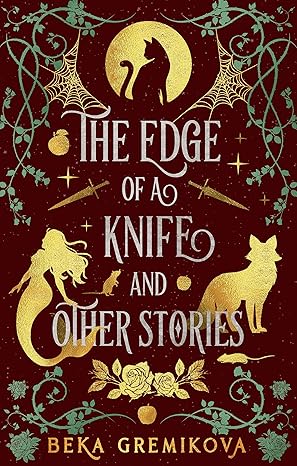
I’d like to start this début review for my A Tale Transformed project dedicated to reviewing fairy tale retellings with some general remarks on the author’s writing:
a. Beka Gremikova has a nice mix of cruelty and warm ‘n’ fuzzies in this anthology, and knows how to strike a balance between both. When she wants to do silly, she does it hilariously silly (so long as you like her brand of humour), and when she wants to be Very Bad to Characters, she makes everyone suffer.
b. Beka can do Mainstream Retelling and Peripheral Retelling both. A rare ability, in my reading experience, as most authors that tackle retellings of fairy tales and myths tend to master only one of them and either be passable or not good at the other.
c. She wrote some of these stories in a way that doesn’t quite fit the mould of traditional retellings. There should definitely be a new and officially-named subgenre to describe this kind of stories that aren’t retellings but feel so fairy tale-ish as if they were. If there’s not one already, I’m going to name this subgenre as Folkloric Fantasy and refer to it as such from now on, credit to this author for calling it so to me, regardless of who came up with the name first as I am not in the know yet.
Now, onto the stories themselves:
These nine short stories were originally published in various other anthologies and magazines, like it happened with her previous anthology. The author has been collecting all the short stories she has written so far in her career, and rewriting them for republication in new dedicated anthologies, of which she has several planned and this is the second to date.
I have read some of these stories in their previous versions, and in at least one case I didn’t recognise the new version at all. It had been so completely rewritten as if from scratch, and in my opinion for the better. I suspect that’s the reason why Beka is doing this massive rewrite, because she has had noticeable improvement in her craft as a writer since her early Indie days and the new versions do show this improvement over the rougher originals.
Of the nine short stories included in this collection, only three are proper fairy tale retellings, two Peripheral and one Mainstream. Another couple of them are retellings of Classics, and the remaining four aren’t retellings but Folkloric Fantasy stories. (Glad to see a few of my friends are catching onto this name and have started talking about Folkloric Fantasy like it’s the newfangled term du jour.)
THE EDGE OF A KNIFE
This one is easy to guess where the inspiration comes from: “The Little Mermaid,” but Hans Christian Andersen’s original tale and not Disney’s. It’s brutal and punchy, the first version already was but this remade one is worse, in a good way.
This was my first favourite, it poses interesting questions about free will, sacrifice, and whether to let our loved ones make their own mistakes or intervene. As I’ve told Beka, the mermaid in this one deserves her own book, not just because of how good the story is but also for the originality of swimming counter-current to Andersen’s dilemma.
THE STARDUST SMUGGLERS
I confess I groaned (and loudly!) at finding this right after the kick in the delicate parts that the prior story was, and protested to the author about it. There’s no tale or myth behind this, it reads like it drinks from all those space shows and films we grew up with, but a goofy drug smuggling in space story that is more Jar Jar Binks than Han Solo to me, more Spaceballs than Star Wars, so I’m guessing this one could be the least-loved story in the collection.
Ah, but it does have a certain charm by the end, when it goes from goofy to gallows humour and you can’t help snort at it.
GOLDEN CHILD
Another story where the inspiration behind it will take you by the throat and shake you till you ask for mercy. It’s that obvious.
Maybe it’s my familiarity with the myth of Midas, but this one didn’t have the emotional punch it should have given the tragic plotline. Maybe it’s that the plot is straightforward and happens quickly and very linearly, it feels like arriving at the end of ”Romeo & Juliet” with the reconciliation of the Montagues and Capulets without having the story of Romeo and Juliet onpage to witness it unfolding. But I do get the point is to show the price of ambition for Oros and Silvis, the parents of the characters, and I do think it works better with the added layer compared to the old version.
PAY THE PIPER
This was not only my second favourite story in the collection but is also one of my all-time favourite retellings of The Pied Piper of Hamelin. I think it’s perfect in length and emotional punch, and the wee tweak to the ending made it perfect to me.
Yes, you do know it’ll end like that, but its predictability isn’t the point. There’s one little, almost throwaway aspect this story contains that makes me want to beg, cajole, blackmail, or bribe Beka Gremikova to take it and develop in another story, preferably a full novel (don’t touch this little story), because it’s an extremely intriguing concept I have never seen any other author of Fantasy come up with. So, Beka, if you’re reading this, please state your price.
EVERY BONE IN THE BODY
Maybe the newer, better version makes it easier to see the inspiration, but the version I read first was a lesson in humility for me and the reason why I wholeheartedly believe the ancient Greek tragedians. The gods saw fit to punish my fan-mythicist Hubris and chose Beka Gremikova as my Nemesis. I pride myself in knowing my mythology inside and out, but I didn’t recognise the inspiration for “Every Bone in the Body.” Can you believe it? Disgraceful. And to twist the knife, it’s one of my top three favourite myths too.
Other reviewers might spoil it for those of you that didn’t guess, or the newest version will enable you to guess by yourself, but to me it would be too spoilery to tell. I suffered terribly reading this story, wishing all along it wouldn’t end and also not wishing to change a thing about how it ended. I think that, together with the titular story, this one is what makes the title of the book make sense in context. Expected brutality yet also unexpected is how I’d describe it.
LIKE A FOX
In my opinion, the version published here is better than the first one published years ago, and also very different. It does keep its clean plot, cheery tone, and overall wholesomeness, but the relationship between Veya and Mishak is developed better (I wasn’t a fan of how it was in the first version).
This one is Folkloric Fantasy in its purest form. Out of all the stories here, this is perhaps the one that reads the more YA, in the “for young audiences” sense, not less because the fox shapeshifter POV that narrates this is very young but also because its A-rated storyline makes it appropriate for children, and taken out of this collection it could very well be a children’s book of its own. It also has a very Disney animated motion picture vibe, I couldn’t stop picturing these characters as Disney characters of the old school: sweet, nice, and yes, if you’re one of the older and grumpier folks like me, it can feel a tad cloying. I wouldn’t be surprised if this was written back when the author was very young herself.
RATS IN THE GRAIN
This was another kick on the rump by my Nemesis: I disliked this story in its original version, Beka rewrote it and made me reread it years later in this anthology, and what do you think happened? I liked it, completely oblivious to the fact that I had hated it before. Disgraceful. But also bless my holey memory.
For me, that I liked it this time round was as much that the shapeshifter slave girl (hey, are you sensing a pattern with shapeshifters here?) has an engaging voice as the unrealised potential this story possesses. It isn’t a retelling of anything at all, I would say it can pass for either Folkloric Fantasy or Victorian-era magical urchin misery yarn, but given that it’s me and I have a tendency to pinpoint fairy tales where not even the authors may have placed them, I saw this one as a retelling for one fairy tale in its current finished state and as a potential retelling of two other separate tales if rewritten. The author knows which those tales are, courtesy of yours truly, so I wouldn’t be surprised if we were to see sequels of this story one day.
ECHO AMONGST THE STARS
I appreciate that the author didn’t have Kaz find out for sure what happened to Mira after the end and that he’s not fully sure he succeeded, as that makes his sacrifice all the nobler in hindsight. But I also think that things go too much as planned for him, so smoothly and with many coincidences in his favour, which gave me a feeling of implausible ease to overcome challenges presented to him. This is probably another story Beka wrote when she was young, because it has maintained the style of her younger years before her writing matured.
You can tell space stories aren’t a hit with me by now, I suppose, because this one together with the space drug smuggler one were the pointiest “thorns” in this rosebush for me. But others might like this more, especially Sci-Fi fans that fancy haunted spaceships.
ONCE UPON A PUMPKIN
And now, we finally arrive to the big red, gorgeous, fragrant rose that is the jewel of this garden: a Beauty and the Beast retelling that ends this collection on a high, high note.
The Rose
This isn’t a pure B&B retelling but one that combines it with two other tales: Cinderella and Snow White. I’m still scratching my head in admiration at how precisely the author managed this combination of three tales in one, considering B&B is tricky to mix with other tales.
The fairy tales Beka used elements from here are the Grimms’ versions, which is why the Snow White inclusion is bloodier than you’ll expect (because that’s how it goes in the Grimms), and also explains the appearance of the Beast character. Cinderella appears to be Perrault with Disney, though.
Remarkably, Beast is neither from Villeneuve nor Beaumont, much less Disney, but from the Grimms as well. To me, he gives off vibes from the German version, and that would explain the absence of the traditional Beauty figure (which is French).
And I also loved the portrayal of the Evil Queen figure done without villainising Snow White or giving the Queen a sob story to justify her past evil. Bravo for that!
The thorn
I was about to say this was a perfect thornless rose, and then I remembered the pesky fairy godmother.
Whilst other characters also have a touch or two of goofiness, such as one of the princes that is a “no intelligence required” himbo and that Cinderella is his perfect match in terms of cute-silly, you can be more indulgent to those two as they are like that for comedic effect. But the fairy godmother, although she’s also like that for comedic effect, is a flavour of goofy that might be annoying to some readers. Not me, as she did nothing for me either way, but I’m aware that impressions vary widely whenever comedy is present. It all depends on your sense of humour aligning with the writer’s.
Since I opened with some overall positive remarks on the writing, I would like to close with some observations on what could’ve been done to improve this anthology: Taken as a whole, the stories are solid, and the quality is high for what you usually expect from collections. But there’s a mismatch of tone that is very noticeable and will not be to many readers’ liking.
What I mean by this is that because of the title and promotional description, readers are going to expect a certain atmosphere for all the stories here, in this case a dark one (the title is “Edge of a Knife,” after all, and that hints at tough themes), and they won’t find it consistently in every story here. That can lead to judging the “non-compliant” stories more harshly than they would otherwise. I know that has been true for me, I haven’t quite enjoyed the silly/comedic stories because they clashed with the darker and tougher ones that I was looking forward to and evidently liked.
Would I, and other readers, have liked the goofier stories more if we had known of their inclusion beforehand? Likely. If you come expecting comedic and fluffy, you’ll laugh. If you come expecting shock and suffering, you may feel bothered by the clowning about mixed in with the horribly tragic. Therefore, I recommend future collections mind the tone more carefully when considering what stories to include and that it all matches. It’s not only curating the themes, the story quality, or arranging a balanced mix of styles and story types that matters for a quality anthology; atmospheric consistency matters a lot too.
 PAWN TO PLAYER