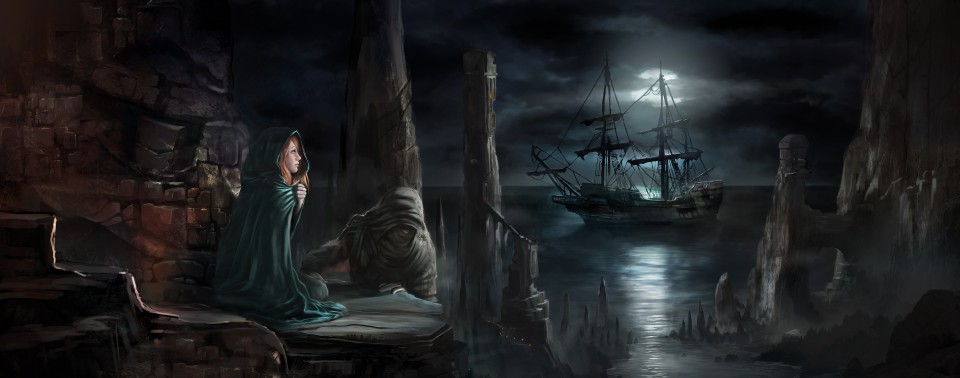
Once upon a time, in a vegetation-overrun cottage by the river in The Shire, there lived a little girl who didn’t read fairy tales.
But she knew them all.
Once upon a time, there was a mother who never bought her children a children’s book, let alone a fairy tale.
But she told them all.
Once upon a time, there was a little boy with a big imagination who wrote stories for his friends in exchange for pennies, even though they weren’t fairy tales.
But he grew up to write a great book series full of them.
Once upon a time, there was a kind young woman bright and cheery as the sunlight bathing her paradisiac island, who didn’t believe in songs and fairy tales.
But she put on her armour to defend a despised fictional girl who believed in them.
First of all, thank you for your interest in the backstory of this new project, which was not meant to be the journey of self-discovery that it became over the years. The genesis of the idea I am presenting here took place five years ago when, once Game of Thrones ended and we found ourselves without hopes for a sixth ASOIAF book to keep Pawn to Player active with consistent analytical pieces, it occurred to me to create a project dedicated to fairy tale retellings that would host an exclusive award for them. In the long preparation phase for it, I learnt a lot that I didn’t expect to, in addition to clarifying things that I had only vaguely intuited. Now I am going to share with you what this new project is about, after several lovely people that became aware of my plans helped me greatly with polishing them, and to whom I am very grateful, especially to Mariella Taylor and this site’s founder, Brashcandie, without whom this would have never become a reality.
My story with fairy tale retellings has been a series of events that coincided one after another in a successive chain, easy to trace. Unlike what is normal for many children, I didn’t have children’s books growing up; my voracious appetite for reading was satisfied with “tales for grown-ups,” as author Chufo Llórens calls adult literature. I wasn’t familiar with fairy tale books and films as a child, not even Disney’s (which I didn’t watch until my late teens), but I knew them by heart through oral transmission and had some favourites.
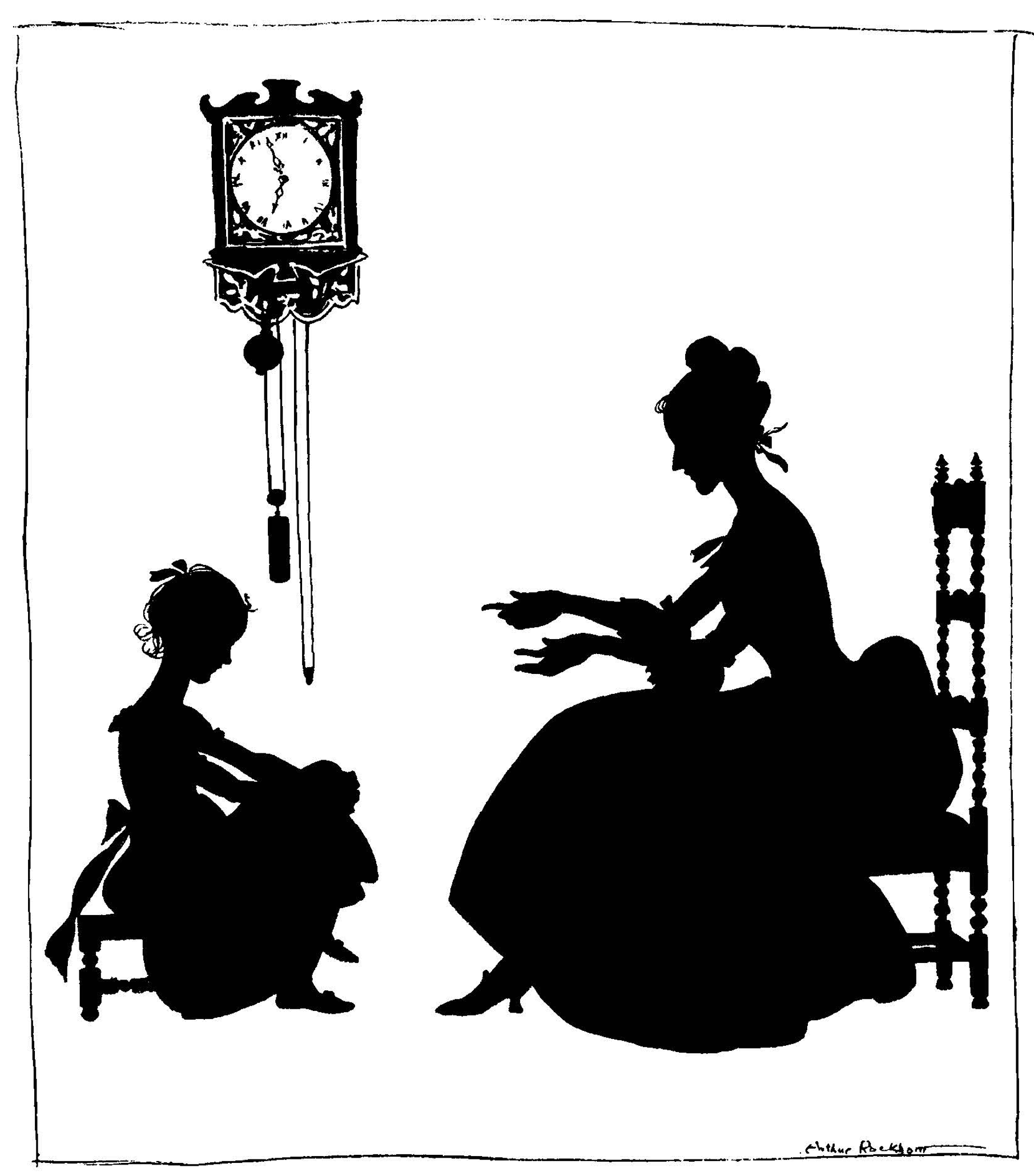
My mum was responsible for that. Many times, at bedtime or when I was sick in bed, she would come and tell me fairy stories to entertain me. She was born in difficult circumstances and she had to fend for herself alone in her youth, so she never had fairy tales or children’s stories to read either. But she had an innate curiosity, an alert mind, and a natural talent for storytelling and doing voices and character impersonations. She learnt many children’s stories and fairy tales by ear and told them all to me and my siblings. I still remember that my favourite of all the stories she told me was Little Red Riding Hood, mostly because of her hilarious impersonation of the Big Bad Wolf with a deep, frightening voice that scared and delighted little me. To this day, yelling “To better eat you with!” imitating Mum’s wolfish voice is an inside joke in my family.
You could say that I became familiar with fairy tales and their retellings without even trying. When I was older, I won a nice edition of Puss-in-Boots in a children’s contest as part of my rewards for participation, which was my first traditional fairy tale book, and my much-older siblings left me as inheritance of sorts a double edition of Alice in Wonderland and Peter Pan without a cover, a cracked spine, and loose pages with broken edges. I didn’t have more tales than these three.
But the seed had already been sown, and I took them up again in adulthood, when I was old enough for fairy tales, to paraphrase C. S. Lewis. In fact, all the fairy tales I’ve read I did as an adult, and I did it for myself. Normally, adult fans of children’s literature have children of their own to read to and find books for, or they work teaching young children, or they are academics in fields related to folklore studies. Few deviate from this pattern, from what I can see, and it is usually because they have a personal connection to fairy tales and mythology, as has been my case.
I’ve been focusing on fairy tales for years as a reader, amateur student of the subject, and reviewer/critic, and there are so many things I have learnt, rediscovered, and understood better in the process of reading as many as possible. The first lesson that stands out from all those years with fairy tales and retellings is that I honestly don’t like the genre as a whole. That is to say, my heart is set exclusively on one specific fairy tale and not on all fairy tales. This tale is, as you may have guessed, Beauty and the Beast.
The reason I became interested in fairy tales again as an adult was Beauty and the Beast, not fairy tales themselves. It has been a decade and a half since my love for this story was born, driven and stimulated by a couple of characters that fit the archetype of Beauty and the Beast perfectly, for their narrative arc, which touches on key themes and points in the original story’s plot. My interest in other fairy tales began as a secondary and complementary development, growing as an extension of my love for Beauty and the Beast, just as Beauty and the Beast was born out of my love for that story all of our regulars know so well. And from there I moved on to retellings. I didn’t start reading them because I love retellings in themselves, but because I wanted to read more Beauty and the Beast. So, for me, that was a second big revelation: I didn’t care about the retellings of Cinderella, Snow White, Sleeping Beauty, Rapunzel, The Goose Girl, etc. I can do without those and all the other types of retellings. I cared about Beauty and the Beast retellings.
It was my attempt at diversifying to cover all fairy tales that led to my complete reading exhaustion, a fatigue I couldn’t seem to shake off for a long time, which led to my third big revelation. If I had focused exclusively on B&B (I don’t use the more common abbreviation BatB) as I had in the beginning, such exhaustion wouldn’t have happened. I shot myself in the foot by trying to be inclusive to other tales and all the stories that I simply felt no passion for.
Now we’ve arrived to the raison d’être of this long personal account. Why host Beauty and the Beast on Pawn to Player if this place was built for ASOIAF content? Because Pawn to Player was the origin, the source, and the foundation of it all. When I joined the PtP’s Rereading Sansa and Rethinking Sansa discussion threads that Brashcandie had created and hosted at the w.org forums back in 2011, her discussions had already made relevant contributions to the fandom in terms of studying the character of Sansa Stark, who at the time was much vilified in the ASOIAF/GOT fandoms, and Pawn to Player had pioneered turning the tide. Of course, there were already some fans in those threads and elsewhere talking about Beauty and the Beast integrated into Sansa’s story, you would’ve had to be blind and dumb on top not to see the obvious, more so when George R. R. Martin himself was a fan of the fairy tale and had written an adaptation of it for TV before ASOIAF. He even had an illustration of Sandor and Sansa as Beauty & Beast from Jean Cocteau’s 1946 film hanging on the wall at his house! It was a no-brainer to notice that Sansa’s story with Sandor Clegane was Martin’s very own Beauty and the Beast retelling within ASOIAF, even if not everyone liked it. And it was also obvious that Jaime and Brienne had elements of Beauty and the Beast in their own arc.
But at the time, there were many misconceptions, bad takes, and blatant misrepresentations of the Beauty and the Beast story. There was little serious analysis of it, and except for a fan here and there on social media, most people talked about how “toxic” the story was and some published articles about how the story excused Stockholm syndrome, abusive relationships, teaching women to be submissive, etc. That was the mainstream groupthink at the time. Now it’s hard to imagine all that, because now there are many good fan analysts who understand the story and defend it from the misconceptions of the past, but back then the outlook was disheartening. It was in this context that I proceeded to create the project “Examining the Beauty and the Beast Motif in ASOIAF” for Pawn to Player, with the enthusiastic participation of several regular PtPers and a beautiful poster by our friend Magdalena, the artist known as Bubug.
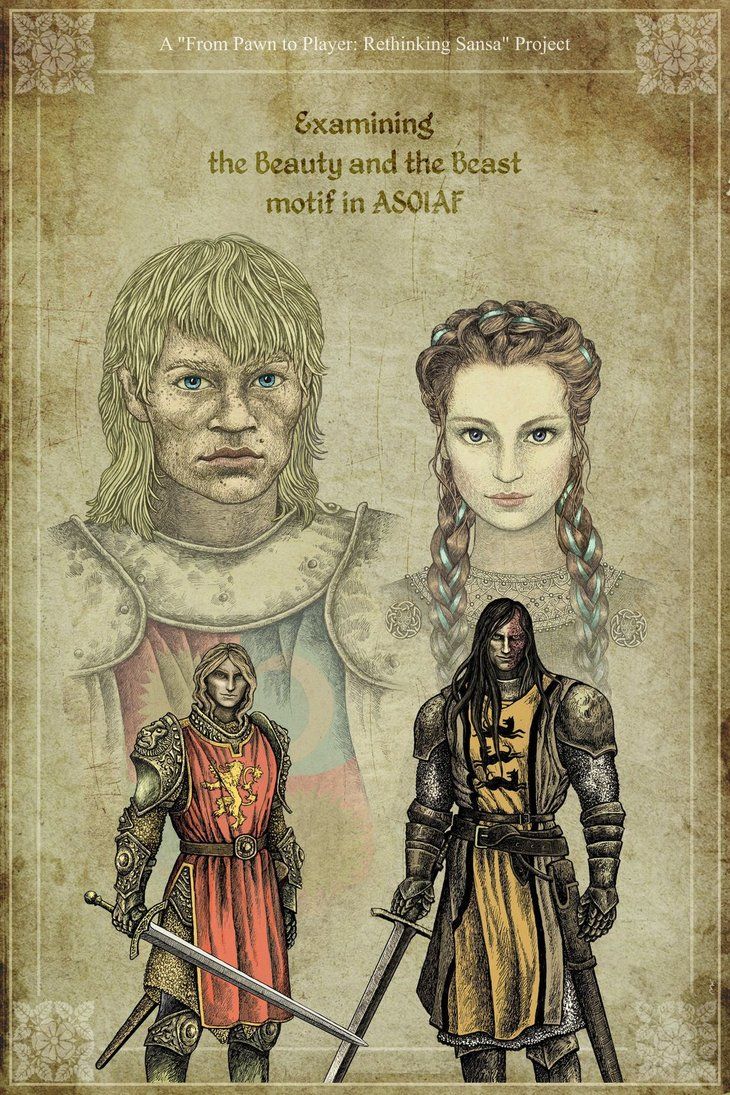
The best of that project is selected for permanent hosting on this site, although not everything had the depth we would’ve wanted and, our contributors and ourselves being mere fans and not trained experts, it may contain mistakes. I like to think that we were amongst the first defenders of B&B, and of course we had disagreements and disputes in defence of the tale, whether because of the original story itself or because of the story rooted in Sansa’s, because there’s always been controversy over SanSan. At times, that project was a discouraging experience, but time proved it worthwhile. A decade and a half later, I believe the fairy tale has a better reputation, although there are still misunderstandings about it circulating out there, and this is a victory won by the old-time B&B fans. Today’s casual readers of any B&B adaptation have no idea that they are standing on the shoulders of those old-time fans, they have no idea that when they say “a pretty girl + a hero with scars on his face does not equal Beauty and the Beast,” they are repeating concepts from the B&B pioneers. It’s all taken for granted, as if it had always been obvious and common knowledge, and not the product of painstaking work of years by several people.
For example, my interpretation of the Beast’s curse as the result of child molestation and grooming by the fairy godmother, based on the original French text by Madame de Villeneuve wasn’t the norm, I don’t recall even other B&B fan-experts knew it. I first published my observation on the PtP, and it was a surprise that caused some to message me in private about it, because they didn’t know about this from the original tale, and to this day there are even some folklore scholars I could name that tend to downplay it or dismiss it because the abuser is a woman and the abused is a minor male. There’s a clear need for a place to collect, organise, and preserve for posterity all the material related to Beauty and the Beast that I have outside of the PtP project. I have all of that on the Goodreads platform, but that site is likely to disappear one day, and my B&B material and reviews of fairy tale retellings would be lost.
So the way forward is: a permanent site to host a permanent project. What better place for it than Pawn to Player? To me, it feels like a natural development, circling back to where it all started and continuing there, regardless of whether we ever see TWOW or if ASOIAF is ever completed, the Pawn to Player evolves and lives on.
A Tale Transformed: Reexamining ‘Beauty and the Beast’ will be a modest endeavour at first, naturally. We will start with two regular features: a review of Beauty and the Beast retelling books or of one with similar elements/vibes and adjacent tales, and interviews with authors that have published something in the genre. Over time, we hope to add a Hall of Fame for the best retellings, and non-fiction, academic articles, and in the very, very long term, we would like the project to accommodate my one big dream: a writing contest, the sponsorship of an anthology, an award for B&B retellings. All under our brand name.
You might say that B&B is too limited and restrictive a niche, and I would say yes, it is. But that is the limited and restrictive niche that needs this investment of time, resources, and mental energy. And there’s also a pragmatic side: it’s a niche that I can easily fill because no one is. There are many critics, bloggers, Booktubers, Booktokers, and podcasters focused on fairy tales and their adaptations at large, and countless folklore enthusiasts who read retellings and review them all the time. But, as far as I know, almost no one focuses exclusively on B&B retellings, which is surprising for the most popular fairy tale in the world that has dozens of books published every year with it as the core theme.
Finally, there was a fourth big revelation on this journey, cemented by my latest book of fairy tales, ironically entitled “Requiem for Fairy Tales” (this was totally unintentional and fortuitous, one of those strange coincidences in my life that I’ll have to attribute to the Universe giving me a wink and nudge): What I really like, more than “pure” retellings, is what an author friend, Beka Gremikova, calls “Folkloric Fantasy.” I don’t know if it’s an official genre name or just what Beka Gremikova came up with to name it, but here’s what it is: Fantasy that reads like a fairy tale, but is neither a fairy tale nor a retelling of one. It may have elements from a specific tale or a handful of collective fairy tale motifs/themes/archetypes, either in general or from the tradition of a specific country. Does it make sense? I can cite examples of books that fit the description if you’re not sure of my meaning, but just to give a few clues, that’s essentially what authors like Naomi Novik or Katherine Arden do.
Folkloric Fantasy is much more varied and flexible than proper retellings because it doesn’t have to follow the plot of a fairy tale, it doesn’t depend on the framework of a fairy tale, and (something very important to me, as I am strict about respecting the core themes of a tale) it doesn’t have to respect a fairy tale’s core theme, as it isn’t subject to any. The genre can play more freely with themes, motifs, plots, and elements, and it can twist fairy tales much more impunity than retellings. In short, it’s like what Historical Fantasy is to Historical Fiction: more room for creative licence and historical anachronisms that would be unforgivable in traditional Hist-Fic. Similarly, in Folkloric Fantasy you can forgive what you can’t overlook in traditional retellings.
That flexibility allows me to enjoy not only Beauty and the Beast-adjacent stories, but also other fairy tales in a way that traditional retellings don’t allow. Many years ago, when I was looking for more books by a Spanish author, Laura Gallego, who had written a short retelling of Beauty and the Beast (more irony!), I got my initial suspicion that Folkloric Fantasy was my thing rather than retellings. I had loved Gallego’s short story and wanted more, and I found out she had written a book called “All the Fairies in the Realm.” Because of the title and her previous short retelling, I mistook it for a fairy tale retelling and spent the entirety of the book trying to guess which fairy tale she was rewriting. In the end, I felt foolish and ignorant because I couldn’t identify the fairy tale, as it had many motifs from various tales, and concluded that I didn’t possess enough knowledge to pinpoint such a complex mix of several tales. I had no idea that I had just discovered Folkloric Fantasy.
That book whetted my appetite for more books of that kind, although for years I continued to mistake Folkloric Fantasy for traditional retellings. It had the effect of broadening my scope of B&B to include books that were not “retellings” per se, but had the vibe in one way or another. My B&B collection thus became full of titles that aren’t retellings of the tale but that have so many similarities that anyone could mistake them for B&B retellings, and that subconscious association was probably the beginning of my eventual discovery of what I really want from this genre, as well as enabling me to have a personal definition of B&B that is probably more ample than most people’s, and that I don’t understand retellings the same way other readers do. But it wasn’t until I met Beka Gremikova and her circle of charming indie writers that I finally learnt a name for this.
All that said, the short-term goal for A Tale Transformed is to build a reputation before I can think about a larger, more ambitious project. Although I am fairly well known in the community of amateur book reviewers, outside of it I have no online presence and no reviews outside of Goodreads. Some popular Booktube and Booktok reviewers have a wide reach, and there are some who have been focusing on fairy tales and retellings in general for years and already have an established audience and reputation, but in my case, my reviews without a home of their own are all I have in terms of clout. Can you imagine what the sensible world of literary awards would think if an unknown girl suddenly burst onto the stage with a pretentious award for fairy tale retellings? They would laugh me out of the room!
The objective is that this becomes a “brand” for reviews of B&B retellings and, yes, Folkloric Fantasy books too, something with a name that the bookish public will easily recognise and authors will see and know as a reliable source of book reviews and analysis. That way, when the time comes to create an award for retellings as is my one overarching goal, it won’t be unexpected. Because by then, just by seeing the name of the award, people would immediately know that it is reliable, serious, and here to stay.
It’s exciting, but also scary, and perhaps rather ambitious. I’m used to anonymity, and I know that this expanding online presence would expose me more than I’m used to. Those that knew my work as Milady of York don’t know my reviewer persona as Marquise, and vice versa. But I know there’s loyal followers we can count on that have showed enthusiasm for this new direction, and at the very least, this will be useful in saving my material from loss,
We will see where the yellow brick road takes us, my Dorothies!
 PAWN TO PLAYER