• Home
  • Reread
    • AGOT
    • ACOK
    • ASOS
    • AFFC
  • Rethink
    • Female Influences I
    • Female Influences II
    • Male Influences I
    • Male Influences II
    • Beauty and the Beast project
    • Mini-projects
    • Standalone Essays & Posts
  • GOT Analysis
  • Rereading Sandor
    • AGOT
    • ACOK
    • ASOS
    • AFFC
  • The Winds of Winter
  • Illustrating Westeros
  • Submissions
  • About us
  • Contact

PAWN TO PLAYER

~ A Rethinking Sansa Stark Resource

PAWN TO PLAYER

Tag Archives: littlefinger

To Kill a Mockingbird, Part II

14 Wednesday Oct 2020

Posted by miladyofyork in PTP TWOW

≈ Leave a comment

Tags

littlefinger, petyr baelish, sansa stark

Littlefinger by Xin Xia

In Part I of our series analysing Petyr Baelish’s moves as a player on the Westerosi political chessboard, we saw that Littlefinger’s economics strategy has basically been to steal from the crown through fabricated expenses and his magical revenues are simply from cutting the treasury in on a percentage of his own graft.

In trying to puzzle out Littlefinger’s endgame it is very easy to get lost in the weeds.  He is the villain most fond of exposition, but his efforts to impress a thirteen-year-old girl with his brilliance only reveal the trail of his destruction and not a clear path forward to his own goals. He’s been granted Harrenhal and Lord Paramount of the Riverlands, yet he completely ignores his seat and his domain beyond the status it gives him to marry Lysa.  He eliminates Lysa and solidifies his hold over Sweetrobin, but then claims he wants the child eliminated in favor of the Vale passing to Harry the Heir with Sansa as his bride.  He has de jure control over one of the Seven Kingdoms and de facto control of another, and still his eyes look with lust toward some other horizon. What is Littlefinger’s envisioned end state?

Clearly he wants power, but his decisions to pass up power as he does in the Riverlands or use power he’s acquired as merely a stepping stone like he’s doing in the Vale show that he’s particular about the place, the amount, or the circumstances of the power he desires. The most apparent of these are the circumstances and the primary circumstance is through his relationship with Sansa. Throughout all of Littlefinger’s scheming, Sansa plays prominently and she seems to be the key to deciphering his ultimate goals. The current Part II aims to expose how he maneuvers to acquire the political power leading to the achievement ot such goals, or, more specifically, who he uses.

To Kill a Mockingbird, Part II

by Ragnorak

From the first time Petyr meets Sansa at the Hand’s Tourney, his interest is clear. We already have the backstory of his fixation on Catelyn as Littlefinger’s first words are that Sansa “must be one of her daughters.” Baelish makes Sansa feel “ill at ease” even before speaking. She notes that his eyes do not smile when his mouth does before he goes on to tell her that she has Cat’s hair as he strokes it, and that Cat was once “my queen of beauty.” She introduces herself as Sansa Stark, but Littlefinger goes on to state that she has the Tully look. These initial elements will repeat throughout Sansa’s arc.


Littlefinger will continue to display an interest that makes Sansa uncomfortable long before he imposes unwelcome kisses. When she is brought before the Small Council after Ned’s arres, his stares make Sansa feel as if she has no clothes on. In context, her father has just been arrested and the Stark household slaughtered, yet Cersei manages to fix her with a look that gives Sansa the illusion of kindness behind her green eyes compared to Petyr’s lecherous gaze. Again, Baelish asserts that “She reminds me of the mother, not the father” as he comments on her hair and eyes.

It is not until A Dance with Dragons treats us to one of Cersei’s what-if laments that we receive the information to fully interpret these scenes.

Petyr Baelish had offered to wed the girl himself, she recalled, but of course that was impossible; he was much too lowborn.

Offering to marry the king’s betrothed is a guaranteed way to earn a date with Ilyn Payne, so some context seems in order. During the meeting, when Sansa is asked to write the letter home, the issue of whether or not the daughter of a traitor could still be allowed to marry the king is raised by Cersei. Given Cersei’s later recollection of Petyr’s offer, it seems likely that, in the meeting the Small Council had prior to bringing Sansa in to persuade her to write the letter, the issue of the betrothal and potential alternate matches for Joffrey were raised. Petyr seems to have offered himself as an option should the betrothal be set aside, and would likely have raised the small benefits of keeping Sansa at Court long-term as a hostage as well as his ability to sway Catelyn Stark on the peaceful merits of such a union. So Sansa’s chapter where Petyr is undressing her with his eyes is, for him, the moment where he believes the opportunity for him to marry Sansa is being decided.


Given the way Littlefinger’s path to power plays out, this is a deeply important revelation. Petyr’s birth as a lord, even the lowest of lords with fewer assets than most landed knights, was a permission slip for entry into the power circle of Westeros. It is what allowed for his fostering at Riverrun, and what allowed for him to be eligible for offices such as his Gulltown post and Master of Coin. Still, his birth status as a lord only prevented his denial of these offices by station; it did nothing to ensure him a place at the table. It was only through Lysa’s intervention that he was ever able to rise above the meager height of Lord of Sheepshit to his lofty perch on Aegon’s High Hill. Knowing Lysa’s reaction to the Snow Winterfell kiss, we can safely assume that a marriage to Sansa would have burned the Lysa bridge and left him with a very unstable woman scorned looking to prove certain truths about hell’s fury. That Baelish was willing to risk such a thing at this early stage speaks volumes about the degree of importance Sansa plays in his goals.


Littlefinger’s plan always seems to have involved obtaining a title sufficient to justify a marriage to Lysa to usurp control of the Vale through Sweetrobin. This has been Lysa’s impression all along. While Petyr would lie to her and lead her on with no reservations, it does happen to fit with his chess moves and the schemes he plays out. He deliberately used Lysa to keep the Vale out of the fighting, which would generally only be a smart move if his plans included the Vale as one of his eventual pieces. Why leave a future adversary untouched by the ravages of war?

Littlefinger is from the Vale and his initial powerbase was established in Gulltown. He as much as comes out and says this to Sansa:

“The solar.” She should have stopped with that, but the words came tumbling out of her. “If you gave them Robert…”

“…and the Vale?”

“They have the Vale.”

“Oh, much of it, that’s true. Not all, however. I am well loved in Gulltown, and have some lordly friends of mine own as well. Grafton, Lynderly, Lyonel Corbray…”

Houses Grafton and Corbray both sided with Aerys Targaryen in Robert’s Rebellion against the choice of their liege lord Jon Arryn. Both fought against Robert in the Battle of Gulltown, and Marq Grafton, the then Lord of Gulltown, was personally slain by Robert Baratheon in that battle. It may well be that Lord Grafton had ambitions to be raised to Lord Paramount of the Vale. Lord Godric Borrell tells Davos of the temptation to send Ned Stark’s head to Aerys:

“Our maester urged us to send Stark’s head to Aerys, to prove our loyalty. It would have meant a rich reward. The Mad King was open-handed with them as pleased him.”

Whatever Lord Grafton’s motivations, and despite his son switching sides and supporting Robert after the defeat at Gulltown, it must have left them more than a little out of favor with Jon Arryn when the rebellion was over. Sending Petyr Baelish, the lowest of possible lords, to manage a port that is the very heart of House Grafton was likely as much a message to House Grafton as it was a gesture to appease Lysa. Even if Jon Arryn held no grudge, it would be difficult for House Grafton to not interpret the appointment as such.

So the young Petyr Baelish would have arrived in Gulltown appearing the darling of the high lord and Hand of the King to serve as salt in the wound of the new Lord Grafton’s recently dead father. Littlefinger’s modus operandi would make him the type to play up on that insult and use it to drive a wedge in-between Houses Grafton and Arryn in order to exploit the rift. Baelish would also have appealed to vice, in this case likely greed and envy of other Houses in Arryn’s favor, to attempt to make House Grafton one of his pieces. Lysa tells Sansa that Littlefinger increased the revenues in Gulltown by tenfold, which is curiously the same figure he is credited with as Master of Coin. This tells us that Littlefinger was almost certainly engaged in the same wage and market manipulation scams in Gulltown as he was in King’s Landing, and was likely buying House Grafton with a cut of the corruption. They are named House Grafton.


Littlefinger’s ability to effortlessly switch sides from Stark to Lannister to Tyrell gives the impression of a man with no assets to defend and no roots to tie him down. However, this is not entirely the case. He has roots in Gulltown, and relationships in the Vale with both merchants and lords. He has set Lysa up to make her willing and eager to grant him Lord Protector of the Vale for Sweetrobin’s minority. He has essentially set up a lesser version of the Varys/Aegon scheme. Gulltown is his Illyrio financing, with Littlefinger being the puppet master in hiding and Sweetrobin the heir in plain sight in a reversal of Varys and Aegon. Marrying Sansa would put all this in jeopardy, and have the immediate risk of driving Lysa’s Vale back into the camp of the North and Riverlands with Lysa’s knowledge of the twincest. This is before Ned is executed, before Robb marches south, before Riverrun falls to Jaime’s host or the Westerland army even attacks the Riverlands, and before either Stannis, Renly or Highgarden declare their intentions. Baelish makes this offer to marry Sansa while Lysa has Tyrion sitting in a sky cell over his dagger lie. It is hard to conceive of a worse chess move, and difficult to read this information as anything other than a blinding obsession with Sansa.

When Tyrion offers him Harrenhal, it seems clear that Baelish already has the plans made to marry Lysa and is simply waiting for an enabling title and opportunity. Before Tyrion has a chance to lay out his offer, Petyr preemptively tries to sabotage a Jaime for Sansa trade:

 “That would depend on the words. If you mean to offer Sansa in return for your brother, waste someone else’s time. Joffrey will never surrender his plaything, and Lady Catelyn is not so great a fool as to barter the Kingslayer for a slip of a girl.”

Of course, Cat is completely willing and even desirous of making this very trade. She not only tries to persuade Robb to make this deal, she frees Jaime on her own to try and force Robb’s hand. The question left for the reader is only whether or not Littlefinger knows this about Cat or if he has an agenda in swaying Tyrion from this course. Given his successful manipulation of Cat from Lysa’s letter, to the dagger, and using her to get Ned to trust him, the agenda seems far more likely. On the simplest level, such a trade might lead to a peace which a man who thrives on the chaos of war would not want. Looking at Littlefinger’s reaction to Tyrion’s offer provides a more specific reason—Sansa. “Come to the godswood tonight, if you want to go home” is the first line of the very next chapter following Tyrion’s offer. The first thing Baelish does after being offered Lord of Harrenhal, Paramount of the Riverlands, the opportunity to control the Vale through a marriage to Lysa, and custody of a royal heir for his scheming is to put in effect a plan to steal Sansa from King’s Landing.

After negotiating the Tyrell alliance, Littlefinger asks Tywin for the very same reward Tyrion promises in his fake offer. It is possible that Baelish came upon his scheme through Tyrion’s offer, but it is also possible he had this in mind all along. Lord of Harrenhal is the same prize that he arranged for Janos Slynt in exchange for betraying Ned Stark. Tywin may fall on the more extreme side of valuing class and birth status, but his bewilderment and outrage at offering a seat of kings to a butcher is hardly abnormal amongst Westeros nobility. The likelihood of Janos Slynt ever claiming Harrenhal or keeping it for long if he managed to enter its gates was always extraordinarily low. It is quite possible Baelish was arranging to keep it off the table so that it could become available for himself at some future date. Such a reward following Ned’s treason accusation is as good as advertising one’s complicity, and it is possible Petyr Baelish did not want to be so publicly pronounced a Lannister lackey at this stage of the game. It is also possible that the Harrenhal reward was his to dispense. Slynt was Littlefinger’s man, and it was Petyr and not Cersei who arrived at terms with Slynt. If Cersei had called off the betrothal and offered Sansa to Baelish, perhaps he would have taken Harrenhal as his own prize. Cersei’s thoughts only reveal that she believed Petyr was too lowborn for Sansa, which in her value system would still apply even if he were granted a sufficient title such as Harrenhal to warrant the match. There isn’t sufficient information in the text to know for sure, but Petyr was involved in three Harrenhal offers and all three involved an attempt to claim or snatch Sansa for his own, which is rather telling in itself.

One of the elements that is consistently intertwined with Littlefinger’s Sansa fixation is his repeated denial of her identity as a Stark. The text intentionally mirrors this with Sansa physically resembling Cat and Arya resembling Ned, as well as Sansa’s initial fascination and association with Southron life and the Seven at the beginning of the series. As the story unfolds, it is Arya who begins to more resemble Cat’s personality, and Arya whose story and direwolf tie her to her mother’s place in the Riverlands. Sansa’s personality is revealed to be far more like Ned’s and she finds herself drawn to the godswood, and literally and figuratively following in his footsteps as her story unfolds. This denial of Sansa as a Stark is possibly the single most important clue as to Littlefinger’s fate.

The scene where Littlefinger betrays Ned plays out as a mockery of First Men justice. Baelish looks Ned in the eyes, passes sentence, but has no interest in hearing his last words. His true “crime” in Littlefinger’s eyes is stealing Cat, so it is really about vengeance and not justice from his perspective. Instead of swinging the sword himself, Baelish waits for the next chapter to carry out the sentence with a dagger to the back while again not looking Ned in the eyes while the “sentence” is carried out.

He leaned back and looked Ned full in the face, his grey-green eyes bright with mockery. “You wear your honor like a suit of armor, Stark. You think it keeps you safe, but all it does is weigh you down and make it hard for you to move. Look at you now. You know why you summoned me here. You know what you want to ask me to do. You know it has to be done… but it’s not honorable, so the words stick in your throat.”

Littlefinger laughed. “I ought to make you say it, but that would be cruel… so have no fear, my good lord. For the sake of the love I bear for Catelyn, I will go to Janos Slynt this very hour and make certain that the City Watch is yours. Six thousand gold pieces should do it. A third for the Commander, a third for the officers, a third for the men. We might be able to buy them for half that much, but I prefer not to take chances.” Smiling, he plucked up the dagger and offered it to Ned, hilt first.

As his men died around him, Littlefinger slid Ned’s dagger from its sheath and shoved it up under his chin. His smile was apologetic. “I did warn you not to trust me, you know.”

The circumstance Ned found himself in was Lord Protector without an army and under an illusion born of Cat that he could trust someone. Several books later, Petyr Baelish finds himself in that same awkward position of Lord Protector with no army and under a not dissimilar illusion born of Cat that he can trust Sansa. Given Littlefinger’s repeated willful blindness regarding Sansa’s heritage as Ned’s daughter, he may well have quipped his own epitaph to Ned:

Littlefinger sighed. “I fear I did forget, my lord. Pray forgive me. For a moment I did not remember that I was talking to a Stark.”

From his earliest introduction in A Game of Thrones, the foundation has been laid for Littlefinger’s downfall at Sansa’s hands within the metaphorical context of First Men justice. That leaves a great deal of room in terms of plot-specific speculation, but we do get some strong prophetic hints straight from the Old Gods. The first is Bran’s vision of the giant, which at first bears little resemblance to Littlefinger.

He looked south, and saw the great blue-green rush of the Trident. He saw his father pleading with the king, his face etched with grief. He saw Sansa crying herself to sleep at night, and he saw Arya watching in silence and holding her secrets hard in her heart. There were shadows all around them. One shadow was dark as ash, with the terrible face of a hound. Another was armored like the sun, golden and beautiful. Over them both loomed a giant in armor made of stone, but when he opened his visor, there was nothing inside but darkness and thick black blood.

On a first read, the giant seems closer to Gregor Clegane, and speculation of an undead headless Gregor only reinforces that impression. Giants and shadows are some of Martin’s frequent in-story metaphors, and even Tyrion is referred to as a giant on multiple occasions, so the vision need not be literal. Speculation that Littlefinger might be the giant of Bran’s vision comes with the information that his original sigil was the stone Titan of Braavos. It is further fueled by the Ghost of Highheart and her vision of a maid slaying a giant in a castle made of snow.

“I dreamt a wolf howling in the rain, but no one heard his grief,” the dwarf woman was saying. “I dreamt such a clangor I thought my head might burst, drums and horns and pipes and screams, but the saddest sound was the little bells. I dreamt of a maid at a feast with purple serpents in her hair, venom dripping from their fangs. And later I dreamt that maid again, slaying a savage giant in a castle built of snow.”

The first part is the Red Wedding and the second part seems to be the Purple Wedding and the poisoned hairnet, which makes Sansa the maid to slay the savage giant in the castle made of snow. Littlefinger as the savage giant is hinted at again as Arya first sees the Titan of Braavos:

Arya could see the arrow slits in the great bronze breastplate, and stains and speckles on the Titan’s arms and shoulders where the seabirds nested. Her neck craned upward. Baelor the Blessed would not reach his knee. He could step right over the walls of Winterfell.

Stepping over the walls of Winterfell is exactly what the man born with the Titan of Braavos as his sigil did when Sansa was rebuilding Winterfell in snow.

When he had enough, he stepped over both walls with a single long stride and squatted on his heels in the middle of the yard.

During that Snow Winterfell scene, Sansa figuratively slays a giant in the form of Sweetrobin’s doll by beheading it and mounting the head on the walls of Snow Winterfell. It is doubtful the Ghost of Highheart prophesized the death of a spoiled child’s toy amidst scenes of the death of kings, so the Snow Winterfell scene is likely more symbolism for the eventual slaying of the savage giant. The castle made of snow could be Winterfell given that Sansa remade it in snow and it is already buried in snow by the end of A Dance with Dragons and likely to stay that way until Spring. It could also be the Eyrie, which Sansa describes as “a castle made of snow” on her descent at the end of A Feast for Crows. From a plot perspective, Littlefinger’s death at the Eyrie would be far more imminent, while a death at Winterfell would make for a comparatively longer and more drawn out plotline.

Ser Morgarth is the Elder Brother: A Pawn to Player Q&A Discussion

09 Wednesday Sep 2020

Posted by brashcandie in PTP TWOW

≈ Leave a comment

Tags

alayne stone, littlefinger, quiet isle, sansa stark, ser morgarth, the elder brother, twow

a_brother_s_mercy_by_allnamesinuse_d9h4fsq-fullview

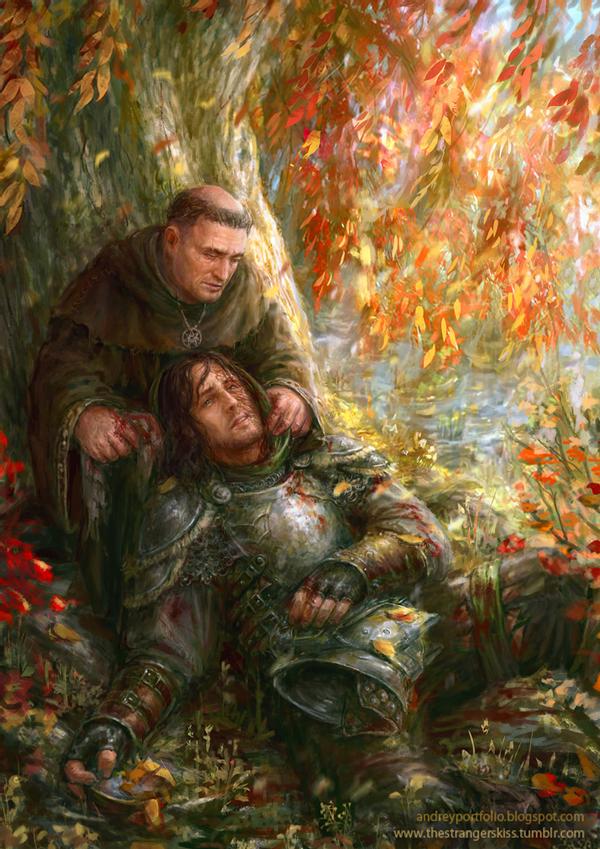
A Brother’s Mercy by Allnamesinuse; The Elder Brother tends to a gravely wounded Sandor Clegane.

Back in 2013, Milady of York and I had the crazy idea during one of our conversations that there might be another knight in the group entering into Petyr Baelish’s service who was hiding his true identity. We couldn’t find any existing theory in the fandom that analysed Ser Morgarth the Merry as a potential interloper, as all the debate up to that point tended to focus on Ser Shadrich, and the startling realisation that he had succeeded in finding Sansa Stark after revealing to Brienne of Tarth his search for the missing girl. It seemed so unbelievable at the time that we labelled the theory a crackpot and posted it in our Pawn to Player thread at Westeros.org in order to receive feedback from members at the forum.

It’s this subsequent discussion that we’re highlighting in the Q&A portion after the theory, along with some expanded posts, since we believe most fans have not read a lot of the very elucidating analysis that followed which helped to refine and clarify the main ideas and presented additional points for future investigation and development. We should add that some of our views have slightly changed since these initial answers were provided seven years ago, for example, we now think that it’s more likely that all three of the knights are working together and not on separate missions. It’s noteworthy that the TWOW sample chapter does not disprove the theory and indeed gives further credence to the belief that the men will have an important role to play in Sansa’s story as Martin highlights their presence at two distinct points in the chapter: Ser Shadrich’s conversation with Alayne and Randa prior to Harry the Heir’s arrival, and later all three are shown dancing with her at the feast in celebration of the upcoming tourney.

There’s a lot of thought-provoking material to get through, so we suggest going slow and thinking carefully. Later this week we’ll be back to feature a new offshoot of this theory, examining the role of Ser Byron the Beautiful. We’d love to hear your thoughts on Ser Morgarth, whether you agree with our central argument or not, and what other ideas are sparked by this discussion.

Who is Ser Morgarth the Merry? An Original Pawn to Player Crackpot

by Brashcandy and Milady of York

When Sansa leaves the Eyrie in her final chapter of AFFC, she is sent to Littlefinger’s solar at the Gates of the Moon and there she encounters three knights, all of whom display pleasure at meeting the Lord Protector’s beautiful daughter. After the men depart, Littlefinger explains his reason for hiring these “hungry knights”:

“… I thought it best that we have a few more swords about us. The times grow ever more interesting, my sweet, and when the times are interesting you can never have too many swords. The Merling King’s returned to Gulltown, and old Oswell had some tales to tell.”

For a man with no martial ability and currently overseeing contentious factions in the Vale, hiring more swords is a smart move, and Littlefinger is certainly correct in his assertion that these are interesting times. The news of a dragon queen in the East would have made its way to his ears via the port in Gulltown, and probably informs his later talk of the three queens. But the men he contracts are also quite interesting, as one is Ser Shadrich, the Mad Mouse, who is searching for Sansa in order to gain the ransom offered by Varys:

Ser Shadrich laughed. “Oh, I doubt that, but it may be that you and I share a quest. A little lost sister, is it? With blue eyes and auburn hair?” He laughed again. “You are not the only hunter in the woods.

I seek for Sansa Stark as well.”

Brienne kept her face a mask, to hide her dismay. “Who is this Sansa Stark, and why do you seek her?”

“For love, why else?”

She furrowed her brow. “Love?”

“Aye, love of gold. Unlike your good Ser Creighton, I did fight upon the Blackwater, but on the losing side. My ransom ruined me. You know who Varys is, I trust? The eunuch has offered a plump bag of gold for this girl you’ve never heard of. I am not a greedy man. If some oversized wench would help me find this naughty child, I would split the Spider’s coin with her.”

So we know that Shadrich has succeeded where Brienne has not, and managed to find himself in the same location of Sansa Stark, even though there’s no indication that he has recognised Alayne Stone as the missing girl he seeks at this point in time. For readers, the Mad Mouse is meant to stand out for the risk he presents to Sansa’s security and Littlefinger’s carefully laid plans. But has Martin pulled one over on us? Has he secreted another interloper in this group who’s also interested in finding Sansa Stark? This is the crux of our crackpot. Let’s look again at the descriptions of the men:

She hugged him dutifully and kissed him on the cheek. “I am sorry to intrude, Father. No one told me you had company.”

“You are never an intrusion, sweetling. I was just now telling these good knights what a dutiful daughter I had.”

“Dutiful and beautiful,” said an elegant young knight whose thick blond mane cascaded down well past his shoulders.

“Aye,” said the second knight, a burly fellow with a thick salt-and-pepper beard, a red nose bulbous with broken veins, and gnarled hands as large as hams. “You left out that part, m’lord.”

“I would do the same if she were my daughter,” said the last knight, a short, wiry man with a wry smile, pointed nose, and bristly orange hair. “Particularly around louts like us.”

Alayne laughed. “Are you louts?” she said, teasing. “Why, I took the three of you for gallant knights.”

The first knight is young and handsome, and is the one who kisses Alayne’s hands before leaving the room. Of the three hedge knights, the second one going by the name of Ser Morgarth passes virtually unnoticed. His description, however, is curious, not only because of the “thick beard” that could indicate someone trying to conceal their identity, but particularly the “red nose bulbous with broken veins.” The description first recalls Ser Dontos, who happens to be the man that is rumoured to have helped Sansa escape and believed to be still in her company. The Mad Mouse tells Brienne:

“A certain fool vanished from King’s Landing the night King Joffrey died, a stout fellow with a nose full of broken veins, one Ser Dontos the Red, formerly of Duskendale. I pray your sister and her drunken fool are not mistaken for the Stark girl and Ser Dontos. That could be most unfortunate.”

But unless Dontos has risen from the dead, and both Alayne and Littlefinger are suffering from acute memory loss, we know that Ser Morgarth is not the former knight turned court jester. There is someone else who matches the description, though. Someone who knows of Sansa Stark and that she’s missing:

The Elder Brother was not what Brienne had expected. He could hardly be called elder, for a start; whereas the brothers weeding in the garden had had the stooped shoulders and bent backs of old men, he stood straight and tall, and moved with the vigor of a man in the prime of his years. Nor did he have the gentle, kindly face she expected of a healer. His head was large and square, his eyes shrewd, his nose veined and red. Though he wore a tonsure, his scalp was as stubbly as his heavy jaw.

He looks more like a man made to break bones than to heal one, thought the Maid of Tarth, as the Elder Brother strode across the room to embrace Septon Meribald and pat Dog.

There are a few coincidences to highlight:

  • Like Ser Morgarth, the Elder Brother has a veiny red nose.
  • Brienne notes that the Elder Brother looks as though he would break bones, not heal them, which could accord with the “hands as large as hams” of Morgarth.
  • The Elder Brother may be an older man, but he’s a former knight and still fit and capable enough to impress Brienne—a warrior herself. He would have no problem convincing Littlefinger to hire him for protection, and Morgarth is described as “burly.”
  • At the time of Brienne’s visit, the Elder Brother’s jaw has stubble on it. Is this the beginning of the thick beard we see later on?

During their conversation, the Elder Brother reveals knowledge of Sansa once Brienne tells him the standard description she’s been repeating along her quest. His quick confirmation would indicate prior familiarity with Sansa’s appearance, which we can assume came from Sandor Clegane, who is being sheltered on the island, unbeknownst to Brienne. He tells her that the Hound died on the banks of the Trident, a tortured man who gave and received no love, but only lived to kill his brother. His advice for the Maid of Tarth is to go home and reunite with her father. But Brienne stubbornly insists that she cannot do so, she has sworn an oath and must keep it:

“I have to find her,” she finished. “There are others looking, all wanting to capture her and sell her to the queen. I have to find her first. I promised Jaime. Oathkeeper, he named the sword. I have to try to save her . . . or die in the attempt.”

This is apparently the last we see of the Elder Brother, and Brienne moves on to the Crossroads Inn, to kill “the Hound,” and her eventual meeting with Lady Stoneheart. But just why would the Elder Brother leave the peaceful enclave of the QI and travel to the Vale? Resuming his old occupation is no problem as Brienne tells him “you look more like a knight than you do a holy man,” yet that life was aimless and unfulfilling, fighting on Rhaegar’s side of the war only by chance, and so desperate to regain a horse that he kept on fighting even whilst injured. All of this changes when he washes up on the QI, born again into the Faith of the Seven. It doesn’t sound like a man who would willingly get back into the political arena, but this appears to be his intention:

“The riverlands are still too dangerous. Vargo Hoat’s scum remain abroad, and Beric Dondarrion has been hanging Freys. Is it true that Sandor Clegane has joined him?”

How does he know that? “Some say. Reports are confused.” The bird had come last night, from a septry on an island hard by the mouth of the Trident. The nearby town of Saltpans had been savagely raided by a band of outlaws, and some of the survivors claimed a roaring brute in a hound’s head helm was amongst the raiders. Supposedly he’d killed a dozen men and raped a girl of twelve.”

Why would the Elder Brother choose to send a report to the Crown of all people about the events of Saltpans, and which mentions a roaring brute in a hound’s helm? This is like a papal Nuncio reporting to the Pentagon instead of the Vatican, so why did the Elder Brother not report to his superiors instead, to the High Sparrow? Why to Cersei, the former boss of the Hound? This is strange, as the Elder Brother knows that the Crown wants Sandor’s head, and sending this information is basically an official attempt to “clear his name.” These words to Brienne after he talks about Saltpans and before he discloses that he “buried the Hound” are also telling about the purpose of writing to the Crown:

“Wolves are nobler than that . . . and so are dogs, I think.”

“I see.” Brienne did not know why he was telling her all of this, or what else she ought to say.

Whatever the Elder Brother is involved in or planning, it likely has to do with Sandor Clegane as well. It may explain why he tries so hard to convince Brienne that the Hound is dead and to give up her quest. We have not overlooked the possibility that the Elder Brother could be invested in finding Sansa Stark, and Brienne’s final words are a poignant outpouring of emotion in support of finding the girl and protecting her from the captors in the capital. However, we think his efforts have more to do with clearing Sandor’s name because he needs him for his still undisclosed plans and infiltrating the Vale’s political workings as Littlefinger is the Lord Paramount of the Riverlands. That he was already prepared for this mission before Brienne’s arrival can be surmised by the growth of hair on his head and jaw despite wearing a tonsure. And he might have made Brother Narbert privy to some of these plans, as the proctor has given at least two indications that he may know the true identity of the Gravedigger:

“Lady Brienne is a warrior maid,” confided Septon Meribald, “hunting for the Hound.”

“Aye?” Narbert seemed taken aback. “To what end?”

Brienne touched Oathkeeper’s hilt. “His,” she said.

The proctor studied her. “You are . . . brawny for a woman, it is true, but . . . mayhaps I should take you up to Elder Brother. He will have seen you crossing the mud. Come.”

He is “taken aback” when Meribald tells him she’s looking for the Hound, and when she tells him she wants to kill him, he assesses her critically, as if he’d seen the Hound face to face and knew his size and his prowess not just by reputation. Then, talking of Saltpans, he describes the (real) Hound as “brutal,” which he might know by fame only, but then he closes his speech with “some wounds do not show.” This would hint that Narbert helped Elder Brother with Sandor, because no matter how strong the latter is, Sandor is extremely big and heavy, and he’d have needed some assistance whilst nursing him back to health, but due to the perils of hiding a wanted fugitive, he could only trust, to an extent at least, his proctor. That line fits so well with Sandor that makes one wonder if the Proctor knows some of the things he confessed to the Elder Brother.

The timeline also fits, as according to two timeline sources, there’s an average of approximately 3 weeks to one month between the time of Brienne’s arrival at the Quiet Isle and Sansa’s meeting with the knights. Plus, based on the close proximity of the QI to the Vale, this would have been enough time for the Elder Brother to reach the Gates of the Moon.

Finally, the statements by the knights upon seeing Sansa may also hold clues for analysis. Ser Byron is the first to respond, and his words indicate an immediate attraction to Sansa, based on her looks. He later kisses her hand, making his affection clear. But it’s the two with hidden agendas whose statements are most provocative:

“Aye,” said the second knight, a burly fellow with a thick salt-and-pepper beard, a red nose bulbous with broken veins, and gnarled hands as large as hams. “You left out that part, m’lord.”

“I would do the same if she were my daughter,” said the last knight, a short, wiry man with a wry smile, pointed nose, and bristly orange hair. “Particularly around louts like us.”

Ser Morgarth’s words are an implicit challenge almost, a sly suggestion that Littlefinger has not been upfront about the true nature of this beautiful daughter. The Mad Mouse on the other hand pretends to support such an evasion, citing their loutish behaviour as the reason. It’s all meant to be light-hearted and good-natured teasing, but everyone in the room is playing a game and a part. Have Ser Morgarth’s suspicions been raised? If he truly is the Elder Brother, then he knows the exact appearance of Sansa Stark, and more significantly, if he’s been privy to remembrances by Sandor Clegane, he also knows more personal qualities that Sansa might not think to conceal. Has Littlefinger only succeeded in hiring daggers instead of swords?

Gates of The Moon

The Gates of the Moon by Paolo Puggioni

Q & A Discussion with Pawn to Player Posters

Q: Are you operating under the theory that EB went downriver to Gulltown? It seems like the fastest and easiest way for him to enter the Vale. Do you recall if there was mention of a boat on the QI? Not that there had to be, but if GRRM mentioned it you can bet it would be significant.

Also, do you think Ser Shadrich could be under the impression that Morgarth is Ser Dontos?

A: When Septon Meribald and the others arrive at the Isle, Brother Narbert asks if they’ll require the ferry in the morning, so there is transport that could have taken the EB to Gulltown.

We are working from the assumption that the Mad Mouse is not connected to the other two knights, although it’s certainly a possibility we can’t rule out, given that he offered to team up with Brienne in order to find Sansa and split the ransom. If both the Mad Mouse and Morgarth are keeping secrets, does this mean something similar might be up with the handsome Ser Byron? Is he in league with Morgarth or Shadrich or out for his own glory?

Q: What if somehow Sandor accompanied the EB in some sort of disguise so that he could verify for the EB that Alayne is Sansa?

A: We don’t believe Sandor is travelling with the EB, for the simple fact that when we last saw him he hasn’t fully recovered and still has the lurching gait that would draw attention to him, if the ridiculously tall monk who never removes his hood didn’t do the trick. And the roads are still dangerous. Perhaps the EB is on a strict fact finding mission, and there’s the likelihood that it has nothing to do with Sansa, although it’s hard to imagine that she won’t be involved now.

But let’s say if Sandor had gone, for the sake of argument. . .

We’ve considered if Sandor’s limping would be a reason for him to not leave the monastery with the Elder Brother as well. His limp means that he can’t fight with a sword as proficiently as usual, but the work he’s doing as a gravedigger is arduous in that terrain, suggesting that he’s recovered enough to perform some demanding physical activities, therefore is in an acceptable shape for travelling, more so if it’s by boat or by horse, that don’t require him to walk as much and therefore wouldn’t burden the leg at all. He can even fight on horseback right now, limp and all, with a sword, a mace, a lance, a hammer, a morningstar, an axe, etc. Also, approximately one month has passed since the arrival of Brienne to the Quiet Isle until the appearance of the three knights at the Gates, time enough for his limping to have improved, if not reasonably healed (if GRRM doesn’t decide the contrary). So, taking that into account, yes, from a purely physical standpoint, he would’ve been fit to have gone.

There’s the question of whether the Elder Brother would’ve wanted to bring him on this trip, and if so the difficulty of concealing his six feet eight inches crowned with a scarred face is not necessarily something that rules out Sandor accompanying the Elder Brother. He’s good at disguise, as he proved with Arya in front of someone who knew him, so he could pass unnoticed by others as well. I mentioned the possibility that the limping could’ve improved, yet in case it didn’t, even so people see what they want to see and this isn’t a characteristic that any would associate with the Hound. Considering the reputation he’s gotten recently due to Saltpans, the robes of a monk would be the last thing under which they’d look for the Hound, more so if he is accompanied by someone like the Elder Brother. So, if both went to the Vale through the Gulltown route, it’d have been as monks, and from then to the Gates of the Moon as men-at-arms looking for a job.

We wondered if he could have expressed to the Elder Brother a desire to go search for Sansa after he recovered. He knows she’s alive and escaped, and is hiding somewhere. He didn’t have time to process the news he heard at the Crossroads Inn and decide what to do with regard to that, because he was wounded and “died” soon after; but his last words were so full of regret about failing to help and protect Sansa… So, could it be that once he came back to his senses at the Quiet Isle after passing out from fever, after he was told by the Elder Brother what his prognosis was, he voiced a wish to go search for the little bird and protect her as the new and nobler purpose of his life? And if the Elder Brother more or less had agreed, or at the very least understood his rationale, then he’d have allowed him to go with him on this trip to the Vale even if the purpose on his part wasn’t related to Sansa. It’d have been on Sandor’s part. Remember where he and Arya were going to when he was wounded: to the Vale by boat from Saltpans. When she left him to die, Arya was heading towards Saltpans still, and Sandor, though feverish, would’ve guessed her destination, and he has no reason to believe she’d go to Essos. Arya might not be a good motivation for him to go to the Vale, but she’s the little bird’s sister and if he thinks Arya could’ve gone to the Vale, to her aunt, then Sansa could have too, since she has nowhere else to go. Even the Mad Mouse seems to have suspicions that Sansa could’ve gone to the Vale, where she has relatives, so why would Sandor not think the same?

Q: Any textual clue that would point to a possible motive for the EB to go to the Vale?

A: There’s one such passage on the QI chapter. Notice Brienne’s thoughts about “true knights” and that Ser Quincy’s actions were terrible. Although Septon Meribald tries to give an excuse, the EB is much more in line with Brienne’s kind of thinking, so much so that he cannot even bring himself to offer forgiveness to Cox:

The smile vanished. “They burned everything at Saltpans, save the castle. Only that was made of stone . . . though it had as well been made of suet for all the good it did the town. It fell to me to treat some of the survivors. The fisherfolk brought them across the bay to me after the flames had gone out and they deemed it safe to land. One poor woman had been raped a dozen times, and her breasts . . . my lady, you wear man’s mail, so I shall not spare you these horrors . . . her breasts had been torn and chewed and eaten, as if by some . . . cruel beast. I did what I could for her, though that was little enough. As she lay dying, her worst curses were not for the men who had raped her, nor the monster who devoured her living flesh, but for Ser Quincy Cox, who barred his gates when the outlaws entered the town and sat safe behind stone walls as his people screamed and died.”

“Ser Quincy is an old man,” said Septon Meribald gently. “His sons and good-sons are far away or dead, his grandsons are still boys, and he has two daughters. What could he have done, one man against so many?”

He could have tried, Brienne thought. He could have died. Old or young, a true knight is sworn to protect those who are weaker than himself, or die in the attempt.

“True words, and wise,” the Elder Brother said to Septon Meribald. “When you cross to Saltpans, no doubt Ser Quincy will ask you for forgiveness. I am glad that you are here to give it. I could not.”

This is interesting to consider. It demonstrates that this is a man not as comfortable in holy solitude as the wisdom he dispenses implies. We can imagine a Sandor Clegane would espouse that it amounts to doing nothing and is just another form of cowardice at some point in their conversation (even if in the end Sandor is persuaded to adopt the lifestyle for a time). The accusation is likely to sting a man like the Elder Brother on some level given his views of Cox. He isn’t likely to change his lifestyle over a verbal rebuke from Sandor, but…

As for this beast who wears his helm, he will be found and hanged. The wars are ending, and these outlaws cannot survive the peace. Randyll Tarly is hunting them from Maidenpool and Walder Frey from the Twins, and there is a new young lord in Darry, a pious man who will surely set his lands to rights. Go home, child.

The Ironborn bring more war instead of peace (aside from whatever Dany, Aegon, or other war rumors might reach the Quiet Isle). The very first line of the next chapter is “A thousand ships” in Cersei’s POV spoken by Margaery about the Ironborn attack. Tarly goes south to King’s Landing after Margaery is imprisoned and does not continue to hunt outlaws. The new Darry lord does not take up the title but joins the Faith Militant, and the Freys offer their own breed of problem aside from the number of them turning up hanging from trees. The war that was over just isn’t and each of these outside people he mentions that will address the horrors like the Saltpans have yet again withdrawn into political struggles rather than protecting the smallfolk. The genesis of the Faith Militant being reformed lies in incidents like the Saltpans and the failures of noble men like Cox to stop them.

So there’s an excellent case to be made for the Elder Brother picking up the sword again given the views he expresses, that his hope for the “proper authorities” to bring peace are crushed straight down the list, and that the Faith he uses to cloak himself in peace is calling for him to wield the sword. We can’t build a rock solid case that he go to Sansa, but Sandor and Brienne both came into his life expressing “knightly” desires to protect her and we have Brienne’s refusal to heed his advice to go home:

Q: What are your thoughts on the letter the Elder Brother sent to King’s Landing about the Saltpans massacre?

A: The hypothesis is that it was well-intentioned and that it could’ve been an attempt to clear Sandor’s name by establishing that it wasn’t him at Saltpans, an information that would’ve concerned the Crown, and that the resulting order to hunt down and kill the Hound stemmed from Cersei’s faulty logic. In other words, that it didn’t turn out as the Elder Brother had intended.

Let’s take the first mention of Clegane’s supposed whereabouts, in AFFC Cersei III. Kevan seems to be doubtful and asks Cersei if it’s the Hound she knew, and even if she admits reports are “confused,” she doesn’t question the identity of the man. She assumes it’s Sandor Clegane without as much as a passing thought, and we don’t know exactly what was in the letter, what words the Elder Brother used, if he did, so we only have Cersei’s assumption that the reports by “some of the survivors [that] claimed a roaring brute in a hound’s head helm was amongst the raiders” is Clegane beyond a doubt. And Cersei then taunts her uncle to hunt the outlaws, doesn’t order him to do so:

“No doubt Lancel will be eager to hunt down Clegane and Lord Beric both, to restore the king’s peace to the riverlands.”

Ser Kevan stared into her eyes for a moment. “My son is not the man to deal with Sandor Clegane.”

We agree on that much, at least. “His father might be.”

The Queen doesn’t care whether it really is her former shield or not; and Jaime, who knows his sister well, muses about her real motivations for telling her uncle to finish him off:

Though perhaps Cersei was hoping that the Hound might do her work for her. If Sandor Clegane cut down Ser Kevan, she would not need to bloody her own hands. And he will, if they should meet. Kevan Lannister had once been a stout man with a sword, but he was no longer young, and the Hound . . .

Jaime is the only one that doubts the reports, because he knows the true Hound wouldn’t do what he’s accused of regardless of his famed brutality. However, even he is ordered by Cersei to get rid of the outlaws and the Hound, after she goes to the High Sparrow to plead for an official anointing ceremony for Tommen, where the High Sparrow reproaches her about Clegane:

“Some of my sparrows speak of bands of lions who despoiled them . . . and of the Hound, who was your own sworn man. At Saltpans he slew an aged septon and despoiled a girl of twelve, an innocent child promised to the Faith. He wore his armor as he raped her and her tender flesh was torn and crushed by his iron mail. When he was done he gave her to his men, who cut off her nose and nipples.”

“His Grace cannot be held responsible for the crimes of every man who ever served House Lannister. Sandor Clegane is a traitor and a brute. Why do you think I dismissed him from our service? He fights for the outlaw Beric Dondarrion now, not for King Tommen.”

So this is how the High Sparrow found out about Saltpans, by word of mouth and not from the Elder Brother as it should have been, and he too assumes it’s Clegane. But it’s been one month since Cersei got that letter from the Quiet Isle, according to the ASOIAF Timeline, so there was time for the assumption that it was Clegane to have been spread around by survivors and gossip-mongers, without Cersei even paying a second thought to it after her talk with Kevan until the encounter with the High Septon.

And after this comes the Brienne chapter in which she arrives to the Quiet Isle and meets the monk that had written that letter. He reveals a great deal about the Hound to Brienne, and there’s no reason for believing that he could’ve written anything much different in his letter where Saltpans is concerned, and that he expresses regret at leaving the hound’s helm on the grave of the Hound to be picked up by someone that “soiled” his reputation even further with atrocities he knows that Clegane wouldn’t have committed could be another clue. I don’t see anything particularly dubious in this action, perhaps due to familiarity with ancient and medieval history, as burying a soldier with his arms or placing them as markers for his grave wasn’t that uncommon, but as it was stolen by a monstrous criminal it has proven to have been a grievous error which the Elder Brother regrets. What to do, then? It’s not the competence of the Faith to deal with outlaws, it’s the Crown’s, and they’re also the ones that want Clegane’s head for desertion and the ones that’ll add the new atrocities to their list of grievances against him. However, desertion can be pardoned after a change of regime, and even if not and Sandor were to be out whilst the Lannisters are still in power, his status as a novice would offer him a measure of protection, because—and this is purely a speculation of mine—it might be that joining the Faith could be akin to joining the Catholic Church’s monastic orders or the monkish knights crusader during the Middle Ages, which allowed the impious and the criminals to “redeem” themselves fighting for God’s cause, and those who joined the Church’s monasteries as simple non-combatant monks were also protected, and the secular authorities couldn’t touch them. Hence why the Elder Brother doesn’t seem overly worried about giving refuge to a man wanted by the Crown. But a crime like Saltpans doesn’t expire so easily with a change of regime, it blackens Sandor Clegane’s name beyond any possibility of a royal pardon, something a man with the wisdom of the Elder Brother couldn’t in good conscience let pass without trying to right the wrong he himself is responsible for. So, he writes to the Lannisters, and the Lannister queen doesn’t get his point rightly, but he still has the opportunity to explain to Brienne, who right after that meeting goes to kill the fake Hound on-page, with all the gruesome details included, as if GRRM didn’t want to leave any doubts floating around, and she can pass the information to Jaime, who’s en route to finding another fake Hound as Brienne leads him to the BwB; so assuming they don’t die too soon, there would be three important witnesses to vouch for Sandor’s innocence in the Saltpans massacre if he were to reappear somehow: the Elder Brother, with the letter as proof (there could be a copy at the monastery), Brienne and Jaime.

Q: The Elder Brother is known to be a healer, might he be able to help Sweetrobin as well as Sansa?

A: There is a possibility that we could see him utilizing that talent, although right now his cover has to be grounded in being a mercenary knight. He is called Ser Morgarth the Merry though, so it may be a clue that like Ser Dontos, he’s going to play a jovial, unassuming type of character.

The EB’s presence in the Vale also aligns nicely with the motif of non/ex-knights being re-inspired through their association with Sansa and actively involved in helping her somehow.

Further Expansion on the Theory by the Pawn to Player Hosts & Contributors

ON THE PARALLELS BETWEEN LITTLEFINGER’S THREE HEDGE KNIGHTS AND CERSEI’S THREE KETTLEBLACKS

(Ragnorak)
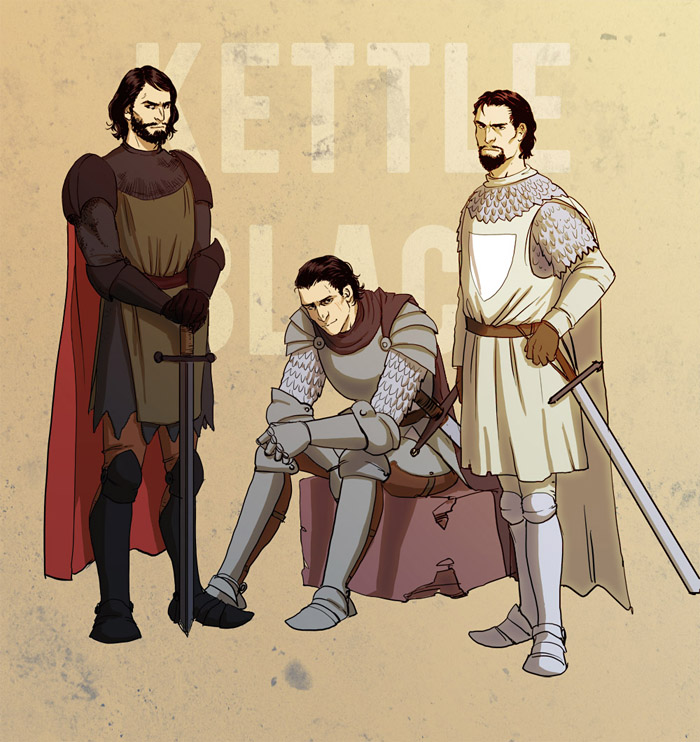
kettleblacks

O.K., O.K. and O.K. by Pojypojy

I’ve always connected Littlefinger’s hiring three hedge knights to his planting the three Kettleblacks (there’s even an irony built into the name) for Cersei. Littlefinger also tells Tyrion, before being dispatched to negotiate the Tyrell marriage, that he fears the sheep and not the shepherds. Here he is bringing three sheep into his fold to protect him against shepherds. There’s also his method of hiding Sansa which has come up before:

“The queen intends to send Prince Tommen away.” They knelt alone in the hushed dimness of the sept, surrounded by shadows and flickering candles, but even so Lancel kept his voice low. “Lord Gyles will take him to Rosby, and conceal him there in the guise of a page. They plan to darken his hair and tell everyone that he is the son of a hedge knight.”

Face it, Riverrun is under siege, Winterfell is sacked, and Moat Cailin being held by Ironborn blocks any land access to any hypothetically loyal Northern bannermen—Lysa Arryn in the Vale isn’t exactly rocket science.

So Littlefinger is mirroring Cersei with her hiring the three Kettleblacks and her plot to hide Tommen. I tie this into his betrayal of Ned where another Lord Protector found himself without an army amidst political intrigue. There may well be a theme here that the “weaknesses” Littlefinger exploits are more inherent in the needs of a Lord with assets to defend than something born of foolishness. It is a different game when you have something to lose, holdings to protect, and you are on everyone else’s radar. Coming back to our current crackpot, if the Cersei parallels are intentional then viewing these three knights as pseudo-Kettleblack figures may be helpful especially since we’re given enough to know that at least one has ulterior motives.

There’s one more parallel between these two. Here’s Cersei, thinking of the failed betrothal to Rhaegar and how Princess Rhaenys could’ve been her daughter:

Margaery’s clumsy attempts at seduction were so obvious as to be laughable. Tommen is too young for kisses, so she gives him kittens. Cersei rather wished they were not black, though. Black cats brought ill luck, as Rhaegar’s little girl had discovered in this very castle. She would have been my daughter, if the Mad King had not played his cruel jape on Father. It had to have been the madness that led Aerys to refuse Lord Tywin’s daughter and take his son instead, whilst marrying his own son to a feeble Dornish princess with black eyes and a flat chest.

The memory of the rejection still rankled, even after all these years.

And the Mockingbird, speaking of the woman he never had and of how Sansa could’ve been his daughter:

“But she gave me something finer, a gift a woman can give but once. How could I turn my back upon her daughter? In a better world, you might have been mine, not Eddard Stark’s. My loyal loving daughter…”

I think this is even a better parallel than the other two. If memory serves, they are the only such explicit surrogate child delusions. Mormont gives Jon Longclaw which is a clear foster father gesture, and there are instances where someone like Cat will witness something and think of her own children; but despite all the could have been marriages, I don’t think we have any other such delusional adoptions of the mind. Cersei attributes Jaime’s Kingsguard acceptance to a madness of Aerys when we know from Jaime that this was purely the result of her own scheming. Littlefinger is delusional about sleeping with Cat, but I wonder if there isn’t a better parallel to Cersei’s delusion buried somewhere. He certainly bears culpability in his exile from Riverrun, which seems a sore point based on his Paramount of the Riverlands drooling at Tyrion’s offer. Maybe there’s an angle to view Sweetrobin as his son that makes a better comparison?

If there is more to the Littlefinger/Cersei parallels that adds a level of interest to the Elder Brother showing up in the Vale, Cersei is experiencing a downfall as a result of her own scheming (which sounds like LF’s eventual end state) but also one strongly intertwined with the Faith. Littlefinger has his home on that curious spot the Faith first landed in Westeros and Sansa has a great deal of religious symbolism surrounding her. The Elder Brother as a force in LF’s downfall obviously adds to any such intentional role of religion surrounding their own self-destructions. Aside from the immediate Sansa angles, I find Martin intentionally doing Littlefinger/Cersei parallels to have fascinating implications.

ON THE REASONS THAT MIGHT’VE COMPELLED THE ELDER BROTHER TO INFILTRATE THE VALE

(Ragnorak)

Looking through the text, he does tell Brienne:

“He begged me for the gift of mercy, but I am sworn not to kill again.”

Martin does pit morality vs. Oaths, but that puts a limiting quality on his scheming absent a deep moral dilemma. The warrior turned holy man forced by injustice to pick up the sword again would have been a common theme in literature and television during Martin’s formative years. The concept is the essence of The Quiet Man that was a Saint Patrick’s Day staple of American television for years. In-between Brienne’s meeting the Elder brother and the appearance of the three knights the Faith Militant is reformed, so that would give the Elder Brother a plausible cause to revisit that vow. That requires a lot of speculation, but this is a crackpot theory.

The letter by raven to King’s Landing is a little peculiar. House Cox has a seat at the Saltpans and we’re told Ser Quincy Cox locked himself in his keep and didn’t come out to help the smallfolk. He lived. So why didn’t the letter to King’s Landing come from Cox? I can’t imagine that there wouldn’t be ravens near a port to send word inland of news that arrives by sea. So Cox should have sent word to King’s Landing and the Elder Brother ought to have sent word to the High Septon. Martin could very easily have simply referred to it as “the news” about The Hound had only arrived last night without specifically attributing it to the Quiet Isle through description sans name.

There are interesting parallels laid out between the Elder Brother and Sandor.

“I had women too, and there I did disgrace myself, for some I took by force. There was a girl I wished to marry, the younger daughter of a petty lord, but I was my father’s thirdborn son and had neither land nor wealth to offer her… only a sword, a horse, a shield. All in all, I was a sad man. When I was not fighting, I was drunk. My life was writ in red, in blood and wine.”

Sandor was a second-born son, so it isn’t exact, but the spirit of the passage is very much in line. Sandor does seem to be the Gravedigger and, based on what the Elder Brother shares, we can reasonably assume he “confessed his sins” and that the Elder Brother knows everything Sandor knows. There is an easy case to make that Sandor’s pain over Sansa (everything from wanting a girl above his station to his failure to protect her) strikes chords with the Elder Brother. Translating that into the Elder Brother going to the Vale in the guise of a hedge knight requires a bit more (but, hey, this is a crackpot theory).

“I see.” Brienne did not know why he was telling her all of this, or what else she ought to say.

“Do you?” He leaned forward, his big hands on his knees. “If so, give up this quest of yours. The Hound is dead, and in any case he never had your Sansa Stark. As for this beast who wears his helm, he will be found and hanged. The wars are ending, and these outlaws cannot survive the peace.

There’s the “big hands” description, which could fit with the “ham” description of our hedge knight. Brienne wonders why the Elder Brother is telling her this, which is a good sign the reader ought to be pondering it as well. (Martin seems to do this often—Jon wondering why Aemon tells him about Ravens and Doves is the first example that comes to mind). This could just be limited to being a clue about the Gravedigger’s identity.

“I have to find her,” she finished. “There are others looking, all wanting to capture her and sell her to the queen. I have to find her first. I promised Jaime. Oathkeeper, he named the sword. I have to try to save her… or die in the attempt.”

Brienne warns him that others are looking for Sansa too, so there may be reasons in what the Elder Brother hears from Sandor and Brienne that could play into his motivations.

“Wolves are nobler than that . . . and so are dogs, I think.”

“Dogs” most certainly seems to be a nod at Sandor, and though “wolves” seems to be a reference to the scavengers a few lines earlier, it could also be a nod at Sansa (and a clue in the phrasing). Aside from the various ways helping Sansa could play into “redeeming” Sandor, there is his likely confession that he failed to protect Sansa which could be the Elder Brother’s motivation. It could also be that Sansa is known or believed to be of decent moral character and he thinks she could offer leadership, a symbol or some other means of dealing with the broken men who fall under the “wolves” category, which is in keeping with the Elder Brother’s own story and priorities as well as Septon Meribald’s.

There’s also the Arya angle.

I think we can assume that the Elder Brother knows what Sandor knows. So he knows about Arya, including that they were destined for the Saltpans prior to her leaving Sandor. Arya is also publicly known to be heading North to marry Ramsay, so if the EB believes Sandor, he knows the Crown is sending a false Arya North.

The bird had come last night, from a septry on an island hard by the mouth of the Trident. The nearby town of Saltpans had been savagely raided by a band of outlaws, and some of the survivors claimed a roaring brute in a hound’s head helm was amongst the raiders. Supposedly he’d killed a dozen men and raped a girl of twelve.

Who knows that Arya is “fake?” Who knows the real Arya has been about the Riverlands? Lady Stoneheart and the BwB know. Is that a well kept secret? Did he and/or Sandor—the gravedigger—go to Saltpans and bury the dead to see that Arya was not among them? If the Elder Brother knows that Arya was alive and headed to the Saltpans (which is likely), that last line can be read as an Arya reference. The Elder Brother has to know that Ramsay’s Arya is fake and that the Crown knows this too, but I can’t reason out any way that he has reason to suspect that King’s Landing knows the travels of the real Arya. Assuming it is a message about Arya, it does not specify that the raped girl was murdered—only raped. So it could be a ploy to make the Crown think a real Arya is alive and in the Riverlands, or it could be a ploy to make the Crown think the real Arya is dead. I can’t see who (other than Varys) he might think possesses knowledge or will soon possess knowledge of the real Arya’s itinerary such that this coded information would be impactful. Brienne does allude to looking for Arya if I recall and does mention Jaime set her on the quest, which ties back to KL and knowledge of a living Arya, but that strikes me as a dead end since Jaime was acting on his own in that regard.

I first thought of Arya when I read that passage and thought it was odd since we already knew Arya’s fate and it wasn’t really a cliffhanger. I tried to think of who might get that word and think the Arya that lived might be dead at the Saltpans and how that might matter. I like the Arya disinformation angle more and more as I ponder it, but I can’t fit it into an agenda that makes any sense yet.

All in all, I can’t piece it together into a coherent scheme, but at the same time I think there are several elements here that are almost certainly part of a “something” or maybe multiple “somethings.” There’s also the story of Rhaegar’s rubies washing up on the Quiet Isle and speculation that Jon is the seventh ruby that will eventually arrive there. If that’s accurate, we may be seeing the early seeds of that eventual plotline which very well could run through Sansa.

ON THE ELDER BROTHER AND RHAEGAR’S RUBIES

(Bran Vras)
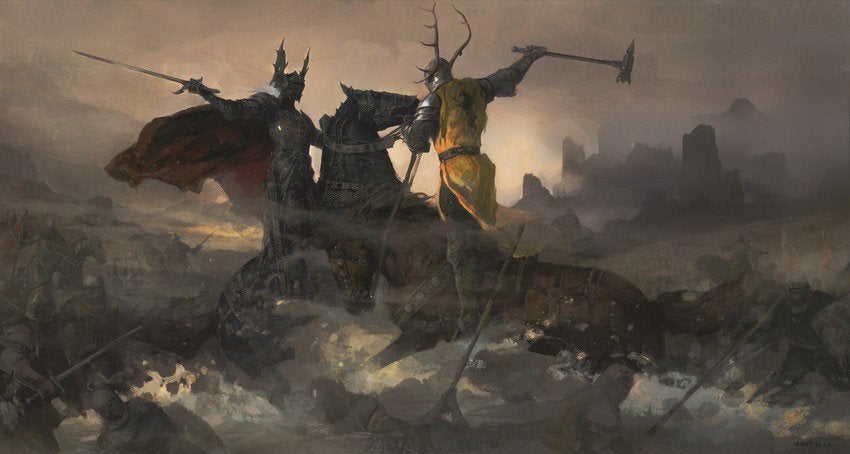
tridentbattle

Battle of the Trident by Justin Sweet

When Brashcandy communicated to me the discovery she made with Milady, my immediate feeling was that they were right about the Elder Brother reappearance at Sansa’s side. What follows is my reaction to their suggestion. I have been encouraged by Brashcandy to post my thinking here.

We start from what the Elder Brother tells Brienne.

When Brienne complimented them, he said, “My lady is too kind. All we do is cut and polish the wood. We are blessed here. Where the river meets the bay, the currents and the tides wrestle one against the other, and many strange and wondrous things are pushed toward us, to wash up on our shores. Driftwood is the least of it. We have found silver cups and iron pots, sacks of wool and bolts of silk, rusted helms and shining swords… aye, and rubies.”

That interested Ser Hyle. “Rhaegar’s rubies?”

“It may be. Who can say? The battle was long leagues from here, but the river is tireless and patient. Six have been found. We are all waiting for the seventh.” (AFfC)

What could that mean?

Where do Rhaegar’s rubies come from?

When can we expect the seventh ruby to show up?

First, recall how early we became acquainted with Rhaegar’s rubies, which are mentioned in Ned Stark’s internal monologue during Robert’s visit to Winterfell. We were reminded of those rubies numerous times: by Ned Stark when he recalled the great tourney at Harrenhal, by Arya and Mikken at the Ruby Ford, by Daenerys’ dreams in the House of the Undying, by Jaime in the memory of his last conversation with the crown prince.

Of course, rubies are as valuable and impressive in Martin’s world as they are in our own world. Moreover, they are sometimes the vehicles of certain sorceries. Here is a brief inventory of the rubies we see in the story: Lannisters, especially Tywin, have a great fondness for rubies, that they set as eyes on their golden lions. We have Melisandre’s great square-cut ruby, the lesser stone she gave Mance Rayder and the greater stone she gave Stannis. Lord Celtigar and Euron have both a treasure chest containing rubies. Illyrio has a ruby on his fingers, and has given three large rubies to Aegon. There is a heart-shaped ruby on Lyn Corbray’s sword.

Let’s consider the sentence: We are all waiting for the seventh. Waiting in order to do what? Would the monks of the Quiet Isle, or at least the EB, feel released from their vows by the miraculous appearance of the final ruby? I am not sure the EB necessarily expects the seventh stone to be brought by the tide or the river, though.

It might be possible that the rubies sought by the EB have landed on the Quiet Isle when the EB mentioned his expectation. Indeed, here is Brienne in her conversation with the EB:

The Elder Brother sat in one, and put the lantern down. “May I stay a while? I feel that we should talk.”

“If you wish.” Brienne undid her swordbelt and hung it from the second chair, then sat cross- legged on the pallet. (AFfC)

Let’s have a look at the sword and scabbard that go along the swordbelt. Brienne started her quest for Sansa with a common sword on open display, and

But she had another longsword hidden in her bedroll. She sat on the bed and took it out. Gold glimmered yellow in the candlelight and rubies smoldered red. When she slid Oathkeeper from the ornate scabbard, Brienne’s breath caught in her throat. (AFfC)

At the Whispers, Brienne started to use the Valyrian blade. She seemed to carry the sword as her primary weapon from that point on. In particular, here she is with brother Narbert upon her arrival at the Quiet Isle:

“Lady Brienne is a warrior maid,” confided Septon Meribald, “hunting for the Hound.”

“Aye?” Narbert seemed taken aback. “To what end?”

Brienne touched Oathkeeper’s hilt. “His,” she said. (AFfC)

The sword has been given by Jaime:

“Brienne of Tarth.” Jaime sighed. “I have a gift for you.” He reached down under the Lord Commander’s chair and brought it out, wrapped in folds of crimson velvet.

Brienne approached as if the bundle was like to bite her, reached out a huge freckled hand, and flipped back a fold of cloth. Rubies glimmered in the light. She picked the treasure up gingerly, curled her fingers around the leather grip, and slowly slid the sword free of its scabbard. Blood and black the ripples shone. A finger of reflected light ran red along the edge. “Is this Valyrian steel? I have never seen such colors.” (ASoS)

In turn, Jaime has received the sword from his father:

Tyrion put down Joffrey’s sword and took up the other. If not twins, the two were at least close cousins. This one was thicker and heavier, a half-inch wider and three inches longer, but they shared the same fine clean lines and the same distinctive color, the ripples of blood and night. Three fullers, deeply incised, ran down the second blade from hilt to point; the king’s sword had only two. Joff’s hilt was a good deal more ornate, the arms of its crossguard done as lions’ paws with ruby claws unsheathed, but both swords had grips of finely tooled red leather and gold lions’ heads for pornmels.

“Magnificent.” Even in hands as unskilled as Tyrion’s, the blade felt alive. “I have never felt better balance.”

“It is meant for my son.”

No need to ask which son. Tyrion placed Jaime’s sword back on the table beside Joffrey’s, wondering if Robb Stark would let his brother live long enough to wield it. Our father must surely think so, else why have this blade forged?

“You have done good work, Master Mott,” Lord Tywin told the armorer. “My steward will see to your payment. And remember, rubies for the scabbards.” (ASoS)

Who is this Master Mott? We met him through Ned Stark:

The slim young serving girl took quick note of Ned’s badge and the sigil on his doublet, and the master came hurrying out, all smiles and bows. “Wine for the King’s Hand,” he told the girl, gesturing Ned to a couch. “I am Tobho Mott, my lord, please, please, put yourself at ease.” He wore a black velvet coat with hammers embroidered on the sleeves in silver thread, Around his neck was a heavy silver chain and a sapphire as large as a pigeon’s egg. “If you are in need of new arms for the Hand’s tourney, you have come to the right shop.” Ned did not bother to correct him. “My work is costly, and I make no apologies for that, my lord,” he said as he filled two matching silver goblets. “You will not find craftsmanship equal to mine anywhere in the Seven Kingdoms, I promise you. Visit every forge in King’s Landing if you like, and compare for yourself. Any village smith can hammer out a shift of mail; my work is art.” (AGoT)

It might be boasting, but I tend to believe Thobo Mott’s claim of being unequalled in the Seven Kingdoms.

Ned sipped his wine and let the man go on. The Knight of Flowers bought all his armor here, Tobho boasted, and many high lords, the ones who knew fine steel, and even Lord Renly, the king’s own brother. Perhaps the Hand had seen Lord Renly’s new armor, the green plate with the golden antlers? No other armorer in the city could get that deep a green; he knew the secret of putting color in the steel itself, paint and enamel were the crutches of a journeyman. Or mayhaps the Hand wanted a blade? Tobho had learned to work Valyrian steel at the forges of Qohor as a boy. Only a man who knew the spells could take old weapons and forge them anew. (AGoT)

Let’s look now at Loras Tyrell armor.

Ser Loras Tyrell was slender as a reed, dressed in a suit of fabulous silver armor polished to a blinding sheen and filigreed with twining black vines and tiny blue forget-me-nots. The commons realized in the same instant as Ned that the blue of the flowers came from sapphires; a gasp went up from a thousand throats. Across the boy’s shoulders his cloak hung heavy. It was woven of forget-me-nots, real ones, hundreds of fresh blooms sewn to a heavy woolen cape. (AGoT)

Return now to Rhaegar’s fabled armor.

The crown prince wore the armor he would die in: gleaming black plate with the three-headed dragon of his House wrought in rubies on the breast. A plume of scarlet silk streamed behind him when he rode, and it seemed no lance could touch him. (AGoT)

Note the silk assorted to the gemstones for both Rhaegar (red) and Ser Loras (blue). The suggestion is clear: Master Mott has made Rhaegar’s armor. He has been in King’s Landing for some time, since Gendry has been brought to his workshop as an infant. If indeed Tobho Mott crafted the armor, then the rubies in Rhaegar’s armor and those of Oathkeeper originate from the same place. It is even conceivable that some of Rhaegar’s rubies, it they were recovered and perhaps sold back, ended on Brienne’s sword.

So we arrive at the notion that Brienne’s rubies are of the type expected by the EB. Of course, the EB’s expectation seems to be of a single additional ruby, perhaps not the two gemstones that serve as eyes of the golden lion on Brienne’s sword or the stones set on the scabbard. So we are left to wonder what the EB was thinking when he glanced at the rubies on the scabbard and pommel of Oathkeeper, and whether he felt that the time had arrived.

Still concerning Rhaegar’s rubies, I am intrigued by the heart-faced ruby on Lynn Corbray’s sword. Lynn Corbray fought at the battle of the Trident, and was around when the rubies fell from Rhaegar’s armor. So? The heart shape recalls of course the sigil of house Corbray.

Returning to the monks of the Quiet Isle, it is tempting to conjecture that a fair number of them are Targaryen loyalists who fought on the Trident, and had to find (or chose to find) a new life after the battle. The battle of the Trident was not without consequence for the Isle, as the following exchange seem to imply:

“The war has never come here?” Brienne said.

“Not this war, praise the Seven. Our prayers protect us.”

“And your tides,” suggested Meribald. Dog barked agreement. (AFfC)

The monks were even perhaps devotees of Rhaegar, who retreated to the life on the Isle to escape Robert’s wrath. The EB himself fought for Rhaegar, but dismisses his involvement as a mere historical accident. However, note that the EB fought fiercely, and he stresses the devotion of the combattants on both sides. Who would want to appear a Targaryen fanatic after the rebellion? I do not doubt the devotion of the monks to the faith of the Seven. When the monks saw rubies reappearing on the Isle, they might have conceived the notion of Rhaegar’s return with the seventh stone.

However, the story of the Elder Brother is the following: he found himself on the shore naked (without any visible mark of allegiance) and was welcome by a previous Elder Brother. He spent ten years in silence, before perhaps becoming a proctor or the new EB. So, the EB did not become the immediate leader. He might only be the front figure.

There is another little sign of a devotion to Rhaegar.

Nor was the meal a somber one. Meribald pronounced a prayer before the food was served, and whilst the brothers ate at four long trestle tables, one of their number played for them on the high harp, filling the hall with soft sweet sounds. (AFfC)

Of course, the high harp was a hallmark of the Prince of Dragonstone. It is not completely unconceivable that the harp is Rhaegar’s. Indeed Rhaegar seemed to travel everywhere with his harp, as his sojourns in Harrenhal, Summerhall, Lannisport and Griffin’s Roost show. It’s likely that Rhaegar had the harp with him on the eve of the battle. So the instrument might have been carried away by loyalists after the defeat. But there is no sign that the harp of the Quiet Isle has any silver string. If the harp playing is intended to recall Rhaegar, then the monks appear to hear the music every day, which seems like an interesting endoctrinement.

The rubies expected on the Quiet Isle might be on the Shy Maid.

When the lad emerged from the cabin with Lemore by his side, Griff looked him over carefully from head to heel. The prince wore sword and dagger, black boots polished to a high sheen, a black cloak lined with blood-red silk. With his hair washed and cut and freshly dyed a deep, dark blue, his eyes looked blue as well. At his throat he wore three huge square-cut rubies on a chain of black iron, a gift from Magister Illyrio. Red and black. Dragon colors. That was good. “You look a proper prince,” he told the boy. “Your father would be proud if he could see you.” (ADwD)

Aegon’s sponsors want to play on the ruby imagery for passing Aegon as Rhaegar’s heir. Illyrio seems to be the one that insisted on the rubies. Septa Lemore, a woman of the faith, might be connected to the men of the faith in the Seven Kingdoms, and might have slept once in one of the cottages in the eastern side of the Isle.

I do not know for sure whether the EB has considered his prophecy fulfilled when he saw Oathkeeper’s rubies. I am not sure whether the seventh ruby is expected as another gift of the river or as Aegon’s landing in Westeros or some other ruby (perhaps Jon Snow wearing one of those rubies we see in the north, if we want to believe that he could represent Rhaegar’s return) or as a sign that someone would send to the Quiet Isle (and that the EB would have understood as such on Brienne).

A few more points on the sociology of the septry. The Quiet Isle seems to have old monks and novices of all ages. The EB has spent ten years in silence. Since the Battle of the Trident happened sixteen years ago, he became EB over the last six years. Interestingly he wasn’t the oldest monk at the septry, since Brother Clement just passed away as the age of forty eight. Brother Narbert says that the EB knows more about Brother Clement, but he wouldn’t divulge what would disturb the peace of the community. That seems an invitation to reflect on what happened to Clement in Saltspans. We see novices that joined, we can presume, during the War of the Five Kings. Indeed some of them are grown men. The brothers seem older than the EB.

Septon Meribald says that he would invite broken men to visit the Quiet Isle. So we shouldn’t take the stories of the EB and of Sandor Cleganes as exceptional tales. When Brienne reached the island, beside Brother Narbert, two brothers were hiding their faces, which could mean that they feared recognition. What happened to Sandor might be the standard recruitment process at the Quiet Isle.

Here is a sign that some members of Rhaegar’s entourage might have ended at the Quiet Isle. We know that the Prince of Dragonstone had a devoted following:

Ser Kevan wished that he could share his certainty. He had known Jon Connington, slightly—a proud youth, the most headstrong of the gaggle of young lordlings who had gathered around Prince Rhaegar Targaryen, competing for his royal favor.

(ADwD)

I presume those lordlings fought at the Trident. The only ones I can identify are Richard Lonmouth and Myles Mooton, who had been Rhaegar’s squires. Myles Motoon was killed by Robert at the battle of the Bells. But the whereabouts of Lonmouth, the knight of skulls and kisses, are unknown. Could he have ended up at the Isle?

There seems to be a certain amount of Targaryen loyalty in the vicinity of the Quiet Isle. Indeed, Nimble Dick says that Cracklaw Point is all for the Targaryens. The current Lord of Maidenpool, Myles Mooton’s brother, has just married his daughter to the Tarly heir.

I don’t think Septon Meribald is part of the cult of Rhaegar I am positing. Indeed, the good septon has walked the Riverlands for forty years. However, he might be quite knowledgeable about the Blackfyre rebellion, since he has fought during the War of the Ninepenny Kings.

On the question of what the EB could be up to. The most natural thing that comes to mind is the following: Ser Morgath (possibly the EB) seems associated to Ser Shadrich, who says he has been hired by Varys to seek Sansa. Why would Varys seek Sansa, if not to find a bride to Aegon? Of course, we already have Arianne Martell as possible queen. But it seems perfectly natural to me that Rhaegar’s heir would attempt to marry both the Stark daughter and the Martell daughter (or at least play with the idea), accomplishing thus what was prevented by his father’s untimely death.
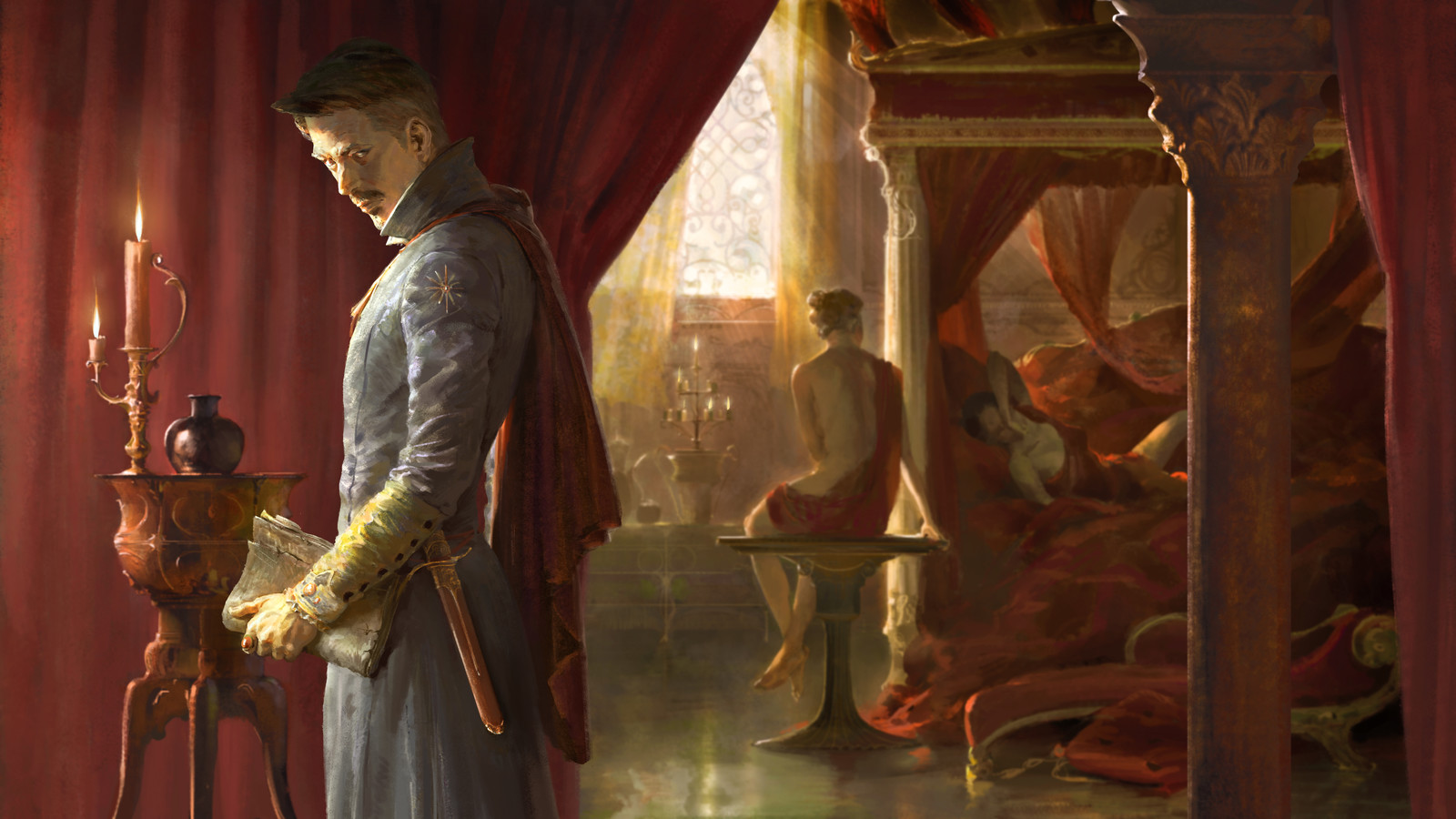
The King’s Tapestries

29 Wednesday Jul 2020

Posted by brashcandie in PTP TWOW

≈ Leave a comment

Tags

littlefinger, lord royce, nestor royce, the vale, theory, twow

We’re pleased to feature the work of Lady Gwynhyfvar, who has kindly given permission for her theory to be reposted here at Pawn to Player as it relates to Littlefinger’s potential machinations in the Vale. Lady Gwyn is the co-host of the popular podcast, Radio Westeros, and a longtime contributor and advisor to PTP.

huntingtap1

Spoilers for The Winds of Winter, Alayne I

The same panels had once hung in the Red Keep of King’s Landing, when Robert sat the Iron Throne. Joffrey had them taken down and they had languished in some cellar until Petyr Baelish arranged for them to be brought to the Vale as a gift for Nestor Royce. Not only were the hangings beautiful, but the High Steward delighted in telling anyone who’d listen that they had once belonged to a king.

In a recent episode of Radio Westeros we mentioned a new theory about what exactly is going on with those tapestries from the Red Keep that are mentioned numerous times from AGoT onwards. In Alayne I it says that Lord Nestor was showing off “his prize tapestries”, a recent gift from the Lord Protector. These tapestries were mentioned several times in AGoT, hanging on the walls of the throne room of the Red Keep until, after Robert’s death, Sansa observed this:

the hunting tapestries that King Robert loved [had been] taken down and stacked in the corner in an untidy heap.

Fast forward to AFfC when, several months after leaving the city, Petyr Baelish sends a letter to Cersei. Here’s a quote:

His last letter mentions the rebels only briefly before beseeching me to ship him some old tapestries of Robert’s.

Not long after, Baelish tells Alayne that Cersei is “sending me some splendid tapestries. Isn’t that kind of her?” And then somewhere around two months later, it appears the tapestries have arrived in the Vale. What many fans want to know is— what was so significant about these tapestries that Baelish went to the trouble of requesting them from Cersei? Was it indeed only for their symbolic value as a “gift” to Lord Nestor? Are they the sort of tapestry The World Book tells us can be “worth their weight in gold”? Is there some valuable information hidden in the images they depict? Or did the tapestries themselves merely serve to disguise something else that Baelish wanted smuggled out of King’s Landing?

We can’t know for certain, but we can certainly consider the options. As a gift or bribe only, they wouldn’t seem that valuable. As much as Nestor Royce appreciates the fact that they once belonged to King Robert, the Lord Protector has already gifted the High Steward of the Vale something of much greater symbolic value in perpetuity, namely the title he bears and the castle he commands. And while if these were Myrish tapestries “worth their weight in gold” we can see Cersei being oblivious, we certainly can’t see the shrewd Petyr Baelish simply gifting something of great monetary value to someone he’s essentially already bought.

And while many tapestries in the series (and real life! We’re looking at you Bayeux Tapestry) are noted to show histories or genealogies, which could conceivably be valuable to someone who trades in information, these are specifically noted to be hunting scenes. In fact they seem all in all like rather boring examples of an art form that could be found in castles and chambers the world over, special mainly because the former king liked hunting.

And that leaves us with the final option— that Baelish wished to smuggle *something* out of King’s Landing, and the tapestries were used to conceal that something. This could definitely explain the largesse shown in bestowing them upon Nestor Royce— once the *something* was removed, the tapestries themselves were of no more use than an old box or envelope, though Baelish would certainly be clever enough to make what use of them he could by giving what appeared to be a very generous and thoughtful gift to his host.

So, what would this *something* be? Our thought was once that it was Widow’s Wail, stolen as a symbolic gift for Sansa perhaps. But in 2008 GRRM answered a fan’s question about Widow’s Wail’s location saying “Still at the Red Keep, until such time as King Tommen is old enough to wield it.” While he could have been prevaricating, making a direct answer like that usually isn’t his style if he wants to keep a secret. So over time we’ve realized the Widow’s Wail theory is unlikely, but in our opinion the best object to conceal inside a rolled up tapestry is still something long and slender like a SWORD, and so we’re left with the mystery of which sword could be so valuable that Baelish would go to such trouble to smuggle it into the Vale.

We considered swords that would be of value to Littlefinger, and why, and which swords of great value are noted as having their whereabouts unknown. And we found one interesting option that could actually have significant value to Littlefinger’s plans and is noted to have been missing for over a century and a half.

The Valyrian steel sword LAMENTATION was the ancestral sword of House Royce. House Royce of Runestone is a famously old and powerful First Men house, one of several to have survived the Andal invasion. Once known as the Bronze Kings, their descendants still pride themselves on their ancestral armor, made of bronze and allegedly inscribed with magical runes of protection.

The last Bronze King, Robar Royce, unified the First Men of the Vale and Fingers and Mountains of the Moon. As their High King, he very nearly succeeded in defeating the Andal invaders, until the Andals united behind Ser Artys Arryn, known as the Falcon Knight, and the resulting Battle of the Seven Stars led to the death of Robar Royce and a conclusive defeat of the First Men by the Andals. Based on the histories, it’s possible to infer that House Royce at the time was not in possession of a sword of Valyrian steel, so Lamentation must have been acquired by the family later, after the Andal victory.

Because in spite of their defeat, House Royce endured, and prospered even, and the Dance of the Dragons found a knight called Ser Willam Royce carrying a quote “famed” Valyrian steel sword and serving Queen Rhaenyra Targaryen. Ser Willam was one of the famous “Seven Who Rode” during the storming of the Dragonpit. Along with four knights of the Queensguard and two other knights called Ser Harmon of the Reeds and Ser Gyles Yronwood, Ser Willam rode out into the riots in Flea Bottom to recover Prince Joffrey Velaryon, who had been thrown into the crowd when he attempted to fly his mother’s dragon Syrax to the Dragonpit in order to save the other dragons.

Fire and Blood tells us that the knights did find Joffrey’s body at last, but that three of the seven were killed in the fighting— Ser Glendon Goode, LC of the QG, Ser Gyles Yronwood, and Ser Willam Royce who, it says “was felled by a man who leapt down from a rooftop to land upon his back (his famed sword, Lamentation, was torn from his hand and carried off, never to be found again).”

So Gyldayn tells us that Lamentation was lost forever, but then gives us reason to think otherwise just a few pages later when relating the death of the dragon Syrax. Here’s the passage:

“Some speak of an unnamed spearman, “a blood-soaked giant” who leapt from the Dragonpit’s broken dome onto the dragon’s back. Others relate how a knight named Ser Warrick Wheaton slashed a wing from Syrax with a Valyrian steel sword (Lamentation, most like)…”

Of Warrick Wheaton we know nothing beyond this brief mention. Part of an “unruly mob” that gained momentary infamy when they somehow brought about the death of the Queen’s dragon, he and his House seem to have vanished from history. As did Lamentation.

It’s a well known problem among art thieves that stealing something completely unique is problematic in terms of disposal. Without an underground network and a demand for the artifact you find yourself in possession of, it can be notoriously tricky to profit from your theft. Given the circumstances of its loss, and its possible last appearance in the hands of an obscure knight who is never heard from again, we’d view the fate of Lamentation in these terms. Having fallen into the hands of someone with no connections in the underworld, and there being no real possible market for such an artifact without incriminating the seller, we propose the sword languished in the possession of frightened or ignorant people for several generations.

And then along comes Petyr Baelish. A man who trades in information, and is well versed in using his enemies’ weaknesses to either neutralize them or get them on side. He has a big problem with Bronze Yohn Royce. The effective leader of the Lords Declarant had declared that he would personally see Petyr Baelish removed as Lord Protector, and his visit to the Eyrie in which he was outmaneuvered by Littlefinger doesn’t seem to have changed his outlook.

Of the Lords Declarant, by Alayne I, Petyr Baelish has succeeded at effectively buying Lady Waynwood, Lord Belmore, and Lord Templeton, seems to have some information regarding a murder plot  in House Hunter that will give him leverage there, and may have even reached an agreement of sorts with Lord Redfort, whose son Mychel is there for the tourney. He’s also made an essential alliance with Nestor Royce, the High Steward of the Vale, by making his title and possession of the Gates of the Moon hereditary. But so far, there’s been no mention of the Lord Protector’s plans to bring House Royce of Runestone into the fold.

So our suggestion goes something like this— that Petyr Baelish cleverly recognized the extreme value that would be placed upon the recovery of their ancestral sword by House Royce. That through his connections in the underworld of King’s Landing he actively sought out or coincidentally heard of the sword that had gone missing in that very city so many years ago. Having discovered its location, it would probably be a simple thing to finally provide a market for such an inconvenient heirloom, especially at a time when money and bread would be valued above useless metal.

Then, having through his agents acquired the sword, he had it secreted in the forgotten and rolled up tapestries beneath the Red Keep. Following his departure from the city and marriage to Lysa Arryn, at the height of his good will with Cersei, he then requested those old tapestries be sent to him as a gift. What a modest and simple request from someone who had been of such great service! Request granted, the tapestries arrive in the Vale and the sword is moved to a new location until the right time, and the tapestries put to a second good use as a further gift to Lord Nestor, just to keep him sweet.

There’s a clever bit in this scenario where both the tapestries and the item they concealed are to be used to bribe a Lord Royce— two different gifts for two very different Royces. So, that’s our new theory about what’s going on with those tapestries, and while we like the theory, and continue to think that the tapestries being somehow significant is the best explanation for the number of times they’re mentioned, we’re interested to hear what you all think! Let us know if you have feedback or other thoughts to share with us.

The Past is Prologue: Analysing the upcoming Winged Knight tourney in The Winds of Winter

11 Wednesday Oct 2017

Posted by brashcandie in PTP TWOW

≈ 8 Comments

Tags

alayne stone, analysis, littlefinger, sansa stark, the winds of winter, tourney, winged knights

by Brashcandy

Sansa and Sweetrobin depart the Eyrie in A Feast for Crows.  ©Anndr


Tourneys in the Song of Ice and Fire saga have never been simple affairs. Whether ostensibly organized to celebrate weddings or birthdays, honour officials in high positions, their noble family members, or some other festive occasion, these tournaments — grand or small — have been sites of intrigue, power struggles, attempted rebellions, romantic entanglements, and political scandals. In every tourney that Martin has turned a sustained gaze upon, we have seen the oft deadly game of thrones in operation, where deceit and trickery hold sway, and personal ambition comes with high costs.  Therefore, with Sansa’s TWOW sample chapter revealing another planned tourney that Martin will explore in significant textual detail, we should expect to see many of the same thematic elements and surprising plot developments arising from this event at the Gates of the Moon. This is why, for the purposes of the following analysis, I have found it so instructive to closely examine the five tourneys in the ASOIAF universe that we have been given substantive information on: the Hand’s tourney in A Game of Thrones and Joffrey’s name day tourney in A Clash of Kings; the tourney at Harrenhal in the year of the false spring; and the pair we read of in the Dunk and Egg novellas, staged by Lord Ashford and Lord Butterwell respectively in The Hedge Knight and The Mystery Knight.

Before we get into the central features of the aforementioned tourneys and the revealing parallels that are contained in Sansa’s storyline, let’s spend a little time exploring just why tourneys are such a critical component of Sansa’s arc and development. Rivalled only by her younger brother Bran for her early idealism and valorisation of knighthood, Sansa begins the novel with starry-eyed beliefs that these warriors are fundamentally good and honourable, uphold a chivalric code of conduct, and behave as she puts it like “true knights.” Tourneys, with their grandeur and spectacle, initially dazzle and amaze the young girl we are introduced to in A Game of Thrones:

Sansa rode to the Hand’s tourney with Septa Mordane and Jeyne Poole, in a litter with curtains of yellow silk so fine she could see right through them. They turned the whole world gold. Beyond the city walls, a hundred pavilions had been raised beside the river, and the common folk came out in the thousands to watch the games. The splendor of it all took Sansa’s breath away; the shining armor, the great chargers caparisoned in silver and gold, the shouts of the crowd, the banners snapping in the wind . . . and the knights themselves, the knights most of all.

“It is better than the songs,” she whispered when they found the places that her father had promised her, among the high lords and ladies. Sansa was dressed beautifully that day, in a green gown that brought out the auburn of her hair, and she knew they were looking at her and smiling.

If tourneys are the staging ground for displays of jousting skills by knights, they become an important training ground for the elder Stark daughter, educating her in the violence and dishonourable tactics that can regularly occur, revealing and sharpening her empathetic skillset, and fostering her relationship with Sandor Clegane. Not to be overlooked is Lord Petyr Baelish, aka Littlefinger, who also initiates his connection to Sansa at the Hand’s tourney, transferring his ruthless obsession with Catelyn to her daughter, and begins to look for ways to exploit her naïveté. For all the passivity that appears to define Sansa’s time in captivity with the Lannisters, she plays a pivotal role at the two tourneys she attends, elevating her status from that of mere ornamentation and insignificant hostage.

By opening Sansa’s TWOW chapter with the plans for the imminent staging of a tourney of sixty-four competitors, Martin is confirming to the reader that whatever may develop out of this event with respect to her future prospects, a tourney is familiar territory for Sansa, and one where she has a habit of forming unusual and clandestine alliances. Although she is still in LF’s orbit of influence, Sansa is no longer imprisoned or cut off from potential sources of assistance. She is older and wiser, with considerably more self-confidence and daring, divorced from the childish estimation of knights, and in possession of a strategic understanding of the wants and desires that motivate those around her and how to manipulate such to her favour. It may not be overstating the matter to say that in agreeing to host the tourney, Littlefinger has opened up the possibility of Sansa having a key tactical advantage over him; especially when he later leaves it up to her to decide which knight will receive her favour. However, we cannot disregard LF’s own plans for this event, which are certain to be more complex and far-reaching than finding eight winged knights to act as Robert Arryn’s protectors.

Vile princes and kings

In The Hedge Knight, Ser Duncan the Tall attends the tourney in honour of Lord Ashford’s daughter who is celebrating her 13th birthday. This is the same age Joffrey turns when his own name day tourney is held in A Clash of Kings, and whose increasingly cruel behaviour calls to mind the disturbed nature of the Targaryen prince, Aerion Brightflame, who will maim Humfrey Hardyng at Ashford and later fight Dunk in a trial by seven after the hedge knight comes to the rescue of Tanselle Too Tall. Compare Aerion’s cruel treatment of Tanselle with Joff’s violence against Sansa and the disturbing parallel is all too clear:

The dragon puppet was scattered all about them, a broken wing here, its head there, its tail in three pieces. And in the midst of it all stood Prince Aerion, resplendent in red velvet doublet,
with long, dagged sleeves, twisting Tanselle’s arm in both hands. She was on her knees, pleading
with him. Aerion ignored her. He forced open her hand and seized one of her fingers. Dunk stood
there stupidly, not quite believing what he saw. Then he heard a crack, and Tanselle screamed.
(The Hedge Knight)

Knowing that Joffrey would require her to attend the tourney in his honor, Sansa had taken special care with her face and clothes. She wore a gown of pale purple silk and a moonstone hair net that had been a gift from Joffrey. The gown had long sleeves to hide the bruises on her arms. Those were Joffrey’s gifts as well. When they told him that Robb had been proclaimed King in the North, his rage had been a fearsome thing, and he had sent Ser Boros to beat her.
(Sansa I, ACOK)

It’s noteworthy that Sansa, like Dunk, performed her own brand of heroics at Joffrey’s tourney, when she convinced him not to kill the drunken knight Ser Dontos. Whilst the Vale tourney is mercifully free from the spectre of princely ire and madness, there are some characters that display the same kind of arrogance and hot-headed nature which could prove troublesome on the day. Sansa notes in particular the simmering rage of Ser Lyn Corbray. Couple this with the fact that Martin seems to be fond of having knights from the Vale meet their deaths at tournaments – in addition to Ser Humfrey at Ashford is the killing of Ser Hugh by Gregor Clegane at the Hand’s tourney – and we could be in for a similarly violent spectacle at the Gates. Relevant to this discussion is the theory that Littlefinger may have also played a role in the killing of Ser Hugh in order to thwart Ned Stark’s investigation into Jon Arryn’s death. This speculation is not unfounded given the other heartless tactics we have seen LF employ throughout the series.

Sansa’s position in the Vale is not like the one she occupied in KL – vulnerable and at the mercy of Joffrey’s cruel whims — yet she is not completely out of the woods as it relates to those who might try to do her harm. Martin has set up the likes of Corbray and Ser Shadrich as unpredictable characters, and there’s no telling how much Sansa’s true identity remains more of an open secret at this point.

The Ashford tourney ends in a trial of seven with Dunk and Aerion Brightflame fighting against each other alongside their respective champions. Notably, Catelyn witnessed a trial by combat at the Eyrie, and Sansa’s experiences there have tracked closely to her mother’s. During that trial between Tyrion’s champion Bronn and Ser Vardis Egen, Sweetrobin’s behaviour recalls the kind of infantile bloodlust exhibited by Joffrey, who also loved to suggest making men fight to the death:

“Make them fight!” Lord Robert called out.
Ser Vardis faced the Lord of the Eyrie and lifted his sword in salute. “For the Eyrie and Vale!”
Tyrion Lannister had been seated on a balcony across the garden, flanked by his guards. It was to him that Bronn turned with a cursory salute.
“They await your command,” Lady Lysa said to her lord son.
“Fight!” The boy screamed, his arms trembling as they clutched at his chair.

As the fighting ensues, Cat remembers the duel fought between LF and Brandon Stark, her betrothed, who agreed to spare the young Petyr on her behalf. Since then, LF claims to have learnt his lesson about his lack of martial prowess, but it’s worth considering if he could face a similar trial by combat in the Vale (or Winterfell) if his crimes are made known to the Lords there, and Sansa certainly has no similar incentive to spare him as her mother did. Perhaps SR will eventually get his wish to see the “bad little man” fly.

Sansa’s tourney and Littlefinger’s Plans

We learn in the sample chapter that the Vale tournament is being staged for the honour of serving as a member of Lord Robert’s Winged Knights:

Lord Robert’s mother had filled him full of fears, but he always took courage from the tales she read him of Ser Artys Arryn, the Winged Knight of legend, founder of his line. Why not surround him with Winged Knights? She had thought one night, after Sweetrobin had finally drifted off to sleep. His own Kingsguard, to keep him safe and make him brave.

It is a novel idea for a tourney up to this point in the series and one that aims to placate the irritable and insecure young Lord of the Eyrie. However, as the chapter develops, the curious fact emerges that this is an event seeming designed more to honour Sansa Stark than her cousin. I say Sansa Stark and not Alayne Stone deliberately, because the evidence suggests that Littlefinger has plans to declare her true identity. It is here that the past tourneys prove quite useful to study for elucidating the hidden workings at play in Sansa’s chapter, with precedent already set in Martin’s universe for a tourney that conceals its true purpose: the attempted Second Blackfyre rebellion in The Mystery Knight, which masqueraded as a mere wedding celebration for Lord Butterwell and his Frey bride.

The first hint that we have concerns Sansa’s thoughts about the tourney itself, which repeatedly highlight her role in its conception and organisation. It is a point of considerable pride for her:

The competitors came from all over the Vale, from the mountain valleys and the coast, from Gulltown and the Bloody Gate, even the Three Sisters. Though a few were promised, only three were wed; the eight victors would be expected to spend the next three years at Lord Robert’s side, as his own personal guard (Alayne had suggested seven, like the Kingsguard, but Sweetrobin had insisted that he must have more knights than King Tommen), so older men with wives and children had not been invited.

And they came, Alayne thought proudly. They all came.

It had fallen out just as Petyr said it would, the day the ravens flew. “They’re young, eager, hungry for adventure and renown. Lysa would not let them go to war. This is the next best thing. A chance to serve their lord and prove their prowess. They will come. Even Harry the Heir.” He had smoothed her hair and kissed her forehead. “What a clever daughter you are.”

It was clever. The tourney, the prizes, the winged knights, it had all been her own notion. 

Is LF complimenting Sansa for her own sake here, or is his pride in her cleverness because it serves to further his own ends? That he has repeatedly misled her and exploited her ignorance of his true intentions makes a strong argument for the latter interpretation. Regardless, Sansa has taken personal responsibility for this tourney, and it is closely linked with her particular desires and personal history – not Alayne’s. Sourcing knights to serve SR looks to only be a thin cover for a tourney that will have much bigger implications for its hostess.

The conversation Sansa has with Littlefinger when she journeys below to the vaults provides additional evidence that something is afoot regarding her true identity and the real purpose for staging this event. As LF attempts to calm her anxiety regarding Harry, we read:

“…Bringing Harry here was the first step in our plan, but now we need to keep him, and only you can do that.  He has a weakness for a pretty face, and whose face is prettier than yours?  Charm him.  Entrance him.  Bewitch him.”

“I don’t know how,” she said miserably.

“Oh, I think you do,” said Littlefinger, with one of those smiles that did not reach his eyes.  “You will be the most beautiful woman in the hall tonight, as lovely as your lady mother at your age.  I cannot seat you on the dais, but you’ll have a place of honor above the salt and underneath a wall sconce.  The fire will be shining in your hair, so everyone will see how fair of face you are.  Keep a good long spoon on hand to beat the squires off, sweetling. You will not want green boys underfoot when the knights come round to beg you for your favor.”

There are two important points relating to Sansa’s identity in this exchange with LF. Firstly, he mentions her resemblance to Catelyn, a direct association between Sansa and her mother that highlights her real parentage. Secondly, and more subtly, he notes that the “fire will be shining in your hair” – a very suggestive description that alludes to Sansa’s natural auburn colour showing once again. It all results in the impression that Sansa is looking very much like Sansa again and, more importantly, that LF doesn’t seem all that concerned about hiding this from the gathered guests. Another intriguing possibility raised by readers is that LF is slipping, that his obsession with his Catelyn proxy is quite literally blinding him to her identity as Sansa Stark which will come back to bite him/could have profound consequences at the tourney. To extend this latter reading, let’s look at the parallel to their first meeting at the Hand’s tourney in King’s Landing:

When Sansa finally looked up, a man was standing over her, staring. He was short, with a pointed beard and a silver streak in his hair, almost as old as her father. “You must be one of her daughters,” he said to her. He had grey-green eyes that did not smile when his mouth did. “You have the Tully look.”

“I’m Sansa Stark,” she said, ill at ease…

“Your mother was my queen of beauty once,” the man said quietly. His breath smelled of mint. “You have her hair.” His fingers brushed against her cheek as he stroked one auburn lock. Quite abruptly he turned and walked away.

The pertinent details relate to LF’s complete association of Sansa to her mother, whom he states was once his “queen of beauty.” Stroking a lock of Sansa’s auburn hair reinforces how much she looks like Catelyn and the attraction it sparks in him as a result. However, notice Sansa’s interjection that LF seemingly does not even hear or chooses to ignore. She asserts that “I’m Sansa Stark” after he tells her she has the Tully look and feels “ill at ease.” I want to stress that the two theories explaining Sansa’s conversation with LF in the vaults — he is aware of her auburn hair showing and wants to highlight it vs. he continues to over-identify Sansa with her mother and what this reveals about his ultimate plans (and their likely success or failure) — are not mutually exclusive. Indeed, it could be argued that it is LF’s obsessive compulsion to regain what he believes should have been his in the first place, along with all the power and privilege he can accrue, that is the governing principle behind all the chaos he has unleashed.

The feast in the night where Sansa holds court as LF promises also has parallels to other major feasts we have seen in the series. The similarity to the Purple Wedding with the extravagant number of dishes has been noted by other commenters, with the inherent symbolism of wastefulness and contempt for the starving populations across Westeros. To begin with the Hand’s tourney, however, we see some telling similarities – right down to the type of dessert served:

Six monstrous huge aurochs had been roasting for hours, turning slowly on wooden spits while kitchen boys basted them with butter and herbs until the meat crackled and spit. Tables and benches had been raised outside the pavilions, piled high with sweetgrass and strawberries and fresh-baked bread…

All the while the courses came and went. A thick soup of barley and venison. Salads of sweetgrass and spinach and plums, sprinkled with crushed nuts. Snails in honey and garlic. Sansa had never eaten snails before; Joffrey showed her how to get the snail out of the shell and fed her the first sweet morsel himself. Then came trout fresh from the river, baked in clay; her prince helped her crack open the hard casing to expose the flaky white flesh within. And when the meat course was brought out he served her himself, slicing a queen’s portion from the joint, smiling as he laid it on her plate…

Later came sweetbreads and pigeon pie and baked apples fragrant with cinnamon and lemon cakes frosted in sugar, but by then Sansa was so stuffed that she could not manage more than two little lemon cakes, as much as she loved them. She was wondering whether she might attempt a third when the king began to shout. (Sansa II, AGOT)

———-

Sixty-four dishes were served, in honor of the sixty-four competitors who had come so far to
contest or the silver wings before their lord. From the rivers and the lakes came pike and trout and salmon, from the seas crab and cod and herring. Ducks there were, and capons, peacocks in their plumage and swans in almond milk. Suckling pigs were served up crackling with apples in their mouths, and three huge aurochs were roasted whole above the firepits in the castle yard, since they were too big to get through the kitchen doors. Loaves of hot bread filled the trestle tables in Lord Nestor’s hall and massive wheels of cheese were brought up from the vaults. The butter was fresh-churned, and there were leeks and carrots, roasted onions, beets, turnips, parsnips. And best of all, Lord Nestor’s cooks prepared a splendid subtlety, a lemon cake in the shape of the Giant’s Lance, twelve feet tall and adorned with an Eyrie made of sugar.

For me, Alayne thought, as they wheeled it out. Sweetrobin loved lemon cakes too, but only after she told him that they were her favorites. The cake had required every lemon in the Vale, but Petyr had promised that he would send to Dorne for more. (Alayne sample, TWOW)

So at both feasts we see Sansa being served with lemoncakes frosted in sugar, the first time when she still expects to eventually become Joffrey’s queen. Lemons in the series have been associated with innocence, childhood, and longing for a return to happier times. Daenerys thinks fondly, for example, of the house with the lemon tree in Braavos. For Sansa’s characterisation, however, whilst lemons do undoubtedly hold a similar kind of symbolism due to her childlike devotion to them, whenever she is served them by others there is always some deception and manipulation involved. In studying the references to lemoncakes in her arc, the pattern is revealing:

  • At the Hand’s tourney, Joffrey begins to treat Sansa more kindly again and she is unaware of his true nature. Readers know that Joffrey isn’t at all what he seems, and his indulgent attention to Sansa is only a momentary guise of gallantry. Sansa is already “stuffed” by the time the lemoncakes arrive, but her love of them leads her to at least attempt eating a few. We will see Sansa make a similarly concentrated attempt to believe in Joffrey’s goodness until his base cruelty is revealed when he kills her father.
  • In the chapter where Sansa remembers the next encounter she has with Littlefinger at court, she and Jeyne go looking for lemon cakes but have to settle for strawberry pie. Here we see the lack of lemon cakes symbolising the absence of any retreat into familiar reassurances/safety where LF is concerned. When she tells him of her belief in “monsters and heroes” for the reason why Ned should have sent Loras Tyrell to kill Gregor Clegane, his reply leaves her deeply unsettled: “Life is not a song, sweetling. You may learn that one day to your sorrow.”
  • In A Storm of Swords, Sansa meets with the Tyrell family and is given the hope of marriage to Willas Tyrell and freedom from the Lannisters. During her initial meeting with them and after, we read of the frequent consumption of lemon cakes, as she comes to think of the Tyrell women as true friends and allies:

“Sansa,” Lady Alerie broke in, “you must be very hungry. Shall we have a bit of boar together, and some lemon cakes?”

“Lemon cakes are my favourite,” Sansa admitted.
“So we have been told,” declared Lady Olenna, who obviously had no intention of being hushed. “That Varys creature seemed to think we should be grateful for the information…” (Sansa I, ASOS)

———-

The cousins took Sansa into their company as if they had known her all their lives. They spent long afternoons doing needlework and talking over lemon cakes and honeyed wine, playing at tiles of an evening, sang together in the castle sept… and after one or two of them would be chosen to share Margaery’s bed, where they would whisper half the night away.
(Sansa II, ASOS)

Alerie’s suggestion of boar and lemon cakes highlights the dual symbolism of regime change by ultimately plotting Joffrey’s murder and their plans to take advantage of Sansa’s status and claim for their own ends. As Sansa will learn when she is forcefully wed to Tyrion Lannister, the Tyrells were never genuinely her friends, and once she is no longer available to be married into their family, they cease their association with her.

  • The next time lemon cakes are mentioned in Sansa’s chapters occurs in A Feast for Crows, when she promises them to Sweetrobin as an inducement to get him out of bed to depart the Eyrie before winter closes in. Once they arrive at the Gates of the Moon and she is ushered in to Littlefinger’s solar, Sansa mentions lemons as one of her guesses on LF’s prompting:

“I have brought my sweet girl back a gift.”
Alayne was as pleased as she was surprised. “Is it a gown?” She had heard they were fine seamstresses in Gulltown, and she was so tired of dressing drably.
“Something better. Guess again.”
“Jewels?”
“No jewels could hope to match my daughter’s eyes.”
“Lemons? Did you find some lemons?” She had promised Sweetrobin lemon cake, and for lemon cake you needed lemons.
Petyr Baelish took her by the hand and drew her down onto his lap. “I have made a marriage contract for you.”
“A marriage…” Her throat tightened. She did not want to be wed again, not now, perhaps not ever.

Once again, we see Sansa’s attempt to normalise the circumstances of her relationship with LF fail. This is highlighted by the symbolic lack of lemon cakes, which she had hoped to secure for Sweetrobin, but is instead met with the news of another marriage pact that understandably reawakens her fears of exploitation and loss of agency.

Taken all together, the lemon cake references provide us with the symbolic clues through which to view the appearance of the giant lemon cake lance at the feast in TWOW. LF is attempting to manipulate Sansa, but this time it is no ordinary machination. After all, the cake has taken every single lemon in the Vale to bake it, suggesting that whatever LF has in mind it is going to considerably momentous. As noted, lemon cakes in Sansa’s arc strongly correspond to the theme of appearance vs. reality as it relates to people hiding their true intentions or character. It raises the question of just what LF is planning; why has he used every lemon in the Vale to bake a cake for Alayne at a public event, when it is widely known as Sansa Stark’s favourite dessert? Why did he readily agree to organise this elaborate event at the Gates of the Moon, inviting young knights sworn to the Vale and hosting them with no expense spared?

An answer to these questions might be found in that last AFFC chapter when LF tells Sansa about the marriage pact. Right before this, he makes a very cryptic remark that has been the subject of much speculation:

“You would not believe half of what is happening in King’s Landing, sweetling. Cersei stumbles from one idiocy to the next, helped along by her council of the deaf, the dim, and the blind. I always anticipated that she would beggar the realm and destroy herself, but I never expected she would do it quite so fast. It is quite vexing. I had hoped to have four or five quiet years to plant some seeds and allow some fruits to ripen, but now…it is a good thing I thrive on chaos. What little peace and order the five kings left us will not long survive the three queens, I fear.”

“Three queens?” She did not understand.

Nor did Petyr choose to explain.

There are a couple reasons to speculate that LF has included Sansa as one of these three warring queens he mentions. In examining his statement closely, we glean that LF is not merely speaking abstractly about coming events that have nothing to do with him. Instead, he implicates himself directly by stating that he had hoped for more time to allow “some fruits to ripen” but that he thrives on chaos. I’d argue that the fruit he was most interested in ripening was Sansa Stark herself, allowing her to further mature, and giving himself time to have her completely under his thumb. The next reason is that he very deliberately chooses not to inform Sansa of the identities of these three queens. Instead, he goes on to tell her of the marriage pact which ends with the promise of retaking Winterfell once she marries Harry the Heir and Sweetrobin dies. Refusing to answer Sansa’s query suggests that Littlefinger has something to hide, and the most plausible answer to why he has something to hide is because it involves Sansa – in a much more prominent role than she could ever imagine.

If LF is planning to declare Sansa as Queen of the North, he could hardly have chosen a more auspicious place to do so. The tourney, with its knights hungry for service and eager for honour, seems tailor-made for making a declaration of a new queen — the last known remaining Stark and rightful ruler of the North — especially when the houses of the Vale had been eager to fight for Robb but denied by Lysa Arryn. Sansa becoming a queen also ties together the foreshadowing of her thoughts when she is with Cersei in the Red Keep – “If I am ever a queen, I’ll make them love me” – and when she meets Bronze Yohn Royce at the Eyrie and thinks that he never fought for Robb, so why would he fight for her.

Before we move onto looking at more food symbolism at the other feasts, there’s another aspect to the lemon cakes that bears brief exploration as I think it presents us with foreshadowing of Littlefinger attempting to make a marriage alliance with the newly landed Aegon, who alleges to be Rhaegar Targaryen’s son:

The cake had required every lemon in the Vale, but Petyr had promised that he would send to Dorne for more.

In Arianne’s two chapters from TWOW, we learn that she is on her way to meet with Aegon on behalf of Dorne, in order to ascertain whether he is truly Rhaegar’s heir. The letter that Connington sends to Doran reads as follows:

            To Prince Doran of House Martell,
You will remember me, I pray. I knew your sister well,
and was a leal servant of your good-brother. I grieve
for them as you do. I did not die, no more than did
your sister’s son. To save his life we kept him hidden,
but the time for hiding is done. A dragon has returned
to Westeros to claim his birthright and seek vengeance
for his father, and for the princess Elia, his mother.
In her name I turn to Dorne. Do not forsake us.
Jon Connington
Lord of Griffin’s Roost
Hand of the True King

With the evidence pointing to lemon cakes being tied to underhanded/manipulative situations in Sansa’s story, Petyr’s sending to Dorne for more lemons suggests him attempting to make an alliance with the one other region outside of the Vale that has not yet entered the war. Right now, Dorne’s decision hinges on what Arianne reports back to her father about Aegon’s identity and chances of success in claiming the Iron Throne. With Dany out of the picture for the time being, a marriage alliance to Sansa Stark of the North, who can deliver the Vale swords would be quite an advantageous match for the young prince.

Sansa’s TWOW chapter hints at important news having reached Littlefinger via Oswell, who arrives from Gulltown on a “lathered horse.” In looking at the ASOIAF timeline, Sansa’s descent from the Eyrie happened in the middle of May, and we know her chapter in TWOW picks up several months later, as she observes that “though snow had blanketed the heights of the Giant’s Lance above, below the mountain the autumn lingered and winter wheat was ripening in the fields.” If we assume an approximate date of late summer/early fall, Sansa’s TWOW chapter puts us somewhere near the middle to late August, and according to the timeline, Arianne learns of Aegon having taken Storm’s End around July 17th. All this means that it is possible for LF to know of Aegon and his success so far with the Golden Company.

Having considered this, it’s important to point out that the lemon cake associated betrothals for Sansa have all failed. She doesn’t end up having to marry Joffrey, and the Willas match is discovered by the Lannisters, leading to forced union with Tyrion Lannister, which as yet still protects her from any other marriages taking place. Martin also seems to be playing with the tourney imagery in having Aegon meet with yet another “Elia” in Oberyn Martell’s bastard daughter Elia Sand, who is nicknamed “Lady Lance” and is skilled at riding and jousting. Of course, it is the wolf-maid Sansa who is organising an actual tourney that could result in her being crowned as queen, following in the tradition of her aunt Lyanna Stark, whom Rhaegar chose over Elia as his queen of love and beauty. This reversal could see Elia being the one to secure Aegon’s affection and Sansa ultimately avoiding a return to Southron politics and game-playing as Aegon’s sure to be ill-fated wife.

Roasted peacocks and boar

The Mystery Knight details the attempted Second Blackfyre Rebellion, where lords still loyal to Black dragons gathered at Whitehalls in order to plot to overthrow the Targaryen king and seat Daemon II Blackfyre on the throne. On the basis of the “secret heir in disguise with sympathetic lords all around” alone, we can see a direct link to Sansa’s situation at the Gates.

One of the early hints we have of the planned regime change in the novella is when boar is served at the inn where Dunk and Egg hope to eat and rest, but are instead turned away and have to seek shelter with three hedge knights nearby:

A good smell was drifting out the windows of the inn, one that made Dunk’s mouth water. “We might like some of what you’re roasting, if it’s not too costly.”

“It’s wild boar,” the woman said, “well-peppered, and served with onions, mushrooms, and mashed neeps.”

Once at the castle, Dunk attends the wedding feast and the similarities between the dishes there and at Sansa’s pre-tourney feast are striking:

Suckling pig was served at the high table; a peacock roasted in its plumage; a great pike crusted with crushed almonds. Not a bite of that made it down below the salt. Instead of suckling pig they got salt pork, soaked in almond milk and peppered pleasantly. In place of peacock they had capons, crisped up nice and brown and stuffed with onions, herbs, mushrooms and roasted chestnuts. In place of pike they ate chunks of flaky white cod in a pastry coffyn, with some sort of tasty brown sauce that Dunk could not quite place. There was pease porridge besides; buttered turnips; carrots drizzled with honey; and a ripe white cheese that smelled as strong as Bennis of the Brown Shield. (The Mystery Knight)

———-

Sixty-four dishes were served, in honor of the sixty-four competitors who had come so far to contest for silver wings before their lord. From the rivers and the lakes came pike and trout and salmon, from the seas crabs and cod and herring. Ducks there were, and capons, peacocks in their plumage and swans in almond milk. Suckling pigs were served up crackling with apples in their mouths, and three huge aurochs were roasted whole above firepits in the castle yard, since they were too big to get through the kitchen doors. Loaves of hot bread filled the trestle tables in Lord Nestor’s hall, and massive wheels of cheese were brought up from the vaults.  The butter was fresh-churned, and there were leeks and carrots, roasted onions, beets, turnips, parsnips. (Alayne sample, TWOW)                                                                    

Out of this bounty of food porn, a few dishes standout: the “peacocks in their plumage,” “suckling pigs,” and the “great pike crusted with crushed almonds.” These are all the dishes that are served for the nobles at Whitehalls, or above the salt as Dunk observes, and we see them again featured at the pre-tourney feast in the Vale. Leaving aside the latter two for now, I want to focus on the peacock entrée, because in addition to these examples, it is mentioned only one other time in the series – at the Purple Wedding.

Then the heralds summoned another singer; Collio Quaynis of Tyrosh, who had a vermillion beard and an accent as ludicrous as Symon had promised. Collio began his version of “The Dance of Dragons” which was more properly a song for two singers, male and female. Tyrion suffered through it with a double helping of honey-ginger partridge and several cups of wine. A haunting ballad of two dying lovers amidst the Doom of Valyria might have pleased the hall more if Collio had not sung it in High Valyrian, which most of the guests could not speak. But “Bessa the Barmaid” won them back with ribald lyrics. Peacocks were served in their plumage, roasted whole and stuffed with dates, while Collio summoned a drummer, bowed low before Lord Tywin, and launched into the “The Rains of Castamere.”

Given how the Purple Wedding ends – Joffrey’s death, Tyrion framed for the murder – “peacocks roasted in the plumage” appears to be symbolic of those who are killed or undermined at a moment of celebration or impending victory. The same is evident for the conspirators at the Whitehalls tourney, who are discovered before their rebellion can gain any traction. The saying “to strut around like a peacock” is to display an attitude of overt pride and confidence that borders on arrogance. The plumage of the peacock — its impressive display of brightly coloured feathers – is the symbol of that pride, and as it so happens, there is one character in Sansa’s arc who has a noted preference for brightly coloured, almost gaudy clothing throughout the series. Is LF the only peacock at the Vale whose plans might be upset? He’s certainly the most major one, yet there are other potential candidates like Ser Lyn Corbray, last seen bashing in the head of a hapless knight, or someone like Harry the Heir, whose initial sneering at Sansa and poor jousting skills don’t bode well for his prospects as either a suitor or champion. We also cannot discount the appearance of an outside force, such as the Mountain clans – newly armed with steel weaponry – who could find a way to infiltrate the Gates and cause widespread destruction, thereby “roasting” the many peacocks represented by the knightly gathering.

If our food symbolism is to bear out, it stands to reason that as we see boar being roasted in The Mystery Knight, it should also be present at the Purple Wedding and in Sansa’s pre-tourney chapter. Tyrion is our gastronomical guide during the excesses of Joffrey’s wedding feast, and sure enough we find this line as he indulges his appetite:

Tyrion listened with half an ear, as he sampled sweetcorn fritters and hot oatbread backed with bits of date, apple, and orange, and gnawed on the rib of a wild boar.

Yet we have no mention of boar being eaten at the pre-tourney feast in TWOW or anywhere else in the chapter. My theory is that instead of highlighting boars at the feast, Martin has cleverly depicted these wild animals in another location, which Alayne casually calls to our attention by way of walking through the castle on her way to locating Littlefinger:

Alayne swept down the tower stairs to enter the pillared gallery at the back of the Great Hall. Below her, serving men were setting up trestle tables for the evening feast, while their wives and daughters swept up the old rushes and scattered fresh ones. Lord Nestor was showing Lady Waxley his prize tapestries, with their scenes of hunt and chase. The same panels had once hung in the Red Keep of King’s Landing, when Robert sat the Iron Throne. Joffrey had them taken down and they had languished in some cellar until Petyr Baelish arranged for them to be brought to the Vale as a gift for Nestor Royce. Not only were the hangings beautiful, but the High Steward delighted in telling anyone who’d listen that they had once belonged to a king.

Hunt and chase — the very activity that leads to Robert’s death, and a favourite pastime of the King’s that Ned recalls in AGOT as he tries to comfort the despondent Barristan Selmy:

“Even the truest knight cannot protect a king against himself,” Ned said. “Robert loved to hunt boar. I have seen take him a thousand of them.” He would stand his ground without flinching, his legs braced, the great spear in his hands, and as often as not he would curse the boar as it charged, and wait until the last possible second, until it was almost on him, before he killed it with a single sure and savage thrust.

Other mentions of the tapestries all reinforce the hunting imagery. In the throne room right before Ned’s arrest, he observes the gold cloaks, standing by the walls “in front of Robert’s tapestries with their scenes of hunt and battle”. Later on, Sansa will observe the throne room “stripped bare, the hunting tapestries that King Robert loved taken down and stacked in the corner in an untidy heap.” The Vale declaring for Sansa as Queen of the North would represent a significant regime change that threatens the Lannister/Tyrell power in the South; even more so if the Vale decides to enter the war and fight on Aegon’s behalf.  Yet, it’s worth noting that the mere nature of “hunt and chase” for the boar symbolism could indicate that LF loses control of the regime change he has put into motion. Unlike at his wedding to Lysa Arryn, where roast boar is served and she later meets a tragic end through the moon door, this one might not turn out to be so straightforward to engineer and direct.

The Mystery Knights of the Vale

“Every wedding needs a singer, and every tourney needs a mystery knight.”
                                                                                                  Ser John the Fiddler

If we are to adhere to the Fiddler’s declaration in the above statement, Martin is overdue in writing of a mystery knight making an appearance at a tournament. The only ones we are privy to in some detail are the Knight of the Laughing Tree – widely considered in the fandom to be Lyanna Stark – and Dunk as the Gallows Knight. The appearance of a mystery knight in the lists at the Vale tourney would seem to be unlikely given that all the competitors have been specially invited and all appear to be accounted for at this point in time. Yet, the parallels between Sansa’s TWOW chapter and The Mystery Knight, coupled with her familial connection to Lyanna and what we learn of how the Harrenhal tourney plays out, make for a convincing case that Martin will feature a mystery knight in the Vale in some form or fashion.

In A Storm of Swords, Meera tells Bran about the story of the Knight of the Laughing Tree, who appears as a mystery knight at the Harrenhal tourney and challenges the knights whose squires were responsible for hurting a crannogman from the Neck. Bran listens to the story and thinks:

Mystery knights would oft appear at tourneys, with helms concealing their faces, and shields that were either blank or bore some strange device. Sometimes they were famous champions in disguise. The Dragonknight once won a tourney as the Knight of Tears, so he could name his sister the queen of love and beauty in place of the king’s mistress. And Barristan the Bold twice donned a mystery knight’s armor, the first time when he was only ten.

The Mystery Knight novella features Dunk appearing as the Gallows Knight, and other characters that are also concealing their true identities and motives. There is Ser John the Fiddler, who is really Daemon II Blackfyre; Ser Glendon Flowers, who reveals that he is the illegitimate son of Ser Quentyn Ball; and Ser Maynard Plumm, who is most likely Bloodraven under the disguise of a glamor. Dunk eventually discovers and helps to scuttle the plans of the conspirators at the tourney, who are using the wedding to secretly plot a rebellion against Aerys I.

This is likely Martin’s last chance to introduce a mystery knight at a tourney in the series, and he has already established a suspicious cast of characters around Sansa in the Vale who could play important roles in how the plot unfolds there. We may not get to see the classic mystery knight figure that Bran recalls, but there are a few candidates who are worthy of consideration, both for their current proximity to Sansa, and others who are relevant because of their shared personal history and connection to the relevant themes in her development.

Contenders inside the Vale:

Ser Shadrich, Ser Morgarth, Ser Byron:  It’s safe bet that the three hedge knights Alayne meets when she descends the Eyrie are not telling the truth about their real identities/motives. We already know that Shadrich is a bounty hunter on the lookout for Sansa Stark, and appears to know he has found her by his comments in TWOW:

“A good melee is all a hedge knight can hope for, unless he stumbles on a bag of dragons. And that’s not likely, is it?”

Regular followers of Pawn to Player would be familiar with our theory that Ser Morgarth is really the Elder Brother from the QI. Sansa also dances with all three of the hedge knights at the feast, so Martin does appear to be keeping them at the forefront of our thoughts for a reason.

Ser Lyn Corbray

The wielder of Lady Forlorn has to be considered as another contender based on Sansa’s observations that he appears to hold a significant amount of genuine dislike against LF for arranging his brother’s marriage, even though he is supposedly working for LF’s interests in secret. Lyn is a highly ambitious man and is obviously not content with gold and boys. If he acts to undermine LF at the tourney, it could prove disastrous for the mockingbird.

Sansa’s champion

Who is the knight that Sansa will select to wear her favour? It’s a seemingly inconsequential choice as suggested by LF, who merely tells her to choose another so not as to overly flatter Harry. But is it merely a trivial detail for Sansa? Throughout the series, Sansa has prayed for a true knight or champion at different moments of crisis, and has been uniformly disappointed by the ones that appeared to care for her or genuinely want to help her. There is no better example of the ruined institution of knighthood than the Kingsguard, who were routinely employed by Joffrey to abuse Sansa in King’s Landing. Although she no longer holds the naïve view of knights being essentially good and honourable, it does not mean that the knight Sansa chooses to wear her favour may not still represent the greater potential of that ideal. Regardless of the basis upon which she makes her decision, Sansa has the chance to make an autonomous choice that could have significant consequences. (Incidentally, LF does not have good luck when it comes to favours; Cat gave her handscarf to Brandon in the fight against him at Riverrun, after Petyr pleaded with her to give him her favour instead.)

Contenders outside the Vale:

Sandor Clegane

Any speculation of mystery knights in Sansa’s arc would be remiss not to include Sandor Clegane. Last seen performing gravedigging duties at the Quiet Isle, Sandor is not believed to be in the Vale; however, present or not at this tourney, Sandor is the one who has consistently acted as Sansa’s champion during their time together. The Hound is famous for his opinions on the hypocrisy and falsity of knighthood, and undoubtedly is responsible for much of the enlightenment and maturity Sansa achieves over time. But their relationship is a two-way street, with Sansa having just as much, if not more, of an impact on his character development; arguably being a major deciding factor in his break from the Lannisters, and inspiring the desire to be his “own dog now.” The Elder Brother tells us that the Hound is dead, while Sandor Clegane is “at rest.” This distinction sets up an interesting identity angle for Martin to explore, in addition to the false rumours of the Hound being responsible for the atrocities at Saltpans necessitating a need for continued concealment on Sandor’s part.

Having played notable roles at the two previous tourneys in the series, both of them involving close contact with Sansa and providing crucial assistance to her, it begs the question if an appearance by Sandor at the third such event isn’t of vital importance to the narrative structure and thematic continuity of their relationship. I would argue that this is why he is conspicuously absent from the pre-tourney chapter in Sansa’s thoughts. Whether he makes a physical return or Sansa recalls a memory about him, Martin intends for it to be of some import.

Sandor’s significance as a mystery non-knight for Sansa is perhaps most invaluable because Littlefinger does not know about it. Not only does she venerate Sandor in terms of truth-telling, but Martin has established a romantic connection between the two that has managed to persist despite a long separation. One of LF’s primary means of control over Sansa is to constantly set up but ultimately undermine any potential suitor or love interest. It’s one of the reasons why I expect the Harry the Heir betrothal to come to naught. LF’s obsession with Sansa, arising from the denial of Catelyn who was his primary love object, causes him to compulsively repeat the act of vanquishing a rival. As the tourney is arranged, LF plainly does not expect any surprises regarding Sansa’s affections, believing that he has successfully manipulated and monopolized her attention with Harry the Heir.

Where matters of the heart are concerned, tourneys can be game changers, and this is why his gamble with Sansa’s favour could backfire. Recall the Hand’s tourney when LF is so certain that the Hound will lose to Jaime Lannister because “hungry dogs know better than to bite the hand that feeds them.” It turned out that Sandor Clegane didn’t know any better, and LF loses his bet to Renly Baratheon. Since then, we have to ask ourselves if LF has gotten any wiser regarding what truly motivates and inspires others. Taking Lyn Corbray as a case study, the answer appears to be no. When at the Fingers, LF poses a question to Sansa, asking: “which is more dangerous, the knife brandished by an enemy or the hidden dagger pressed to your back that you never even see?” What would he have to say about the hidden rival?

Bran Stark

The idea of Bran Stark influencing events in Sansa’s storyline is a compelling one for many reasons. As things stand in the present, Bran is the one Stark with the growing powers to reach out to his siblings and gain insight into their respective circumstances, opening up the possibility that he could be a source of assistance in the future. As Bloodraven promises him in the cave:

Once you have mastered your gifts, you may look where you will and see what the trees have seen, be it yesterday or last year or a thousand years past… Nor will your sight be limited to your godswood. The singers carved eyes into their heart trees to awaken them, and those are the first eyes a new greenseer learns to use… but in time you will see well beyond the trees themselves.

It’s been noted that the “winged knight” tourney could be thought of as an allusion to Bran, and readers are privy to his continued longing for the dreams of knighthood he held as a young boy. Even as late as ADWD, we see him expressing the sorrow of ultimately becoming like his mentor:

One day I will be like him. The thought filled Bran with dread. Bad enough that he was broken, with his useless legs. Was he doomed to lose the rest too, to spend all of his years with a weirwood growing in him and through him? … I was going to be a knight, Bran remembered. I used to run and climb and fight. It seemed a thousand years ago.

What was he now? Only Bran the broken boy, Brandon of House Stark, prince of a lost kingdom, lord of a burned castle, heir to ruins… A thousand eyes, a hundred skins, wisdom as deep as the roots of ancient trees. That was as good as being a knight. Almost as good, anyway.

None of this offers conclusive evidence of a Bran intervention, but it does align him thematically with what is happening currently in the Vale, especially when we factor in the story of the Knight of the Laughing Tree. Bran likes the tale, but has ideas for how it could be even better:

“That was a good story. But is should have been the three bad knights who hurt him, not their squires. Then the little crannogman could have killed them all. The part about the ransoms was stupid. And the mystery knight should win the tourney, defeating every challenger, and name the wolf-maid the queen of love and beauty.”

The wolf-maid becoming queen of love and beauty is what happened to Lyanna Stark, whereas there’s the possibility of Sansa becoming an actual queen by the end of her tourney. Could a mystery knight be the one to undermine LF’s plans and steal the wolf-maid away as Rhaegar Targaryen is alleged to have done with Sansa’s aunt?

Final observations:

Pawn to Player has never been in the business of the making predictions, so I will refrain from making any explicit ones and stick to what this all means for Sansa’s character development. Like all the Stark children, Sansa is under the guidance of a dubious and duplicitous mentor, but the Vale is where we see her maturing and honing the skills that should allow her to break free of LF’s influence. Becoming a queen is not Sansa’s endgame in the sense of her ruling the North in her own right or acting as a queen consort to a King. Sansa’s arc has tracked towards self-empowerment not traditional institutional power. It is about her ultimately possessing the agency and authority to decide what it is she wants and how she can effectively help others. It is about her no longer being manipulated and exploited by those around her. If there’s one thing we know about wearing crowns in ASOIAF is that the likelihood of that manipulation only increases. Sansa’s brothers are still alive and there is Robb’s will that has not yet surfaced naming Jon as his successor. If Sansa is to become queen in this interim period, then her control of the Vale army will have important ramifications for how the remainder of the unrest in Westeros plays out, likely in the North. Home and belonging remain crucial themes in her arc, and the memories of Winterfell and her family strongly resonate throughout the sample chapter. The Sansa we witness in this chapter is on the cusp – of womanhood, power, and reclaiming her true identity.

Points of Foreshadowing/Curious details/Questions for further analysis:

  • “They’re from the Sisters. Did you ever know a Sisterman who could joust?” – Well, as a matter of fact, Myranda, she just might have. If there’s anyone who deserves the title of “sisterman” it’s Sandor Clegane, who has been connected to both Sansa and Arya as a protector figure.
  • Harry the Heir, Alayne thought. My husband-to-be, if he will have me. A sudden terror filled her.  She wondered if her face was red. Don’t stare at him, she reminded herself, don’t stare, don’t gape, don’t gawk.  Look away. Her hair must be a frightful mess after all that running.  It took all her will to stop herself from trying to tuck the loose strands back into place. Never mind your stupid hair.  Your hair doesn’t matter.  It’s him that matters.  Him, and the Waynwoods. – Trying to stop worrying about her “stupid hair” and thinking that it doesn’t matter seems like another blaring signal that actually it does, and this supports what LF will later tell her in the vaults about the fire shining in her hair.
  • What is Sansa wearing in this chapter? For someone who usually loves to describe what Sansa is wearing, Martin is silent on the matter. Even at the feast when Sansa is the centre of attention, we get no description. Clothing symbolism is an important element in analysing Sansa’s chapters, so this is a curiously missing detail.
  • Why is SR so calm at the feast? Alayne notes that he would have been given a strong dose of sweetmilk beforehand, but even she is still worried that the aggravation of seeing her with Harry might cause him to have a seizure. Furthermore, we saw SR wiping his nose when Sansa is with him earlier in the day. This may be a bad sign that the young lord is already dangerously overdosed, as the maester had previously expressed concerns in AFFC about whether he was bleeding from the nose.
  • Food symbolism that still needs to be analysed: suckling pigs and pike.
  • Ser Artys Arryn – conflated as the Winged Knight of legend — is said to have defeated the Griffin King. Jon Connington is the Lord of Griffin’s Roost and Hand of the King. Is the premise of the Winged Knight tourney itself a foreshadowing of the Vale not allying with Aegon?

(This essay is indebted to the great discussions that took place in the Pawn to Player thread at Westeros.org when the sample chapter was released two years ago.)


To Kill a Mockingbird

24 Monday Aug 2015

Posted by miladyofyork in PTP TWOW

≈ 9 Comments

Tags

analysis, littlefinger, petyr baelish, ragnorak

What is Littlefinger’s Agenda?

Part I of an in-depth analysis of Petyr Baelish’s modus operandi and planning.

by Ragnorak

petyr_littlefinger_baelish_by_prokrik-d8hbcd2.png© Artwork by ProKriK

By the time we reach the Alayne gift chapter from The Winds of Winter, we have a long history of Littlefinger’s scheming. Looking at patterns in his behavior, plots, and modus operandi might offer clues as to his future plans.

Petyr’s first scheme dates back to his time at Riverrun when the arrival of the feuding lords Bracken and Blackwood allowed young Baelish and the Tully children to get good and truly drunk. The scheme is rather adolescent and hardly original, applying alcohol to separate a young woman from her smallclothes when more sober machinations have failed, but it still serves to illustrate the elements of his future plotting. It was an opportunistic scheme born of chaos and specifically the chaos of two feuding factions that occupied the attention of the responsible authority figure, allowing his charges to misbehave right under his nose. Cat was already betrothed to Brandon Stark, and our young Petyr sought to appeal to vice in order to overcome the Tully motto and three pillars of Westerosi loyalty, Family, Duty, Honor, to make Cat his. Petyr “Life is not a Song” Baelish danced with Cat six times because Lord Bracken had brought his singer to Riverrun. We can see both his disillusionment with song given his failure with Cat and his view of song as a tool, which he’ll later employ with Olenna while initially plotting the Purple Wedding. Perhaps most telling is the fact that it was Lysa that seduced him rather than Petyr seducing Cat, which may well be a clue regarding his ultimate demise.

In the aftermath of his failure to seduce Cat, he eventually appeals to martial skill to try and make Cat his by dueling with Brandon. The duel is a pathetic failure, and seems to have left him with both a personal disdain for martial skill as well as a general disdain for the pillars of Westerosi loyalty that allow one to command others with martial skill. His desire for revenge against Brandon is carried out by Aerys in a reinforcement of the lesson of two factions in conflict providing opportunity. Littlefinger’s life is saved by Cat’s notions of Family, Brandon’s notions of Honor, and his general appearance of being harmless as he was only a boy—all lessons Petyr Baelish takes to heart and seeks to exploit going forward.

The duel also indirectly offered him insight into the politics and posturing of the great lords and their families. Littlefinger was expelled from Riverrun for having gotten Lysa pregnant, but both Hoster Tully and Jon Arryn were content to cover it up and let outsiders believe the duel was the cause. Even the greatest of lords would put aside honor and marry a soiled bride for the practicalities of a fertile wife to produce an heir and the exigencies of war. Honor and duty become more malleable under pressure. Petyr seems to have come to view this keeping up appearances as a form of hypocrisy designed to hide that nobles are just as buyable as everyone else. The whole drama did give him an insider’s view into how high lords conceal and cope with scandal, and how such family drama can often leave a House vulnerable through an unhappy slighted sibling.

Littlefinger used the slighted sibling Lysa and that same posturing style of the great lords to weave an illusion of his own. Everyone believes that his success at his Gulltown post brought him to the attention of the Hand of the King. Lysa even repeats that tale to Sansa:

My father said he was too lowborn, but I knew how high he’d rise. Jon gave him the customs for Gulltown to please me, but when he increased the incomes tenfold my lord husband saw how clever he was and gave him other appointments, even brought him to King’s Landing to be master of coin.

Yet in Lysa’s Moon Door confession, we get a more truthful tale:

It was me who got you your first post, who made Jon bring you to court so we could be close to one another. You promised me you would never forget that.

So the financial genius of Petyr Baelish is at least in part an illusion born of his aborted child with Lysa. Jon Arryn took no notice of Littlefinger’s performance in Gulltown to merit a move to King’s Landing. Littlefinger’s success in Gulltown was a cover story, just like his exile over the duel for Cat, to rationalize a change in post designed to appease Jon Arryn’s young unhappy wife. Petyr’s financial successes also seem to be far more the result of corruption than genius. The corruption was not perfectly hidden either, as Stannis seemed well aware of it.

Janos was hardly the first gold cloak ever to take a bribe, I grant you, but he may have been the first commander to fatten his purse by selling places and promotions. By the end he must have had half the officers in the City Watch paying him part of their wages. Isn’t that so, Janos?”
…
Littlefinger had a nose for gold, and I’m certain he arranged matters so the crown profited as much from your corruption as you did yourself.

We get more insight into the financial manipulations of the crown’s expenses through Jaime:

The crown pays wages for twenty turnkeys, my lord, a full score, but during my time we have never had more than twelve. We are supposed to have six undergaolers as well, two on each level, but there are only the three.

In the dungeons of the Red Keep alone, just under 50% of the wages are fictitious. If the rest of the crown’s expenses are like either the dungeon payroll or Slynt’s wage scam, it is easy to imagine how Baelish conjured his magical money reputation. He’s basically been stealing from the crown through fabricated expenses and his magical revenues are simply from cutting the treasury in on a percentage of his own graft.

Again, we see Petyr utilizing vices, in this case Slynt’s greed, to make someone abandon duty to become Littlefinger’s. Baelish also exploited the conflict between Stannis and Robert to perpetuate his scam. The Baratheon conflict blends in elements of exploiting sibling rivalry and vices on Robert’s part as well, but they are all elements present in Petyr’s first naïve little scheme and its consequences. What is worth noting is that his hands were not clean. Jon Arryn knew and had evidence that he showed Stannis. Littlefinger was likely confident in his ability to whisper in Robert’s ear, the animosity between Stannis and Robert, and the protection Lysa provided him from any potential wrath from Jon Arryn. That would fit with his pattern of arrogance toward Tyrion later. Still, Stannis lived to tell the tale to a room full of people at the Wall, so Jon and Sam know and that information could easily be passed to Tycho and then on to the Iron Bank in Braavos or to anyone at the Citadel by Sam. These may not be dire threats or imminent ones at this stage, but they are definitely not the signs of someone with perfectly clean hands. This pattern will continue throughout Littlefinger’s story.

Aside from the wage fraud, Baelish also seems to be engaged in large scale embezzlement and price-fixing schemes. The scope of these activities is enormous, and does far more to explain where he gets the money to buy off the Vale lords than his creating false expenses for the crown. Through Tyrion, we get an idea of the scale of these financial manipulations.

(…) today the crown’s revenues were ten times what they had been under his beleaguered predecessor… though the crown’s debts had grown vast as well. A master juggler, was Petyr Baelish.

Ten times revenues is simply an astounding figure. There is no information about massive tax increases under Robert Baratheon’s reign. Kevan Lannister as Regent is so concerned about the nobility’s attitudes towards increased taxes that he finds it preferable to pay off the Iron Bank with Lannister gold rather than increase taxes:

Unless a new source of coin could be found, or the Iron Bank persuaded to relent, he would have no choice but to pay the crown’s debts with Lannister gold. He dare not resort to new taxes, not with the Seven Kingdoms crawling with rebellion. Half the lords in the realm could not tell taxation from tyranny, and would bolt to the nearest usurper in a heartbeat if it would save them a clipped copper.

There is no way Petyr would be thought of as “everyone’s friend” had he raised taxes, even if it were Arryn or Robert’s doing. Taxes are also a rather mundane means of increasing revenue, and hardly the type of solution to earn someone the reputation of a miraculous gold dragon breeder.

There is also the question of exactly where that money went if in fact it ever existed outside of an illusionary appearance on Littlefinger’s ledgers. Robert built no Harrenhal, he had no grand redesign of King’s Landing to replace dragon statues with stags, no massive new network of roads to connect his kingdom, or any grand project to drain the treasury. The single war in Robert’s reign was the Greyjoy Rebellion. It was brief in time, limited in scope of damages, and at least partially offset in cost by the spoils of war. Most of the expenses, such as the Stark and Lannister soldiers or the rebuilding of Lannisport and the Shield Islands, would have been born by the Lord Paramount and not the Crown. Stannis was the Master of Ships and was in charge of the main naval conflict, so that seems to be the primary wartime expense falling to the Crown. The timeline also places the Rebellion at the beginning of the nine year Summer, which are the times of plenty for the Seven Kingdoms of Westeros and not an economically contracting Winter like the current story. Robert Baratheon’s defining financial vice was grand tournaments. While we aren’t provided with enough information to piece together the Iron Throne’s operating budget, we are provided with the cost of Robert’s tourney to honor his new Hand and the size of the crown’s debt:

We owe Lord Tywin some three million dragons at present, what matter another hundred thousand?”
Ned was stunned. “Are you claiming that the Crown is three million gold pieces in debt?”
“The Crown is more than six million gold pieces in debt, Lord Stark. The Lannisters are the biggest part of it, but we have also borrowed from Lord Tyrell, the Iron Bank of Braavos, and several Tyroshi trading cartels. Of late I’ve had to turn to the Faith. The High Septon haggles worse than a Dornish fishmonger.

The math simply does not add up. Six million in debt would cover four tourneys as grand as the Hand’s Tourney each year for Robert’s entire fifteen year reign. The vast majority of the Hand’s Tourney expense is the prize money totaling 90,000 gold dragons. The “prodigious feast… cooks, carpenters, serving girls, singers, jugglers, fools,” and other expenses are only 10,000 gold dragons. Without the prize money, Robert could have hosted a tourney like the Hand’s every fortnight for his entire fifteen year reign and still not accumulated six million in debt. That is without even considering our gold dragon rubbing prestidigitator’s supposed tenfold revenue increase. The admittedly irresponsible Robert Baratheon would first have to spend nine times more than Aerys’s annual budget before needing to borrow anything if Littlefinger’s financial gains were genuine. Since they seem to be a work of fiction, one must read between the lines to find the real story.

When Tyrion takes over as Master of Coin and begins combing through Littlefinger’s ledgers, he describes them as a labyrinth. When he tries to discover how Baelish created money, the investments smell worse than week-old fish. Tyrion is a gold-obsessed Lannister whose training, intellect and bookish nature make him better suited to navigate ledgers and accounts than almost anyone in Westeros. If the ledgers are a migraine-inducing maze and the ventures are more rotten than Hamlet’s Denmark, the answer is simple. Littlefinger was not breeding dragons but embezzling them, and his ledgers are merely a tale left for his successor to chase.

While Tyrion is still a true believer in the financial genius of Petyr Baelish, he gives our first details of what Littlefinger did as Master of Coin. It seems the true story of Littlefinger is one of a merchant and market manipulator:

He paid the king’s debts in promises, and put the king’s gold to work. He bought wagons, shops, ships, houses. He bought grain when it was plentiful and sold bread when it was scarce. He bought wool from the north and linen from the south and lace from Lys, stored it, moved it, dyed it, sold it. The golden dragons bred and multiplied, and Littlefinger lent them out and brought them home with hatchlings.

Littlefinger basically bought the prerequisite assets to start monopolizing trade and is using the crown’s capital to do it. Shops to buy the goods at port, ports he largely controlled through his subordinates as Master of Coin, the same shops to sell those goods to the public, ships and wagons to transport those goods to other markets, and houses to store those goods to help control the available supply. The fact that he’s buying from the north, south and Essos tells us how expansive his operation has grown. We also see he’s engaged in manufacturing raw goods into finished products to the extent that it existed in this pseudo-Middle Ages. There are some legitimately profitable endeavors taking place, but those endeavors are also necessary to extend control to as much of the market as possible.

Tyrion also notes how many of Littlefinger’s own people he has positioned:

And in the process, he moved his own men into place. The Keepers of the Keys were his, all four. The King’s Counter and the King’s Scales were men he’d named. The officers in charge of all three mints. Harbormasters, tax farmers, customs sergeants, wool factors, toll collectors, pursers, wine factors; nine of every ten belonged to Littlefinger. They were men of middling birth, by and large; merchants’ sons, lesser lordlings, sometimes even foreigners, but judging from their results, far more able than their highborn predecessors.

We can assume that these men share the salary arrangements we saw with Slynt. They each likely pay a percentage of their wages to their superiors, with some of that money reaching Littlefinger. Since these men are directly involved in financial transactions, they probably more than make up for what they lose in salary from bribes and a cut of Littlefinger’s corrupt endeavors that they’re enforcing or enabling. Also, even with the salary tribute, these positions are probably better than they could have hoped for given their lower birth stations. Petyr Baelish has basically set up his own financial feudal system amongst the sheep right under the shepherd’s nose.

This network was also ideally suited to feed him information for price-fixing. The taxation rate in Westeros isn’t sufficient to control an entire economy, but nine times the annual royal budget is enough to buy up certain goods when they were in short supply and high demand. Based on the taxes on wool, wine and other products as well as reports about which goods were being imported and exported by harbormasters, Littlefinger would have an excellent picture of the supply and demand for goods throughout Westeros. Such information can be a treasure as Sam noted to Jon:

An inventory,” Sam said, “or perhaps a bill of sale.”
“Who cares how much pickled cod they ate six hundred years ago?” Jon wondered.
“I would.” Sam carefully replaced the scroll in the bin from which Jon had plucked it. “You can learn so much from ledgers like that, truly you can.

The Antler Men plot helps illustrate this and shows that Baelish brought merchants into his fold as well. When Varys first shows Tyrion the list of traitors, he notes:

I know some of these names. These are rich men. Traders, merchants, craftsmen.

After Tyrion takes over as Master of Coin and is going through Littlefinger’s ledgers, he realizes that many of them seem to have taken loans from the crown:

I wouldn’t have been so quick to let Joffrey fling the Antler Men over the walls if I’d known how many of the bloody bastards had taken loans from the crown.

These loans were, at least in part, the capital provided to Littlefinger’s merchants to buy up a sufficient quantity of the supply to influence and then exploit the market price. So, when we reach the TWOW gift chapter and see Littlefinger’s plan to hoard grain and sell at desperation prices, this isn’t anything new for him at all. He’s simply continuing a practice he’s been engaged in for over a decade, because he believes that practice to be responsible for his “success.” Of course, like the rest of his actions as Lord Protector, the difference is that he’ll be doing it in the open and will have to bear the consequences of being the public decision-maker that were never a factor while he operated from the shadows.

The Antler Men also provide another example of Petyr’s failure to keep his hands clean. It seems rather unlikely that rich men being showed favor by the current Master of Coin would plot against the crown. Other merchants competing with those being shown favor might have cause to seek a regime change, but not those with preferential treatment under the current rulers. Tyrion’s initial bewildered reaction to the news seems closer to the truth. While there may well have been a plot by some to open the gates for Stannis, it would seem that Varys added the names of Littlefinger’s merchants to the list. So Varys is covering Littlefinger’s trail while also diminishing his assets and influence, but intentionally leaving Littlefinger in play by preventing Tyrion from pursuing the trail evidence in the future. Despite the earlier setback of Ned’s beheading, Varys still acts as if Littlefinger were his pawn and not a competing player.

We get some further evidence for Petyr’s fixation on markets while he’s laughing at Joffrey losing his crossbow war with the hares:

The king is fighting hares with a crossbow,” he said. “The hares are winning. Come see.”
…
Littlefinger turned away. “Boy, are you fond of potted hare?” he asked Podrick Payne.
Pod stared at the visitor’s boots, lovely things of red-dyed leather ornamented with black scrollwork. “To eat, my lord?”
“Invest in pots,” Littlefinger advised. “Hares will soon overrun the castle. We’ll be eating hare thrice a day.

This quip is rather revealing for Littlefinger’s underlying thought process. He isn’t simply thinking of a starving city and seeing a waste of potential food in Joffrey’s bad aim. He’s thinking past the food to ancillary goods people will need to cook it and how he can profit from that need as he’s been doing for his whole tenure as Master of Coin. He’s been invited to a meeting with the Hand of the King, the same Hand that has recently made a chess move to deprive him of an asset in the Gold Cloaks. Littlefinger’s thoughts would be focused on the game and his seemingly offhand remark is telling. He’s looking to Joffrey, the king, and how to profit from his folly. His confident air and bold taunting of Tyrion with the infamous dagger show his faith in his own ability to play Joffrey as a trump card against Tyrion as he had previously played Robert against Stannis over the Slynt incident. Petyr’s beliefs that sibling rivalry can be exploited to overcome the loyalty bonds of family are on full display, as are his views that the power he wields through vice and money is greater than being a highborn son of a great lord even when wielding a lofty title like Hand of the King.

Littlefinger seems to be proven correct in the short term as Tyrion thinks:

If ever truly a man had armored himself in gold, it was Petyr Baelish
…
But do I dare touch him? Tyrion wondered. Even if he is a traitor?
He was not at all certain he could, least of all now, while the war raged.

While it is true that Petyr’s earlier lessons about chaos, feuding factions and the exigencies of war are all playing out successfully here, the key to their success for Littlefinger is embodied in another of Tyrion’s observations:

Littlefinger was no threat to anyone. A clever, smiling, genial man, everyone’s friend, always able to find whatever gold the king or his Hand required, and yet of such undistinguished birth, one step up from a hedge knight, he was not a man to fear. He had no banners to call, no army of retainers, no great stronghold, no holdings to speak of, no prospects of a great marriage.

With the exception of acquiring an army in fact instead of in name only, Petyr Baelish will put himself on other people’s radar for all of the reasons Tyrion lists here. He’ll have a powerful marriage to Lysa, holdings and strongholds in Harrenhal and the Eyrie as Lord Protector, and at least in theory the banners of the Vale and Riverlands to call.

Baelish’s view of the buyable nature of lords is on full display again in the Small Council meeting following Renly’s death, where he explicitly spells it out. When asked what reasons they might offer Highgarden, Littlefinger responds:

Gold reasons,” Littlefinger suggested at once.
“Have you been to our markets of late, Lord Varys?” asked Littlefinger. “You’d find it easier to buy a lord than a chicken, I daresay. Of course, lords cluck prouder than chickens, and take it ill if you offer them coin like a tradesman, but they are seldom adverse to taking gifts… honors, lands, castles…

Petyr Baelish makes no distinctions between gold and “gifts.” Nobles may react poorly when offered gold like a tradesman, but to Littlefinger despite the veneer they’re being bought and sold all the same. We also see his focus on markets where he hints that chickens may well be more valuable than lords. While the foundation for the Purple Wedding is laid here, Petyr deservedly comes across as a very astute player, but within his mockery of the lords he’ll play so well are also the seeds of his likely undoing.

Petyr’s ability to make Robert’s men his helps to reinforce his disdain for the Family, Duty, Honor pillars of Westerosi loyalty, but he’s failing to account for his formative lesson in keeping up appearances. These men are Petyr’s in fact so long as they can remain Robert’s or Joffrey’s in name. Overtly commanding loyalty as the man in charge is a very different dynamic from covertly corrupting loyalties from the shadows. The limits of what gold can buy is a hard lesson Tyrion learns repeatedly throughout his entire arc, and thematically gold’s position as one of the three pillars of power in the Varys riddle makes it a dubious basket to store all of one’s golden eggs. Unlike Tyrion, Petyr has shown no evolution in his understanding of the limits of gold even after he has emerged from the shadows into the spotlight as Lord Protector of the Vale. The “evil genius” of the mockingbird seems destined for the same fate as the “super genius” of the coyote—a great fall.

That fall will almost certainly involve some manner of reaping the harvest Littlefinger has sown, but the specifics remain elusive. From the analysis of the dynamic of his past plotting, we can begin to speculate on what his current schemes and agenda for the future might be. To date, the one unchanging facet of Littlefinger’s plotting and chameleon loyalties is his fixation with Sansa. It is Sansa who is the key to piecing together Petyr Baelish’s agenda, and Sansa who offers us the best clues and insights into the impending demise of the mockingbird.

The Winds of Winter Sample Chapter Overview: Alayne I

10 Friday Apr 2015

Posted by brashcandie in PTP TWOW

≈ Leave a comment

Tags

asoiaf, george r.r.martin, harry the heir, littlefinger, sansa, sweetrobin, twow

She was reading her little lord a tale of the Winged Knight . . .

The unexpectedly released new TWOW sample chapter opens with a line that calls back another scene in her last chapter in AFFC, where Sansa is also trying to get little Robert Arryn out of bed, promising to read him all the stories he wants and give him all the lemoncakes he wants if he’ll do so. The latter delicacy will come later, but here she’s making good of her word in what is essentially a scene meant to show that Alayne Stone is still exercising a beneficial influence on Sweetrobin, employing the trappings of the songs she’s left behind to embolden and hold control over a difficult child she takes care of. She is making use of method acting from the very beginning, appearing in full Alayne mode since the initial lines, from her first thoughts on the need to make Harry Hardyng accept and love her and her use of her bastardy to stop the insistent demands of a little boy with a huge crush on her that wants to marry her and expresses displeasure at the presence of the Heir, demonstrating a surprising awareness about people’s real impressions and ambitions concerning his seat we’d not heard of before:

I hate that Harry,” Sweetrobin said when she was gone. “He calls me cousin, but he’s just waiting for me to die so he can take the Eyrie. He thinks I don’t know, but I do.” . . . “He wants my father’s castle, that’s all, so he pretends.” The boy clutched the blanket to his pimply chest. “I don’t want you to marry him, Alayne. I am the Lord of the Eyrie, and I forbid it.” He sounded as if he were about to cry. “You should marry me instead. We could sleep in the same bed every night, and you could read me stories.

Internally, Alayne thinks like Sansa and expresses that she cannot be married so long as the Imp is alive, a significant line that does help properly frame her behaviour towards Harry, as well as reminiscing the time she was trueborn and noble and was meant for this boy, but outwardly she resorts to her status as a natural daughter of the Lord Protector, arguing that the bannermen won’t let such an union go unchallenged because of him, mixing her identities when she says any child of theirs would be baseborn. Similar to her exasperation in her last chapter when the boy-lord was particularly obstinate, she is harsh in her thoughts when Sweetrobin insists that he could have her despite marrying another, which prompts Alayne to retort with whether he’d want to dishonour her so and leave. On the whole, the scene does show three salient points: that she’s pretty much still the only one that can have Sweetrobin behave as best he can, that the boy is quite aware of his surroundings, and that Sansa is not aware that Sweetrobin is being poisoned; on the contrary, she tells the little boy that he’ll someday have someone appropriate for a consort, and in her internal thoughts, she wishes him to live long enough to have a wife that can appreciate something beautiful in him, like his hair.

Searching for her “father,” Alayne goes freely and confidently through the castle describing the scenery, alluding to a detail that can be of significance at a later date: the scattered papers on Baelish’s solar that look, and reveals the destination of the much speculated-about tapestries of the former king. Alongside her walk, she reflects on the upcoming tournament, which we get to know was her idea, with the purpose of empowering young Lord Arryn and give him security by reproducing his favourite story about Ser Artys Arryn.

 […] the eight victors would be expected to spend the next three years at Lord Robert’s side, as his own personal guard (Alayne had suggested seven, like the Kingsguard, but Sweetrobin had insisted that he must have more knights than King Tommen).

Baelish had found the idea “clever” and preparations were made for the youth of the Vale to attend a tourney where sixty-four knights would compete for one of the eight places and wings in the Winged Knights guard for Sweetrobin. Aside the positive impact on the little lord’s morale, this is also a political move that will render fruits to Baelish in terms of tightening his control of the Vale and keeping the nobles in check, which accounts for why he accepted it readily. Most contestants are in the castle for one month or so already, and some of the knights are in the yard, training some and courting Myranda Royce others. In the scene where she “rescues” Randa from her admirers, we get the first instance showing her new level of maturity, as Alayne has come far from the proper little lady that blushed at compliments and overtly sexual comments, due to her influence, as now she does reply with banter of her own to the knights, a flirtatiousness of which we’d gotten a glimpse before and that is amplified a lot in this chapter, and doesn’t react going beet-red at Randa’s racy remarks but instead does for the first time call the bedding act by its name, and later giggles at the older lady’s joke on Lyn Corbray’s inclinations. Showing quite a great deal of confidence, she dares to use her “father” as a means to boldly poke and prod Ser Lyn over the newly-married Lord Corbray’s impending fatherhood, coming from a marriage arranged by Baelish, which leads to the startling discovery that Lyn is definitely very infuriated at losing his place as heir and resentful of Littlefinger for this; resentment he doesn’t hide to the girl. Alayne concludes that the man could in reality be Baelish’s foe pretending to be his ally pretending to be his foe, a discovery that could have interesting and potentially negative consequences for the Lord Protector and his plans. No less interesting a discovery with potential for trouble is that the Mad Mouse, into whom she bumps right after leaving the yard, has definitely identified her as Sansa Stark.

“A good melee is all a hedge knight can hope for, unless he stumbles on a bag of dragons. And that’s not likely, is it?”

“I suppose not. But now you must excuse us, ser, we need to find my lord father. “

She has no clue about what he was really alluding to, though, and concentrates her efforts again on finding her Baelish to greet the upcoming last guests, wisely ignoring Randa’s pointed questions about her “father’s” little finger. She doesn’t find him before the Waynwood party arrive, so has to race to the gates with the Royce girl, reminiscing along the way of similar races she had in Winterfell with her sister and friend Jeyne, another example of Sansa is very much there despite the chapter never mentioning her real name even once in accordance with the needs of acting like she’s someone else. There, she greets Lady Anya Waynwood, who addressed Lady Royce and herself, introducing her grandson Roland, her younger son Wallace, and her ward Harrold, to whom Alayne has a nervous yet hopeful reaction, wishing him to like her as it’s crucial for her “father’s” plan:

My Harry.  My lord, my lover, my betrothed.

Ser Harrold Hardyng looked every inch a lord-in-waiting; clean-limbed and handsome, straight as a lance, hard with muscle. Men old enough to have known Jon Arryn in his youth said Ser Harrold had his look, she knew. He had a mop of sandy blond hair, pale blue eyes, an aquiline nose. Joffrey was comely too, though, she reminded herself.   A comely monster, that’s what he was.  Little Lord Tyrion was kinder, twisted though he was.

She admires his handsomeness, going through a mental list of the things he could be as she does so, but immediately compares him to Joffrey, who was her first and most lamented mistake of judgement as a young girl, a sign that this worldlier version of herself can no longer be seduced by looks alone, a hard lesson. She does understand the need to win him over, despite the lack of genuine sentiments towards him, so she behaves graciously and charmingly, but also notices that, unlike the gallant flirter Ser Roland and the eager Ser Wallace, he doesn’t look pleased to meet her. Indeed, he ends up insulting her rudely when she offers to escort him to his place in the castle, saying that there’s no reason as to why it’d please him to be escorted by “Littlefinger’s bastard,” which almost has Alayne in tears. Stone-faced, she begs her leave, wishing in her head for Hardyng to fall off his horse in the tilts and be humiliated as she goes to search for Baelish. On the path, she finds Lothor Brune, who bestows on the boy the epithet of Harry the Arse, for which Alayne is grateful.

Despite working for Baelish and taking part in some unsavoury activities, Martin seems to have pinpointed Brune as someone that Sansa can regard as a friend and potential ally, and the “quick hug” she gives him is another example of her ability to forge alliances in hostile settings. Finally locating her father in the vaults – the Lord Protector had been having a meeting on the Vale’s food stores—Alayne shares her distress over Harry’s ill-mannered words: “…He called me your bastard. Right in the yard, in front of everyone.” Although he is quick to reassure her by citing realistic reasons for Harry’s behaviour, Petyr’s callous self-interest is revealed when he shifts seamlessly into his Littlefinger persona:

Petyr put his arm around her … “Charm him. Entrance him. Bewitch him.”

“I don’t know how,” she said miserably.

“Oh, I think you do,” said Littlefinger, with one of those smiles that did not reach his eyes.

It’s easy to forget with the overwhelming carefree tone of this chapter, but the insidious coercion LF employs over Sansa is still in effect, and his only concern about any misgivings she might have is how soon she gets over them. Another significant detail in their conversation is that LF mentions her hair will be shining in the firelight at the feast, which suggests that Sansa’s natural hair colour is returning, an auburn shade that makes her resemblance to her mother even more striking. As LF predicts, Alayne rules the night with constant requests for dancing and knights vying for her attention. The highlight of the feasting comes when a massive lemon cake is wheeled out in the shape of the Giant’s Lance, with a sugary Eyrie on top. Sansa thinks that the cake was made especially for her as Robert only came to love the delicacy because it was her favourite. The phallic symbolism of the cake can be interpreted through the lens of sexuality and power, but it’s also a remarkable display of lavish extravagance that brings to mind the Purple Wedding—an event that ended in disaster. Alayne is rewarded when Harry comes to her table as the dancing is underway and pleads her forgiveness for his rude comments. She hesitates in accepting his apology, but grants his request for a dance. After struggling to think of what to say to capture his interest, she settles on an interesting choice to ask about his bastards, in order “to see if Ser Harrold would lie.” Why this focus on honesty, especially as Harry’s bastards are common knowledge and Alayne herself is participating in a deceit? The answer may be found in the fact that honesty is a particular quality that Sansa values when it comes to judging the merits of her suitors, as she once recalled with bitterness the “Lannister lies” fed to her by Tyrion in contrast to Sandor’s “a dog can smell a lie” brand of candour and trustworthiness.

While he doesn’t lie about his bastard children, Harry does show considerable insensitivity towards the girl who bore his first child, Cissy, commenting that she has grown as “fat as a cow.” It’s not a remark that would endear anyone to him, and it’s to Sansa’s credit that rather than find anything funny about Harry’s comments on Cissy, she goes for the harmless teasing about names when he mentions that “it is different with Saffron,” the girl he has left currently pregnant. It is this teasing manner and her sharp play of words that finally attracts Harry’s true interest in her as more than a pretty girl with a large dowry:

 I hope you joust better than you talk.”

For a moment he looked shocked. But as the song was ending, he burst into a laugh. “No one told me you were clever.

Having been successfully disarmed, Harry asks Sansa for her favor to wear in the tourney; Sansa is still following through with LF’s script, however, and withholds this token, telling Harry that it is “promised to another.” It’s an intriguing comment that further suggests the relative insignificance of Sansa’s relationship with Harry, and ushers in the prospect of unforeseen characters and events emerging ahead.

Recent Posts

  • 2025 STATE OF THE TALE: The Best “Beauty and the Beast” Reads of the Year
  • AUTHOR INTERVIEW: Beka Gremikova
  • BOOK REVIEW: “The Edge of a Knife and Other Stories” by Beka Gremikova
  • A Tale Transformed: Reexamining ‘Beauty and the Beast’
  • ‘Pawn to Player’ is back!

Archives

Categories

Blogs I Follow

  • Martin Studies International Network
  • Race for the Iron Throne
  • lucifermeanslightbringer
  • Wars and Politics of Ice and Fire
  • Radio Westeros

Blog at WordPress.com.

Martin Studies International Network

Race for the Iron Throne

You Win or You Die - Historical and Political Analysis of Game of Thrones by Steven Attewell

lucifermeanslightbringer

The Mythical Astronomy of Ice and Fire

Wars and Politics of Ice and Fire

Political, Military and Historical Analysis of A Song of Ice and Fire

Radio Westeros

ASoIaF Podcasts

  • Subscribe Subscribed
    • PAWN TO PLAYER
    • Join 74 other subscribers
    • Already have a WordPress.com account? Log in now.
    • PAWN TO PLAYER
    • Subscribe Subscribed
    • Sign up
    • Log in
    • Report this content
    • View site in Reader
    • Manage subscriptions
    • Collapse this bar
 

Loading Comments...