The Ghost Wolves of Winter: Symbolism and Substance in the Sansa/Jon relationship

Tags

, , ,

constantine-marin-snowyjonny

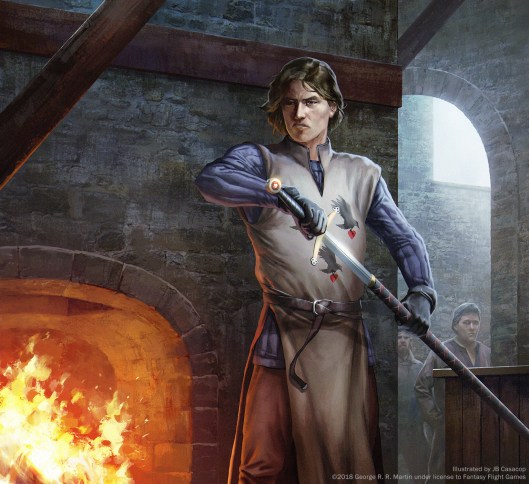
Jon Snow by Constantine Marin

Written before the release of the Alayne sample chapter from The Winds of Winter, the following essay is a provocative and detailed examination of the relationship between Sansa Stark and Jon Snow, two characters that we have seen grow and develop in significant ways throughout the series, with Martin establishing their leadership capabilities and commitment to the well-being of those under their care. Despite never interacting on the page up to this point in the narrative, Martin has been careful to suggest the ways in which Sansa draws inspiration from her older relative, and both are poised to undergo important transformations that involve (re)claiming their true identities.

As all worthwhile analyses should, this one stands the test of time, and it is quite revealing to explore how Martin extends some of the mythological allusions around Sansa that the essay outlined after we meet her again as Alayne in TWOW. When she ventures into the vaults to find Petyr Baelish, it can be read as a symbolic descent into the underworld as a Persephone figure, where Littlefinger offers ambiguous reassurance that “the night belongs to you, sweetling, remember that, always.” It is a tantalising quote that may allude more to Sansa’s upcoming role as winter descends upon Westeros rather than her mere stimulating experience at the tourney feast. Furthermore, Littlefinger is seeking to hoard food as the winter approaches, using the Stark words in a moment of bitter irony as he tells Lords Grafton and Belmore “winter is coming” in order to justify his plans. In fitting with the entire LF/Sansa dynamic, this is a perversion of the myth as it is Persephone’s emergence from the underworld that causes the earth to bear fruit again. All things considered, we can expect that LF’s attempts at entrapment and control will ultimately fail. Sansa’s connection to her Stark identity is continually reasserted in the sample chapter through her thoughts and memories, and if the night truly belongs to her as Littlefinger promises, it could prove to be much longer and deadlier for those who have betrayed the Starks of Winterfell.

Jon Snow*

by Tze

Sansa and Jon are, as far as I can tell, the only two Starks we never actually see interact in “present” time, and I don’t think that’s a coincidence from a literary standpoint. Everything we know of their past interactions comes via someone’s reminiscences, so each is present in the other’s life, but only in the past, never in the present. If Jon and Sansa meet in the future, it will doubtless come across to readers, in a very real way, as their very first meeting. Given the changes they’ve both undergone since their last meeting, that type of dynamic makes a certain amount of literary sense.

At the beginning of the series, Jon and Sansa seemed to sit at two opposite ends of the “Stark” children’s cultural spectrum: Sansa is viewed by other characters as the most culturally “southern” of the children, (and she did initially seem to value “southern” courtly culture more than Northern culture), while Jon is viewed as the most culturally “Northern” of the Starks because he does not associate with southern-based institutions. Sansa was the Stark child most heavily and explicitly associated with the Faith of the Seven (she was always with her septa and she’s the Stark child we see actually worshiping in the sept the most), while Jon was, at the beginning of the series, the most heavily associated with the Old Gods (given that he’s the only one of the children who does not keep the Faith at all, not to mention Ghost’s physical resemblance to a weirwood tree). Of the boys, Jon looks the most like Ned, while Sansa looks the most (out of the girls) like Catelyn—superficially, readers were encouraged, in the beginning, to associate Sansa and Jon with two different “regions”, one with the South and one with the North.

In AGOT, Sansa and Jon occupied two very different, inherently non-overlapping worlds, and each person’s understanding of how “the world” worked implicitly contained no real “place” for the other. By that I mean: Jon loved to fight, occupied a world in which fighting was the primary activity, and at the beginning had a great deal of difficulty interacting with people incapable of fighting. Look at his initial attitude toward Tyrion as well as the other Watch recruits, for example. Sansa is the one Stark child inherently incapable of fighting. She loved knitting, dancing, listening to singers, things that Jon had no use for—there was no room for Sansa in Jon’s “world”.

And Sansa’s “world” contained no real “place” for Jon. She believed that knighthood and its accompanying (southern) chivalric code were the celebrated foundations of the world, and interpreted everything she saw through that cultural lens. Sansa knew her “world of chivalry” clearly viewed a bastard like Jon with suspicion, and because of that, I think Sansa probably had difficulty holding what seemed like two contradictory notions in her head: on the one hand, Jon was her brother, raised along with her and someone she never seemed to have any open conflicts with (unlike Arya, for example), and on the other hand, as the occupier of a “place” (bastard) that her social code condemned.

Now, I think it’s worth noting that, although bastards have far lesser status in Westerosi society, there are “places” that can be carved out for them nonetheless, especially for paternally-acknowledged highborn bastards like Jon: we’re told that bastards have served in the Kingsguard, a bastard (Sam Stone) serves as Master-At-Arms for House Royce of Runestone, a bastard ends up on Cersei’s Small Council, at least one bastard served as Hand of the King, bastards freely join the Citadel and the Faith, etc., etc. But the issue with Jon is that Sansa, during AGOT, pretty clearly viewed knighthood as the central aspect of a man’s worth. To “properly” occupy an honored place in “Sansa’s world”, Jon would have to first be a knight—not just a fighter, but an actual anointed knight, with all of the accompanying chivalric duties and responsibilities. (Look at how she thinks about Jory vs. how she thinks of Alyn in AGOT for an illustration of this.) Jon clearly had the fighting ability to attain knighthood, but unlike the other Starks, he has never kept the Seven at all. Knighthood was never a real possibility for him, as it was for Robb/Bran/Rickon, and presumably Sansa recognized that. I think it was difficult for her, especially early on, to really find a positive place for Jon in her understanding of the world, because he obviously couldn’t be a septon, he couldn’t join the Citadel (she would have recognized Jon wasn’t exactly a bookworm), he was not in line for lordship, and he wasn’t going to be a knight . . . but deep down she loved him nonetheless. So what was he? Where did he fit? How could she believe that knighthood and chivalry were the cornerstones of her society while simultaneously having a relationship with her non-knight bastard brother? I think this is why Sansa was, in the beginning, so very, very keen on pointing out Jon’s exact relationship to her: her half-brother, a bastard. I think deep down Jon really confused her, and this was her way of repeatedly clarifying to herself exactly who Jon was, of seeking a measure of control over a relationship that must have confuzzled her greatly, because its very existence contradicted her understanding of how the world was supposed to work.

Because while Jon and Sansa seemed to have the most “distant” relationship of the Stark children, it’s pretty clear that Jon and Sansa did always love each other deep down. At the Wall, Jon mentioned that he missed Sansa. In ADWD, when he thinks of his lost siblings, right before he starts making plans to head to Winterfell, an image of Sansa brushing Lady’s coat and singing is included. And even in AGOT, though Sansa rarely thought about Jon, when he did enter her thoughts we saw her seem to subconsciously want Jon to occupy a “positive” position in her understanding of the world order. We know from Jon that Sansa tried to teach him how to talk to girls, and though he mentions that she always called him her “half”-brother, there’s no indication she tried to ignore or insult him, as other trueborn children might have done to a bastard. Her love for him was clearly not as “free” as Arya’s love for him was—Sansa’s world of chivalry and knighthood was a stumbling block to such a relationship, so it’s easy for readers to overlook that she did love him. But even in AGOT, look at her reaction to Yoren:

She had always imagined the Night’s Watch to be men like Uncle Benjen. In the songs, they were called the black knights of the Wall. But this man had been crookbacked and hideous, and he looked as though he might have lice. If this was what the Night’s Watch was truly like, she felt sorry for her bastard half-brother, Jon.

It’s easy for readers to focus on her calling Jon her “bastard half-brother” here, but if we look a little deeper, we notice how she also thinks to herself that the singers called the Watch “the black knights of the Wall”. This is important because we know what a huge premium Sansa was putting on the idea of knighthood. Though religion seemingly prevents Jon from attaining knighthood, Sansa seemed to subconsciously look for a loophole there, and found one in the songs: her beloved singers could “grant” Jon a sort of honorary knighthood as a member of the Watch, so that is the route her thoughts took.

(And here we also see that Jon and Sansa, though superficially incredibly divergent, actually did look at the world in somewhat similar ways: each believed in the stories and songs, in honor–just different stories and different methods of honor. Each believed Benjen Stark was the prototypical Watchman. Jon believed all Watchmen were true and honorable, Sansa believed all knights were true and honorable. They each had specific ideas about how a specific place was supposed to be (the Wall and the South), and each of them had those ideas dashed by reality.)

As ASOIAF has progressed, we’ve seen Jon and Sansa slip into each other’s roles, into each other’s shoes. Jon becomes a Lord in ASOS, the same book in which Sansa ceases “being” a Lady. Robb disinherited Sansa at the same time (if the will says what many suspect it does) that he declared he wanted Jon to inherit. Becoming Alayne meant Sansa became a bastard, just like Jon, (and Jon could very well have been declared trueborn by Robb’s will, which would mean that Sansa “became” a bastard and Jon “became” a trueborn Stark). Sansa began her story by loving singers, and has progressed toward disliking them (Marillion), while Jon initially seemed to have no use for singers . . . until he met the singer Mance Rayder. The Littlefinger/Lysa/Sansa dynamic played out almost as a vicious, over-the-top caricature of the Ned/Catelyn/Jon dynamic, with Sansa forced to literally stand in a (heavily skewed and sensationalized) version of Jon’s shoes: Catelyn saw Jon as a living representation of another woman that she feared Ned loved more than her, and Lysa saw Sansa as a living representation of Catelyn, the woman that Lysa (rightly) feared Littlefinger loved more than her. Sansa seemed to have a much closer relationship with her mother than with her father (the exact opposite of Jon), but “Alayne” had a much “closer” relationship with Littlefinger than with Lysa—Sansa takes on with Littlefinger (a much skeevier version of) the relatively close father/child relationship that Jon had with Ned.

In her final chapter of AFFC, Sansa thinks to herself:

She had not thought of Jon in ages.

Or so Sansa tells herself. But I think there’s a pretty good chance Sansa had actually been subconsciously thinking about Jon ever since she took on the Alayne Stone identity, because Sansa seems to be subconsciously patterning her “Alayne Stone” persona around Jon Snow. Sansa wants “Alayne” to be 14 years old, because “She had decided that Alayne Stone should be older than Sansa Stark”. How old was Jon the last time Sansa saw him? 14 years old. She becomes worried at the prospect of dancing, because she seems to think that, for some unexplained reason, Alayne Stone might not enjoy dancing:

What would she do when the music began to play? It was a vexing question, to which her heart and head gave different answers. Sansa loved to dance, but Alayne…

Dancing is a pretty popular activity among women of all social classes and we know it’s an activity very close to Sansa’s heart, given that she was able to dance even at her own terrible wedding. But then in ADWD we discover that Jon does not appear to enjoy dancing—he refuses to dance with Alys, and Alys teases him about it when she brings up previous dances they were forced to dance together at Winterfell. If Sansa is subconsciously patterning “Alayne” on Jon Snow, then the fact that she’s concerned that Alayne might not enjoy dancing makes quite a bit of sense, given that Jon’s apparent dislike of dancing seems like the sort of thing Sansa would have picked up on. (In other words, if “Alayne” is patterned after Jon Snow, then the “real” reason Sansa fears Alayne won’t like dancing is because Sansa knows Jon, on whom Alayne is molded, dislikes dancing.) Sansa thinks of Alayne as “bastard-brave”, and since she barely knows Mya, what bastard does Sansa want Alayne to be as brave as? The obvious answer is Jon. And we see “Alayne” take on the type of caregiver role with Sweetrobin that the other Stark children (Bran and Arya, especially) seem to have associated with Jon, a role that Sansa herself seemed to take on with people like Beth Cassel and Jeyne Poole in Winterfell, but not with her own younger siblings.

He was only her half-brother, but still… with Robb and Bran and Rickon dead, Jon Snow was the only brother that remained to her. I am a bastard too now, just like him. Oh, it would be so sweet, to see him once again.

This is Sansa’s thought process once Myranda Royce tells her about Jon’s new position as Lord Commander of the Watch. If I’m correct and she’s had Jon on the brain throughout AFFC, then this right here actually serves as a breakthrough for her, because Sansa goes from subconsciously longing for Jon to explicitly longing for Jon. And her thought process here is a pretty useful distillation of how far Sansa’s come from AGOT, a semi-culmination of her ideological journey thus far: the main issues she once had with Jon—that he was a bastard, that he didn’t “fit” the world of knights and chivalry that Sansa loved—have been essentially nullified. She starts out with the “old” Sansa’s thought patterns (“He was only her half-brother”), but then she immediately (and pretty substantially) switches gears and starts openly longing to see Jon again, expressly thinking about how she’s now a bastard too. The ideological barriers between them are basically gone.

Indeed, Sansa’s entire arc had been bringing her closer and closer, ideologically, to the forces (winter, the North, and the Old Gods) represented by Jon. Sansa started out in AGOT preferring the Faith of the Seven, loving knighthood, loving the south, and losing her direwolf. By AFFC, we see her (far) more heavily associated with the Old Gods, favoring a non-knight (the Hound), and in an overall sense, switching gears from the epitomization of a “summer’s child” to (IMO) someone on the path to becoming a “winter’s child”. Jon and Sansa become the Starks who we see most heavily drawing their inner strength from the cold and the snow: Jon mentions on more than one occasion that Ghost loves the snow, we see Jon frequently seeking out the cold (not the heat) at the Wall. We see Sansa literally drawing strength from the snow and the cold at the Eyrie. In the beginning of AGOT, Sansa wanted only to be a queen in the hot south. By AFFC, we see her building a scale model of Winterfell and drawing spiritual strength from the forces of winter.

Given the way Sansa seems to have been sliding more and more “toward” Jon as her arc has progressed—given the way her arc has been bringing her closer to him both ideologically and thematically—I wonder what implications Jon’s stabbing (and the potential future that stabbing could bring for him) have for Sansa’s future. Because the myth of Persephone looms large over both Jon and Sansa, and given what happened to Jon at the end of ADWD, I’m very, very curious what GRRM has in store for Sansa’s arc, especially now that winter has come.

Both Jon and Sansa encounter “the pomegranate”: Sansa is offered a literal pomegranate by Littlefinger, while Jon’s rulership arc in ADWD was confronted at every turn by the Old Pomegranate, Bowen Marsh. The pomegranate, in Greek mythology, is what causes Persephone to become Queen of the Dead in perpetuity, and it’s the reason winter comes in the first place—winter, in Greek mythology, being viewed as Demeter’s grief at her separation from her daughter when Persephone descends every year to rule in the Underworld. The pomegrante causes Persephone to undertake two disparate roles, to become a creature of two separate worlds: she is both the Goddess of Spring and the Queen of the Underworld simultaneously (and concurrently), she rules in both the sunlight and the darkness. That idea—of a person moving between two contradictory spheres of existence, of a person gaining strength by a capacity to move between the darkness and the light—is a theme GRRM has played around with in other works, so there’s an excellent chance he’s exploring it in ASOIAF as well.

Both Jon and Sansa choose to reject “the pomegranate”: Jon rejects the Old Pomegranate’s demands for the future of the Watch, Sansa rejects Littlefinger’s attempt to have her eat an actual pomegranate. But look at what happened to Jon in ADWD: he refused to acquiese to the Old Pomegranate’s wishes, but the Old Pomegranate would not quietly accept rejection, choosing to physically attack him: there’s been a lot of speculation on these boards that the attack on Jon will lead to some death-based transformation, that he (like Persephone) might find himself transformed (and possibly occupying a new leadership role) because of the Old Pomegranate. GRRM apparently had some Sansa chapters prepared for ADWD, but he pushed them back to TWOW. I’m very curious about what those chapters contained.

Because winter has now come, and in winter, Persephone rules over the dead. Sansa’s arc has tracked Persephone in some pretty substantial ways: at the beginning of AGOT, when summer was in swing, she was the Stark most heavily associated with the warmth and frivolity of the South, just as Persephone was the flower-loving Goddess of Spring; Sansa was forced to marry, against her will, a man heavily associated with worldly wealth (in Greek mythology, Hades is associated with wealth because gold, silver, and jewels are drawn from beneath the ground, and Hades of course rules the Underworld). As winter approaches, Sansa loses her childlike innocence and naivete. And winter has now hit Westeros, and will presumably hit with a vengeance during TWOW—so what will Sansa become in the winter? Where winter is a time of imprisonment for Persephone, with spring/summer freeing her to walk the warm world above, it seems that summer was a time of imprisonment for Sansa, and winter might end up freeing her. And the story of Persephone ends with Persephone holding dominion over the dead during the winter. This might be a hint toward our pomegranate-associated characters’ future, especially given the heavy associations both Jon and Sansa have with the living dead. (With Jon, those associations are obvious—he’s a living man who wears black, his direwolf is named Ghost, he’s fighting wights. With Sansa, the associations are less obvious but no less profound: Sansa’s direwolf is dead (and since the Starks “are” their direwolves, Sansa is both alive and dead simultaneously because part of her is dead while part of her lives on), Littlefinger associates her with Catelyn reborn (and Catelyn has literally become the walking dead), not to mention the Hound: “The Hound is dead” we are told, and this “dead man” of course hated fire—I doubt it’s a coincidence that this description of the Hound, as a walking dead man who hates fire, sounds quite a bit like a wight.)

And then there’s this bit from AFFC:

All around was empty air and sky, the ground falling away sharply to either side. There was ice underfoot, and broken stones just waiting to turn an ankle, and the wind was howling fiercely. It sounds like a wolf, thought Sansa. A ghost wolf, big as mountains.

It’s easy to forget sometimes that AFFC and ADWD were originally meant to be one super-book. Could Sansa have been “sensing” Jon’s “death” here? Is the “ghost wolf” Ghost? Or is there a hint here for Sansa herself? She’s become a Stone, and she’s been told that a stone is a mountain’s daughter. The cold winds are howling, and she thinks the cold winds are becoming a ghost wolf—is Sansa, she of the dead direwolf, en route to her own eventual death and resurrection?

(*Originally published in Pawn to Player as part of our Male Influences project.)

A Closer Look at Ser Lyn Corbray

Tags

, , ,

lyncorbray

Lyn Corbray and Lady Forlorn by JB Casacop


An unpredictable figure in Vale politics since we first glimpse him at the Eyrie during Tyrion’s trial, Ser Lyn Corbray is one of Martin’s more interesting minor characters who looks set to play a prominent role in Sansa’s plotline during The Winds of Winter. As the following analysis into the man will bear out, Martin has been quite consistent in his characterisation of Ser Lyn, presenting him to readers as ruthlessly ambitious, audacious to the point of recklessness, and proud. Importantly, we see that Sansa gains insight into Lyn’s increasing frustration with his secret partnership with Petyr Baelish that has not resulted in him gaining a lordship and lands. How she can use this knowledge to her advantage and how Lyn’s volatile nature might throw Littlefinger’s plans into disarray are intriguing points to consider as we look ahead to the next book.

What are your theories on the role Ser Lyn will play in TWOW?


The Ultimate Ser Lyn Corbray collection*

by Lyanna Stark

Ser Lyn is peculiarly placed in the TWOW spoiler chapter, and while there have been some posts on him before, we haven’t spent a lot of the Sansa pages discussing him. However, he seems to have a more and more prominent position in Sansa’s storyline and may be worth an extra look.

Part 1: AGOT-AFFC

Our first introduction to Corbray is from Tyrion, who describes him as early on as before his Trial at the Eyrie. The words he used are “slender as a sword”.

Later, we get some choice words from Corbray, which could be potentially interesting:

The gods favour the man with the just cause,” said Ser Lyn Corbray, “yet often that turns out to be the man with the surest sword. We all know who that is.” He smiled modestly.

Well. Very modest man indeed, Ser Lyn.

The next time we see Ser Lyn, Lysa is eating a blackberry off his dagger. Catelyn comments on his unsuitability as a suitor to Lysa:

Catelyn was hard-pressed to say which man was more unsuitable. Eon Hunter was even older than Jon Arryn had been, half crippled by gout, and cursed by three quarrelsome sons, each more grasping than the last. Ser Lyn was a different sort of folly; lean and handsome, heir to an ancient but impoverished house, but vain, reckless, hot-tempered… and, it was whispered, notoriously uninterested in the charms of women.

So Cat knows which way Lyn swings, but unlike Littlefinger she does not reference “boys”, just that he is uninterested in the charms of women.

Ser Lyn also comments on Tyrion’s trial that first he’ll have a trial, and then an execution, as if it was a done thing. He is also the one who gets to usher Tyrion out the Bloody Gate and is then described as “stone faced”.

In AFFC, we get Nestor Royce and Littlefinger in a conversation where Nestor comments that Lyn Corbray is a dangerous man and Littlefinger says that Ser Lyn has taken a dislike to him, but that he will still be invited to the Eyrie. Initially, Littlefinger even describes Ser Lyn as “some Corbrays” he invited. It’s only when Nestor enquires that he specifies it is Ser Lyn.

Another man who views Ser Lyn as dangerous is Kevan Lannister, who talks about it in a meeting of Lannisters in King’s Landing. If Kevan thinks Ser Lyn is dangerous, it means Tywin thinks he is, too, since as Tyrion says, Kevan hasn’t had a thought that Tywin didn’t think first. Kevan discusses with Tyrion, Cersei and Tywin that Littlefinger has agreed to woo lady Lysa and to become the Protector of the Vale, effectively queue-jumping Ser Lyn Corbray, Horton Redfort and Bronze Yohn Royce, which are all mentioned and labelled “dangerous men, all in their own way, and proud”.

Littlefinger later comments in AFFC specifically on Lyn Corbray:

Ser Lyn is not the sort of man to stay away when blood is in the offing.

This does not soothe Sansa’s fears, and she reflects that Ser Lyn has killed as many men in duels as he has in battle. We also know that Lyn Corbray cut down Prince Lewyn Martell of Dorne, although the prince was said to have been badly wounded already. Littlefinger cautions Sansa against mentioning this though.

“That’s not a point you’ll want to raise with Corbray, though. Those who do are soon given the chance to ask Martell himself the truth of it, down in the halls of hell.”

Littlefinger then goes on to explain that while Lyonel Corbray is swayed to Littlefinger’s side,  Ser Lyn goes his own way independent of his older brother. Then we get an interesting commentary on how Lyonel spent his energy on saving his father while Ser Lyn picked up the sword Lady Forlorn and went on killing. Littlefinger continues with some comments on how Ser Lyn feels about his brother Lyonel.

 “… whilst Ser Lyn… well, he loves Lyonel as much as he loves me. He wanted Lysa’s hand for himself.”

Sweetrobin then confesses to not liking Ser Lyn and that he does not want to have him in the Eyrie. In AFFC, we get Sansa’s description of Ser Lyn as he comes up to the Eyrie with the Lords Declarant:

The youngest man in the party had three ravens on his chest, each clutching a blood-red heart in its talons. His brown hair was shoulder length; one stray lock curled down across his forehead. Ser Lyn Corbray, Alayne thought, with a wary glance at his hard mouth and restless eyes.

When Bronze Yohn seems to at first recognise Alayne as Sansa, and when she is then explained to be Littlefinger’s bastard daughter, Ser Lyn shows himself as being quite rude and uncouth.

“Littlefinger’s little finger has been busy,” said Lyn Corbray, with a wicked smile.

Lady Waynwood asks how old Alayne is, and gets the reply that she is four-and-ten, and not a child but “a maiden flowered”, at which point Lord Hunter (one of the younger ones now who helped off the father) comments that she’s hopefully not deflowered.

“Yet,” said Lyn Corbray, as if she were not there. “But ripe for the plucking soon, I’d say.”

Lady Waynwood then tells Corbray that he is being rude and to mind his tongue.

“My tongue is my concern,” Corbray replied. “Your ladyship should take care to mind her own. I have never taken kindly to chastisement, as any number of dead men can tell you.”

When the Lords Declarant file into the Eyrie solar, they all sit side by side, apart from Nestor Royce who sits down closer to Littlefinger and Lyn Corbray who goes to stand beside the hearth instead. Sansa observes him.

Alayne saw him smile at Lothor Brune. Ser Lyn is very handsome for an older man, she thought, but I do not like the way he smiles.

When Littlefinger suggests that the Lords Grafton and Lynderly send him their sons as wards to be fostered with Sweetrobin, Ser Lyn seems dismissive.

Lyn Corbray laughed. “Two pups from a pair of lapdogs.”

When Bronze Yohn Royce sets the ultimatum that they will have Lord Sweetrobin or else, it seems they reached an impasse in the negotiations. However, this is when Corbray makes his move.

For a moment it seemed as though they had come to an impasse, until Lyn Corbray turned from the fire.

“All this talk makes me ill. Littlefinger will talk you out of your smallclothes if you let him long enough. The only way to settle his sort is with steel.” He drew his longsword.
Petyr spread his hands. “I wear no sword, ser.”
“Easily remedied.” Candlelight rippled along the smoke-grey blade of Corbray’s blade, so dark it put Sansa in mind of Ice, her father’s greatsword. “Your apple-eater holds a blade. Tell him to give it to you, or draw your dagger.”
She saw Lothor Brune reach for his own sword, but before the blades could meet Bronze Yohn rose in wrath. “Put up your steel ser! Are you a Corbray or are you a Frey? We are guests here.”
Lady Waynwood pursed her lips, and said, “This is unseemly”.
“Sheathe your sword Corbray,”  Young Lord Hunter echoed, “you shame us all with this”.
“Come, Lyn,” chided Redfort in a softer tone. “This will serve for naught. Put Lady Forlorn to bed.”
“My lady has a thirst,” Ser Lyn insisted. “Whenever she comes out to dance, she likes a drop of red.”
“Your lady must go thirsty.” Bronze Yohn put himself squarely in Corbray’s path.
“The Lords Declarant.” Lyn Corbray snorted. “You should have named yourself the Six Old Women.
He slid the dark sword back into its scabbard and left them, shouldering Brune aside as if he were not there. Alayne listened to his footsteps recede.

Overall, Cat’s initial assessment of Ser Lyn seems correct. He comes across as vain, reckless and hot-tempered.

Part 2: TWOW Alayne spoiler chapter

Alayne/Sansa spots two men fighting in the yard and when she notices three ravens clutching three red hearts, she knew how the fight would end. When Lyn Corbray beats his opponent we get a brief description of how it happened.

If the swords had not been blunted, there would be brains as well. That last head blow had been so hard Alayne had winced in sympathy when it fell.

Interesting to note perhaps that Ser Lyn beat his opponent by striking at his head. Armoured, to be sure, and with blunted swords or “there would have been brains”, but it’s potentially interesting to compare to how Sandor did not strike at his brother’s head back in AGOT. Not particularly chivalrous, our Ser Lyn.

Myranda then comments:

Do you think if I asked nicely Ser Lyn would kill my suitors for me?
“He might, for a plump bag of gold.” Ser Lyn Corbray was forever desperately short of coin, all the Vale knew that.

What looks humorous at first glance takes on a bit of an ominous tone when looked at further. Myranda doesn’t have any serious suitors at present and she said it flippantly enough, but Alayne might have one that Lyn could potentially kill if he tried to. Harry is described as not particularly skilled. This could mean potentially bad news for Harrold Hardyng.

Myranda goes on to comment on what Cat had heard whispered.

“Alas, all I have is a plump pair of teats. Though with Ser Lyn, a plump sausage under my skirts would serve me better.”

Randa confirms here what we sort of already knew about which way Ser Lyn swings, although again, no mention of “boys” and “plump sausage” seems to indicate it’s men he prefers, not boys, perhaps giving the lie to Littlefinger’s words (and it wouldn’t be the first time either). And you know, Randa’s humour is incorrigible. It is rather nice that Sansa who previously was such a little proper lady finds this amusing, though, and their giggles alert Ser Lyn to their presence.

Alayne’s giggle drew Corbray’s attention. He handed his shield to his loutish squire, removed his helm and quilted coif.  “Ladies.” His long brown hair was plastered to his brow by sweat.
“Well struck, Ser Lyn,” Alayne called out. “Though I fear you’ve knocked poor Ser Owen insensible.”
Corbray glanced back to where his foe was being helped from the yard by his squire. “He had no sense to start with, or he should not have tried me.”

Alayne reflects that he speaks the truth, but really he is also very smug here. not unlike his “modest” smile in Tyrion’s AGOT chapter where he likes to tell people about his mad fighting skillz. He also seems to have acquired a loutish squire as a replacement for Mychel Redfort, who was his squire in AGOT (as referenced in Cat’s climb to the Eyrie chapter).

But! Alayne-Sansa shows she is not a meek little lady anymore, but decides to poke and prod Ser Lyn a bit, and we get an interesting tidbit on just how volatile and unstable Ser Lyn’s loyalties to LF may be.

There is truth in that, Alayne thought, but some demon of mischief was in her that morning, so she gave Ser Lyn a thrust of her own. Smiling sweetly, she said, “My lord father tells me your brother’s new wife is with child.”

Corbray gave her a dark look. “Lyonel sends his regrets. He remains at Heart’s Home with his peddler’s daughter, watching her belly swell as if he were the first man who ever got a wench pregnant.”

Oh, that’s an open wound, thought Alayne. Lyonel Corbray’s first wife had given him nothing but a frail, sickly babe who died in infancy, and during all those years Ser Lyn had remained his brother’s heir. When the poor woman finally died, however, Petyr Baelish had stepped in and brokered a new marriage for Lord Corbray. The second Lady Corbray was sixteen, the daughter of a wealthy Gulltown merchant, but she had come with an immense dowry, and men said she was a tall, strapping, healthy girl, with big breasts and good, wide hips. And fertile too, it seems.

Alayne’s barb here is described as a “thrust,” as if she was fencing with Ser Lyn and managed to score a hit. She may also have realised something that LF did not regarding how pissed off this has made Ser Lyn. Clearly, despite him not fancying women and being a younger son, he was used to being heir to his house, does not like his brother and did definitely not like being bumped down the list of heirs.

Alayne could not help herself. She smiled and said, “My father is always pleased to be of service to one of Lord Robert’s leal bannermen. I’m sure he would be most delighted to help broker a marriage for you as well, Ser Lyn.”

How kind of him.” Corbray’s lips drew back in something that might have been meant as a smile, though it gave Alayne a chill. “But what need have I for heirs when I am landless and like to remain so, thanks to our Lord Protector?  No.  Tell your lord father I need none of his brood mares.

Yes, he is landless and like to remain so thanks to our lovely Lord Petyr. Ser Lyn is not keen on any lowly broodmares, he had his sights set higher. (This makes me wonder a bit if, should Ser Shadrich tell Ser Lyn about who Alayne really is, perhaps he won’t abduct her to “sell” her to Freys or Lannisters or Tyrells, perhaps he would try and hold her as a future bride as Sansa Stark is very high-ranking and comes with a potential Winterfell dowry. Quite a nice prize for Ser Lyn, no? Despite being a sausage fan.) Here he is definitely mostly pissed at Littlefinger, though.

The venom in his voice was so thick that for a moment she almost forgot that Lyn Corbray was actually her father’s catspaw, bought and paid for. Or was he?  Perhaps, instead of being Petyr’s man pretending to be Petyr’s foe, he was actually his foe pretending to be his man pretending to be his foe.

Just thinking about it was enough to make her head spin. Alayne turned abruptly from the yard… and bumped into a short, sharp-faced man with a brush of orange hair who had come up behind her.  

And here Sansa starts to see that Ser Lyn might be bought and paid for once, but given what has happened with LF brokering the marriage for his brother and bumping him down the line, he is no longer an ally pretending to be a foe, he is actually genuinely not an ally anymore, or at least nobody they can trust.

When she realises Lyn is a loose cannon ready to blow… in steps Ser Shadrich, as on demand. So we have “Ser Lyn’s allegiance is not certain” linked to “… and in steps Ser Shadrich, who just happens to be looking for Sansa”.

I’m thinking whichever way this goes, it doesn’t look like good news. The only really good part is that Sansa has herself figured out that Ser Lyn is no longer in LF’s pocket and cannot be relied on to act as an ally.

Other random strange things: When she first spots Ser Lyn, she describes his shield with hearts and ravens, and the this comes in italics.

Three hearts and three ravens.

Just randomly ominous, or a reference to Bloodraven? I also thought of Maester Aemon’s speech to Jon on Ravens and doves and getting your hands bloody.

Further, we also don’t see Ser Lyn referenced as attending the feast where Sansa/Alayne dances with Harry the Heir. Does she not notice him? (Seem strange) Or is he making himself scarce?

The “do you think he would kill my suitor for me if I asked” comment really stands out as very much potential ouch, especially as Sansa wishes for Harry to fail and fall and be embarrassed. She doesn’t wish him dead, but then as we’ve seen before, Lady Forlorn likes some red once she is drawn, no? “My lady has a thirst”.

Ser Lyn also thinks his opponent is an idiot for fighting him, and we see that LF et al. think Harry the Heir is not a very good fighter and that he is an idiot to try the tourney, but that Bronze Yohn Royce allowed it anyway because he is honourable. Is Harry also going to be an idiot and fight Lyn Corbray? Should Sansa give Corbray her favour, he would feel compelled to do so.

It’s rather interesting to draw parallels to other fighting men Sansa has encountered during her travels and travails in the Seven Kingdoms. I’m thinking Ser Loras and Sandor Clegane primarily, perhaps, as she’s seen them fight in a previous tourney. We know Sandor was dismissive of the Tourney of Gnats, but in general he seems to not really do duels and while he speaks gruffly, he certainly doesn’t as a rule go around threatening old ladies to shut it up or murderdeathkill. Sandor is a younger son who hates his older brother, but we don’t see the vanity and the same ambition in him. While a brutally efficient killer, he doesn’t seem to go out of his way to kill people unless needed. He also lacks Ser Lyn’s pretty looks and “sword thin” physique.

Ser Loras is a hot-headed youth, and like Corbray good-looking (and he happens to swing the same way), but I actually think Loras is less vain and prideful. He is also a younger son, but genuinely likes his older brothers and fights for them. When faced with Brienne in King’s Landing and how he probably killed his Kingsguard brothers for nothing, he is remorseful and not proud, prickly or vain.

*(originally published in Pawn to Player as part of our Male Influences project)

Murder as a plot device and its impact on bias

Tags

, , , ,

bubug

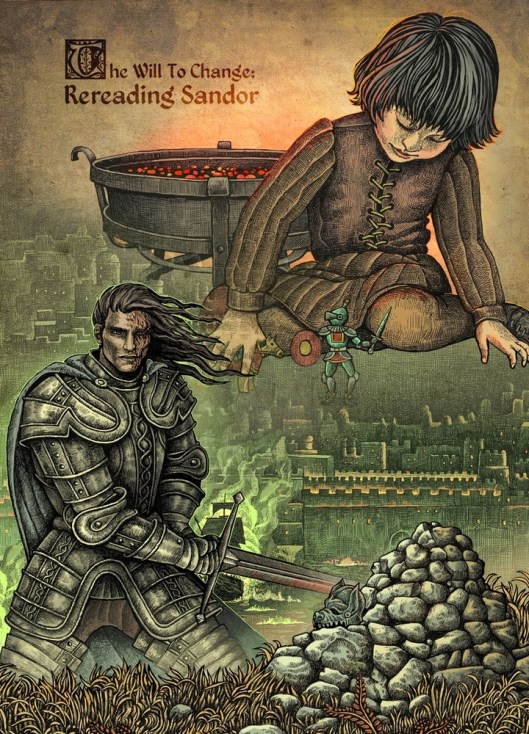
Official poster by the artist Bubug for the Rereading Sandor project 

In 2015, Pawn to Player embarked on another major reread project, this time centred on Sandor Clegane, aka the Hound, who plays a prominent role in the narrative and character development of the two Stark sisters, Sansa and Arya. The project was conducted at the Westeros.org forum, and led by our resident Sandor expert Milady of York, whose essay we are featuring below.  Joining in the project as co-hosts were myself and PTP member Doglover. As outlined in the introduction to our examination of the Hound’s character:

In starting this reread, our central preoccupation is with discussing Sandor on his own terms and for his own sake. By this we mean to establish the authority of Sandor’s viewpoint: delving inside the man’s unique characteristics, the conflicts, the controversies and, of course, the connections he is able to foster with others. We fundamentally believe that while the Hound may be dead, Sandor Clegane is still alive, and still has a significant part to play in how the rest of the drama unfolds in Martin’s fantasy epic. The Will to Change is concerned with his personal journey, with looking at the experiences that have defined the man we meet, but also at the ones that eventually challenge and transform him.

It’s taken a while, but we’ve finally uploaded our Sandor reread summaries and analyses here at the blog for readers to easily access (see top menu). There’s a wealth of valuable insight contained in this material, pertaining to the central POV characters that Sandor interacts with, and crucially, for anyone interested in a deeper understanding of the man himself, who occupies pride of place as one of Martin’s most vivid and memorable secondary character portrayals. An examination of the infamous non-knight elucidates core themes of the ASOIAF universe and challenges readers to reassess our first impressions and biases, leading to a greater appreciation for the complexity of human nature and interaction that make the series such a hallmark of the fantasy genre.

The following essay was completed as part of the Rereading Sandor project, written as a “Featured Commentary” in the A Game of Thrones section.  It offers very relevant insight into how child murder functions as a mechanism to elicit varying reactions and degrees of empathy from readers, via our identification with the victims of the crime, and how it factors into the redemptive arcs of the perpetrators of these violent acts in different ways. We hope you enjoy reading it and welcome your feedback.


FEATURED COMMENTARY:

Murder as a plot device and its impact on bias

To the extent that I’ve been able to make the characters real, people invest in them emotionally, they identify with them, and they like or dislike other of the characters. They argue about them—I find that very gratifying. It’s one of the things that suggests to me that what I’m doing with the characters is working. When I hear from different fans who have varying opinions about a character, about who’s a good guy and who’s a bad guy, and who they’d like to live and who they’d like to die—it’s not always the expected ones, and they disagree sharply with each other. That’s a good sign. In real life, people don’t always like the same people. People make moral judgments that differ sharply with each other—witness some of the arguments we see going on about the current election. People should respond to fictional characters in the same way. If you introduce a character who everybody loves, or who everybody hates, that’s probably a sign that that character’s a little too one-dimensional, because in real life there’s no one that everybody loves, and there’s no one that everybody hates.

—— George R. R. Martin, in an interview

by Milady of York

When discussing personal change-based arcs in ASOIAF like those of Sandor, Jaime and Theon, the most divisive topic is probably that of child-killing. In broad strokes, the diverging sides will argue either in favour of discernment through attenuating surrounding circumstances and contextual liability, or will argue based on questions of morality and justice that provide cause for impeaching and judging them. However, there’s one factor that doesn’t get discussed as much yet does have considerable influence on the matter on a meta-conscious level, and that does mould people’s opinion to variable extents, wheresoever they may stand.

This factor carries the name of Identifiable Victim Effect that psychologists have given it, and is really more comprehensible than its scholarly-sounding classification tag implies. In fact, some might already know of it from somewhere by name or by description.

A single death is a tragedy; a million deaths is a statistic.”

This phrase mistakenly fastened onto Soviet Union dictator Josef Stalin, but likely from earlier and by someone else, condenses quite well what the Identifiable Victim Effect is and also gives the phenomenon its pop-culture denominator of A Million is a Statistic: it refers to the natural tendency of individuals to sympathise with, defend and offer greater aid when a specific, visible and identifiable person—the “victim”—is observed under hardship, as contrasted to a large, vaguely defined and unseen group of several people undergoing the same hardship, as clinical therapist Rebecca Collins explained it, because of proximity, for these “vivid, flesh and blood-victims are often more powerful sources of persuasion than abstract statistic.”

The same researcher also points out that this doesn’t end at simply empathising with and helping the victim, but is furthermore a two-pronged effect: its other spearpoint is directed at the perpetrator. There’s greater motivation towards doing something to them in the name of the victim, towards defensive attack and punishing, be it verbal or physical, and when the opportunity for punishment appears, then we’re more likely to dispense it, and often more harshly, if/when punishing the specific and identifiable victimiser of an specific and identifiable victim.

This would be due to neurologically imprinted and outwardly nourished cognitive processes shared by all humans. People possess three types of empathy: cognitive empathy, that is to share what the other thinks; then affective empathy, meaning to feel what the other feels too; and finally sympathetic empathy, which is a mix of the former two, conjoined with the impulse to take action and do something. And empathy is a finite quality, it has a limit and a defined breaking point. Such a limit to the ability to empathise is the so-called Dunbar Number effect, explained by anthropologist Robin Dunbar as a psychological phenomenon that restricts the amount of a person’s significant relationships to a certain number (which for him is 150 within a 100-200 range, but others have given different numbers), because the innate ability to handle meaningful and emotionally-fulfilling relationships is less optimal and falters past that limit, as the close network fades into the abstract, crowded mass of people. As a result, the amount of sympathy that death, cruelty, injustice and suffering evoke is inversely proportional to the magnitude of its effects, and it’s our knowledge of the affected person that has the major impact. Paul Slovic, who did some studies to confirm this, calls it “psychic numbing” and declares that the problem with anonymous statistics is that they don’t activate moral emotions, because the mind can’t grasp suffering on such a massive and abstract scale. And so, for example, people can be riveted easily when media show a child suffering, but empathy is turned off when the news talk of thousands of little ones suffering.

Applying this to bias in literature, historically the murder of the innocent and the weak as a vilification method to make the Bad/Evil One out of someone is a very ancient rhetorical technique that seems to have been always there, from the Old Testament to the rousing speeches of Classical playwrights to Shakespeare’s works and the modern examples in any Top Fictional Villains list. Regardless of the evolution of customs and ethics across epochs, victim identification by proximity remains constant for reasons of the stable cognitive traits earlier mentioned, an ages-tested effectiveness that accounts for its extensive employment. To create the perception of a character as a villain—or an anti-hero, depending—in the readership’s mind, or at the very least make a case for interpreting a scene as an indictment of the character as deeply-flawed, the ideal writing device is to have them inflict suffering on and/or kill an innocent. This is quite effective in writing because:

  1. The victim is innocent, an absolutely pivotal component for the effect to be present. Or they must be presumed to be guiltless. And if furthermore they’re defenceless, the intensity of loathing for the perpetrator is higher; which is why little children, women and the crippled are chosen by default.

  2. When the bad act resulting in the death or suffering happens on-page, whether in the perpetrator’s POV or the victim’s, we get to “witness” the act as it unfolds. Generally, this is the best option for maximum emotional impact, both because the character who suffers pain and the character who inflicts it are more memorable, and even when readers don’t necessarily feel what the character feels, the intensity of it intensifies the readers’ own feelings.

  3. Vividness and proximity matter more than magnitude. Due to the victim identification repercussions, how bad the deed is isn’t impactful by itself, for even if it isn’t comparatively as heinous or as sadistic as what happens to other characters in the same story, it will affect the reader nonetheless. For this reason, minor transgressions such as slaps, crude words and the like can matter a lot if directed at the identifiable victim the readers are partial to.

  4. The POV character’s reactions penetrate into the readers and influence their own reactions, often more than the narrative itself. This is especially true in three instances: when the deed is done off-page, because then we only have the POV’s post-facto reaction to build ours on; when the victim is a non-POV, because here it falls on the POV to pass judgement, and whichever path is chosen after the initial shock: vindictiveness, justice, forgiveness, indifference, etc., is likely to be shared by the readers; and finally, when the perpetrator is a non-POV, in which case the possibility of bias is so high as to be a certainty for most cases. Because, as there’s only one version and even when it’s true in essence, not getting to know the perpetrator’s motivations (be it selfish or understandable), essentially creates a deceptive appearance, and we judge the perpetrator’s motives on this apparent “proof.”

The off-stage/non-POV option leaves more room to a writer for subversion than when it happens to be on-stage/POV, which is still possible provided it applies certain counterweight measures. In GRRM’s books, only one of the three cases when a character acquires a villainous reputation through murder of a child occurs in present-time in a POV: the throwing of Bran out the window from the tower at Winterfell in AGOT Bran II:

Bran’s fingers started to slip. He grabbed the ledge with his other hand. Fingernails dug into unyielding stone. The man reached down. “Take my hand,” he said. “Before you fall.”

Bran seized his arm and held on tight with all his strength. The man yanked him up to the ledge. “What are you doing?” the woman demanded.

The man ignored her. He was very strong. He stood Bran up on the sill. “How old are you, boy?”

Seven,” Bran said, shaking with relief. His fingers had dug deep gouges in the man’s forearm. He let go sheepishly.

The man looked over at the woman. “The things I do for love,” he said with loathing. He gave Bran a shove.

Screaming, Bran went backward out the window into empty air. There was nothing to grab on to. The courtyard rushed up to meet him.

Somewhere off in the distance, a wolf was howling. Crows circled the broken tower, waiting for corn.

From this incident, a couple things stand out: On the pro, it’s Bran’s second POV, we already know a fair bit about this boy and what we know is that he’s a sympathetic sweet boy, and facts like that he’s daydreaming about what a great Kingsguard knight he’d wish to be add to the tragedy of being maimed by a Kingsguard knight. On the contra: we don’t have a POV by Jaime, and what we know of him from others is unflattering; plus he willingly and consciously put himself at risk of discovery for engaging in incestuous adultery in a foreign castle. The knowledge of the reasons Jaime had for throwing Bran out the window that comes later is contrasted with the fact that the woman and children he’d be protecting with this crime are also more crimes of his, which makes this a very complex moral issue. To cement the bias, the first version we hear from the guilty duo comes from Cersei, who claims to have never wanted Bran to be thrown, just intimidated into silence, and blames all on Jaime’s impulsiveness. Thus, by the time we get to read about his version, it’s too late to completely revert this perception: we already know fairly accurately what happened and why, we spent two whole books in the victim’s head reading about the painful post-traumatic mourning of the child, we see the consequences of that action blow off, and Jaime’s initial apparent lack of repentance and attempt at latching blame on Bran by insisting the boy wasn’t innocent as he’d been spying on them in his first chapters in ASOS pre-maiming are damning too. In other words, readers are wholly and deeply identified with the child victim. It appears impossible to modify that somehow. Yet it’s done nevertheless through the humanising of Jaime after he loses the hand that caused the paralysis of Bran.

But there’s a catch: having Jaime lose his hand by itself isn’t as effective a tool for reverting the negative perception. Following the principle that the reaction of the POV or victim counts greatly for the readers, Bran’s side of the tale is annulled by means of depriving him of any memory of who did that to him. The fact that Bran doesn’t remember it was Jaime and his weak clues are quickly shooed away by the Three-Eyed Crow make it possible for Jaime to gain in sympathy through his own POV unhindered by a counterbalance POV of his victim. We don’t get to read what Bran’s reaction would be, we can’t be certain whether he’d react with hate or with forgiveness, no idea on how it’d affect him to know. Therefore, authorial plot reasons for erasing Bran’s memory notwithstanding, the end result is that the beneficiary of this writing method was Jaime at the cost of Bran, as his “redemptive” arc in ASOS wouldn’t have had the same impact with Bran’s memory intact. For this reason, it should be interesting to read the child’s thoughts when he finds out whether by recovering his memory or through use of his powers.

Theon’s murder of the two miller’s boys is another interesting study with unique characteristics the other examples don’t possess, that bring it closer to the A Million is a Statistic analogy than the others, because it’s the only one that actually has anonymous victims. Those two boys are faceless and nameless, never glimpsed on-page and not described in detail or called by their names. This is also the only case in which the perpetrator has a POV that reveals in present-time all his emotions and his motivation for the crime, which are selfish and convey revulsion, and also brings to view in-world reactions like Maester Luwin’s quiet distress and Asha’s scorn:

Well, I’m no great warrior like you, brother,” She quaffed half a horn of ale and wiped her mouth with the back of her hand. “I saw the heads above your gates. Tell me true, which one gave you the fiercest fight, the cripple or the babe?”

Theon could feel the blood rushing to his face. He took no joy from those heads, no more than he had in displaying the headless bodies of the children before the castle. Old Nan stood with her soft toothless mouth opening and closing soundlessly, and Farlen threw himself at Theon, snarling like one of his hounds. Urzen and Cadwyl had to beat him senseless with the butts of their spears. How did I come to this? he remembered thinking as he stood over the fly-speckled bodies.

Only Maester Luwin had the stomach to come near. Stone-faced, the small grey man had begged leave to sew the boys’ heads back onto their shoulders, so they might be laid in the crypts below with the other Stark dead.

No,” Theon had told him. “Not the crypts.”

But why, my lord? Surely they cannot harm you now. It is where they belong. All the bones of the Starks—”

I said no.” He needed the heads for the wall, but he had burned the headless bodies that very day, in all their finery. Afterward he had knelt amongst the bones and ashes to retrieve a slag of melted silver and cracked jet, all that remained of the wolf’s-head brooch that had once been Bran’s. He had it still.

I treated Bran and Rickon generously,” he told his sister. “They brought their fate on themselves.”

Yet the miller’s boys still remain a statistic by virtue of their anonymity that precludes emotional investment in them for themselves. This becomes a scenario in which these boys are overshadowed by the two Starks they are passed off as, given that Greyjoy’s other victims—Bran and Rickon—have had enough time on-page for the readership to form an attachment to them and have already endured enough tragedies to elicit sympathy; more importantly: unlike with Jaime, there’s a counterbalance POV from Bran showing the other side, thereby “broadcasting live” what Brandon thinks and feels about the perpetrator he grew up with. Which would account for why Theon’s actions towards the Stark family are more likely to be judged harsher than towards the peasant boys.

In the third case, Sandor, we again have a distinctive feature: both victim and perpetrator are non-POVs, so both are by necessity filtered through the POVs connected to this murder, and therefore readers will absorb the POVs’ reactions to it in absence of reading at least one of the involved viewpoints. To complicate matters, no POV was near to witness the killing of Mycah; it happens off-page and the victim is a minor enough background extra as to have been tagged as a statistic if not for GRRM’s efficacious use of literary countermeasures. Those were:

  • The butcher’s boy isn’t anonymous. He has a name and a face due to Sansa and Arya respectively. From hearing the younger girl say things like “Mycah and I are going to ride upstream and look for rubies at the ford,” we know that the boy is her friend and that she loved playing with him along the slow-paced trip to King’s Landing; and thanks to the elder girl, we saw him onstage in AGOT Sansa I at the fight by the Trident, wherein we saw him be hurt and be terrified of the Crown Prince.

  • He is killed by and because of unsympathetic non-POVs. Not only have we verified that the boy is innocent of the charges, which heightens our sense of injustice, but we’re also aware already from before that Joffrey and Cersei are horrible people of whom not even the only Lannister POV in the first book thinks highly. So, too, is their Hound perceived as such by association atop of his own acts.

  • His death elicits revulsion from a POV. In the wake of the prescribed technique that a main character’s reactions will influence our opinion, Lord Stark is the one that gets to see first the dead body and gauge the morality of the perpetrator, in AGOT Eddard III:

He was walking back to the tower to give himself up to sleep at last when Sandor Clegane and his riders came pounding through the castle gate, back from their hunt.

There was something slung over the back of his destrier, a heavy shape wrapped in a bloody cloak. “No sign of your daughter, Hand,” the Hound rasped down, “but the day was not wholly wasted. We got her little pet.” He reached back and shoved the burden off, and it fell with a thump in front of Ned.

Bending, Ned pulled back the cloak, dreading the words he would have to find for Arya, but it was not Nymeria after all. It was the butcher’s boy, Mycah, his body covered in dried blood. He had been cut almost in half from shoulder to waist by some terrible blow struck from above.

You rode him down,” Ned said.

The Hound’s eyes seemed to glitter through the steel of that hideous dog’s-head helm. “He ran.” He looked at Ned’s face and laughed. “But not very fast.”

  • The butcher’s boy has a POV champion. The killing could’ve been one more unjudged and unavenged Lannister crime against smallfolk in-universe and easily slid into becoming a statistic if this hadn’t been developed as an expanded plotline, and a way to ameliorate the characterisation of both Sandor and Arya. The latter’s is the reaction following Ned’s, and given her closeness to the victim, it resonates with the readership. We get to read the whole long process towards becoming Mycah’s champion, from her father’s rueful thoughts that she “was lost after she heard what had happened to her butcher’s boy” to her own recounting of the over-exaggerated version she got in AGOT Arya II . . .

They’d let the queen kill Lady, that was horrible enough, but then the Hound found Mycah. Jeyne Poole had told Arya that he’d cut him up in so many pieces that they’d given him back to the butcher in a bag, and at first the poor man had thought it was a pig they’d slaughtered.

From her guilt-ridden talk with her father in the same chapter . . .

Arya desperately wanted to explain, to make him see. “I was trying to learn, but . . . ” Her eyes filled with tears. “I asked Mycah to practice with me.” The grief came on her all at once. She turned away, shaking. “I asked him,” she cried. “It was my fault, it was me . . . ”

Suddenly her father’s arms were around her. He held her gently as she turned to him and sobbed against his chest. “No, sweet one,” he murmured. “Grieve for your friend, but never blame yourself. You did not kill the butcher’s boy. That murder lies at the Hound’s door, him and the cruel woman he serves.”

. . . to the spat with her sister in AGOT Sansa III, the point where we see the initial reaction evolved into a desire for retribution:

Arya screwed up her face in a scowl. “Jaime Lannister murdered Jory and Heward and Wyl, and the Hound murdered Mycah. Somebody should have beheaded them.”

It’s not the same,” Sansa said. “The Hound is Joffrey’s sworn shield. Your butcher’s boy attacked the prince.”

And at the end of the road, the culmination of the process is that Arya decides she wants to kill all those who wronged those that matter to her, starting the death prayer in ACOK Arya VI, and including the Hound specifically for Mycah:

Arya watched and listened and polished her hates the way Gendry had once polished his horned helm. Dunsen wore those bull’s horns now, and she hated him for it. She hated Polliver for Needle, and she hated old Chiswyck who thought he was funny. And Raff the Sweetling, who’d driven his spear through Lommy’s throat, she hated even more. She hated Ser Amory Lorch for Yoren, and she hated Ser Meryn Trant for Syrio, the Hound for killing the butcher’s boy Mycah, and Ser Ilyn and Prince Joffrey and the queen for the sake of her father and Fat Tom and Desmond and the rest, and even for Lady, Sansa’s wolf. The Tickler was almost too scary to hate. At times she could almost forget he was still with them; when he was not asking questions, he was just another soldier, quieter than most, with a face like a thousand other men.

Every night Arya would say their names. “Ser Gregor,” she’d whisper to her stone pillow. “Dunsen, Polliver, Chiswyck, Raff the Sweetling. The Tickler and the Hound. Ser Amory, Ser Ilyn, Ser Meryn, King Joffrey, Queen Cersei.”

All four factors contribute in tandem, but the third and fourth are by far the most important when it pertains to bias formation because of the non-witness POVs involved. With regard to this, there can be no doubt that GRRM does consciously use writing methods to evoke certain reactions in his readership, to which he’s alluded in interviews like the opening quote in this write-up, and when he said the following: [http://web.archive.org/web/20001005212114/eventhorizon.com/sfzine/chats/transcripts/031899.html]:

When I write a POV, after all, I am trying to put you in that person’s head so you will presumably empathize with them, at least while reading the chapter.

In view of this, the structure of Eddard’s account is of particular interest to analyse its genesis, not only because it mirrors a similar scene in which he also jumped to hasty conclusions on sight without knowing the circumstances yet (the killing of Aerys), but also because the abrupt ending of the scene right after the Hound’s words is very eye-opening: GRRM puts the full stop after the “‘He ran.” He looked at Ned’s face and laughed. “But not very fast’” line without giving the reader a chance to find out what Eddard said after, or whether he ever did, what Sandor said or did after, etc. So as a direct product of this deliberate cliffhanger, the details that stick are those that shocked the most, like the cleaved-in-half state of the boy’s body, Eddard’s judgemental stance and the Hound’s laughter.

Standing on that foundation, Arya’s reaction keeps it vivid and current throughout her POV from Book I until the Hound “dies,” and because the author doesn’t go point-counterpoint like with the other two child-killer characters, her view of the killing predominates. For a while at least, because Martin didn’t let it lie with any of the three cases and provided with details that would allow moving past initial bias. His intention when writing the “redemptive” arcs was, in his own words, to explore the concept of forgiveness and whether a person can be forgiven [http://www.westeros.org/Citadel/SSM/Entry/1405], about which he explains:

One of the things I wanted to explore with Jaime, and with so many of the characters, is the whole issue of redemption. When can we be redeemed? Is redemption even possible? I don’t have an answer. But when do we forgive people? You see it all around in our society, in constant debates. Should we forgive Michael Vick? I have friends who are dog-lovers who will never forgive Michael Vick. Michael Vick has served years in prison; he’s apologized. Has he apologized sufficiently? Woody Allen: Is Woody Allen someone that we should laud, or someone that we should despise? Or Roman Polanski, Paula Deen. Our society is full of people who have fallen in one way or another, and what do we do with these people? How many good acts make up for a bad act? If you’re a Nazi war criminal and then spend the next 40 years doing good deeds and feeding the hungry, does that make up for being a concentration-camp guard? I don’t know the answer, but these are questions worth thinking about. I want there to be a possibility of redemption for us, because we all do terrible things. We should be able to be forgiven. Because if there is no possibility of redemption, what’s the answer then?

We can safely assume that the Hound is amongst those “many of the characters,” and that the road trip across the Riverlands and the Vale with Arya did serve to explore the topic in his own arc as well as hers, using Arya in the triple role of champion of the victim, judge and executioner. And this is why details like her three chances to kill him and hesitating before first stab, thinking of him by his first name after a while in his company, taking him off her death prayer, and needing to resort to childish rationalisation when leaving him to die are of utmost significance in our future analysis, because of their antithetical function when taken into account in conjunction with his actions and words during that period.

The King’s Tapestries

Tags

, , , , ,

We’re pleased to feature the work of Lady Gwynhyfvar, who has kindly given permission for her theory to be reposted here at Pawn to Player as it relates to Littlefinger’s potential machinations in the Vale. Lady Gwyn is the co-host of the popular podcast, Radio Westeros, and a longtime contributor and advisor to PTP.

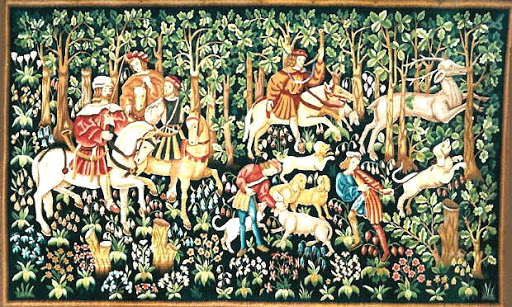
huntingtap1

Spoilers for The Winds of Winter, Alayne I

The same panels had once hung in the Red Keep of King’s Landing, when Robert sat the Iron Throne. Joffrey had them taken down and they had languished in some cellar until Petyr Baelish arranged for them to be brought to the Vale as a gift for Nestor Royce. Not only were the hangings beautiful, but the High Steward delighted in telling anyone who’d listen that they had once belonged to a king.

In a recent episode of Radio Westeros we mentioned a new theory about what exactly is going on with those tapestries from the Red Keep that are mentioned numerous times from AGoT onwards. In Alayne I it says that Lord Nestor was showing off “his prize tapestries”, a recent gift from the Lord Protector. These tapestries were mentioned several times in AGoT, hanging on the walls of the throne room of the Red Keep until, after Robert’s death, Sansa observed this:

the hunting tapestries that King Robert loved [had been] taken down and stacked in the corner in an untidy heap.

Fast forward to AFfC when, several months after leaving the city, Petyr Baelish sends a letter to Cersei. Here’s a quote:

His last letter mentions the rebels only briefly before beseeching me to ship him some old tapestries of Robert’s.

Not long after, Baelish tells Alayne that Cersei is “sending me some splendid tapestries. Isn’t that kind of her?” And then somewhere around two months later, it appears the tapestries have arrived in the Vale. What many fans want to know is— what was so significant about these tapestries that Baelish went to the trouble of requesting them from Cersei? Was it indeed only for their symbolic value as a “gift” to Lord Nestor? Are they the sort of tapestry The World Book tells us can be “worth their weight in gold”? Is there some valuable information hidden in the images they depict? Or did the tapestries themselves merely serve to disguise something else that Baelish wanted smuggled out of King’s Landing?

We can’t know for certain, but we can certainly consider the options. As a gift or bribe only, they wouldn’t seem that valuable. As much as Nestor Royce appreciates the fact that they once belonged to King Robert, the Lord Protector has already gifted the High Steward of the Vale something of much greater symbolic value in perpetuity, namely the title he bears and the castle he commands. And while if these were Myrish tapestries “worth their weight in gold” we can see Cersei being oblivious, we certainly can’t see the shrewd Petyr Baelish simply gifting something of great monetary value to someone he’s essentially already bought.

And while many tapestries in the series (and real life! We’re looking at you Bayeux Tapestry) are noted to show histories or genealogies, which could conceivably be valuable to someone who trades in information, these are specifically noted to be hunting scenes. In fact they seem all in all like rather boring examples of an art form that could be found in castles and chambers the world over, special mainly because the former king liked hunting.

And that leaves us with the final option— that Baelish wished to smuggle *something* out of King’s Landing, and the tapestries were used to conceal that something. This could definitely explain the largesse shown in bestowing them upon Nestor Royce— once the *something* was removed, the tapestries themselves were of no more use than an old box or envelope, though Baelish would certainly be clever enough to make what use of them he could by giving what appeared to be a very generous and thoughtful gift to his host.

So, what would this *something* be? Our thought was once that it was Widow’s Wail, stolen as a symbolic gift for Sansa perhaps. But in 2008 GRRM answered a fan’s question about Widow’s Wail’s location saying “Still at the Red Keep, until such time as King Tommen is old enough to wield it.” While he could have been prevaricating, making a direct answer like that usually isn’t his style if he wants to keep a secret. So over time we’ve realized the Widow’s Wail theory is unlikely, but in our opinion the best object to conceal inside a rolled up tapestry is still something long and slender like a SWORD, and so we’re left with the mystery of which sword could be so valuable that Baelish would go to such trouble to smuggle it into the Vale.

We considered swords that would be of value to Littlefinger, and why, and which swords of great value are noted as having their whereabouts unknown. And we found one interesting option that could actually have significant value to Littlefinger’s plans and is noted to have been missing for over a century and a half.

The Valyrian steel sword LAMENTATION was the ancestral sword of House Royce. House Royce of Runestone is a famously old and powerful First Men house, one of several to have survived the Andal invasion. Once known as the Bronze Kings, their descendants still pride themselves on their ancestral armor, made of bronze and allegedly inscribed with magical runes of protection.

The last Bronze King, Robar Royce, unified the First Men of the Vale and Fingers and Mountains of the Moon. As their High King, he very nearly succeeded in defeating the Andal invaders, until the Andals united behind Ser Artys Arryn, known as the Falcon Knight, and the resulting Battle of the Seven Stars led to the death of Robar Royce and a conclusive defeat of the First Men by the Andals. Based on the histories, it’s possible to infer that House Royce at the time was not in possession of a sword of Valyrian steel, so Lamentation must have been acquired by the family later, after the Andal victory.

Because in spite of their defeat, House Royce endured, and prospered even, and the Dance of the Dragons found a knight called Ser Willam Royce carrying a quote “famed” Valyrian steel sword and serving Queen Rhaenyra Targaryen. Ser Willam was one of the famous “Seven Who Rode” during the storming of the Dragonpit. Along with four knights of the Queensguard and two other knights called Ser Harmon of the Reeds and Ser Gyles Yronwood, Ser Willam rode out into the riots in Flea Bottom to recover Prince Joffrey Velaryon, who had been thrown into the crowd when he attempted to fly his mother’s dragon Syrax to the Dragonpit in order to save the other dragons.

Fire and Blood tells us that the knights did find Joffrey’s body at last, but that three of the seven were killed in the fighting— Ser Glendon Goode, LC of the QG, Ser Gyles Yronwood, and Ser Willam Royce who, it says “was felled by a man who leapt down from a rooftop to land upon his back (his famed sword, Lamentation, was torn from his hand and carried off, never to be found again).”

So Gyldayn tells us that Lamentation was lost forever, but then gives us reason to think otherwise just a few pages later when relating the death of the dragon Syrax. Here’s the passage:

“Some speak of an unnamed spearman, “a blood-soaked giant” who leapt from the Dragonpit’s broken dome onto the dragon’s back. Others relate how a knight named Ser Warrick Wheaton slashed a wing from Syrax with a Valyrian steel sword (Lamentation, most like)…”

Of Warrick Wheaton we know nothing beyond this brief mention. Part of an “unruly mob” that gained momentary infamy when they somehow brought about the death of the Queen’s dragon, he and his House seem to have vanished from history. As did Lamentation.

It’s a well known problem among art thieves that stealing something completely unique is problematic in terms of disposal. Without an underground network and a demand for the artifact you find yourself in possession of, it can be notoriously tricky to profit from your theft. Given the circumstances of its loss, and its possible last appearance in the hands of an obscure knight who is never heard from again, we’d view the fate of Lamentation in these terms. Having fallen into the hands of someone with no connections in the underworld, and there being no real possible market for such an artifact without incriminating the seller, we propose the sword languished in the possession of frightened or ignorant people for several generations.

And then along comes Petyr Baelish. A man who trades in information, and is well versed in using his enemies’ weaknesses to either neutralize them or get them on side. He has a big problem with Bronze Yohn Royce. The effective leader of the Lords Declarant had declared that he would personally see Petyr Baelish removed as Lord Protector, and his visit to the Eyrie in which he was outmaneuvered by Littlefinger doesn’t seem to have changed his outlook.

Of the Lords Declarant, by Alayne I, Petyr Baelish has succeeded at effectively buying Lady Waynwood, Lord Belmore, and Lord Templeton, seems to have some information regarding a murder plot  in House Hunter that will give him leverage there, and may have even reached an agreement of sorts with Lord Redfort, whose son Mychel is there for the tourney. He’s also made an essential alliance with Nestor Royce, the High Steward of the Vale, by making his title and possession of the Gates of the Moon hereditary. But so far, there’s been no mention of the Lord Protector’s plans to bring House Royce of Runestone into the fold.

So our suggestion goes something like this— that Petyr Baelish cleverly recognized the extreme value that would be placed upon the recovery of their ancestral sword by House Royce. That through his connections in the underworld of King’s Landing he actively sought out or coincidentally heard of the sword that had gone missing in that very city so many years ago. Having discovered its location, it would probably be a simple thing to finally provide a market for such an inconvenient heirloom, especially at a time when money and bread would be valued above useless metal.

Then, having through his agents acquired the sword, he had it secreted in the forgotten and rolled up tapestries beneath the Red Keep. Following his departure from the city and marriage to Lysa Arryn, at the height of his good will with Cersei, he then requested those old tapestries be sent to him as a gift. What a modest and simple request from someone who had been of such great service! Request granted, the tapestries arrive in the Vale and the sword is moved to a new location until the right time, and the tapestries put to a second good use as a further gift to Lord Nestor, just to keep him sweet.

There’s a clever bit in this scenario where both the tapestries and the item they concealed are to be used to bribe a Lord Royce— two different gifts for two very different Royces. So, that’s our new theory about what’s going on with those tapestries, and while we like the theory, and continue to think that the tapestries being somehow significant is the best explanation for the number of times they’re mentioned, we’re interested to hear what you all think! Let us know if you have feedback or other thoughts to share with us.

We’re back! Blog updates, critical essays and new theories.

Tags

,

Greetings to our old and new friends in the ASOIAF fandom. We hope you and your loved ones have remained safe and healthy during the pandemic, and that you’re continuing to implement all public health measures which will ensure we can eventually emerge from these turbulent times to resume our normal, productive livelihoods.

After an extended hiatus, we’re excited to be restarting activities at Pawn to Player, with plans to feature essays from various contributors and updating outstanding sections of the site. Of course, The Winds of Winter is still not published, so we invite discussion on Sansa Stark and related characters with the awareness that such analyses continue to be limited and inherently speculative. We are also returning under the shadow of the Game of Thrones finale, and while PTP has always centred on book analysis, the show’s ending cannot help but inform ideas and theories on what the “endgame” looks like for the main characters. However, we remain committed to treating the two as distinct creative entities, especially in light of Sansa’s controversial depiction on the show.

Pawn to Player has richly benefitted from the knowledge and insight of many contributors over the years and we welcome those interested in helping develop our canon of critical output to consider submitting your work for publication at the blog. All submissions are subject to a review process that you can find more information on here. Despite the weariness that has understandably settled in the fandom over the long wait between books, along with the sense of having said all there is to be said with the material we have — there is always a fresh angle, a new way of appreciating certain elements of characterisation, theme, or symbolism. A review of PTP’s extensive collection of essays, employing different modes of analysis, schools of thought, and comparative research, supports our belief that there is always more to be gleaned from those willing to devote the time and effort to critical thinking. The two pillars that comprise PTP textual examination — to reread and to rethink — remain crucial to helping understand the complex characters that comprise Martin’s world, their motivations, desires, and ambitions.

In focusing on Sansa’s journey throughout the series, we appreciate that in her Martin has created an indomitable heroine, one who relies on the more traditionally feminine arts as her weapons of choice, but whose continued survival is no less impressive for it, even in a world where girls are dragon-riders, assassins, and knights. Her growth comes with painful lessons and missteps, yet she learns to navigate what are arguably two of the most dangerous settings in Westeros: the royal court of Joffrey Baratheon, and his mother Cersei, and later on the snow capped mountains of the Eyrie, under the predatory control of Petyr Baelish. Through it all, we see Sansa’s stubborn refusal to bend to the will of her captors or to allow them to vanquish her secret resistance. From a forced marriage to the assumption of another identity, Sansa maintains a vital connection to her true desires and real identity as a Stark of Winterfell.

We continue to value your input and ideas going forward, so please feel free to share any thoughts you have in the comment section and contribute to the discussion when essays are posted. That way we can all be a little more engaged and prepared as we await TWOW’s arrival, hopefully sometime over this decade.


Male Influences: Harrold Hardyng

Tags

, , , ,

(With the release of the Alayne chapter in ‘The Winds of Winter’ giving us our first introduction to Harry the Heir and the beginning of his interaction with Sansa, we thought it necessary to update our Male Influences project with an analysis of his character and how his relationship with Sansa is likely to develop. We’re pleased to welcome our newest contributor, Westeros.org member Blue-Eyed Wolf, who brings her knowledge and passion to bear on the topic. You can follow her at https://bluelemonsforever.tumblr.com/)

by Blue-Eyed Wolf

(TWOW spoilers abound)

Petyr arched an eyebrow. “When Robert dies. Our poor brave Sweetrobin is such a sickly boy, it is only a matter of time. When Robert dies, Harry the Heir becomes Lord Harrold, Defender of the Vale and Lord of the Eyrie. Jon Arryn’s bannermen will never love me, nor our silly, shaking Robert, but they will love their Young Falcon . . . and when they come together for his wedding, and you come out with your long auburn hair, clad in a maiden’s cloak of white and grey with a direwolf emblazoned on the back . . . why, every knight in the Vale will pledge his sword to win you back your birthright. So those are your gifts from me, my sweet Sansa . . . Harry, the Eyrie, and Winterfell. That’s worth another kiss now, don’t you think?”  — Alayne II, AFFC.

A gallant young knight rises up. Handsome and full of youthful vigor. One with the magnetic ability to rally the Vale lords behind him.  And on behalf of his lady love, Harry will lead an army to take back her home from the villains who stole it. Together they will rule over two vast kingdoms and live happily ever after… Then you remember this is Littlefinger speaking.

It’s a perfectly tailored sales pitch to a guileless eleven-year-old Sansa, except she is no longer that child that Littlefinger is condescending to. While the chapter ends on this quote and the author has withheld Sansa’s reaction to it, I think it’s safe to say Sansa is probably of two minds about Harrold Hardyng entering her life. Her understandable gut reaction to another marriage proposal is horror. Yet, once he lays it all out for her, Sansa surely must give some pause to the possibility of finally going home and being safe. It’s the only thing out of what Littlefinger is offering that she truly wants even if it comes with strings attached. Those creepy, unfatherly kisses suggest what he expects in return for that “help.”

Right now we need to appreciate where Sansa is in all this. She’s stuck under a false identity indefinitely. She’s still wanted for regicide with a bounty on her head. She believes there’s no one else she can turn to and no other option has presented itself. We know that Sansa does not consider the Eyrie a home, but a cold, lonely place. She’s not keen on another marriage for her claim or name. Her thoughts have never been far from Winterfell, though. For that reason, we will see that Sansa does give consideration to the match, but with a critical eye and a little hope that Harry could love her for herself in spite of her claim once she is revealed. As with Ser Dontos before, Littlefinger has used knighthood to gain her trust and complicity, also with the promise of going home only for Sansa to discover she was misled. Yet she’s also a character of irrepressible hopefulness despite her misgivings.

As we explore Alayne I, TWOW, and the possibility of a match with Harry, we’ll see how much Sansa has truly evolved since the earlier novels. She’s not immediately trusting in the institution of knighthood or the beauty of youth as a stamp of goodness. Thus she isn’t dismissive of some troubling information she learns about Ser Harrold as she was with Joffrey; however, she’s not a total cynic, either. There’s a willingness to still give him a fair chance and see who he is with her own eyes. While Harry will fall short of an ideal husband in many ways, that doesn’t necessarily make him dangerous and violent like Joffrey. What it may mean is that Sansa has to decide whether she can put aside her other dream of mutual love and devotion in marriage. She’s being asked to stake her person and future on a man that Littlefinger promises can deliver all that and more. And if he doesn’t? From her perspective she faces a potentially loveless marriage with little to show for it. The question Sansa must answer for herself is: Is Harrold Hardyng the horse she should bet on?

Let’s look at Harry’s place in the overall plot. What we’re really talking about is a battle for political control of the Vale between Littlefinger and Bronze Yohn Royce starting with the custody dispute over Robert Arryn. In the Lords Declarant meeting of Alayne I, AFFC, the lords of the Vale petition to raise Robert in the more wholesome environment of Runestone as a ward to Yohn Royce. They fail due to Lyn Corbray’s violent outburst at the parley, staged by Littlefinger; however, Littlefinger tipped his hand by revealing his interest in Harrold Hardyng, Lady Anya Waynwood’s ward.

Robert should have an older boy about him too. A promising young squire, say. Someone he could admire and try to emulate.” Petyr turned to Lady Waynwood. “You have such a boy at Ironoaks, my lady. Perhaps you might agree to send me Harrold Hardyng.”

Anya Waynwood seemed amused. “Lord Petyr, you are as bold a thief as I’d ever care to meet.

While the Lords Declarant meeting failed to oust Littlefinger as Lord Protector, Yohn Royce now knows he must act quickly to secure influence over Harry with Robert’s health so uncertain. Especially when it’s revealed in Alayne II that Lady Anya’s debts have been bought up by Littlefinger. That and offering an enormous dowry forces her to entertain his proposal and use her influence to nudge Harry along.   

The Waynwoods are very old and very proud, but not as rich as one might think, as I discovered when I began buying up their debt. Not that Lady Anya would ever sell a son for gold. A ward, however . . . young Harry’s only a cousin, and the dower that I offered her ladyship was even larger than the one that Lyonel Corbray just collected. It had to be, for her to risk Bronze Yohn’s wroth. This will put all his plans awry. You are promised to Harrold Hardyng, sweetling, provided you can win his boyish heart . . . which should not be hard, for you.

How does Yohn Royce counter Littlefinger’s move toward Harry?  He holds a tourney for squires at Runestone. From Myranda Royce’s telling we know it was rigged for Harry to win the championship and his knighthood.

Our cousin Bronze Yohn had himself a mêlée at Runestone,” Myranda Royce went on, oblivious, “a small one, just for squires. It was meant for Harry the Heir to win the honors, and so he did.”

“Harry the Heir?”

“Lady Waynwood’s ward. Harrold Hardyng. I suppose we must call him Ser Harry now. Bronze Yohn knighted him.

By Yohn Royce personally bestowing knighthood upon him, he hopes to create a close mentor-mentee relationship. No doubt he warns Harry to mistrust Littlefinger’s wiles, especially in regards to marrying Alayne Stone. When Sansa suggests a tourney of Winged Knights to alleviate Robert’s anxieties, she inadvertently gives Littlefinger his counter maneuver. Harry will be tempted with glory as all his eager young peers are. Since Littlefinger leaves nothing to chance, this tourney is surely rigged as well. In the sample chapter, Sansa looks for Petyr in his solar and conspicuously mentions a list of competitors among the papers on his desk. There’s actually a few parallels here to the tourney at Whitewalls (also held by a former master of coin) in “The Mystery Knight” novella where the master of games was bribed to arrange the lists favorably.

It had fallen out just as Petyr said it would, the day the ravens flew. “They’re young, eager, hungry for adventure and renown. Lysa would not let them go to war. This is the next best thing. A chance to serve their lord and prove their prowess. They will come. Even Harry the Heir.” He had smoothed her hair and kissed her forehead. “What a clever daughter you are.

Yohn was left no choice but to acquiesce to Harry’s insistence lest he “create a rift between them.”  The players involved must ingratiate themselves by flattering his ego, but much to their frustration he can be swayed in the opposite direction as easily as a weather vane.  One can’t be completely sure if Harry has much awareness of the political tug-o-war over him or if he just doesn’t particularly care. Either way, he’s established as headstrong and heedlessly headed toward Littlefinger’s plot to ensnare him despite the red flags. Now he’s moved into position for Alayne Stone to charm him as the betrothal is contingent on Harry’s approval.

From a Doylist perspective, what does Harry represent by the way Littlefinger idyllically describes him when he lays out his plan?  We only have to look to Aegon Targaryen to guess what Martin thinks of this staple of the fantasy genre: a young hero who is also the rightful ruler, driven by destiny, arrives on scene with perfect timing to set things right.  There’s a beautiful princess waiting for him at the end. We’re assured of his success without having to read any further. Aegon’s handlers have carefully shaped their “perfect prince” to the point that he unquestioningly believes his story is just a matter of checking off all the boxes. Along that same vein, Littlefinger presents Harrold Hardyng not just as Robert Arryn’s heir, but as the worthier heir of the Vale who is waiting to come to center stage and take his rightful place. Harry even looks the part as he is noted to resemble Jon Arryn in his youth with his blonde hair, blue eyes, and aquiline nose. A perfect example of Andal purity and able-bodied manhood. Small, frail, brown-haired Robert must seem like a changeling by comparison.

There’s a parallel theme of the true and rightful heir trope being fast-tracked in his ascension without sacrifice or hardship on his part.  This is the antithesis of Martin making his characters like Daenerys or Jon earn their ascensions the hard way, facing real dangers and suffering through hard choices. Even then success is not a guarantee. Remember that Sansa herself more authentically embodies the “rightful heir” in hiding who has suffered real dangers and learned from her trial. However, the author appears to be misdirecting us to the “young falcon” as if he will be the protagonist of Sansa’s story, relegating her to the princess that will be awarded to him. Sansa is the major POV here and Harry must serve her story.

There is reasonable evidence that the “mummer’s dragon” will be exposed as an imposter at some point.  Even if it’s unbeknownst to him, how could Aegon ever have been at real risk of failure or peril if those trials were always orchestrated for his benefit?  But at least we can say Aegon has exerted his own efforts into preparing himself for kingship and considers his rule a duty he owes his people. I would argue that Harry sinks a bit lower in the deconstruction of the perfect prince and “rightful heir” trope.  He’s a poor imitation of even the imposter. His credentials and rewards have been completely unearned given the fact that Ser Harrold got his knighthood essentially handed to him in a tourney he could never win on his own merits. This is made clear to us when we see other characters finding Harry’s reputed martial skills to be quite underwhelming. Lothor Brune calls him “just some upjumped squire” and from Littlefinger’s own mouth with Belmore concurring:

…The boy is nowise skilled enough to win a place amongst the Winged Knights.”

“I suppose not,” said Belmore, grudgingly. — Alayne I, TWOW.

Yohn Royce must be of the same opinion if he had to leave nothing to chance.  If Harry doesn’t know he’s being wooed and handed token honors, then he’s profoundly stupid.  If he does know that his knighthood was never truly earned and he accepted it anyway, it speaks to a certain lack of scruples.  Especially when he puts on airs of deserving his rewards, as his imperious attitude when he arrives on scene would suggest. Abiding by even the most basic level of courtesy as a guest is beneath him.

Ser Harrold Hardyng looked every inch a lord-in-waiting; clean-limbed and handsome, straight as a lance, hard with muscle. Men old enough to have known Jon Arryn in his youth said Ser Harrold had his look, she knew. He had a mop of sandy blond hair, pale blue eyes, an aquiline nose. Joffrey was comely too, though, she reminded herself. A comely monster, that’s what he was. Little Lord Tyrion was kinder, twisted though he was.

Harry was staring at her. He knows who I am, she realized, and he does not seem pleased to see me.

Ser Harrold looked down at her coldly. “Why should it please me to be escorted anywhere by Littlefinger’s bastard?”

All three Waynwoods looked at him askance. “You are a guest here, Harry,” Lady Anya reminded him, in a frosty voice. “See that you remember that.  

Harry is also quite “upjumped” in more ways than just knighthood. Let’s review exactly how Harrold Hardyng is Robert Arryn’s heir. Until Robert is born, Jon Arryn had no children from any of his three marriages.  His younger brother Ronnel had a son named Elbert, who upon the death of his father became his uncle’s heir. Elbert was later murdered by King Aerys II Targaryen. Jon’s sister Alys, who was married to Elys Waynwood, had nine children: one son and eight daughters. The son, Jasper, dies at three from being kicked by a horse. Three of the daughters die of natural causes. One becomes a septa. One is seduced by a sellsword and then becomes a Silent Sister. One marries, but is barren. One is carried off by the Burned Men. The youngest daughter marries a member of House Hardyng, which appears to be a small landed knight house.  She dies not long after Harrold is born and Lady Anya Waynwood then takes him as her ward. Between the Arryns and Waynwoods, there’s quite a string of misfortunes and accidents of fate that have happened to finally whittle down the family tree to Harrold.

That’s right — he’s “Harry the Heir” by sheer dumb luck. It’s almost comical when you think about how far flung he is in inheritance order.  While this isn’t anything reflective of his character in itself, I think it juxtaposes significantly with Harrold’s apparent lack of humility at this extremely rare leap in upward mobility. It’s definitely made worse by how often he’s catered to. He is also sporting a highly conspicuous new sigil:

Though his surcoat and horse trappings were patterned in the red-and-white diamonds of House Hardyng, his shield was quartered. The arms of Hardyng and Waynwood were displayed in the first and third quarters, respectively, but in the second and fourth quarters he bore the moon-and-falcon of House Arryn, sky blue and cream. Sweetrobin will not like that. — Alayne I, TWOW.

While there’s plenty of House Hardyng pride, he’s in no small terms emphasizing his more prestigious relations of the Waynwoods and Arryns. He’s displaying a need to shore up his pedigree and he’s doing so in a very crass and presumptuous way. The only way he can actually claim the Arryn sigil is literally over his cousin’s dead body, who is at present still alive and this tourney is in his honor.  It makes Robert’s earlier statement that “he calls me cousin, but he’s just waiting for me to die so he can take the Eyrie” seem astute in hindsight.

Another character that gives us interesting insights on Harry is Myranda Royce, daughter of Lord Nestor of the cadet branch of House Royce.  Nestor had approached Lady Anya to betroth Myranda to Harry and she was soundly rejected without serious consideration. But why?

Lady Myranda snorted. “I pray [Harry] gets the pox. He has a bastard daughter by some common girl, you know. My lord father had hoped to marry me to Harry, but Lady Waynwood would not hear of it. I do not know whether it was me she found unsuitable, or just my dowry.” She gave a sigh.  — Alayne II, AFFC.

Her anger seems to be directed at Harry first, then Lady Waynwood, indicating her unsuitability wasn’t just the latter’s determination.  Then when the subject is revisited again in TWOW:

The first Lady Waynwood must have been a mare, I think. How else to explain why all the Waynwood men are horse-faced? If I were ever to wed a Waynwood, he would have to swear a vow to don his helm whenever he wished to fuck me, and keep the visor closed.” She gave Alayne a pinch on the arm. “My Harry will be with them, though. I notice that you left him out. I shall never forgive you for stealing him away from me. He’s the boy I want to marry.”

“The betrothal was my father’s doing,” Alayne protested, as she had a hundred times before. She is only teasing, she told herself…but behind the japes, she could hear the hurt.

There’s still some bitterness there toward Lady Anya, but now it’s more a sore spot. While Myranda may say Alayne stole him from her, we know her suit was rejected long before Alayne was ever in the picture. I think Myranda might have invented a new narrative to a less painful version if we look at everything in context. We’ve seen the author use this technique before in Sandor’s romanticized and misleading version of Sansa’s singing to him in Arya IX, ASOS. Myranda has clearly taken the rejection very personally, so I doubt it was an impersonal matter of dowry. The cadet Royces are still an ancient First Men house in the Vale and they boast the familial connection to House Stark through Jocelyn Stark marrying Benedict Royce. Catelyn references this connection when suggesting possible heirs for King Robb to name in his will. Myranda comes from a prestigious family and we know Harry values this from his quartered sigil. So we must conclude it was something about Myranda herself that Anya and Harry rejected.  While her bawdy humor and frank sex-positivity might be too much for Lady Anya, I doubt Harry would find that displeasing. He seems quite taken with Alayne’s cleverness and is thoroughly on the hook the moment she merely suggests she’ll be “all the spice [he’ll] want.” We might say it’s Alayne’s beauty, but Harry doesn’t find her that attractive.  “You’re comely enough, I’ll grant you” is basically saying “you’re okay, I guess.” So why reject as a bride the true born noble girl of ancient name who is just as flirtatious, clever, and spirited? I think we’re given a strong suggestion at the real reason Myranda was rejected and why it’s so hurtful to her: she’s fat.  

Lord Nestor’s daughter proved to be a short, fleshy woman, of an age with Mya Stone, but where Mya was slim and sinewy, Myranda was soft-bodied and sweet-smelling, broad of hip, thick of waist, and extremely buxom. Her thick chestnut curls framed round red cheeks, a small mouth, and a pair of lively brown eyes. — Alayne II, AFFC.   

And Harry’s fatphobia is bluntly stated for us in TWOW:

Cissy was a pretty thing when I tumbled her, but childbirth left her as fat as a cow, so Lady Anya arranged for her to marry one of her men-at-arms…

It’s an extremely callous attitude toward the mother of his first child. She puts on pregnancy weight, Harry is disgusted by her appearance and coldly discards her, and Lady Anya cleans up Harry’s mess. I think it’s safe to assume Cissy was the daughter of someone serving Lady Anya or a maid close to her personally, which is why she felt compelled to smooth the scandal over.  When Harry speaks of his current lover’s beauty in contrast, her slimness is noted among her attractive features. With Harry possibly being her future high lord and knowing about the Cissy incident, I cannot see Lady Anya souring her relationship to Harry by saddling him with a bride that would disgust him.  It’s political suicide for her family’s future interests. And even with Alayne she is careful not to make Harry feel too forced.

We can now see why an otherwise self-confident young woman would be vague about the reason for her rejection.  It’s cruel and shallow. It’s probably why we see Myranda biting back by skewering the Waynwood appearance as “horse-faced,” paying Lady Anya back in her own coin.  As Harry finds Cissy repulsive, Myranda says the same thing about requiring Waynwood men to wear a closed-visor helm to bed. The sentiment is very “you don’t have room to talk, lady.”  Joking about Alayne stealing Harry allows her to imagine a more tolerable explanation. Stolen implies he was already hers, hence she was never outright rejected to begin with. It’s such an offhand comment I don’t think Myranda truly believes this any more than Sandor really believed his own self-serving fantasy.  Let’s not jump to conclusions that Myranda is seethingly jealous over Harry. Deep down she probably still hopes he gets an STD.

Note that Harry doesn’t acknowledge Myranda at all while the Waynwoods do in contrast.  She is the lady of the Gates of the Moon and he is a guest in her father’s home. It’s a glaring breach of etiquette. If we could be inside her head instead of Sansa’s at that moment, the slight would be obvious. Among the myriad of ways that fatphobia manifests itself, being treated as invisible in moments where a person should be recognized is one of them.  Myranda could represent an inverse of “Fat Walda” Frey who is relishing being the new Lady Bolton.  Roose Bolton chose to wed her specifically because Old Walder Frey offered him the bride’s weight in silver for a dowry.  While still a mercenary reason, her fatness in that case was the prospective bride’s shining feature.

If we take a step back and break down how the Alayne sample chapter is structured, we’ll see a recurring theme that I think gives us clarity on the author’s intentions.  Since we meet Harry in person toward the end of the chapter, everything before that is a preamble. Beginning, middle, and end we will see examples of female characters being used, dishonored, devalued, and discarded by men. Their trust betrayed. Their hopes and dreams trampled.

The chapter opens with Mya Stone arriving in Robert Arryn’s bedchamber with straw in her hair and “scowl” on her face. Sansa knows immediately her dark mood was triggered by the presence of Mychel Redfort, the young man who had once promised to marry her. He has been staying at the Gates of the Moon to compete in the tourney and it seems that Mya has seen him just prior to the opening scene. Mya’s dreamy innocence is very much like Sansa’s, until it’s crushed by a broken promise and harsh reality. Like Sansa, she too dreamed of marrying for love. Mya had once told Catelyn of her and Mychel’s plan to marry once he was knighted, to which Catelyn privately doubts Horton Redfort would ever allow that. Mya trusted his word on this so implicitly that she gave her virginity to him. Then we learn in AFFC that Mychel has married Ysilla Royce instead and Mya was left with a soiled reputation and broken heart. Servants gossip about her as if she were promiscuous. There is also a sense that she’s not yet been able to heal and move on. She may love him still. Since learning of the marriage, she has stubbornly refused all of Nestor Royce’s offers to make a match for her nor will she consider another suitor. As Myranda says:

Mychel was the best young swordsman in the Vale, and gallant . . . or so poor Mya thought, till he wed one of Bronze Yohn’s daughters. Lord Horton gave him no choice in the matter, I am sure, but it was still a cruel thing to do to Mya.”

“Ser Lothor is fond of her.” Alayne glanced down at the mule girl, twenty steps below. “More than fond.”

“Lothor Brune?” Myranda raised an eyebrow. “Does she know?” She did not wait for an answer. “He has no hope, poor man. My father’s tried to make a match for Mya, but she’ll have none of them. She is half mule, that one.

It was wrong of Mychel to let her believe they’d be married, especially if it leveraged her consent to a sexual relationship.  Even if he would have prefered to marry Mya, he always knew he would concede to his father’s will on the matter. This is a bit of speculation on my part, but I believe the added detail of the straw in her hair paired with her scowl is meant to imply she recently had sex with him in the stables — a nod to the tawdry cliche of a “roll in the hay” akin to the way Harry describes “tumbling” Cissy.  It’s consistent with her emotionally compromised state. It’s plausible to see her in a desperate, fleeting attempt to recapture intimacy with him; however, a tryst only leaves her feeling cheapened and bitter, hence the scowl. Nothing changes the reality that he has a wife now, the wife she’ll never be. But bastard girls aren’t supposed to expect any better, are they? She took a leap of faith on the wrong man and discovered he was a poor imitation of gallant. This is exactly the cautionary tale Sansa must take to heart.

Next comes Robert and Alayne’s conversation on Harrold. While Alayne attempts to soothe his anxieties about his cousin and his distress about her marrying him, Robert pouts and says he should marry her one day instead.  She tries to gently dissuade him from such notions. While his crush on her is mostly harmless, it starts to become overly possessive and entitled in tone. He’s still a little boy and only partially understands what he’s saying, but she nips that attitude right in the bud.  Alayne sharply corrects Robert when he insists he can keep Alayne as his mistress if he can’t marry her. Note how highly appropriate this is for Sansa just coming off of recognizing Mya’s situation with Mychel. The interaction plays out the sexual politics of the same nobleman / bastard girl dynamic:  

The Lord of the Eyrie can do as he likes. Can’t I still love you, even if I have to marry her? Ser Harrold has a common woman. Benjicot says she’s carrying his bastard.”

Benjicot should learn to keep his fool’s mouth shut. “Is that what you would have from me? A bastard?” She pulled her fingers from his grasp. “Would you dishonor me that way?”

The boy looked stricken. “No. I never meant—

Having Alayne as his mistress is a perfectly agreeable solution for him, so he never considers she could feel differently about it. He is legitimately shocked to learn this arrangement would dishonor her and the mere suggestion of it is insulting. He represents the theme of privileged men treating women (consciously or not) as pretty toys they can pick up and put down as they like, clueless to their feelings and inconsiderate of their actions.  It’s especially heinous when love is used as a carrot on a stick. Women like Mya and Cissy paid a costly price for misplacing their trust in reckless, selfish men. Well, Alayne is having none of that.  Just because Robert is Lord of the Eyrie doesn’t mean he can “do as he likes,” especially not with a woman he claims to love and care for. She’s making Robert think about the harsh social stigma women face as well as their bastard children.  That there is more at stake than just satisfying his desires. Harrold’s behavior with his common woman is no role model for manhood or a proper lord. It’s a moment of really good parenting where she sets clear boundaries, teaches him to respect and empathize with women, and withdraws her company so he can contemplate the lesson.   

Next she finds a “desperate” looking Myranda Royce in the training yard and she’s been inundated by the unwanted attentions of Ser Ossifer Lipps and Ser Uthor Shett.  Sansa makes an excuse to “rescue” her from the situation to which she is grateful. The tone of their conversation seems light, but there’s an undercurrent of sadness in Myranda.  She reveals her father, Nestor Royce, is threatening to marry her off to an undesirable suitor just to be rid of her. Myranda is highly intelligent and vivacious; furthermore, she’s proven capable of running a household well. Many a man would count themselves lucky to have her. Why would her father do this?

Alayne giggled. “Surely Lord Nestor would not seriously entertain a suit from such men.”

“Oh, he might. My lord father is annoyed with me for killing my last husband and putting him to all this trouble.”

“It was not your fault he died.”

“There was no one else in the bed that I recall.

In Alayne II, AFFC, Myranda jokes she killed her husband while they were having sex, but it appears the older man simply had a heart attack or stroke.  We can see in her personality she often uses jokes to hide her pain, in this case guilt and shame. There’s nothing to suggest that she disliked her late husband.  The way she was widowed and her reputation for being “frolicsome” is embarrassing in the conservative culture of the Vale. Myranda blames herself for his death and appears to have internalized her father’s words.  Alayne responds with sympathy. She has in the past referred to herself as a “dreadful slut,” which in hindsight seems sad rather than funny. Add to the fact that Nestor was probably humiliated as well when Lady Anya turned down the marriage proposal to Harry.  His frustration and criticism is all aimed at Myranda for not being the right kind of woman. Instead of valuing her and supporting her, he’s at the point of just marrying her off to practically anyone.

Used, dishonored, devalued, and discarded.  We can also put that into the context of Littlefinger’s treatment of Sansa.  She’s his perfect woman. He wants to mold her to his philosophy, make her completely dependent upon him, as well as barter her as commodity for his interests.  He has promised her Harry will be her true knight that will take her home.  At the end of the chapter we learn about Cissy’s fate, and the probability of Saffron suffering the same dashed hopes and broken promises. These are signposts along Sansa’s path through the chapter, warning her to be wary of empty promises and misplaced trust. Thus we, the readers, should not trust the overall whimsical tone of the chapter and think Sansa has finally caught a break with Harry. Look closer and you’ll see the cracks.       

With Myranda’s first mention of Harry in AFFC, Harry’s bastards are an oft-mentioned subject of gossip and a prominent association with his character.  Clearly GRRM wanted the reader and Sansa to come armed with this information just before Littlefinger paints his pretty picture and stresses how lucky she is to have this opportunity to wed him.    

Harry the Heir?” Alayne tried to recall what Myranda had told her about him on the mountain. “He was just knighted. And he has a bastard daughter by some common girl.”

“And another on the way by a different wench. Harry can be a beguiling one, no doubt. Soft sandy hair, deep blue eyes, and dimples when he smiles. And very gallant, I am told.” He teased her with a smile. “Bastard-born or no, sweetling, when this match is announced you will be the envy of every highborn maiden in the Vale, and a few from the riverlands and the Reach as well.” — Alayne II, AFFC.

His first child comes from the aforementioned Cissy and he has a second on the way by a Gulltown merchant’s daughter named Saffron, his current lover.  This is by no means considered honorable behavior in general, but I would also point out that while she takes note of it, Sansa doesn’t seem to really judge him for it either. It makes sense considering her beloved father also had a bastard that she considers her family. She only uses the information to test Harry’s honesty and this is where his character becomes a little more complex.

I have heard that you are about to be a father.” It was not something most girls would say to their almost-betrothed, but she wanted to see if Ser Harrold would lie.

“For the second time. My daughter Alys is two years old.

We can see Harry does acknowledge both his children, making Alys a Stone as well as the one to come.  And he is forthright about it. He calls her “my daughter,” not “my bastard,” and by her name. He’s not treating her as something to be ashamed of no matter how she came to be or his relationship with the mother.  There’s a respect for her personhood. While Harry may be lacking in other ways, at least we can say he seems to care for Alys enough to officially claim her and give her the related social advantages. We have no evidence that he would be an absentee father.  There’s definitely a comparison here to be made with Robert Baratheon who fathered many bastards including Mya Stone while he spent his teen years in the Vale. Harry is about the same age. While Harry lacks Robert’s martial skill and likely the natural leadership abilities to go with it, he hasn’t abandoned his children.  Robert never officially acknowledged Mya, though it was simply obvious who fathered her; this oversight is noted to put limitations on Mya’s marriage options and thus continues to affect her. Sansa is also all too aware of Mya’s personal pain over it. For a brief time she felt loved by Robert, then he disappeared from her life.  So Harry does seem to have a one-up on Robert.

By not making Harry the Worst Person Ever™, GRRM gives Sansa something to chew on.  If Harry is a loving father to their children and she can live in relative safety, perhaps even return to Winterfell one day, is that enough for her?  Could she tolerate him possibly being unfaithful to her as long as he was discrete? What if she gained pregnancy weight as Cissy had? It calls back to Cersei’s assertion that Sansa “may never love [her husband], but [she’ll] love his children.”  Sansa isn’t being presented with a nightmare marriage to an outright monstrous abuser-type. That would be a no-brainer on her part. She’s actually being presented with a fairly typical transactional marriage among nobility. There’s an expectation of gain for both parties and the quiet toleration of certain aspects.  It means giving up the dream of being “loved for herself” (the passionate choice) in favor of the conventional good enough marriage that would give her social security and children to love (the pleasant choice).

I’m using “pleasant” versus “passionate” labels deliberately.  It’s no secret that GRRM’s favorite interpretation of Beauty and the Beast is the Jean Cocteau film La Belle et la Bête (1946).  In this version, the lead actor Jean Marais plays three roles:  the Beast, Prince Ardent (the Beast’s true form), and Avenant (a family friend that is Beauty’s other suitor). Their names literally translate into “passionate” and “pleasant.” Avenant is not the clear villain that Gaston of the Disney version is.  He has a greedy streak. He’s immature and brash, but he’s not evil. Beauty does find him attractive and he does have a certain amusing boyish charm about him.  She does consider marrying him, but her heart is not moved enough to accept. The purpose of his character is to provide Beauty with a bonafide choice between two viable options, both with certain desirable and disagreeable traits.  One is the easy, reliable, expected choice. The choice her family would condone.  He’s familiar and she knows they would get along fine. The other, represented by the Beast / Prince Ardent, means taking the riskier but potentially more fulfilling path of the unconventional and daring to follow one’s heart. That is consistent with Sansa’s wish to have a marriage based on mutual love and desire; however, who ends up playing that role is beyond the scope of his essay, but I’m sure it will be revealed in TWOW.

This La Belle et la Bête dichotomy is repeated in Brienne’s AFFC arc between the potential suits of Jaime Lannister and Hyle Hunt, who also bears a double “H” name.  Ser Hyle also has a bastard daughter that he acknowledges and visits, while having a strained relationship with the mother. He’s very Avenant.  He has glaring shortcomings, he’s young and dumb, he’s not good enough for Brienne, but there’s also something endearing about the fool in spite of it.        

What I want to win is you, Lord Selwyn’s only living child. I’ve known men to wed lackwits and suckling babes for prizes a tenth the size of Tarth. I am not Renly Baratheon, I confess it, but I have the virtue of being still amongst the living. Some would say that is my only virtue. Marriage would serve the both of us. Lands for me, and a castle full of these for you.” He waved his hand at the children. “I am capable, I assure you. I’ve sired at least one bastard that I know of. Have no fear, I shan’t inflict her upon you. The last time I went to see her, her mother doused me with a kettle of soup.

There’s similarities as Sansa is the only known living heir to Winterfell, but Harry doesn’t yet know who Alayne really is.  Sansa’s attitude going into this whole situation seems to be initially hopeful that this could turn out for the best despite her misgivings.  One of the things she looks for is that he shows some sign of genuinely liking her. As Alayne, her hope is that he can see past “Littlefinger’s bastard” to the person underneath — that somehow a real loving marriage could be salvaged from these schemes and intrigues.   For her own sake, if Harry can love her as a bastard girl before he knows about her true name and claim, then such a marriage can be possible. If he suddenly treats her kindly and professes words of love when he finds out she’s Sansa Stark, well… this doesn’t speak well of his character and she’s truly stuck in a loveless marriage for her claim. Again. So she goes in prepared to give this a fair shot.

And if the gods are good, he will love me too. Her tummy gave a little flutter.

This time her eyes met Harry’s. She smiled just for him, and said a silent prayer to the Maiden. Please, he doesn’t need to love me, just make him like me, just a little, that would be enough for now.

… and you can almost hear the record scratch the moment he coldly addresses her while looking down upon Littlefinger’s bastard.  It’s not going to go that smoothly. To her credit, Sansa stifles her tears of embarrassment at being insulted and embodies “bastard brave”-style courtesy.  She gratefully receives support from Lothor Brune who dubs him “Harry the Arse.” Next she finds Littlefinger who offers some mixed advice.

He’s horrible.”

“The world is full of horrors, sweet. By now you ought to know that. You’ve seen enough of them.”

“Yes,” she said, “but why must he be so cruel? He called me your bastard. Right in the yard, in front of everyone.”

“So far as he knows, that’s who you are. This betrothal was never his idea, and Bronze Yohn has no doubt warned him against my wiles. You are my daughter. He does not trust you, and he believes that you’re beneath him.

While I’m loathe to say Littlefinger has a point, it is true she has seen real malice and cruelty in Joffrey and Cersei, far beyond any snub Harry could lob at her.  It’s plausible his initial hostility could partially stem from being pushed into a marriage for his claim with someone he considers part of an enemy camp. A position Sansa can surely sympathize with. She’ll give it another go at the feast — except doing it her way, not following Littlefinger’s urging to smile, pet, and “tease him, to pique his pride.”  She turns the tables on him pretty handedly.

And there he stood, Harry the Heir himself; tall, handsome, scowling. “Lady Alayne. May I partner you in this dance?”

She considered for a moment. “No. I don’t think so.”

Color rose to his cheeks. “I was unforgiveably rude to you in the yard. You must forgive me.”

“Must?” She tossed her hair, took a sip of wine, made him wait. “How can you forgive someone who is unforgiveably rude? Will you explain that to me, ser?”

Ser Harrold looked confused. “Please. One dance.”

Charm him. Entrance him. Bewitch him. “If you insist.”

At first he’s very grudgingly asking for a dance at Lady Anya’s insistence, fully expecting Littlefinger’s bastard to just gratefully accept. There’s no flirtation or sweetness from Alayne. It’s pointed indifference at his insincere apology and a demand that she forgive him. The toss of hair and sip of wine to make him wait is so Cersei, a very well-played adaptation of the queen’s posturing. The power dynamic seems to flip in an instant and Harry is left bewildered and begging. Clearly Sansa is capable of reading Harry better than Littlefinger and adjusted her tack accordingly. His strategy would have never worked.

What follows during their dance is their blunt conversation about his bastards and the women he has been involved with. While Cissy was discarded, he claims that “it is different with Saffron.” For a moment the tone seems to indicate he has deeper feelings for her and it would give him a sympathetic reason to resist a match to another; however, it turns out that Harry’s sense of romantic love has a proportional relationship to her family’s coffers.  

Her father says she is more precious to him than gold. He’s rich, the richest man in Gulltown. A fortune in spices.”

“Saffron is very beautiful, I’ll have you know. Tall and slim, with big brown eyes and hair like honey.

Very Avenant, indeed. It’s probably safe to deduce that Saffron’s very wealthy father was also interested in offering up a hefty dowry for his beloved daughter. One can imagine how high an unmarried, pregnant Saffron’s hopes must be and that she’s likely heard the same sweet profession that it’s “different with [her].” Harry must have at least entertained the idea of marriage if he had this conversation with her father. Remember this is pretty on par with many people’s idea of a normal marriage negotiation where both parties assess the advantages. There’s a ladyship in it for Saffron as well. There’s a parallel to the marriage of a very satisfied Lord Lyonel Corbray to another wealthy Gulltown merchant’s daughter who has proven quite fertile; however, Lord Lyonel already had the ancient name and fertility is obviously not where Harry is lacking.           

An agreeable match they may otherwise be, the only thing Saffron can’t offer is an ancient noble bloodline and her father probably isn’t audacious enough to buy up Lady Anya’s debts to press the issue either. Alayne Stone is also a wealthy man’s daughter, but as a bastard she can’t even claim his landed-knight family name. And the Vale lords consider Petyr quite upjumped himself. Saffron and Alayne are actually on equal footing in this respect. But in Harry’s eyes, Alayne doesn’t even come close to Saffron’s beauty. It’s Alayne’s clever japes and deft handling of him that causes Harry to warm to her. In the end she has him smiling and asking to wear her favor, which she denies him.  This is turning into quite an intriguing experience for him. She excels in offering novelty. Unlike most trying to curry his favor, she’s actually making him work for her attention and approval. So how does Sansa feel about Harry by the end of the chapter?  

He has good teeth, she thought, straight and white. And when he smiles, he has the nicest dimples. She ran one finger down his cheek. “Should we ever wed, you’ll have to send Saffron back to her father. I’ll be all the spice you’ll want.”

He grinned. “I will hold you to that promise, my lady. Until that day, may I wear your favor in the tourney?”

“You may not. It is promised to…another.” She was not sure who as yet, but she knew she would find someone.

Good teeth?  You could assess a horse the same way and quite fitting if we’re determining if Harry is the horse to bet on.  It’s the very best likable thing about him she can come up with, which isn’t saying much, but it’s a step up from Harry the Arse.  It’s a good enough start to possibly build upon.  Since it is the last line of the chapter, we can be sure that Alayne’s favor and whoever wears it is set up to be a plot device in TWOW.  All we know now is that person is not Harry.

Returning to the central idea that Harrold Hardyng represents a poor imitation, he embodies certain aspects in common to another important knightly dichotomy in Sansa’s story:  Sandor Clegane and Loras Tyrell. Yet the surface similarities are overshadowed by key differences. Harry’s blunt honesty to the point of being offensive recalls her interactions with the Hound.  Progress in breaking through Harry’s hostility only comes after Sansa makes the effort to dig deeper than her first impressions. She knows that sometimes a prickly exterior can be defense mechanism to conceal past pain and trauma.  It’s through the establishment of intimacy that Sansa reveals there’s substantial complexity and humanity under Sandor’s brutish persona that no one else sees. With a hand upon his shoulder and the simple utterance that “he was no true knight,” Sansa made an indelible impression on Sandor that carried through several books with no sign of waning.  With Harry, we don’t get any such reveal to empathize with. He’s neither a tormented soul nor particularly profound. No sense of shared core values. For Sansa’s part, we can see she has gone from a girl that would be easily flustered by the Hound’s rudeness and posturing to a more mature version that can hold her own with confidence. Harry is intrigued, for now at least, with Alayne.  Like jangling keys in front of a baby, it’s a tenuous connection at best. So while Harry may share some of Sandor’s honesty, there’s nothing of real substance or admirable about what he says or does.

It’s easy to compare Harry and Loras in their similar physicality.  Both are tall, slim, and handsome young men of similar age. They both share an arrogance of over privileged youth.  Unlike Harry, Loras had renown early on as a rising star among knights. Word of his tourney successes and skill as a warrior had reached as far as the North.  Loras’s knighthood was undoubtedly earned through his own merits. When making comparisons between these two, I’ve seen fandom members esteem Harry higher than Loras, citing the latter’s cheating at the Hand’s tourney.  While Loras using a mare in heat to provoke the Mountain’s stallion is in no way considered fair play, one can hardly claim Harry is above taking shortcuts. Accepting honors and accolades he knows he did nothing to earn is no less dishonest or dishonorable.  Loras chose to end the Hand’s tourney by forfeiting to Sandor, in recognition of Sandor’s heroic act in saving his life.  Despite his faults, we can also say that Loras knew deep abiding love for Renly. “When the sun has set, no candle can replace it” is an iconic line of a lover in mourning who remained faithful to Renly’s memory long after he was gone — emphasis on faithful.  What does Harry show us of fidelity in his relationships? He’s a poor imitation of the best qualities of both men.

So with that being the case, his character seems to exist primarily serve Sansa’s by allowing her to apply her discernment skills after four books.  She approaches him with healthy skepticism while still leaving room for him to prove himself a decent partner. No free passes given for handsome knights while she also patiently draws out the real Harry, such as he is.  Even if she feels this may be her only chance to go home, as slim as it may be, what’s important is that she’s approaching this prospective marriage with eyes open and with the ability to assert herself.

All signs so far point to “no,” Harry is not the horse to bet on; however, Harry can also serve one more greater thematic purpose if this bit of speculation is correct.  I don’t think Harry is long for this world, so I don’t think this marriage plot will gain any traction in itself. There’s a few more strong parallels to two other minor Vale characters I think show us where GRRM might be going to go with Harry.  Recall Ser Hugh of the Vale (another “H” name) at the Hand’s tourney. He was squire to Jon Arryn and knighted prematurely by Robert Baratheon in honor of his late Hand. He is described as “arrogant as only a new-made knight can be.”  He arrives at the tourney in shiny new plate and he’s sporting the Arryn colors and crescent moons on his cloak, an association he has no direct claim to as with Harry’s quartered sigil.  Sadly, in his tilt against Gregor Clegane, Ser Hugh meets his end at the tip of a lance to the throat where his gorget was loose. With no squire to assist him, he was ill-prepared against the Mountain. One by one, Sansa sees Ser Hugh’s crescent moons soak through with blood. The Tourney of the Winged Knights takes place at the foot of a mountain whose peak is called the Giant’s Lance. It makes Sansa’s curse (“and may your horse stumble, Harry the Heir, so you fall on your stupid head in your first tilt”) sound almost prophetic. Sansa will note that no songs will be sung to remember young men like Ser Hugh.  Like the “knights of summer” in Renly’s host Catelyn notes are playing at war games, there’s a foreboding sense of wasted youth and potential snuffed out for frivolous pursuits. It’s tragic and it fits all too well with the decadent feasting and revelry of the Vale tourney, all on the cusp of a Winter that demands austerity. Ser Hugh’s death almost certainly foreshadows a blood-soaked Vale, somehow, someway.  

But there might just be a shining moment for Harrold Hardyng in the end and it would twist the knife in our emotions.  We’ve seen Harry’s type before early on in another Vale man. In the prologue chapter of AGOT, Ser Waymar Royce, third son of Yohn Royce, is leading a ranging mission north of the Wall.  On his way to join the Night’s Watch, the Starks feasted him and his father at Winterfell. As he is a young and handsome knight, he’s Sansa’s first mentioned crush in the series. He’s an arrogant, over privileged, know-it-all teenager who mocks his more experienced companions. We’re not given anything likeable about Waymar. He’s given command of this mission for no other reason than to encourage his lordly father’s continued support of the Night’s Watch. We expect someone like Waymar to cower and run as the Others surround him. Death is certain. But in his final moments, Waymar finds it in himself to raise his sword and meet death with defiance. No one will know his courage and no songs will be sung. Even an unlikable, upjumped arse can sometimes surprise us and give us reason to remember him fondly.

The Past is Prologue: Analysing the upcoming Winged Knight tourney in The Winds of Winter

Tags

, , , , , ,

by Brashcandy

Sansa and Sweetrobin depart the Eyrie in A Feast for Crows©Anndr


Tourneys in the Song of Ice and Fire saga have never been simple affairs. Whether ostensibly organized to celebrate weddings or birthdays, honour officials in high positions, their noble family members, or some other festive occasion, these tournaments — grand or small — have been sites of intrigue, power struggles, attempted rebellions, romantic entanglements, and political scandals. In every tourney that Martin has turned a sustained gaze upon, we have seen the oft deadly game of thrones in operation, where deceit and trickery hold sway, and personal ambition comes with high costs.  Therefore, with Sansa’s TWOW sample chapter revealing another planned tourney that Martin will explore in significant textual detail, we should expect to see many of the same thematic elements and surprising plot developments arising from this event at the Gates of the Moon. This is why, for the purposes of the following analysis, I have found it so instructive to closely examine the five tourneys in the ASOIAF universe that we have been given substantive information on: the Hand’s tourney in A Game of Thrones and Joffrey’s name day tourney in A Clash of Kings; the tourney at Harrenhal in the year of the false spring; and the pair we read of in the Dunk and Egg novellas, staged by Lord Ashford and Lord Butterwell respectively in The Hedge Knight and The Mystery Knight.

Before we get into the central features of the aforementioned tourneys and the revealing parallels that are contained in Sansa’s storyline, let’s spend a little time exploring just why tourneys are such a critical component of Sansa’s arc and development. Rivalled only by her younger brother Bran for her early idealism and valorisation of knighthood, Sansa begins the novel with starry-eyed beliefs that these warriors are fundamentally good and honourable, uphold a chivalric code of conduct, and behave as she puts it like “true knights.” Tourneys, with their grandeur and spectacle, initially dazzle and amaze the young girl we are introduced to in A Game of Thrones:

Sansa rode to the Hand’s tourney with Septa Mordane and Jeyne Poole, in a litter with curtains of yellow silk so fine she could see right through them. They turned the whole world gold. Beyond the city walls, a hundred pavilions had been raised beside the river, and the common folk came out in the thousands to watch the games. The splendor of it all took Sansa’s breath away; the shining armor, the great chargers caparisoned in silver and gold, the shouts of the crowd, the banners snapping in the wind . . . and the knights themselves, the knights most of all.

“It is better than the songs,” she whispered when they found the places that her father had promised her, among the high lords and ladies. Sansa was dressed beautifully that day, in a green gown that brought out the auburn of her hair, and she knew they were looking at her and smiling.

If tourneys are the staging ground for displays of jousting skills by knights, they become an important training ground for the elder Stark daughter, educating her in the violence and dishonourable tactics that can regularly occur, revealing and sharpening her empathetic skillset, and fostering her relationship with Sandor Clegane. Not to be overlooked is Lord Petyr Baelish, aka Littlefinger, who also initiates his connection to Sansa at the Hand’s tourney, transferring his ruthless obsession with Catelyn to her daughter, and begins to look for ways to exploit her naïveté. For all the passivity that appears to define Sansa’s time in captivity with the Lannisters, she plays a pivotal role at the two tourneys she attends, elevating her status from that of mere ornamentation and insignificant hostage.

By opening Sansa’s TWOW chapter with the plans for the imminent staging of a tourney of sixty-four competitors, Martin is confirming to the reader that whatever may develop out of this event with respect to her future prospects, a tourney is familiar territory for Sansa, and one where she has a habit of forming unusual and clandestine alliances. Although she is still in LF’s orbit of influence, Sansa is no longer imprisoned or cut off from potential sources of assistance. She is older and wiser, with considerably more self-confidence and daring, divorced from the childish estimation of knights, and in possession of a strategic understanding of the wants and desires that motivate those around her and how to manipulate such to her favour. It may not be overstating the matter to say that in agreeing to host the tourney, Littlefinger has opened up the possibility of Sansa having a key tactical advantage over him; especially when he later leaves it up to her to decide which knight will receive her favour. However, we cannot disregard LF’s own plans for this event, which are certain to be more complex and far-reaching than finding eight winged knights to act as Robert Arryn’s protectors.

Vile princes and kings

In The Hedge Knight, Ser Duncan the Tall attends the tourney in honour of Lord Ashford’s daughter who is celebrating her 13th birthday. This is the same age Joffrey turns when his own name day tourney is held in A Clash of Kings, and whose increasingly cruel behaviour calls to mind the disturbed nature of the Targaryen prince, Aerion Brightflame, who will maim Humfrey Hardyng at Ashford and later fight Dunk in a trial by seven after the hedge knight comes to the rescue of Tanselle Too Tall. Compare Aerion’s cruel treatment of Tanselle with Joff’s violence against Sansa and the disturbing parallel is all too clear:

The dragon puppet was scattered all about them, a broken wing here, its head there, its tail in three pieces. And in the midst of it all stood Prince Aerion, resplendent in red velvet doublet,
with long, dagged sleeves, twisting Tanselle’s arm in both hands. She was on her knees, pleading
with him. Aerion ignored her. He forced open her hand and seized one of her fingers. Dunk stood
there stupidly, not quite believing what he saw. Then he heard a crack, and Tanselle screamed.
(The Hedge Knight)

Knowing that Joffrey would require her to attend the tourney in his honor, Sansa had taken special care with her face and clothes. She wore a gown of pale purple silk and a moonstone hair net that had been a gift from Joffrey. The gown had long sleeves to hide the bruises on her arms. Those were Joffrey’s gifts as well. When they told him that Robb had been proclaimed King in the North, his rage had been a fearsome thing, and he had sent Ser Boros to beat her.
(Sansa I, ACOK)

It’s noteworthy that Sansa, like Dunk, performed her own brand of heroics at Joffrey’s tourney, when she convinced him not to kill the drunken knight Ser Dontos. Whilst the Vale tourney is mercifully free from the spectre of princely ire and madness, there are some characters that display the same kind of arrogance and hot-headed nature which could prove troublesome on the day. Sansa notes in particular the simmering rage of Ser Lyn Corbray. Couple this with the fact that Martin seems to be fond of having knights from the Vale meet their deaths at tournaments – in addition to Ser Humfrey at Ashford is the killing of Ser Hugh by Gregor Clegane at the Hand’s tourney – and we could be in for a similarly violent spectacle at the Gates. Relevant to this discussion is the theory that Littlefinger may have also played a role in the killing of Ser Hugh in order to thwart Ned Stark’s investigation into Jon Arryn’s death. This speculation is not unfounded given the other heartless tactics we have seen LF employ throughout the series.

Sansa’s position in the Vale is not like the one she occupied in KL – vulnerable and at the mercy of Joffrey’s cruel whims — yet she is not completely out of the woods as it relates to those who might try to do her harm. Martin has set up the likes of Corbray and Ser Shadrich as unpredictable characters, and there’s no telling how much Sansa’s true identity remains more of an open secret at this point.

The Ashford tourney ends in a trial of seven with Dunk and Aerion Brightflame fighting against each other alongside their respective champions. Notably, Catelyn witnessed a trial by combat at the Eyrie, and Sansa’s experiences there have tracked closely to her mother’s. During that trial between Tyrion’s champion Bronn and Ser Vardis Egen, Sweetrobin’s behaviour recalls the kind of infantile bloodlust exhibited by Joffrey, who also loved to suggest making men fight to the death:

“Make them fight!” Lord Robert called out.
Ser Vardis faced the Lord of the Eyrie and lifted his sword in salute. “For the Eyrie and Vale!”
Tyrion Lannister had been seated on a balcony across the garden, flanked by his guards. It was to him that Bronn turned with a cursory salute.
“They await your command,” Lady Lysa said to her lord son.
“Fight!” The boy screamed, his arms trembling as they clutched at his chair.

As the fighting ensues, Cat remembers the duel fought between LF and Brandon Stark, her betrothed, who agreed to spare the young Petyr on her behalf. Since then, LF claims to have learnt his lesson about his lack of martial prowess, but it’s worth considering if he could face a similar trial by combat in the Vale (or Winterfell) if his crimes are made known to the Lords there, and Sansa certainly has no similar incentive to spare him as her mother did. Perhaps SR will eventually get his wish to see the “bad little man” fly.

Sansa’s tourney and Littlefinger’s Plans

We learn in the sample chapter that the Vale tournament is being staged for the honour of serving as a member of Lord Robert’s Winged Knights:

Lord Robert’s mother had filled him full of fears, but he always took courage from the tales she read him of Ser Artys Arryn, the Winged Knight of legend, founder of his line. Why not surround him with Winged Knights? She had thought one night, after Sweetrobin had finally drifted off to sleep. His own Kingsguard, to keep him safe and make him brave.

It is a novel idea for a tourney up to this point in the series and one that aims to placate the irritable and insecure young Lord of the Eyrie. However, as the chapter develops, the curious fact emerges that this is an event seeming designed more to honour Sansa Stark than her cousin. I say Sansa Stark and not Alayne Stone deliberately, because the evidence suggests that Littlefinger has plans to declare her true identity. It is here that the past tourneys prove quite useful to study for elucidating the hidden workings at play in Sansa’s chapter, with precedent already set in Martin’s universe for a tourney that conceals its true purpose: the attempted Second Blackfyre rebellion in The Mystery Knight, which masqueraded as a mere wedding celebration for Lord Butterwell and his Frey bride.

The first hint that we have concerns Sansa’s thoughts about the tourney itself, which repeatedly highlight her role in its conception and organisation. It is a point of considerable pride for her:

The competitors came from all over the Vale, from the mountain valleys and the coast, from Gulltown and the Bloody Gate, even the Three Sisters. Though a few were promised, only three were wed; the eight victors would be expected to spend the next three years at Lord Robert’s side, as his own personal guard (Alayne had suggested seven, like the Kingsguard, but Sweetrobin had insisted that he must have more knights than King Tommen), so older men with wives and children had not been invited.

And they came, Alayne thought proudly. They all came.

It had fallen out just as Petyr said it would, the day the ravens flew. “They’re young, eager, hungry for adventure and renown. Lysa would not let them go to war. This is the next best thing. A chance to serve their lord and prove their prowess. They will come. Even Harry the Heir.” He had smoothed her hair and kissed her forehead. “What a clever daughter you are.”

It was clever. The tourney, the prizes, the winged knights, it had all been her own notion. 

Is LF complimenting Sansa for her own sake here, or is his pride in her cleverness because it serves to further his own ends? That he has repeatedly misled her and exploited her ignorance of his true intentions makes a strong argument for the latter interpretation. Regardless, Sansa has taken personal responsibility for this tourney, and it is closely linked with her particular desires and personal history – not Alayne’s. Sourcing knights to serve SR looks to only be a thin cover for a tourney that will have much bigger implications for its hostess.

The conversation Sansa has with Littlefinger when she journeys below to the vaults provides additional evidence that something is afoot regarding her true identity and the real purpose for staging this event. As LF attempts to calm her anxiety regarding Harry, we read:

“…Bringing Harry here was the first step in our plan, but now we need to keep him, and only you can do that.  He has a weakness for a pretty face, and whose face is prettier than yours?  Charm him.  Entrance him.  Bewitch him.”

“I don’t know how,” she said miserably.

“Oh, I think you do,” said Littlefinger, with one of those smiles that did not reach his eyes.  “You will be the most beautiful woman in the hall tonight, as lovely as your lady mother at your age.  I cannot seat you on the dais, but you’ll have a place of honor above the salt and underneath a wall sconce.  The fire will be shining in your hair, so everyone will see how fair of face you are.  Keep a good long spoon on hand to beat the squires off, sweetling. You will not want green boys underfoot when the knights come round to beg you for your favor.”

There are two important points relating to Sansa’s identity in this exchange with LF. Firstly, he mentions her resemblance to Catelyn, a direct association between Sansa and her mother that highlights her real parentage. Secondly, and more subtly, he notes that the “fire will be shining in your hair” – a very suggestive description that alludes to Sansa’s natural auburn colour showing once again. It all results in the impression that Sansa is looking very much like Sansa again and, more importantly, that LF doesn’t seem all that concerned about hiding this from the gathered guests. Another intriguing possibility raised by readers is that LF is slipping, that his obsession with his Catelyn proxy is quite literally blinding him to her identity as Sansa Stark which will come back to bite him/could have profound consequences at the tourney. To extend this latter reading, let’s look at the parallel to their first meeting at the Hand’s tourney in King’s Landing:

When Sansa finally looked up, a man was standing over her, staring. He was short, with a pointed beard and a silver streak in his hair, almost as old as her father. “You must be one of her daughters,” he said to her. He had grey-green eyes that did not smile when his mouth did. “You have the Tully look.”

“I’m Sansa Stark,” she said, ill at ease…

“Your mother was my queen of beauty once,” the man said quietly. His breath smelled of mint. “You have her hair.” His fingers brushed against her cheek as he stroked one auburn lock. Quite abruptly he turned and walked away.

The pertinent details relate to LF’s complete association of Sansa to her mother, whom he states was once his “queen of beauty.” Stroking a lock of Sansa’s auburn hair reinforces how much she looks like Catelyn and the attraction it sparks in him as a result. However, notice Sansa’s interjection that LF seemingly does not even hear or chooses to ignore. She asserts that “I’m Sansa Stark” after he tells her she has the Tully look and feels “ill at ease.” I want to stress that the two theories explaining Sansa’s conversation with LF in the vaults — he is aware of her auburn hair showing and wants to highlight it vs. he continues to over-identify Sansa with her mother and what this reveals about his ultimate plans (and their likely success or failure) — are not mutually exclusive. Indeed, it could be argued that it is LF’s obsessive compulsion to regain what he believes should have been his in the first place, along with all the power and privilege he can accrue, that is the governing principle behind all the chaos he has unleashed.

The feast in the night where Sansa holds court as LF promises also has parallels to other major feasts we have seen in the series. The similarity to the Purple Wedding with the extravagant number of dishes has been noted by other commenters, with the inherent symbolism of wastefulness and contempt for the starving populations across Westeros. To begin with the Hand’s tourney, however, we see some telling similarities – right down to the type of dessert served:

Six monstrous huge aurochs had been roasting for hours, turning slowly on wooden spits while kitchen boys basted them with butter and herbs until the meat crackled and spit. Tables and benches had been raised outside the pavilions, piled high with sweetgrass and strawberries and fresh-baked bread…

All the while the courses came and went. A thick soup of barley and venison. Salads of sweetgrass and spinach and plums, sprinkled with crushed nuts. Snails in honey and garlic. Sansa had never eaten snails before; Joffrey showed her how to get the snail out of the shell and fed her the first sweet morsel himself. Then came trout fresh from the river, baked in clay; her prince helped her crack open the hard casing to expose the flaky white flesh within. And when the meat course was brought out he served her himself, slicing a queen’s portion from the joint, smiling as he laid it on her plate…

Later came sweetbreads and pigeon pie and baked apples fragrant with cinnamon and lemon cakes frosted in sugar, but by then Sansa was so stuffed that she could not manage more than two little lemon cakes, as much as she loved them. She was wondering whether she might attempt a third when the king began to shout. (Sansa II, AGOT)

———-

Sixty-four dishes were served, in honor of the sixty-four competitors who had come so far to
contest or the silver wings before their lord. From the rivers and the lakes came pike and trout and salmon, from the seas crab and cod and herring. Ducks there were, and capons, peacocks in their plumage and swans in almond milk. Suckling pigs were served up crackling with apples in their mouths, and three huge aurochs were roasted whole above the firepits in the castle yard, since they were too big to get through the kitchen doors. Loaves of hot bread filled the trestle tables in Lord Nestor’s hall and massive wheels of cheese were brought up from the vaults. The butter was fresh-churned, and there were leeks and carrots, roasted onions, beets, turnips, parsnips. And best of all, Lord Nestor’s cooks prepared a splendid subtlety, a lemon cake in the shape of the Giant’s Lance, twelve feet tall and adorned with an Eyrie made of sugar.

For me, Alayne thought, as they wheeled it out. Sweetrobin loved lemon cakes too, but only after she told him that they were her favorites. The cake had required every lemon in the Vale, but Petyr had promised that he would send to Dorne for more. (Alayne sample, TWOW)

So at both feasts we see Sansa being served with lemoncakes frosted in sugar, the first time when she still expects to eventually become Joffrey’s queen. Lemons in the series have been associated with innocence, childhood, and longing for a return to happier times. Daenerys thinks fondly, for example, of the house with the lemon tree in Braavos. For Sansa’s characterisation, however, whilst lemons do undoubtedly hold a similar kind of symbolism due to her childlike devotion to them, whenever she is served them by others there is always some deception and manipulation involved. In studying the references to lemoncakes in her arc, the pattern is revealing:

  • At the Hand’s tourney, Joffrey begins to treat Sansa more kindly again and she is unaware of his true nature. Readers know that Joffrey isn’t at all what he seems, and his indulgent attention to Sansa is only a momentary guise of gallantry. Sansa is already “stuffed” by the time the lemoncakes arrive, but her love of them leads her to at least attempt eating a few. We will see Sansa make a similarly concentrated attempt to believe in Joffrey’s goodness until his base cruelty is revealed when he kills her father.
  • In the chapter where Sansa remembers the next encounter she has with Littlefinger at court, she and Jeyne go looking for lemon cakes but have to settle for strawberry pie. Here we see the lack of lemon cakes symbolising the absence of any retreat into familiar reassurances/safety where LF is concerned. When she tells him of her belief in “monsters and heroes” for the reason why Ned should have sent Loras Tyrell to kill Gregor Clegane, his reply leaves her deeply unsettled: “Life is not a song, sweetling. You may learn that one day to your sorrow.”
  • In A Storm of Swords, Sansa meets with the Tyrell family and is given the hope of marriage to Willas Tyrell and freedom from the Lannisters. During her initial meeting with them and after, we read of the frequent consumption of lemon cakes, as she comes to think of the Tyrell women as true friends and allies:

“Sansa,” Lady Alerie broke in, “you must be very hungry. Shall we have a bit of boar together, and some lemon cakes?”

“Lemon cakes are my favourite,” Sansa admitted.
“So we have been told,” declared Lady Olenna, who obviously had no intention of being hushed. “That Varys creature seemed to think we should be grateful for the information…” (Sansa I, ASOS)

———-

The cousins took Sansa into their company as if they had known her all their lives. They spent long afternoons doing needlework and talking over lemon cakes and honeyed wine, playing at tiles of an evening, sang together in the castle sept… and after one or two of them would be chosen to share Margaery’s bed, where they would whisper half the night away.
(Sansa II, ASOS)

Alerie’s suggestion of boar and lemon cakes highlights the dual symbolism of regime change by ultimately plotting Joffrey’s murder and their plans to take advantage of Sansa’s status and claim for their own ends. As Sansa will learn when she is forcefully wed to Tyrion Lannister, the Tyrells were never genuinely her friends, and once she is no longer available to be married into their family, they cease their association with her.

  • The next time lemon cakes are mentioned in Sansa’s chapters occurs in A Feast for Crows, when she promises them to Sweetrobin as an inducement to get him out of bed to depart the Eyrie before winter closes in. Once they arrive at the Gates of the Moon and she is ushered in to Littlefinger’s solar, Sansa mentions lemons as one of her guesses on LF’s prompting:

“I have brought my sweet girl back a gift.”
Alayne was as pleased as she was surprised. “Is it a gown?” She had heard they were fine seamstresses in Gulltown, and she was so tired of dressing drably.
“Something better. Guess again.”
“Jewels?”
“No jewels could hope to match my daughter’s eyes.”
“Lemons? Did you find some lemons?” She had promised Sweetrobin lemon cake, and for lemon cake you needed lemons.
Petyr Baelish took her by the hand and drew her down onto his lap. “I have made a marriage contract for you.”
“A marriage…” Her throat tightened. She did not want to be wed again, not now, perhaps not ever.

Once again, we see Sansa’s attempt to normalise the circumstances of her relationship with LF fail. This is highlighted by the symbolic lack of lemon cakes, which she had hoped to secure for Sweetrobin, but is instead met with the news of another marriage pact that understandably reawakens her fears of exploitation and loss of agency.

Taken all together, the lemon cake references provide us with the symbolic clues through which to view the appearance of the giant lemon cake lance at the feast in TWOW. LF is attempting to manipulate Sansa, but this time it is no ordinary machination. After all, the cake has taken every single lemon in the Vale to bake it, suggesting that whatever LF has in mind it is going to considerably momentous. As noted, lemon cakes in Sansa’s arc strongly correspond to the theme of appearance vs. reality as it relates to people hiding their true intentions or character. It raises the question of just what LF is planning; why has he used every lemon in the Vale to bake a cake for Alayne at a public event, when it is widely known as Sansa Stark’s favourite dessert? Why did he readily agree to organise this elaborate event at the Gates of the Moon, inviting young knights sworn to the Vale and hosting them with no expense spared?

An answer to these questions might be found in that last AFFC chapter when LF tells Sansa about the marriage pact. Right before this, he makes a very cryptic remark that has been the subject of much speculation:

“You would not believe half of what is happening in King’s Landing, sweetling. Cersei stumbles from one idiocy to the next, helped along by her council of the deaf, the dim, and the blind. I always anticipated that she would beggar the realm and destroy herself, but I never expected she would do it quite so fast. It is quite vexing. I had hoped to have four or five quiet years to plant some seeds and allow some fruits to ripen, but now…it is a good thing I thrive on chaos. What little peace and order the five kings left us will not long survive the three queens, I fear.”

“Three queens?” She did not understand.

Nor did Petyr choose to explain.

There are a couple reasons to speculate that LF has included Sansa as one of these three warring queens he mentions. In examining his statement closely, we glean that LF is not merely speaking abstractly about coming events that have nothing to do with him. Instead, he implicates himself directly by stating that he had hoped for more time to allow “some fruits to ripen” but that he thrives on chaos. I’d argue that the fruit he was most interested in ripening was Sansa Stark herself, allowing her to further mature, and giving himself time to have her completely under his thumb. The next reason is that he very deliberately chooses not to inform Sansa of the identities of these three queens. Instead, he goes on to tell her of the marriage pact which ends with the promise of retaking Winterfell once she marries Harry the Heir and Sweetrobin dies. Refusing to answer Sansa’s query suggests that Littlefinger has something to hide, and the most plausible answer to why he has something to hide is because it involves Sansa – in a much more prominent role than she could ever imagine.

If LF is planning to declare Sansa as Queen of the North, he could hardly have chosen a more auspicious place to do so. The tourney, with its knights hungry for service and eager for honour, seems tailor-made for making a declaration of a new queen — the last known remaining Stark and rightful ruler of the North — especially when the houses of the Vale had been eager to fight for Robb but denied by Lysa Arryn. Sansa becoming a queen also ties together the foreshadowing of her thoughts when she is with Cersei in the Red Keep – “If I am ever a queen, I’ll make them love me” – and when she meets Bronze Yohn Royce at the Eyrie and thinks that he never fought for Robb, so why would he fight for her.

Before we move onto looking at more food symbolism at the other feasts, there’s another aspect to the lemon cakes that bears brief exploration as I think it presents us with foreshadowing of Littlefinger attempting to make a marriage alliance with the newly landed Aegon, who alleges to be Rhaegar Targaryen’s son:

The cake had required every lemon in the Vale, but Petyr had promised that he would send to Dorne for more.

In Arianne’s two chapters from TWOW, we learn that she is on her way to meet with Aegon on behalf of Dorne, in order to ascertain whether he is truly Rhaegar’s heir. The letter that Connington sends to Doran reads as follows:

            To Prince Doran of House Martell,
You will remember me, I pray. I knew your sister well,
and was a leal servant of your good-brother. I grieve
for them as you do. I did not die, no more than did
your sister’s son. To save his life we kept him hidden,
but the time for hiding is done. A dragon has returned
to Westeros to claim his birthright and seek vengeance
for his father, and for the princess Elia, his mother.
In her name I turn to Dorne. Do not forsake us.
Jon Connington
Lord of Griffin’s Roost
Hand of the True King

With the evidence pointing to lemon cakes being tied to underhanded/manipulative situations in Sansa’s story, Petyr’s sending to Dorne for more lemons suggests him attempting to make an alliance with the one other region outside of the Vale that has not yet entered the war. Right now, Dorne’s decision hinges on what Arianne reports back to her father about Aegon’s identity and chances of success in claiming the Iron Throne. With Dany out of the picture for the time being, a marriage alliance to Sansa Stark of the North, who can deliver the Vale swords would be quite an advantageous match for the young prince.

Sansa’s TWOW chapter hints at important news having reached Littlefinger via Oswell, who arrives from Gulltown on a “lathered horse.” In looking at the ASOIAF timeline, Sansa’s descent from the Eyrie happened in the middle of May, and we know her chapter in TWOW picks up several months later, as she observes that “though snow had blanketed the heights of the Giant’s Lance above, below the mountain the autumn lingered and winter wheat was ripening in the fields.” If we assume an approximate date of late summer/early fall, Sansa’s TWOW chapter puts us somewhere near the middle to late August, and according to the timeline, Arianne learns of Aegon having taken Storm’s End around July 17th. All this means that it is possible for LF to know of Aegon and his success so far with the Golden Company.

Having considered this, it’s important to point out that the lemon cake associated betrothals for Sansa have all failed. She doesn’t end up having to marry Joffrey, and the Willas match is discovered by the Lannisters, leading to forced union with Tyrion Lannister, which as yet still protects her from any other marriages taking place. Martin also seems to be playing with the tourney imagery in having Aegon meet with yet another “Elia” in Oberyn Martell’s bastard daughter Elia Sand, who is nicknamed “Lady Lance” and is skilled at riding and jousting. Of course, it is the wolf-maid Sansa who is organising an actual tourney that could result in her being crowned as queen, following in the tradition of her aunt Lyanna Stark, whom Rhaegar chose over Elia as his queen of love and beauty. This reversal could see Elia being the one to secure Aegon’s affection and Sansa ultimately avoiding a return to Southron politics and game-playing as Aegon’s sure to be ill-fated wife.

Roasted peacocks and boar

The Mystery Knight details the attempted Second Blackfyre Rebellion, where lords still loyal to Black dragons gathered at Whitehalls in order to plot to overthrow the Targaryen king and seat Daemon II Blackfyre on the throne. On the basis of the “secret heir in disguise with sympathetic lords all around” alone, we can see a direct link to Sansa’s situation at the Gates.

One of the early hints we have of the planned regime change in the novella is when boar is served at the inn where Dunk and Egg hope to eat and rest, but are instead turned away and have to seek shelter with three hedge knights nearby:

A good smell was drifting out the windows of the inn, one that made Dunk’s mouth water. “We might like some of what you’re roasting, if it’s not too costly.”

“It’s wild boar,” the woman said, “well-peppered, and served with onions, mushrooms, and mashed neeps.”

Once at the castle, Dunk attends the wedding feast and the similarities between the dishes there and at Sansa’s pre-tourney feast are striking:

Suckling pig was served at the high table; a peacock roasted in its plumage; a great pike crusted with crushed almonds. Not a bite of that made it down below the salt. Instead of suckling pig they got salt pork, soaked in almond milk and peppered pleasantly. In place of peacock they had capons, crisped up nice and brown and stuffed with onions, herbs, mushrooms and roasted chestnuts. In place of pike they ate chunks of flaky white cod in a pastry coffyn, with some sort of tasty brown sauce that Dunk could not quite place. There was pease porridge besides; buttered turnips; carrots drizzled with honey; and a ripe white cheese that smelled as strong as Bennis of the Brown Shield. (The Mystery Knight)

———-

Sixty-four dishes were served, in honor of the sixty-four competitors who had come so far to contest for silver wings before their lord. From the rivers and the lakes came pike and trout and salmon, from the seas crabs and cod and herring. Ducks there were, and capons, peacocks in their plumage and swans in almond milk. Suckling pigs were served up crackling with apples in their mouths, and three huge aurochs were roasted whole above firepits in the castle yard, since they were too big to get through the kitchen doors. Loaves of hot bread filled the trestle tables in Lord Nestor’s hall, and massive wheels of cheese were brought up from the vaults.  The butter was fresh-churned, and there were leeks and carrots, roasted onions, beets, turnips, parsnips. (Alayne sample, TWOW)                                                                    

Out of this bounty of food porn, a few dishes standout: the “peacocks in their plumage,” “suckling pigs,” and the “great pike crusted with crushed almonds.” These are all the dishes that are served for the nobles at Whitehalls, or above the salt as Dunk observes, and we see them again featured at the pre-tourney feast in the Vale. Leaving aside the latter two for now, I want to focus on the peacock entrée, because in addition to these examples, it is mentioned only one other time in the series – at the Purple Wedding.

Then the heralds summoned another singer; Collio Quaynis of Tyrosh, who had a vermillion beard and an accent as ludicrous as Symon had promised. Collio began his version of “The Dance of Dragons” which was more properly a song for two singers, male and female. Tyrion suffered through it with a double helping of honey-ginger partridge and several cups of wine. A haunting ballad of two dying lovers amidst the Doom of Valyria might have pleased the hall more if Collio had not sung it in High Valyrian, which most of the guests could not speak. But “Bessa the Barmaid” won them back with ribald lyrics. Peacocks were served in their plumage, roasted whole and stuffed with dates, while Collio summoned a drummer, bowed low before Lord Tywin, and launched into the “The Rains of Castamere.”

Given how the Purple Wedding ends – Joffrey’s death, Tyrion framed for the murder – “peacocks roasted in the plumage” appears to be symbolic of those who are killed or undermined at a moment of celebration or impending victory. The same is evident for the conspirators at the Whitehalls tourney, who are discovered before their rebellion can gain any traction. The saying “to strut around like a peacock” is to display an attitude of overt pride and confidence that borders on arrogance. The plumage of the peacock — its impressive display of brightly coloured feathers – is the symbol of that pride, and as it so happens, there is one character in Sansa’s arc who has a noted preference for brightly coloured, almost gaudy clothing throughout the series. Is LF the only peacock at the Vale whose plans might be upset? He’s certainly the most major one, yet there are other potential candidates like Ser Lyn Corbray, last seen bashing in the head of a hapless knight, or someone like Harry the Heir, whose initial sneering at Sansa and poor jousting skills don’t bode well for his prospects as either a suitor or champion. We also cannot discount the appearance of an outside force, such as the Mountain clans – newly armed with steel weaponry – who could find a way to infiltrate the Gates and cause widespread destruction, thereby “roasting” the many peacocks represented by the knightly gathering.

If our food symbolism is to bear out, it stands to reason that as we see boar being roasted in The Mystery Knight, it should also be present at the Purple Wedding and in Sansa’s pre-tourney chapter. Tyrion is our gastronomical guide during the excesses of Joffrey’s wedding feast, and sure enough we find this line as he indulges his appetite:

Tyrion listened with half an ear, as he sampled sweetcorn fritters and hot oatbread backed with bits of date, apple, and orange, and gnawed on the rib of a wild boar.

Yet we have no mention of boar being eaten at the pre-tourney feast in TWOW or anywhere else in the chapter. My theory is that instead of highlighting boars at the feast, Martin has cleverly depicted these wild animals in another location, which Alayne casually calls to our attention by way of walking through the castle on her way to locating Littlefinger:

Alayne swept down the tower stairs to enter the pillared gallery at the back of the Great Hall. Below her, serving men were setting up trestle tables for the evening feast, while their wives and daughters swept up the old rushes and scattered fresh ones. Lord Nestor was showing Lady Waxley his prize tapestries, with their scenes of hunt and chase. The same panels had once hung in the Red Keep of King’s Landing, when Robert sat the Iron Throne. Joffrey had them taken down and they had languished in some cellar until Petyr Baelish arranged for them to be brought to the Vale as a gift for Nestor Royce. Not only were the hangings beautiful, but the High Steward delighted in telling anyone who’d listen that they had once belonged to a king.

Hunt and chase — the very activity that leads to Robert’s death, and a favourite pastime of the King’s that Ned recalls in AGOT as he tries to comfort the despondent Barristan Selmy:

“Even the truest knight cannot protect a king against himself,” Ned said. “Robert loved to hunt boar. I have seen take him a thousand of them.” He would stand his ground without flinching, his legs braced, the great spear in his hands, and as often as not he would curse the boar as it charged, and wait until the last possible second, until it was almost on him, before he killed it with a single sure and savage thrust.

Other mentions of the tapestries all reinforce the hunting imagery. In the throne room right before Ned’s arrest, he observes the gold cloaks, standing by the walls “in front of Robert’s tapestries with their scenes of hunt and battle”. Later on, Sansa will observe the throne room “stripped bare, the hunting tapestries that King Robert loved taken down and stacked in the corner in an untidy heap.” The Vale declaring for Sansa as Queen of the North would represent a significant regime change that threatens the Lannister/Tyrell power in the South; even more so if the Vale decides to enter the war and fight on Aegon’s behalf.  Yet, it’s worth noting that the mere nature of “hunt and chase” for the boar symbolism could indicate that LF loses control of the regime change he has put into motion. Unlike at his wedding to Lysa Arryn, where roast boar is served and she later meets a tragic end through the moon door, this one might not turn out to be so straightforward to engineer and direct.

The Mystery Knights of the Vale

“Every wedding needs a singer, and every tourney needs a mystery knight.”
                                                                                                  Ser John the Fiddler

If we are to adhere to the Fiddler’s declaration in the above statement, Martin is overdue in writing of a mystery knight making an appearance at a tournament. The only ones we are privy to in some detail are the Knight of the Laughing Tree – widely considered in the fandom to be Lyanna Stark – and Dunk as the Gallows Knight. The appearance of a mystery knight in the lists at the Vale tourney would seem to be unlikely given that all the competitors have been specially invited and all appear to be accounted for at this point in time. Yet, the parallels between Sansa’s TWOW chapter and The Mystery Knight, coupled with her familial connection to Lyanna and what we learn of how the Harrenhal tourney plays out, make for a convincing case that Martin will feature a mystery knight in the Vale in some form or fashion.

In A Storm of Swords, Meera tells Bran about the story of the Knight of the Laughing Tree, who appears as a mystery knight at the Harrenhal tourney and challenges the knights whose squires were responsible for hurting a crannogman from the Neck. Bran listens to the story and thinks:

Mystery knights would oft appear at tourneys, with helms concealing their faces, and shields that were either blank or bore some strange device. Sometimes they were famous champions in disguise. The Dragonknight once won a tourney as the Knight of Tears, so he could name his sister the queen of love and beauty in place of the king’s mistress. And Barristan the Bold twice donned a mystery knight’s armor, the first time when he was only ten.

The Mystery Knight novella features Dunk appearing as the Gallows Knight, and other characters that are also concealing their true identities and motives. There is Ser John the Fiddler, who is really Daemon II Blackfyre; Ser Glendon Flowers, who reveals that he is the illegitimate son of Ser Quentyn Ball; and Ser Maynard Plumm, who is most likely Bloodraven under the disguise of a glamor. Dunk eventually discovers and helps to scuttle the plans of the conspirators at the tourney, who are using the wedding to secretly plot a rebellion against Aerys I.

This is likely Martin’s last chance to introduce a mystery knight at a tourney in the series, and he has already established a suspicious cast of characters around Sansa in the Vale who could play important roles in how the plot unfolds there. We may not get to see the classic mystery knight figure that Bran recalls, but there are a few candidates who are worthy of consideration, both for their current proximity to Sansa, and others who are relevant because of their shared personal history and connection to the relevant themes in her development.

Contenders inside the Vale:

Ser Shadrich, Ser Morgarth, Ser Byron:  It’s safe bet that the three hedge knights Alayne meets when she descends the Eyrie are not telling the truth about their real identities/motives. We already know that Shadrich is a bounty hunter on the lookout for Sansa Stark, and appears to know he has found her by his comments in TWOW:

“A good melee is all a hedge knight can hope for, unless he stumbles on a bag of dragons. And that’s not likely, is it?”

Regular followers of Pawn to Player would be familiar with our theory that Ser Morgarth is really the Elder Brother from the QI. Sansa also dances with all three of the hedge knights at the feast, so Martin does appear to be keeping them at the forefront of our thoughts for a reason.

Ser Lyn Corbray

The wielder of Lady Forlorn has to be considered as another contender based on Sansa’s observations that he appears to hold a significant amount of genuine dislike against LF for arranging his brother’s marriage, even though he is supposedly working for LF’s interests in secret. Lyn is a highly ambitious man and is obviously not content with gold and boys. If he acts to undermine LF at the tourney, it could prove disastrous for the mockingbird.

Sansa’s champion

Who is the knight that Sansa will select to wear her favour? It’s a seemingly inconsequential choice as suggested by LF, who merely tells her to choose another so not as to overly flatter Harry. But is it merely a trivial detail for Sansa? Throughout the series, Sansa has prayed for a true knight or champion at different moments of crisis, and has been uniformly disappointed by the ones that appeared to care for her or genuinely want to help her. There is no better example of the ruined institution of knighthood than the Kingsguard, who were routinely employed by Joffrey to abuse Sansa in King’s Landing. Although she no longer holds the naïve view of knights being essentially good and honourable, it does not mean that the knight Sansa chooses to wear her favour may not still represent the greater potential of that ideal. Regardless of the basis upon which she makes her decision, Sansa has the chance to make an autonomous choice that could have significant consequences. (Incidentally, LF does not have good luck when it comes to favours; Cat gave her handscarf to Brandon in the fight against him at Riverrun, after Petyr pleaded with her to give him her favour instead.)

Contenders outside the Vale:

Sandor Clegane

Any speculation of mystery knights in Sansa’s arc would be remiss not to include Sandor Clegane. Last seen performing gravedigging duties at the Quiet Isle, Sandor is not believed to be in the Vale; however, present or not at this tourney, Sandor is the one who has consistently acted as Sansa’s champion during their time together. The Hound is famous for his opinions on the hypocrisy and falsity of knighthood, and undoubtedly is responsible for much of the enlightenment and maturity Sansa achieves over time. But their relationship is a two-way street, with Sansa having just as much, if not more, of an impact on his character development; arguably being a major deciding factor in his break from the Lannisters, and inspiring the desire to be his “own dog now.” The Elder Brother tells us that the Hound is dead, while Sandor Clegane is “at rest.” This distinction sets up an interesting identity angle for Martin to explore, in addition to the false rumours of the Hound being responsible for the atrocities at Saltpans necessitating a need for continued concealment on Sandor’s part.

Having played notable roles at the two previous tourneys in the series, both of them involving close contact with Sansa and providing crucial assistance to her, it begs the question if an appearance by Sandor at the third such event isn’t of vital importance to the narrative structure and thematic continuity of their relationship. I would argue that this is why he is conspicuously absent from the pre-tourney chapter in Sansa’s thoughts. Whether he makes a physical return or Sansa recalls a memory about him, Martin intends for it to be of some import.

Sandor’s significance as a mystery non-knight for Sansa is perhaps most invaluable because Littlefinger does not know about it. Not only does she venerate Sandor in terms of truth-telling, but Martin has established a romantic connection between the two that has managed to persist despite a long separation. One of LF’s primary means of control over Sansa is to constantly set up but ultimately undermine any potential suitor or love interest. It’s one of the reasons why I expect the Harry the Heir betrothal to come to naught. LF’s obsession with Sansa, arising from the denial of Catelyn who was his primary love object, causes him to compulsively repeat the act of vanquishing a rival. As the tourney is arranged, LF plainly does not expect any surprises regarding Sansa’s affections, believing that he has successfully manipulated and monopolized her attention with Harry the Heir.

Where matters of the heart are concerned, tourneys can be game changers, and this is why his gamble with Sansa’s favour could backfire. Recall the Hand’s tourney when LF is so certain that the Hound will lose to Jaime Lannister because “hungry dogs know better than to bite the hand that feeds them.” It turned out that Sandor Clegane didn’t know any better, and LF loses his bet to Renly Baratheon. Since then, we have to ask ourselves if LF has gotten any wiser regarding what truly motivates and inspires others. Taking Lyn Corbray as a case study, the answer appears to be no. When at the Fingers, LF poses a question to Sansa, asking: “which is more dangerous, the knife brandished by an enemy or the hidden dagger pressed to your back that you never even see?” What would he have to say about the hidden rival?

Bran Stark

The idea of Bran Stark influencing events in Sansa’s storyline is a compelling one for many reasons. As things stand in the present, Bran is the one Stark with the growing powers to reach out to his siblings and gain insight into their respective circumstances, opening up the possibility that he could be a source of assistance in the future. As Bloodraven promises him in the cave:

Once you have mastered your gifts, you may look where you will and see what the trees have seen, be it yesterday or last year or a thousand years past… Nor will your sight be limited to your godswood. The singers carved eyes into their heart trees to awaken them, and those are the first eyes a new greenseer learns to use… but in time you will see well beyond the trees themselves.

It’s been noted that the “winged knight” tourney could be thought of as an allusion to Bran, and readers are privy to his continued longing for the dreams of knighthood he held as a young boy. Even as late as ADWD, we see him expressing the sorrow of ultimately becoming like his mentor:

One day I will be like him. The thought filled Bran with dread. Bad enough that he was broken, with his useless legs. Was he doomed to lose the rest too, to spend all of his years with a weirwood growing in him and through him? … I was going to be a knight, Bran remembered. I used to run and climb and fight. It seemed a thousand years ago.

What was he now? Only Bran the broken boy, Brandon of House Stark, prince of a lost kingdom, lord of a burned castle, heir to ruins… A thousand eyes, a hundred skins, wisdom as deep as the roots of ancient trees. That was as good as being a knight. Almost as good, anyway.

None of this offers conclusive evidence of a Bran intervention, but it does align him thematically with what is happening currently in the Vale, especially when we factor in the story of the Knight of the Laughing Tree. Bran likes the tale, but has ideas for how it could be even better:

“That was a good story. But is should have been the three bad knights who hurt him, not their squires. Then the little crannogman could have killed them all. The part about the ransoms was stupid. And the mystery knight should win the tourney, defeating every challenger, and name the wolf-maid the queen of love and beauty.”

The wolf-maid becoming queen of love and beauty is what happened to Lyanna Stark, whereas there’s the possibility of Sansa becoming an actual queen by the end of her tourney. Could a mystery knight be the one to undermine LF’s plans and steal the wolf-maid away as Rhaegar Targaryen is alleged to have done with Sansa’s aunt?

Final observations:

Pawn to Player has never been in the business of the making predictions, so I will refrain from making any explicit ones and stick to what this all means for Sansa’s character development. Like all the Stark children, Sansa is under the guidance of a dubious and duplicitous mentor, but the Vale is where we see her maturing and honing the skills that should allow her to break free of LF’s influence. Becoming a queen is not Sansa’s endgame in the sense of her ruling the North in her own right or acting as a queen consort to a King. Sansa’s arc has tracked towards self-empowerment not traditional institutional power. It is about her ultimately possessing the agency and authority to decide what it is she wants and how she can effectively help others. It is about her no longer being manipulated and exploited by those around her. If there’s one thing we know about wearing crowns in ASOIAF is that the likelihood of that manipulation only increases. Sansa’s brothers are still alive and there is Robb’s will that has not yet surfaced naming Jon as his successor. If Sansa is to become queen in this interim period, then her control of the Vale army will have important ramifications for how the remainder of the unrest in Westeros plays out, likely in the North. Home and belonging remain crucial themes in her arc, and the memories of Winterfell and her family strongly resonate throughout the sample chapter. The Sansa we witness in this chapter is on the cusp – of womanhood, power, and reclaiming her true identity.

Points of Foreshadowing/Curious details/Questions for further analysis:

  • “They’re from the Sisters. Did you ever know a Sisterman who could joust?” – Well, as a matter of fact, Myranda, she just might have. If there’s anyone who deserves the title of “sisterman” it’s Sandor Clegane, who has been connected to both Sansa and Arya as a protector figure.
  • Harry the Heir, Alayne thought. My husband-to-be, if he will have me. A sudden terror filled her.  She wondered if her face was red. Don’t stare at him, she reminded herself, don’t stare, don’t gape, don’t gawkLook away. Her hair must be a frightful mess after all that running.  It took all her will to stop herself from trying to tuck the loose strands back into place. Never mind your stupid hair.  Your hair doesn’t matter.  It’s him that matters.  Him, and the Waynwoods. – Trying to stop worrying about her “stupid hair” and thinking that it doesn’t matter seems like another blaring signal that actually it does, and this supports what LF will later tell her in the vaults about the fire shining in her hair.
  • What is Sansa wearing in this chapter? For someone who usually loves to describe what Sansa is wearing, Martin is silent on the matter. Even at the feast when Sansa is the centre of attention, we get no description. Clothing symbolism is an important element in analysing Sansa’s chapters, so this is a curiously missing detail.
  • Why is SR so calm at the feast? Alayne notes that he would have been given a strong dose of sweetmilk beforehand, but even she is still worried that the aggravation of seeing her with Harry might cause him to have a seizure. Furthermore, we saw SR wiping his nose when Sansa is with him earlier in the day. This may be a bad sign that the young lord is already dangerously overdosed, as the maester had previously expressed concerns in AFFC about whether he was bleeding from the nose.
  • Food symbolism that still needs to be analysed: suckling pigs and pike.
  • Ser Artys Arryn – conflated as the Winged Knight of legend — is said to have defeated the Griffin King. Jon Connington is the Lord of Griffin’s Roost and Hand of the King. Is the premise of the Winged Knight tourney itself a foreshadowing of the Vale not allying with Aegon?

(This essay is indebted to the great discussions that took place in the Pawn to Player thread at Westeros.org when the sample chapter was released two years ago.)
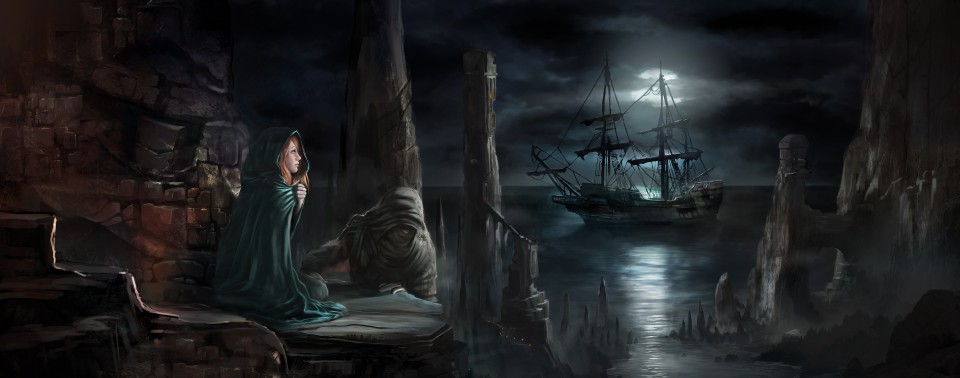
 

Fair Game: The Documentary

https://youtu.be/ZMujSdkOX5w


by Miodrag Zarković

It’s been almost a year since I announced, on this very website, my intention to make a documentary about a paper tiger that is the critical acclaim for Game of Thrones.

Hopefully, it wasn’t a wasted time, because the documentary is finally here, titled Fair Game: The Critical Universe around HBO’s ‘Game of Thrones’.

It will be released on May 3rd on the Internet. It’s appropriate, I think, because the good old web is the only place where countless issues many of the viewers have with that show are addressed. Elsewhere, and in the mainstream media, a certain “Emperor’s New Clothes” routine continues even though the sixth season promises to be even worse than the previous ones.

I honestly hope that Fair Game will be watchable even for those who like Game of Thrones, partly because the documentary is not an attempt at changing anyone’s mind. Everyone’s entitled to feel whatever they do about the show. What Fair Game tries to establish is that we that drastically dislike the show have very legitimate reasons and a firm basis for our opinion, and that that opinion isn’t rooted in some irrational hatred towards the showrunners, nor is it directed at show fans.

The only irrational thing in all this is that our opinion is silenced and marginalized by the mainstream. Or, as one of the interviewees for Fair Game phrased it, that an opinion of dissent is left behind. That is the only real problem in the critical universe centered on Game of Thrones, and that is the main topic of Fair Game.

Critical voices shouldn’t be sidelined so easily. Whatever the subject may be. Period.


To Kill a Mockingbird

Tags

, , ,

What is Littlefinger’s Agenda?

Part I of an in-depth analysis of Petyr Baelish’s modus operandi and planning.

by Ragnorak

petyr_littlefinger_baelish_by_prokrik-d8hbcd2.png© Artwork by ProKriK

By the time we reach the Alayne gift chapter from The Winds of Winter, we have a long history of Littlefinger’s scheming. Looking at patterns in his behavior, plots, and modus operandi might offer clues as to his future plans.

Petyr’s first scheme dates back to his time at Riverrun when the arrival of the feuding lords Bracken and Blackwood allowed young Baelish and the Tully children to get good and truly drunk. The scheme is rather adolescent and hardly original, applying alcohol to separate a young woman from her smallclothes when more sober machinations have failed, but it still serves to illustrate the elements of his future plotting. It was an opportunistic scheme born of chaos and specifically the chaos of two feuding factions that occupied the attention of the responsible authority figure, allowing his charges to misbehave right under his nose. Cat was already betrothed to Brandon Stark, and our young Petyr sought to appeal to vice in order to overcome the Tully motto and three pillars of Westerosi loyalty, Family, Duty, Honor, to make Cat his. Petyr “Life is not a Song” Baelish danced with Cat six times because Lord Bracken had brought his singer to Riverrun. We can see both his disillusionment with song given his failure with Cat and his view of song as a tool, which he’ll later employ with Olenna while initially plotting the Purple Wedding. Perhaps most telling is the fact that it was Lysa that seduced him rather than Petyr seducing Cat, which may well be a clue regarding his ultimate demise.

In the aftermath of his failure to seduce Cat, he eventually appeals to martial skill to try and make Cat his by dueling with Brandon. The duel is a pathetic failure, and seems to have left him with both a personal disdain for martial skill as well as a general disdain for the pillars of Westerosi loyalty that allow one to command others with martial skill. His desire for revenge against Brandon is carried out by Aerys in a reinforcement of the lesson of two factions in conflict providing opportunity. Littlefinger’s life is saved by Cat’s notions of Family, Brandon’s notions of Honor, and his general appearance of being harmless as he was only a boy—all lessons Petyr Baelish takes to heart and seeks to exploit going forward.

The duel also indirectly offered him insight into the politics and posturing of the great lords and their families. Littlefinger was expelled from Riverrun for having gotten Lysa pregnant, but both Hoster Tully and Jon Arryn were content to cover it up and let outsiders believe the duel was the cause. Even the greatest of lords would put aside honor and marry a soiled bride for the practicalities of a fertile wife to produce an heir and the exigencies of war. Honor and duty become more malleable under pressure. Petyr seems to have come to view this keeping up appearances as a form of hypocrisy designed to hide that nobles are just as buyable as everyone else. The whole drama did give him an insider’s view into how high lords conceal and cope with scandal, and how such family drama can often leave a House vulnerable through an unhappy slighted sibling.

Littlefinger used the slighted sibling Lysa and that same posturing style of the great lords to weave an illusion of his own. Everyone believes that his success at his Gulltown post brought him to the attention of the Hand of the King. Lysa even repeats that tale to Sansa:

My father said he was too lowborn, but I knew how high he’d rise. Jon gave him the customs for Gulltown to please me, but when he increased the incomes tenfold my lord husband saw how clever he was and gave him other appointments, even brought him to King’s Landing to be master of coin.

Yet in Lysa’s Moon Door confession, we get a more truthful tale:

It was me who got you your first post, who made Jon bring you to court so we could be close to one another. You promised me you would never forget that.

So the financial genius of Petyr Baelish is at least in part an illusion born of his aborted child with Lysa. Jon Arryn took no notice of Littlefinger’s performance in Gulltown to merit a move to King’s Landing. Littlefinger’s success in Gulltown was a cover story, just like his exile over the duel for Cat, to rationalize a change in post designed to appease Jon Arryn’s young unhappy wife. Petyr’s financial successes also seem to be far more the result of corruption than genius. The corruption was not perfectly hidden either, as Stannis seemed well aware of it.

Janos was hardly the first gold cloak ever to take a bribe, I grant you, but he may have been the first commander to fatten his purse by selling places and promotions. By the end he must have had half the officers in the City Watch paying him part of their wages. Isn’t that so, Janos?”

Littlefinger had a nose for gold, and I’m certain he arranged matters so the crown profited as much from your corruption as you did yourself.

We get more insight into the financial manipulations of the crown’s expenses through Jaime:

The crown pays wages for twenty turnkeys, my lord, a full score, but during my time we have never had more than twelve. We are supposed to have six undergaolers as well, two on each level, but there are only the three.

In the dungeons of the Red Keep alone, just under 50% of the wages are fictitious. If the rest of the crown’s expenses are like either the dungeon payroll or Slynt’s wage scam, it is easy to imagine how Baelish conjured his magical money reputation. He’s basically been stealing from the crown through fabricated expenses and his magical revenues are simply from cutting the treasury in on a percentage of his own graft.

Again, we see Petyr utilizing vices, in this case Slynt’s greed, to make someone abandon duty to become Littlefinger’s. Baelish also exploited the conflict between Stannis and Robert to perpetuate his scam. The Baratheon conflict blends in elements of exploiting sibling rivalry and vices on Robert’s part as well, but they are all elements present in Petyr’s first naïve little scheme and its consequences. What is worth noting is that his hands were not clean. Jon Arryn knew and had evidence that he showed Stannis. Littlefinger was likely confident in his ability to whisper in Robert’s ear, the animosity between Stannis and Robert, and the protection Lysa provided him from any potential wrath from Jon Arryn. That would fit with his pattern of arrogance toward Tyrion later. Still, Stannis lived to tell the tale to a room full of people at the Wall, so Jon and Sam know and that information could easily be passed to Tycho and then on to the Iron Bank in Braavos or to anyone at the Citadel by Sam. These may not be dire threats or imminent ones at this stage, but they are definitely not the signs of someone with perfectly clean hands. This pattern will continue throughout Littlefinger’s story.

Aside from the wage fraud, Baelish also seems to be engaged in large scale embezzlement and price-fixing schemes. The scope of these activities is enormous, and does far more to explain where he gets the money to buy off the Vale lords than his creating false expenses for the crown. Through Tyrion, we get an idea of the scale of these financial manipulations.

(…) today the crown’s revenues were ten times what they had been under his beleaguered predecessor… though the crown’s debts had grown vast as well. A master juggler, was Petyr Baelish.

Ten times revenues is simply an astounding figure. There is no information about massive tax increases under Robert Baratheon’s reign. Kevan Lannister as Regent is so concerned about the nobility’s attitudes towards increased taxes that he finds it preferable to pay off the Iron Bank with Lannister gold rather than increase taxes:

Unless a new source of coin could be found, or the Iron Bank persuaded to relent, he would have no choice but to pay the crown’s debts with Lannister gold. He dare not resort to new taxes, not with the Seven Kingdoms crawling with rebellion. Half the lords in the realm could not tell taxation from tyranny, and would bolt to the nearest usurper in a heartbeat if it would save them a clipped copper.

There is no way Petyr would be thought of as “everyone’s friend” had he raised taxes, even if it were Arryn or Robert’s doing. Taxes are also a rather mundane means of increasing revenue, and hardly the type of solution to earn someone the reputation of a miraculous gold dragon breeder.

There is also the question of exactly where that money went if in fact it ever existed outside of an illusionary appearance on Littlefinger’s ledgers. Robert built no Harrenhal, he had no grand redesign of King’s Landing to replace dragon statues with stags, no massive new network of roads to connect his kingdom, or any grand project to drain the treasury. The single war in Robert’s reign was the Greyjoy Rebellion. It was brief in time, limited in scope of damages, and at least partially offset in cost by the spoils of war. Most of the expenses, such as the Stark and Lannister soldiers or the rebuilding of Lannisport and the Shield Islands, would have been born by the Lord Paramount and not the Crown. Stannis was the Master of Ships and was in charge of the main naval conflict, so that seems to be the primary wartime expense falling to the Crown. The timeline also places the Rebellion at the beginning of the nine year Summer, which are the times of plenty for the Seven Kingdoms of Westeros and not an economically contracting Winter like the current story. Robert Baratheon’s defining financial vice was grand tournaments. While we aren’t provided with enough information to piece together the Iron Throne’s operating budget, we are provided with the cost of Robert’s tourney to honor his new Hand and the size of the crown’s debt:

We owe Lord Tywin some three million dragons at present, what matter another hundred thousand?”
Ned was stunned. “Are you claiming that the Crown is three million gold pieces in debt?”
“The Crown is more than six million gold pieces in debt, Lord Stark. The Lannisters are the biggest part of it, but we have also borrowed from Lord Tyrell, the Iron Bank of Braavos, and several Tyroshi trading cartels. Of late I’ve had to turn to the Faith. The High Septon haggles worse than a Dornish fishmonger.

The math simply does not add up. Six million in debt would cover four tourneys as grand as the Hand’s Tourney each year for Robert’s entire fifteen year reign. The vast majority of the Hand’s Tourney expense is the prize money totaling 90,000 gold dragons. The “prodigious feast… cooks, carpenters, serving girls, singers, jugglers, fools,” and other expenses are only 10,000 gold dragons. Without the prize money, Robert could have hosted a tourney like the Hand’s every fortnight for his entire fifteen year reign and still not accumulated six million in debt. That is without even considering our gold dragon rubbing prestidigitator’s supposed tenfold revenue increase. The admittedly irresponsible Robert Baratheon would first have to spend nine times more than Aerys’s annual budget before needing to borrow anything if Littlefinger’s financial gains were genuine. Since they seem to be a work of fiction, one must read between the lines to find the real story.

When Tyrion takes over as Master of Coin and begins combing through Littlefinger’s ledgers, he describes them as a labyrinth. When he tries to discover how Baelish created money, the investments smell worse than week-old fish. Tyrion is a gold-obsessed Lannister whose training, intellect and bookish nature make him better suited to navigate ledgers and accounts than almost anyone in Westeros. If the ledgers are a migraine-inducing maze and the ventures are more rotten than Hamlet’s Denmark, the answer is simple. Littlefinger was not breeding dragons but embezzling them, and his ledgers are merely a tale left for his successor to chase.

While Tyrion is still a true believer in the financial genius of Petyr Baelish, he gives our first details of what Littlefinger did as Master of Coin. It seems the true story of Littlefinger is one of a merchant and market manipulator:

He paid the king’s debts in promises, and put the king’s gold to work. He bought wagons, shops, ships, houses. He bought grain when it was plentiful and sold bread when it was scarce. He bought wool from the north and linen from the south and lace from Lys, stored it, moved it, dyed it, sold it. The golden dragons bred and multiplied, and Littlefinger lent them out and brought them home with hatchlings.

Littlefinger basically bought the prerequisite assets to start monopolizing trade and is using the crown’s capital to do it. Shops to buy the goods at port, ports he largely controlled through his subordinates as Master of Coin, the same shops to sell those goods to the public, ships and wagons to transport those goods to other markets, and houses to store those goods to help control the available supply. The fact that he’s buying from the north, south and Essos tells us how expansive his operation has grown. We also see he’s engaged in manufacturing raw goods into finished products to the extent that it existed in this pseudo-Middle Ages. There are some legitimately profitable endeavors taking place, but those endeavors are also necessary to extend control to as much of the market as possible.

Tyrion also notes how many of Littlefinger’s own people he has positioned:

And in the process, he moved his own men into place. The Keepers of the Keys were his, all four. The King’s Counter and the King’s Scales were men he’d named. The officers in charge of all three mints. Harbormasters, tax farmers, customs sergeants, wool factors, toll collectors, pursers, wine factors; nine of every ten belonged to Littlefinger. They were men of middling birth, by and large; merchants’ sons, lesser lordlings, sometimes even foreigners, but judging from their results, far more able than their highborn predecessors.

We can assume that these men share the salary arrangements we saw with Slynt. They each likely pay a percentage of their wages to their superiors, with some of that money reaching Littlefinger. Since these men are directly involved in financial transactions, they probably more than make up for what they lose in salary from bribes and a cut of Littlefinger’s corrupt endeavors that they’re enforcing or enabling. Also, even with the salary tribute, these positions are probably better than they could have hoped for given their lower birth stations. Petyr Baelish has basically set up his own financial feudal system amongst the sheep right under the shepherd’s nose.

This network was also ideally suited to feed him information for price-fixing. The taxation rate in Westeros isn’t sufficient to control an entire economy, but nine times the annual royal budget is enough to buy up certain goods when they were in short supply and high demand. Based on the taxes on wool, wine and other products as well as reports about which goods were being imported and exported by harbormasters, Littlefinger would have an excellent picture of the supply and demand for goods throughout Westeros. Such information can be a treasure as Sam noted to Jon:

An inventory,” Sam said, “or perhaps a bill of sale.”
“Who cares how much pickled cod they ate six hundred years ago?” Jon wondered.
“I would.” Sam carefully replaced the scroll in the bin from which Jon had plucked it. “You can learn so much from ledgers like that, truly you can.

The Antler Men plot helps illustrate this and shows that Baelish brought merchants into his fold as well. When Varys first shows Tyrion the list of traitors, he notes:

I know some of these names. These are rich men. Traders, merchants, craftsmen.

After Tyrion takes over as Master of Coin and is going through Littlefinger’s ledgers, he realizes that many of them seem to have taken loans from the crown:

I wouldn’t have been so quick to let Joffrey fling the Antler Men over the walls if I’d known how many of the bloody bastards had taken loans from the crown.

These loans were, at least in part, the capital provided to Littlefinger’s merchants to buy up a sufficient quantity of the supply to influence and then exploit the market price. So, when we reach the TWOW gift chapter and see Littlefinger’s plan to hoard grain and sell at desperation prices, this isn’t anything new for him at all. He’s simply continuing a practice he’s been engaged in for over a decade, because he believes that practice to be responsible for his “success.” Of course, like the rest of his actions as Lord Protector, the difference is that he’ll be doing it in the open and will have to bear the consequences of being the public decision-maker that were never a factor while he operated from the shadows.

The Antler Men also provide another example of Petyr’s failure to keep his hands clean. It seems rather unlikely that rich men being showed favor by the current Master of Coin would plot against the crown. Other merchants competing with those being shown favor might have cause to seek a regime change, but not those with preferential treatment under the current rulers. Tyrion’s initial bewildered reaction to the news seems closer to the truth. While there may well have been a plot by some to open the gates for Stannis, it would seem that Varys added the names of Littlefinger’s merchants to the list. So Varys is covering Littlefinger’s trail while also diminishing his assets and influence, but intentionally leaving Littlefinger in play by preventing Tyrion from pursuing the trail evidence in the future. Despite the earlier setback of Ned’s beheading, Varys still acts as if Littlefinger were his pawn and not a competing player.

We get some further evidence for Petyr’s fixation on markets while he’s laughing at Joffrey losing his crossbow war with the hares:

The king is fighting hares with a crossbow,” he said. “The hares are winning. Come see.”

Littlefinger turned away. “Boy, are you fond of potted hare?” he asked Podrick Payne.
Pod stared at the visitor’s boots, lovely things of red-dyed leather ornamented with black scrollwork. “To eat, my lord?”
“Invest in pots,” Littlefinger advised. “Hares will soon overrun the castle. We’ll be eating hare thrice a day.

This quip is rather revealing for Littlefinger’s underlying thought process. He isn’t simply thinking of a starving city and seeing a waste of potential food in Joffrey’s bad aim. He’s thinking past the food to ancillary goods people will need to cook it and how he can profit from that need as he’s been doing for his whole tenure as Master of Coin. He’s been invited to a meeting with the Hand of the King, the same Hand that has recently made a chess move to deprive him of an asset in the Gold Cloaks. Littlefinger’s thoughts would be focused on the game and his seemingly offhand remark is telling. He’s looking to Joffrey, the king, and how to profit from his folly. His confident air and bold taunting of Tyrion with the infamous dagger show his faith in his own ability to play Joffrey as a trump card against Tyrion as he had previously played Robert against Stannis over the Slynt incident. Petyr’s beliefs that sibling rivalry can be exploited to overcome the loyalty bonds of family are on full display, as are his views that the power he wields through vice and money is greater than being a highborn son of a great lord even when wielding a lofty title like Hand of the King.

Littlefinger seems to be proven correct in the short term as Tyrion thinks:

If ever truly a man had armored himself in gold, it was Petyr Baelish

But do I dare touch him? Tyrion wondered. Even if he is a traitor?
He was not at all certain he could, least of all now, while the war raged.

While it is true that Petyr’s earlier lessons about chaos, feuding factions and the exigencies of war are all playing out successfully here, the key to their success for Littlefinger is embodied in another of Tyrion’s observations:

Littlefinger was no threat to anyone. A clever, smiling, genial man, everyone’s friend, always able to find whatever gold the king or his Hand required, and yet of such undistinguished birth, one step up from a hedge knight, he was not a man to fear. He had no banners to call, no army of retainers, no great stronghold, no holdings to speak of, no prospects of a great marriage.

With the exception of acquiring an army in fact instead of in name only, Petyr Baelish will put himself on other people’s radar for all of the reasons Tyrion lists here. He’ll have a powerful marriage to Lysa, holdings and strongholds in Harrenhal and the Eyrie as Lord Protector, and at least in theory the banners of the Vale and Riverlands to call.

Baelish’s view of the buyable nature of lords is on full display again in the Small Council meeting following Renly’s death, where he explicitly spells it out. When asked what reasons they might offer Highgarden, Littlefinger responds:

Gold reasons,” Littlefinger suggested at once.
“Have you been to our markets of late, Lord Varys?” asked Littlefinger. “You’d find it easier to buy a lord than a chicken, I daresay. Of course, lords cluck prouder than chickens, and take it ill if you offer them coin like a tradesman, but they are seldom adverse to taking gifts… honors, lands, castles…

Petyr Baelish makes no distinctions between gold and “gifts.” Nobles may react poorly when offered gold like a tradesman, but to Littlefinger despite the veneer they’re being bought and sold all the same. We also see his focus on markets where he hints that chickens may well be more valuable than lords. While the foundation for the Purple Wedding is laid here, Petyr deservedly comes across as a very astute player, but within his mockery of the lords he’ll play so well are also the seeds of his likely undoing.

Petyr’s ability to make Robert’s men his helps to reinforce his disdain for the Family, Duty, Honor pillars of Westerosi loyalty, but he’s failing to account for his formative lesson in keeping up appearances. These men are Petyr’s in fact so long as they can remain Robert’s or Joffrey’s in name. Overtly commanding loyalty as the man in charge is a very different dynamic from covertly corrupting loyalties from the shadows. The limits of what gold can buy is a hard lesson Tyrion learns repeatedly throughout his entire arc, and thematically gold’s position as one of the three pillars of power in the Varys riddle makes it a dubious basket to store all of one’s golden eggs. Unlike Tyrion, Petyr has shown no evolution in his understanding of the limits of gold even after he has emerged from the shadows into the spotlight as Lord Protector of the Vale. The “evil genius” of the mockingbird seems destined for the same fate as the “super genius” of the coyote—a great fall.

That fall will almost certainly involve some manner of reaping the harvest Littlefinger has sown, but the specifics remain elusive. From the analysis of the dynamic of his past plotting, we can begin to speculate on what his current schemes and agenda for the future might be. To date, the one unchanging facet of Littlefinger’s plotting and chameleon loyalties is his fixation with Sansa. It is Sansa who is the key to piecing together Petyr Baelish’s agenda, and Sansa who offers us the best clues and insights into the impending demise of the mockingbird.

Interested in being featured at PTP? Submit to us!

Tags

, ,

As part of a new initiative by Pawn to Player, we’re inviting submissions for essays or write-ups on Sansa Stark and characters central to her arc and development. Pawn to Player was built on the power of collaborative effort, and we wish to continue this tradition at the website, sourcing constructive and original content on Sansa that will help to expand the knowledge and appreciation for her experiences and where her journey is headed in the novels.

If you’re interested in contributing an essay to be featured here, we’d love to hear from you. Each piece will be carefully considered for its overall value, and feedback will be promptly provided. Please, see the submissions tab in the main menu for the basic guidelines. We look forward to expanding the PTP resources with your participation!